Just like filling up with fuel, charging is a central concern for all electric car owners. But when should you choose slow charging versus fast charging? What are their advantages and disadvantages?
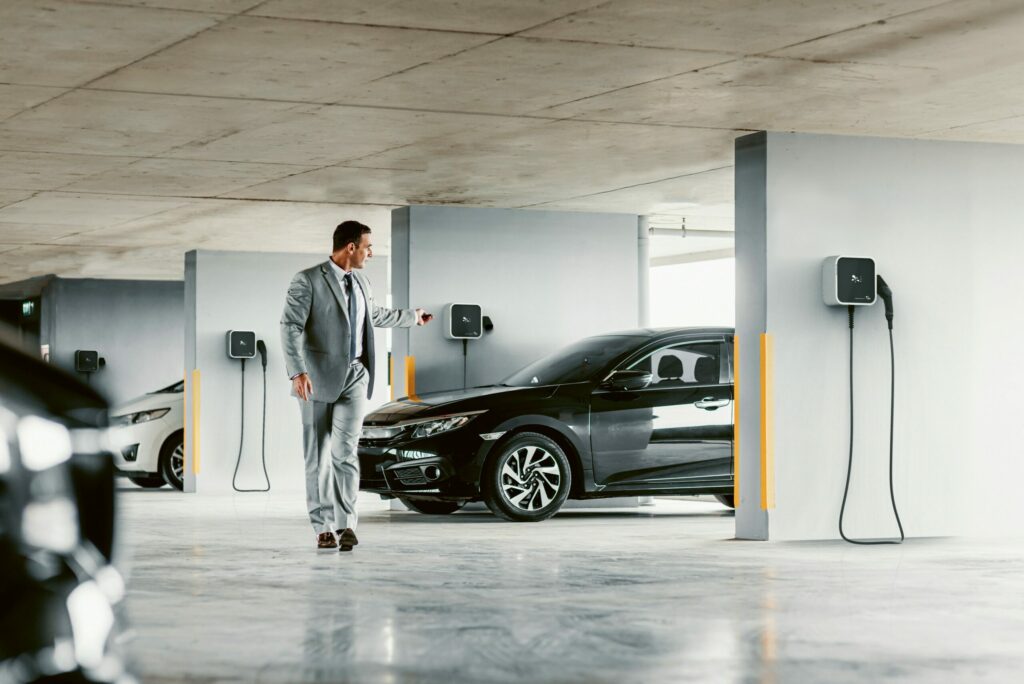
A driver leaves his electric car charged at home, illustrating the simplicity of daily recharging. (Credit: Juice)
Unlike petrol or diesel engines, where a stop at the pump is mandatory, electric charging can be done at home, at public charging stations, or on motorways. Depending on the location, charging stations offer very different power levels and charging times. These are referred to as slow or fast charging, each with its own pros and cons. It is therefore important for electric car owners to know when to prioritise one over the other, to protect their vehicle… and their wallet!
Two main types of charging
1. Slow Charging
Slow charging is carried out at stations with power levels ranging from 2 kW (for a domestic socket) up to around 20 kW at public charging stations. Charging is slower because it uses alternating current, which must be converted into direct current to be stored in the battery.
2. Fast Charging
Fast charging stations, most commonly found at motorway service areas, supply direct current to the battery. Their power ranges from 50 kW to over 500 kW, allowing the battery to be charged much more quickly.
Slow charging for everyday use
Why prioritise slow charging on a daily basis? First of all, because it is less aggressive on the battery cells and therefore preserves the battery’s integrity in the long term. The only downside is the longer charging time. However, this is not really a problem in daily life when it is possible to charge at home or in the office parking lot. If the battery is always kept between 20% and 80%, this is more than sufficient to preserve it while still using the car every day.
Another major advantage, and not the least, is that slow charging is generally cheaper than fast charging, especially if you charge at home during off-peak hours.
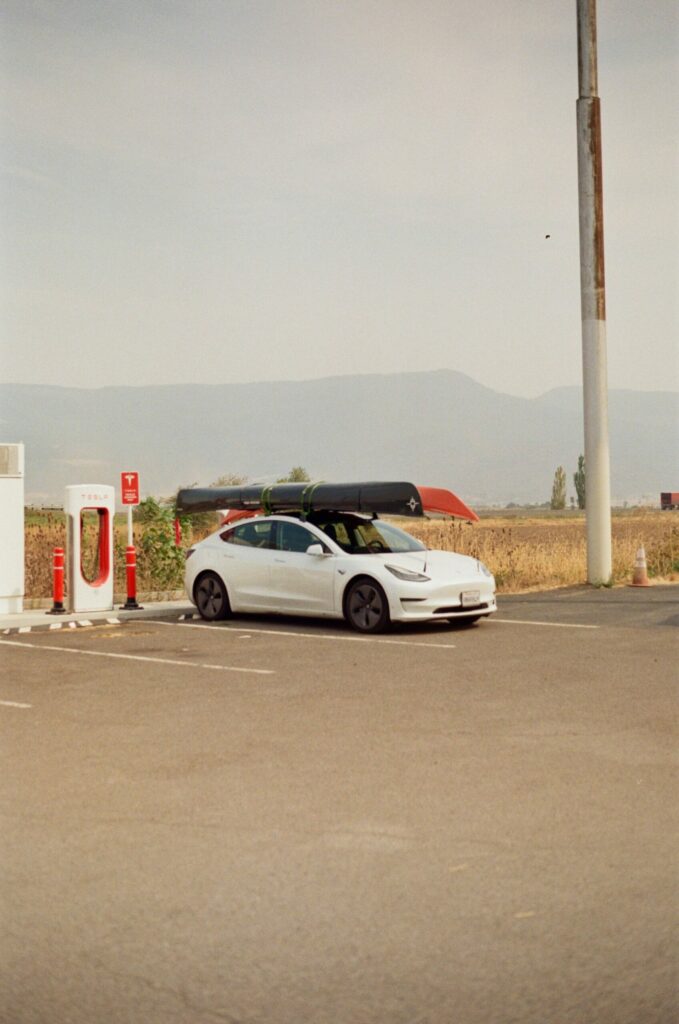
A Tesla charging at a motorway service area, essential for long journeys and electric holidays. (Credit: Ernest Malimon)
Fast charging for long journeys
Fast, or even ultra-fast, charging stations allow you to charge the battery up to 80% in less time than it takes to finish a coffee, a triangular sandwich, and a chocolate bar. Naturally, they are mostly found on motorways. Their existence is essential for long journeys in an electric vehicle.
Without them, drivers would need to stop for several hours, but intensive use of fast charging is not recommended, as it has consequences. Fast charging generates a higher increase in battery cell temperature, which can accelerate battery degradation compared to regular slow charging.
In other words, fast charging is intended for long journeys, emergencies, and unexpected situations.
There have been recent improvements in charging networks as well as promising developments in battery technologies. Whether through the popularisation of solid-state batteries or integrated temperature management, it may no longer be necessary in a few years to question whether to use slow or fast charging.
In the meantime, the best practice is to take care of the battery by prioritising slow charging for everyday use and using fast charging more occasionally.
Canada’s ambitions are among the highest in the world, with a target of 100% zero-emission vehicle sales by 2035. But by 2025, the reality on the ground is quite different: sales of electric vehicles are plummeting, the infrastructure is struggling to keep up and the government incentives that boosted the market have abruptly disappeared.
An electric vehicle drives along a Canadian mountain road, illustrating the challenges of autonomy in cold, isolated terrain.
Stable car market, but electric cars in freefall
The Canadian car market is relatively stable, with around 159,000 vehicles sold in October 2025, down 1.8% on October 2024. A slight drop, but over the first nine months of the year, Canada sold almost 1.45 million units, up 5.9% on the same period last year. So the overall market is in good shape, but unfortunately these figures mask a much bleaker reality for the electric mobility sector.
Zero emission vehicles (ZEVs) are having a catastrophic year in 2025. In the second quarter, their market share fell to 9.2%, compared with 9.7% in the first quarter. What is even more striking is that in June 2025, 14,090 zero-emission vehicles were sold, representing a significant fall of 35.2% compared with June 2024. Over the first six months of 2025, the figure was the same: 79,476 electric vehicles were sold, a fall of 29.8% compared with the same period in 2024. This spectacular fall is mainly due to the end of subsidies.
The end of incentives: a major blow
As explained above, the country’s objective for the energy transition in transport is ambitious. To achieve a drastic increase in the uptake of EVs, the government has had to introduce budgetary incentives. The federal iZEV (Incentives for Zero-Emission Vehicles) programme, launched in May 2019, offered up to CAD 5,000 in rebates for the purchase of a new electric vehicle. This scheme enabled more than 185,000 Canadians to switch to electric vehicles.
But in January 2025, the government announced the suspension of the programme, having exhausted its budget. This decision had an immediate effect: sales of BEVs fell by 57% between the fourth quarter of 2024 and the first quarter of 2025. Plug-in hybrids are not to be outdone either, with sales down 44% over the same period.
Quebec, the historic powerhouse of electromobility in Canada (strong financial incentives, high EV adoption rates and a well-developed recharging network), also suspended its provincial incentives in February and March 2025. In that province, Tesla registrations fell from 5,097 vehicles in the fourth quarter of 2024 to just 524 in the first quarter of 2025, a staggering 90% drop. Despite this, Canadian provinces have autonomy over certain policies, and Quebec was able to relaunch the “Roulez Vert” incentive programme on 1 April 2025, giving Quebecers up to $4,000 CAD in assistance towards the purchase of an electrified vehicle.
These figures reflect our dependence on public subsidies and reveal the fragility of the Canadian market: when subsidies stop, sales immediately plummet.
Hybrids: the big winners in 2025
This drastic fall in sales has benefited conventional hybrid vehicles, which have managed to hold their own. For the first time in 2025, they have overtaken zero-emission vehicles in terms of market share. In the second quarter, conventional hybrids accounted for 12.9% of sales, compared with 9.2% for all ZEVs.
This shift is due to a number of factors common to other countries: electric vehicles are considered too expensive by motorists, and there are still too few recharging facilities in Canada. Hybrids appear to be a compromise.
Map showing the location of public charging stations and the uneven distribution of the network across Canada (Credit: electricautonomy.ca).
An inadequate recharging network
Canada had around 33,767 public charging points spread across 12,955 stations in March 2025, an increase of 24.2% on the previous year. This is encouraging progress, but it falls far short of what is needed, because with its 39 million inhabitants and vast territory of almost 10 million km², Canada suffers from a dispersed geographical coverage, making long-distance journeys more difficult for electric vehicle users.
By way of comparison, France has over 163,000 points for 67 million inhabitants, spread over “only” 551,000 km².
According to a study by Dunsky Energy and Climate, Canada would need 100,520 charging points to achieve its targets. In 2021, the same firm estimated that the country would need 52,000 charging points by 2025. So the development gap is definitely there.
Regional disparities are marked. Most of the infrastructure is concentrated in British Columbia and Quebec. The Atlantic provinces, the Prairies and Northern Canada remain largely under-equipped.
Tesla’s Supercharger network remains the largest in the country. In 2025, Tesla opened up its charging stations to vehicles from other brands. Promising initiatives are emerging: in February 2025, the Australian company Jolt received 194 million dollars to install up to 1,500 chargers in urban centres.
General Motors dethrones Tesla
This year has also seen a major change in terms of manufacturer supremacy: General Motors has become the leading seller of electric vehicles in Canada, dethroning Tesla. GM has an expanded portfolio of 13 electric models, divided between Chevrolet, Cadillac and GMC.
Tesla, which held almost 50% of the electric vehicle market share at the start of 2022, accounted for just 10% in April 2025. This fall can be explained by the arrival of new competitors on the market.
A Tesla photographed in Vancouver, a symbol of the recent decline in sales despite the manufacturer’s strong presence in Canada.
Key Canadian players
Canada is gradually developing its EV industrial chain:
Lion Électrique, a Quebec manufacturer of electric buses and trucks, plans to have more than 1,400 vehicles on the road by 2025.
DANA TM4, also based in Quebec, designs and produces electric motors for buses, trucks and industrial vehicles in Canada and abroad.
Electrify Canada, a network of ultra-fast charging stations, is rolling out its infrastructure in several provinces, but is still limited in relation to needs.
These players exist and are growing, but their market share remains modest, and no local player dominates the national EV market.
The 2035 mandate: an unrealistic objective
With a view to validating its transport energy transition targets, the Canadian government had previously imposed progressive sales targets on manufacturers: 20% VZE by 2026, 60% by 2030 and 100% by 2035. But in September 2025, the government suspended the targets for the 2026 model year. Prime Minister Mark Carney justified this pause by the need to give manufacturers “flexibility”.
Quebec, for its part, has adjusted its targets: in September 2025, the government replaced the objective of 100% zero-emission vehicle sales by 2035 with a target of 90%, now including plug-in hybrids, a decision it justifies as a pragmatic compromise in view of the “North American realities” of the market.
The question now is: how can Canada hope to achieve 100% electric sales in 2035 when it is struggling to exceed 10% in 2025?
A charging point covered in snow, illustrating the impact of harsh winters on the use of electric vehicles in Canada.
Structural challenges persist
Canada faces a number of major obstacles:
Purchase price: without subsidies, electric vehicles remain out of reach for many Canadians. While in Europe several entry-level models are available for less than €25,000, and China has some of the most affordable electric vehicles in the world, Canada has a much more limited range. The cheapest models start at around $30,000 CAD (around €19,000). Despite this equivalent price level, the choice of genuinely accessible vehicles remains limited, reinforcing the idea that, without government support, electric vehicles will remain difficult to access for a large proportion of Canadian households.
Climatic conditions: harsh winters reduce battery life by 20-40%, a challenge for manufacturers and motorists alike, who have to adapt to these demanding and restrictive regional conditions. With such a well-developed recharging network, the adoption of EVs is complicated.
Regional disparities: this vast territory is not developed on the same scale. While British Columbia and Quebec have electric vehicle market shares of 11.8% or more, Ontario, Alberta and the Atlantic provinces are lagging far behind, particularly in terms of recharging infrastructure.
Attachment to pick-ups: Canada is one of the countries with the highest proportion of vans and pick-ups in the world. But electric pick-ups are expensive, and their range drops sharply in winter or when towing. For many Canadians, the current electric range does not meet their real needs (towing, long distances, outdoor work).
Canada, an ambitious but limited country
In 2025, Canada will embody the contradictions of the electricity transition. With some of the most ambitious regulations in the world, the country is lagging behind Europe and China.
Yet Canada has considerable assets: huge reserves of critical minerals, an established automotive industry and a relatively clean electricity mix. But these assets will not be enough. Without a clear strategy, massive investment in infrastructure and stable incentives, Canada runs the risk of seeing its 2035 ambitions unfulfilled. Canada’s electric transition is currently on hold.
ECO MOTORS NEWS interviewed eight taxi and private hire (VTC) drivers who operate fully electric vehicles to find out what they think of the experience — and what their passengers think too! We also asked each of them how likely they are to ever go back to a combustion engine.
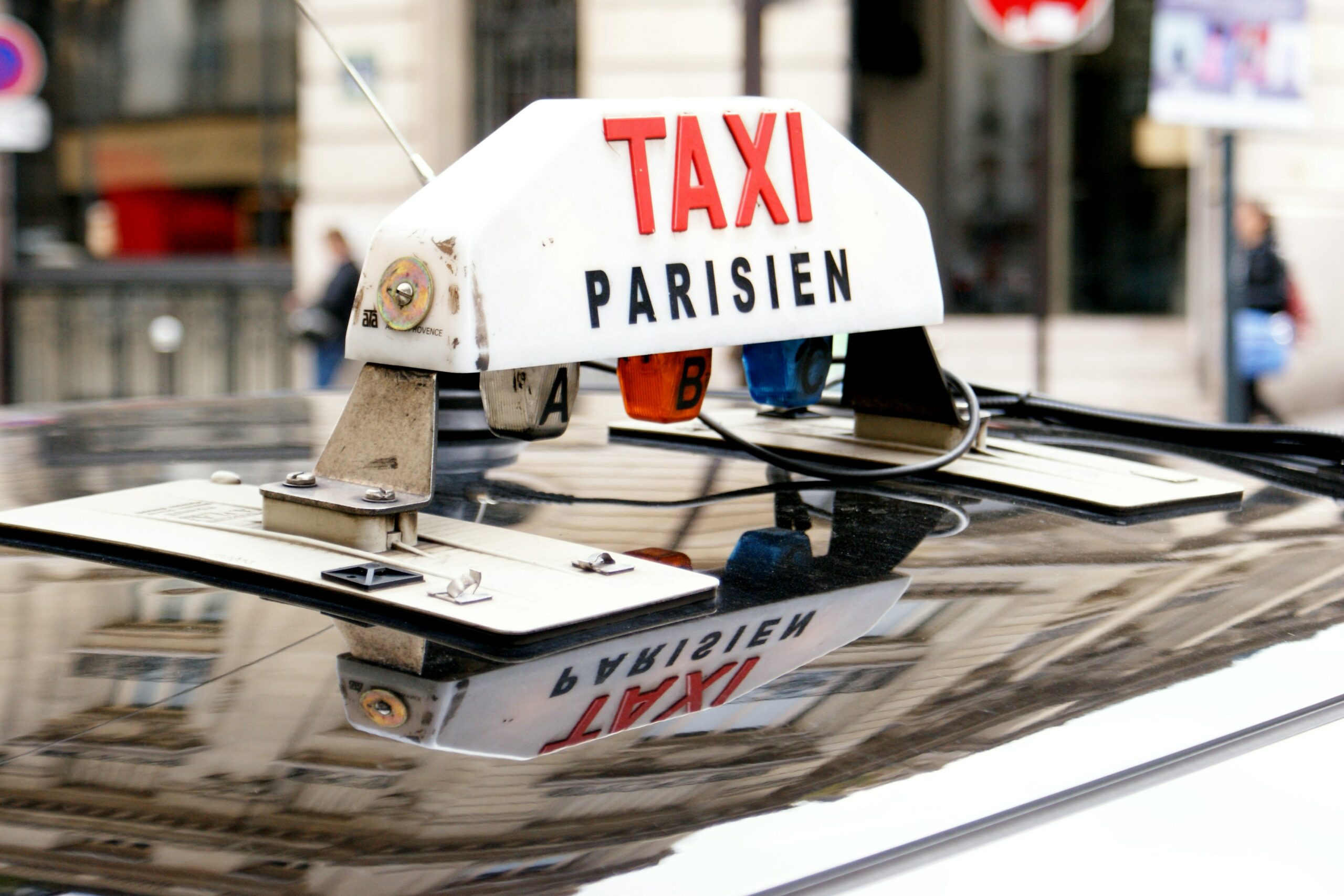
Illuminated “Taxi Parisien” sign on the roof of an electric taxi in the streets of Paris. (Credit: Diego Fernandez)
Ali.Île-de-France.*
As a VTC driver, I switched to 100% electric mainly to save on fuel and maintenance costs. On a daily basis, I notice that younger passengers react positively to this type of engine, while older passengers pay less attention. The driving silence is the advantage I appreciate most, as it significantly improves comfort. However, range remains a weak point for me, especially during long working days. → Probability of returning to combustion: 0%.
Bruno.Île-de-France.
I’m not an environmental activist, but I switched to electric after falling in love with a Hyundai model that is only available in electric. Ultra-fast charging, essential for my busy work schedule, was a decisive factor in my choice. I find that while some clients are initially reluctant, a simple explanation — particularly about my daily 600 km with just one recharge in the middle of the day — is often enough to convince them of the electric vehicle’s reliability. I appreciate the comfort, especially the silence, as well as the savings. The main difference with my old petrol cars is the slight change in work organisation, which I adapted to quickly. → Probability of returning to combustion: 0%.
Christophe. Nouvelle-Aquitaine.
I switched to electric for economic reasons. My clients are generally satisfied with the experience, and they particularly enjoy the silence on board. Unfortunately, managing the various charging cards and the lack of clarity in pricing can sometimes complicate my daily routine. → Probability of returning to thermal: 0%.
David. Provence-Alpes-Côte d’Azur.
Switching to electric happened naturally, motivated by the driving comfort and savings on fuel and maintenance. My clients do not make any particular remarks; it’s already become normal. I mainly appreciate the reduced running costs. However, the range could still be improved to better meet the demands of the job. → Probability of returning to thermal: 0%.
In an electric Tesla: a VTC driver at the wheel, seen from the back seat. (Credit: Fujiphilm)
Karim.Centre-Val de Loire.
I chose to try a 100% electric car out of curiosity. However, I notice a certain hesitation among my clients, often unconvinced by this type of engine, particularly due to the lack of range and longer charging times compared to refuelling with petrol. Personally, I do not find any major advantages in daily use, but rather some drawbacks: limited range, charging stations sometimes hard to locate or out of service, and high purchase cost of the vehicle. → Probability of returning to internal combustion: 70%.
Nathalie. Provence-Alpes-Côte d’Azur.
I switched to electric to save on fuel costs. I estimate that two-thirds of my clients are convinced by electric after a journey with me. The low running costs, far below petrol, and savings on maintenance are definite advantages, as is the driving comfort. However, the range is sometimes insufficient to cover a full day without recharging, and some colleagues have encountered difficulties when reselling their electric vehicle. → Probability of returning to combustion engines: 0%.
Pascal.Île-de-France.
I am a taxi driver and chose a 100% electric car mainly for the reduction in cost per kilometre, but before making the switch, I waited for manufacturers to make progress in terms of range. Overall, my clients are satisfied, but some fear having to stop during the journey to recharge… mostly a psychological concern. Personally, I love the driving comfort, especially thanks to the single pedal and reduced noise, which helps reduce fatigue at the wheel. The main challenge remains managing range and charging times. → Probability of returning to combustion engines: 0%.
Samir.Hauts-de-France.
I benefited from a year of free charging and a 0% loan for the purchase of an electric vehicle, so I didn’t hesitate for long! (laughs) My clients particularly appreciate the calm on board, which makes for a more pleasant journey, and personally, I feel more relaxed at the wheel. I see absolutely no drawbacks to electric. → Probability of returning to combustion engines: 0%.
*Names and regions changed for reasons of confidentiality
Saint-Étienne-based start-up Eenuee is pursuing its ambition to revolutionise regional aviation with a 100% electric aircraft. Thanks to a new industrial partnership and an ongoing fund-raising drive, its project is taking on a more concrete dimension. The aim is to have a 19-seater aircraft flying by 2029 that is as affordable as a TGV ticket.
Eenuee’s future 100% electric GEN-ee regional jet flies over the mountains, a symbol of clean, silent mobility (Credit: Eenuee)
A strategic alliance to take a decisive step forward
After several years of promising research and testing, Eenuee is now joining forces with Duqueine Group, a company based in Ain and renowned for its expertise in aeronautical composite materials. This partnership, described as a “major asset” by Benjamin Persiani, CEO of Eenuee, should enable the start-up to move from a small-scale prototype to a larger-scale demonstrator. Duqueine, a supplier of parts to Airbus, Safran and Dassault, will contribute its industrial expertise to design the structure of the future aircraft. Together, the two companies want to prove that regional innovation can compete with the big names in aeronautics.
This collaboration marks a key stage for Eenuee, which has been working since 2019 on its GEN-ee regional aircraft. This model, which looks like a flying wing, is based on a “load-bearing fuselage” concept, which is more complex to design but offers better aerodynamic and energy performance. Initial tests on a radio-controlled prototype with a four-metre wingspan have already validated the technical feasibility of the project.
A prototype twice the size to get closer to the real thing
The next step is to build an eight-metre model, twice the size of the initial prototype. This intermediate version, scheduled for completion by 2027, will enable the team to move closer to a certifiable aircraft. The Eenuee engineers will see this as an opportunity to test the performance of the fuselage and electric propulsion in real conditions. The ultimate goal is ambitious: to design an aircraft with a 33-metre wingspan capable of carrying 19 passengers over 500 kilometres, with no polluting emissions.
To achieve this, Eenuee still needs to raise nearly €4 million. Supported by the Banque Publique d’Investissement via a Deeptech grant, the company is stepping up discussions with investment funds. According to Baptiste Giuliani, sales manager, “each passenger on our plane will consume less than an electric car driver”.
Eenuee’s GEN-ee electric aircraft, seen from the back, embodies the new generation of zero-emission regional aircraft. (Credit: Eenuee)
A clean, quiet and versatile aircraft
The GEN-ee has a claimed range of 500 kilometres and a cruising speed of around 260 km/h. It will run on two shrouded propeller engines powered by 1,500 kg of solid batteries. Its designers claim that it will consume up to eleven times less energy than an equivalent internal combustion aircraft, while considerably reducing noise. This silent, low-carbon aircraft could, for example, link Clermont-Ferrand to Nantes in less than two hours, or Rome to Monaco in just over two hours.
Another major advantage is its versatility. Eenuee’s electric aircraft can take off and land on very short runways, or even on grassy or watery surfaces. An amphibious version is even envisaged, capable of landing on islands. This flexibility is already of interest to several regional airlines looking for solutions adapted to isolated areas.
An industrial challenge and a race against time
Competing with Aura Aero of Toulouse, which is developing the ERA hybrid aircraft, Eenuee is taking measured but determined steps forward. The Toulouse-based project has a head start and a large number of pre-orders, but the Stéphane-based company’s 100% electric approach is seductive because of its ecological coherence. If all goes according to plan, the full-scale prototype will make its first flight in 2029, before entering service around 2033.
More than just a technological feat, Eenuee wants to help structure a low-carbon aeronautics industry in Auvergne-Rhône-Alpes. By relying on a local ecosystem of innovative companies, the start-up hopes to prove that a successful energy transition can also come from the regions. For Benjamin Persiani, “this regional partnership is a major asset. It allows us to combine technological agility and local industrial strength to take a key step forward. An essential combination if the future of clean aviation is to take off.
The GEN-ee electric aircraft flies over calm waters, demonstrating its versatility and the possibility of a future amphibious version (Credit: Eenuee).
Towards a new regional transport model
With its GEN-ee project, Eenuee aims to make air transport as environmentally friendly as rail, while retaining its speed and flexibility. Its objective is clear: to offer regional connections at an affordable price, without compromising the environment. Although the technical and financial challenges are still numerous, the vision of this young team from Saint-Etienne symbolises a new era for French aviation.
So by 2030, it’s not impossible that the passengers of the future will be boarding an electric aircraft “made in Saint-Étienne” from a small regional aerodrome. A powerful symbol of the transition to cleaner, quieter and more sustainable skies.
On Wednesday 12 November 2025, ECO MOTORS NEWS had the privilege of being invited to Montigny-le-Bretonneux for a press test of the new 100% electric eSprinter, in its chassis cab version, by Mercedes-Benz. A technical day devoted to discovering this new electric version of the famous German van.
The Mercedes eSprinter 100% electric chassis cab, ready to be bodied for professional use. (Credit: Mercedes)
The eSprinter chassis: a new stage for Mercedes
Launched in April 2025, the eSprinter is the latest addition to the Mercedes-Benz range of electric vans, which has already sold more than 40,000 vehicles since the first eVito in 2010. This chassis version opens up new possibilities for the electrification of commercial vehicle fleets. To suit different uses, this version of the 100% electric eSprinter is designed to be specifically bodied.
This versatile van from the German brand has been designed to meet the needs of professionals. The vehicle is available in two lengths (5.90 m or 6.70 m) and four GVWs (Gross Vehicle Weight Rating): 3.5 t, 3.95 t, 4.15 t and 4.25 t.
Two engines are also available: 136 bhp (100 kW) or 204 bhp (150 kW). Three battery capacities are available: 56 kWh (around 210 km range), 81 kWh (around 300 km) and 113 kWh for intensive use. Rapid recharging can deliver up to 115 kW in direct current.
With this chassis version, Mercedes-Benz is aiming directly at small businesses, local authorities and specialist fleets, a segment that has yet to be electrified, but which is undergoing rapid change.
A full day of testing
Accompanied by five fellow journalists, various bodybuilder representatives and, of course, several members of the Mercedes group, the day began with a technical and historical presentation of the Mercedes eVans range and the eSprinter chassis.
Once we’d learned all we needed to know about this vehicle, we were treated to a presentation of the five eSprinter bodies, each built by its respective bodybuilder: Corsin, Laloyau, Trouillet, Labbé and JPM. Tipper, flatbed or specialised configuration, each vehicle has been ingeniously designed to meet the needs of professionals.
After a question-and-answer session with the various players present on the day, we journalists divided up the different vehicles to carry out our tests.
In total, we covered around a hundred kilometres on a route covering different types of road (town, country, motorway), divided into three test slots allowing us to test three different body configurations.
A recharging workshop was also on offer: an opportunity for the Mercedes group to demonstrate its impressive linear recharging capacity, with an average power output of around 116 kW.
The front design of the Mercedes eSprinter chassis highlights the closed grille and modern lines of the German electric van. (Credit: Mercedes)
A full test to come
As mentioned earlier, ECO MOTORS NEWS was able to test several configurations of the eSprinter chassis during the day. Road behaviour, real autonomy, ergonomics, bodywork adaptation: all aspects were tested on the roads of the Paris region.
A full, detailed test will shortly be published in our columns, with figures, measurements and feedback on this electric van. What we can already tell you is that Mercedes-Benz has perfected the adaptation of its vans to electrified mobility.
Confirmation that the electrification of commercial vehicles is no longer an option, but a tangible industrial reality.
American EV manufacturer Rivian Automotive is going through a decisive moment. While the brand is focusing on its new compact SUV, due to be launched in the first half of 2026, it is currently facing serious financial strains.
The headquarters of Rivian Automotive, an American manufacturer of electric vehicles. (Credit: Rivian)
R2: a strategic model for Rivian
Unveiled over a year ago, the Rivian R2 and its 4.71 metre length are aimed directly at the mass-market electric SUV segment, in competition with the Tesla Model Y and the Ford Mustang Mach-E. The vehicle retains the Rivian DNA: a square, robust design inspired by the R1S and an outdoor philosophy faithful to the Californian brand.
In November 2025, the brand announced that development of the R2 was well advanced: prototypes are being assembled at the Normal factory in Illinois, and a little more is known about its technical specifications. Three configurations will be offered: single-engine, twin-engine and three-engine, each corresponding to a more or less affordable range. The announced range exceeds 480 km, for a price that should reach $45,000 in the United States, a strategic price for the brand that wants to widen its audience and thus reach more profitable production volumes.
CEO RJ Scaringe has confirmed that the first commercial version will be a well-equipped but affordable twin-engine Launch Edition, to maximise take-up from launch. The European version is not expected until 2027.
The Rivian R2 electric SUV is shown from the front, combining square design and robustness (Credit: Rivian).
A financially fragile company
Despite these advances, Rivian remains in the red. For 2025, the company is forecasting an operating loss of between 2 and 2.25 billion dollars, compared with an initial forecast of 1.7 to 1.9 billion. Sales are stagnating at around 50,000 vehicles a year, far short of the volumes needed to be profitable.
Even more worryingly, in October 2025 Rivian carried out a third wave of redundancies, cutting around 600 jobs, or 4.5% of the workforce, bringing the total annual cuts to more than 10%. These cuts come at a time when the company is having to adjust its workforce in the face of a weakened US EV market, linked in particular to the expiry of the $7,500 federal tax credit.
A controversial remuneration plan
While sales figures are nothing to write home about, on 7 November 2025 the board of directors announced, in a document sent to the U.S. Securities and Exchange Commission (SEC), a record remuneration package for CEO RJ Scaringe. According to Reuters, the sum allocated could reach an astronomical 4.6 billion dollars over ten years, a plan inspired by that of Elon Musk. The plan is conditional on ambitious objectives, namely to increase the share price to at least $40 from the current $15.22, and to meet the various financial targets set (profit, cash flow) over several years.
The announcement, which came just after the redundancies and against a backdrop of massive losses, drew criticism. While some see it as a necessary ambition to attract and retain the executive in his post, others feel that announcing this plan, which could bring in $4.6 billion for a single person, at such short notice, gives the Californian manufacturer an unfair and inconsistent image.
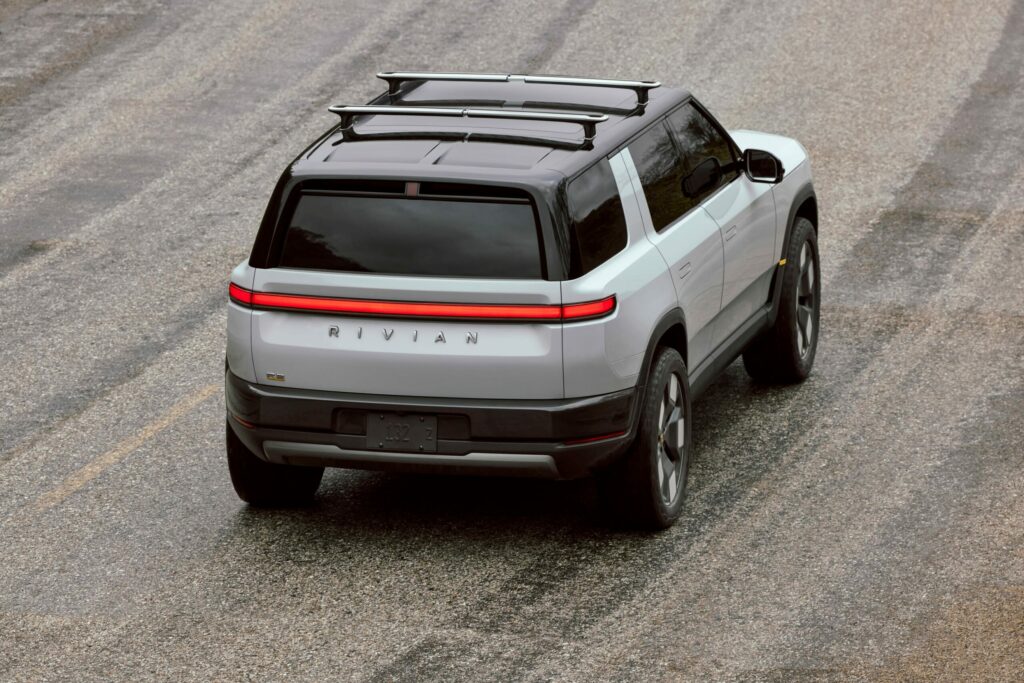
The Rivian R2 SUV photographed from behind, showing off its robust design and distinctive rear lights. (Credit: Rivian)
R2: a decisive test for Rivian
For the brand, the R2 is much more than a new model: its success will determine whether or not the brand can achieve significant volumes, reduce its losses and win over consumers in the face of fierce competition.
One thing is certain: with the announcement of the remuneration package for the CEO, RJ Scaringe will do everything in his power to ensure that Rivian Automotive remains a major player in the electromobility sector.
China has a name for its fast-growing and competitive cars. The NEVs, or New Energy Vehicles, are what the Chinese government considers a key element in their race to dominate the global auto industry. They include not only the pure electric cars (BEV) but also the plug-in hybrid cars (PHEV), extended range (EREV), and hybrids (HEV).
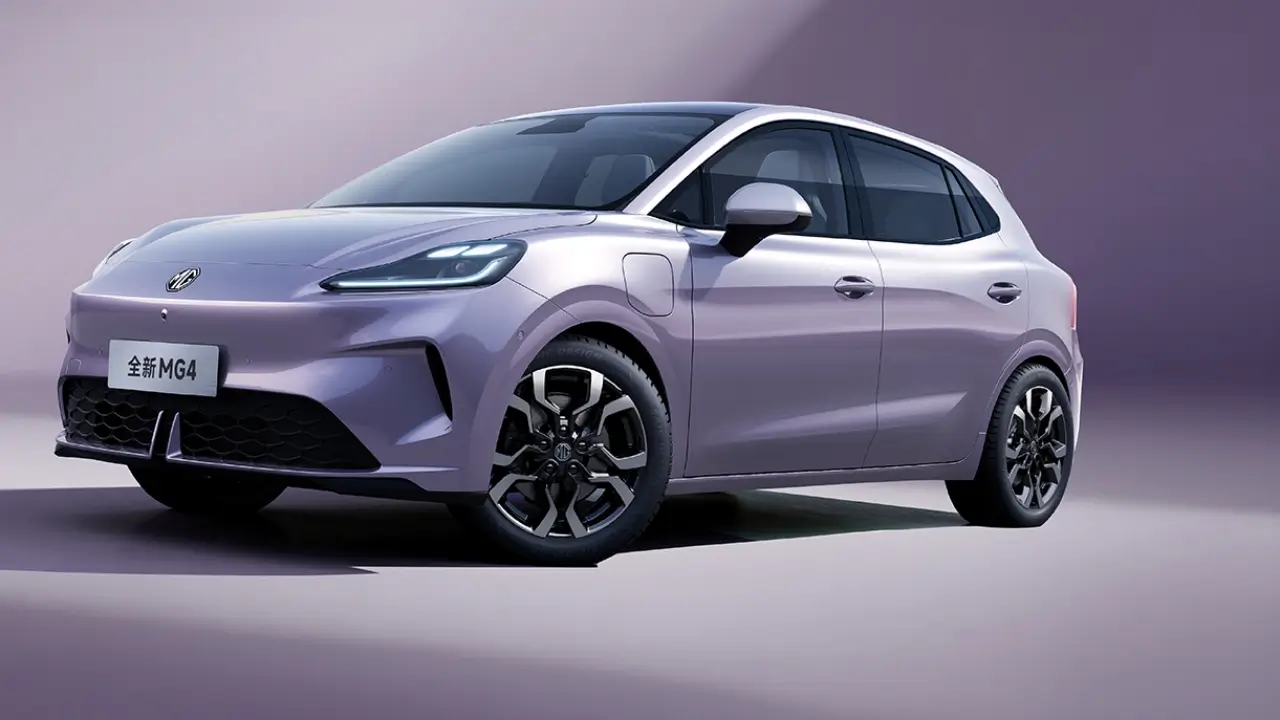
The MG4, one of Europe’s top-selling Chinese New Energy Vehicles in H1 2025.
Their combined sales represented 53% of the new passenger car sales in China in H1 2025. The consumers in China bought 3.29 million BEVs, 1.49 million PHEVs, 537,000 EREVs, and 474,000 HEVs. How many of these models are available in Europe and how popular are they?
BEVs
Despite the tariffs imposed by the European Commission, the Chinese BEVs are still popular in Europe. The ranking for H1 2025 was led by the MG4 with 14,494 units, down by 56% vs H1 2024. It is one of the big casualties of the tariffs and the rise of BYD products. In fact, the second most popular Chinese BEV in Europe was the BYD Seal, up by 130% to 9,433 units. It was followed by another BYD – the Sealion 7, with 7,797 units. The top 10 was completed by the BYD Dolphin (7,701 units), BYD Atto 3 (7,033), Leapmotor T03 (5,918), Xpeng G6 (5,616), MG ZS (4,109), BYD Seal U (3,775), and MG5 (2,938 units).
PHEVs
While the Chinese BEV demand increased by 31% in H1 2025, the volumes for the Chinese PHEVs increased by 544% compared to H1 2024. This powertrain is becoming their way to offset the tariffs imposed on their BEVs. The ranking was led by the BYD Seal U with 29,223 units and Europe’s third top-selling PHEV, only behind the Volkswagen Tiguan and Volvo XC60. It was followed by the MG HS with 11,677 units, and the Jaecoo J7 with 9,938 units. The following positions were occupied by the Lynk & Co 01 (4,270 units), Omoda 9 (1,164), DFSK E5 (1,162), GWM Wey 05 (548), Ebro S700 (407), Ebro S800 (229), and GWM Wey 03 (199).
HEVs and EREVs
The offer of hybrid and extended-range Chinese cars is still very limited. However, they are also making progress here. The MG ZS on its full hybrid version registered 38,445 units between January and June, becoming the region’s 6th top-selling HEV. The MG3 followed with 21,998 units, and Europe’s third best-selling hybrid B-hatchback behind the Toyota Yaris and Renault Clio. The top 5 was completed by the MG HS (216 units), Haval Jolion (96), and the Dongfeng T5 (83 units). The Leapmotor C10 was the only EREV available in Europe with 1,059 units.
Lucid and NVIDIA announce a major collaboration to propel the automotive industry towards complete autonomy. The electric vehicle manufacturer intends to revolutionise the driving experience. The alliance aims to combine artificial intelligence and manufacturing excellence for its next vehicles.
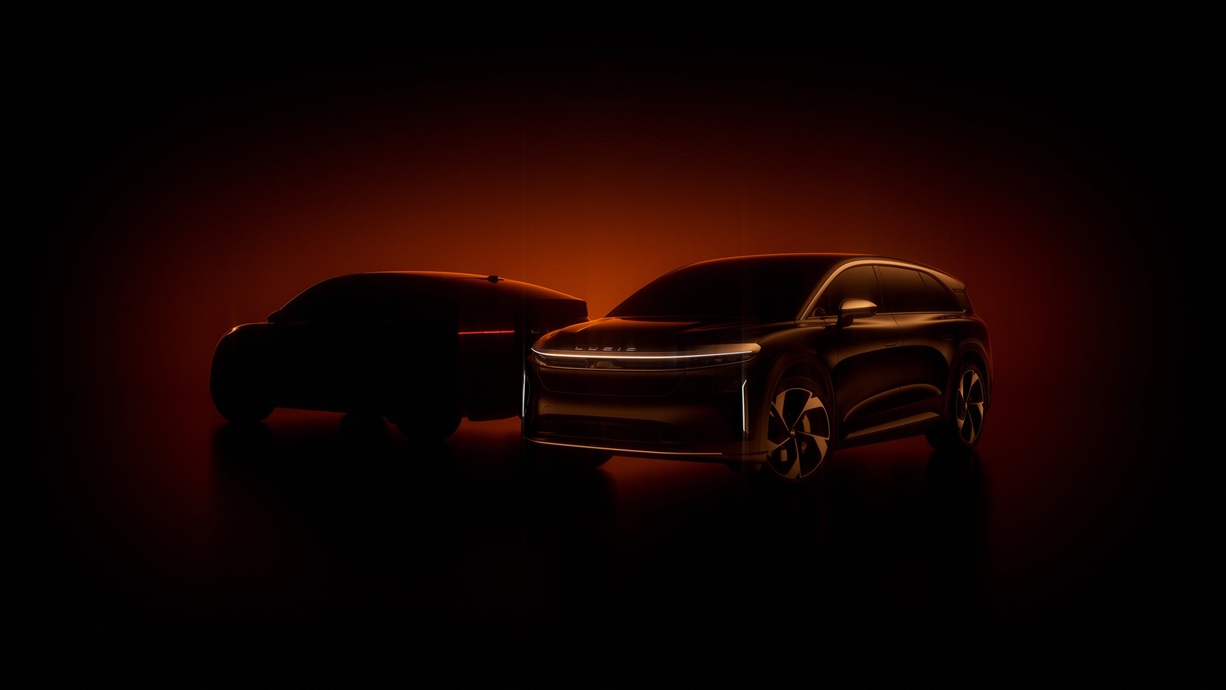
The Lucid EV reveals its futuristic design, combining elegance and performance in a subtle play of shadows (Credit: Lucid)
Unprecedented autonomy for the vehicles of tomorrow
Lucid plans to launch one of the first Level 4 consumer autonomous vehicles incorporating NVIDIA DRIVE AGX Thor technology. This breakthrough will enable true “no look, no touch, no think” driving, ushering in a new era of motoring. The project is based on the DreamDrive Pro ADAS, introduced on the Lucid Air in 2021, which is already capable of hands-free driving and automatic lane changes.
As of today, Lucid is beginning the transition with the Lucid Gravity and its future midsize models in L2++ assisted driving, guaranteeing safety and comfort. The ultimate goal is to reach level 4, thanks to a multi-sensor system combining cameras, radar and lidar. Two NVIDIA DRIVE AGX Thor computers will unify all the automation functions and ensure smooth progress on the autonomy ladder.
Strategic partnership with NVIDIA
This collaboration is not limited to vehicles. NVIDIA is also contributing its industrial platform to optimise manufacturing and reduce costs. Lucid will be able to create intelligent factories, controlled by connected robots and digital twins to simulate and validate processes. Planning becomes faster, production lines more flexible and quality more rigorous.
For Jensen Huang, founder of NVIDIA, this alliance transforms every vehicle into a supercomputer on wheels, reinventing mobility with intelligence. For his part, Marc Winterhoff, interim CEO of Lucid, emphasises the desire to combine cutting-edge technology with engineering excellence. Together, they aim to deliver a luxurious and fully autonomous driving experience.
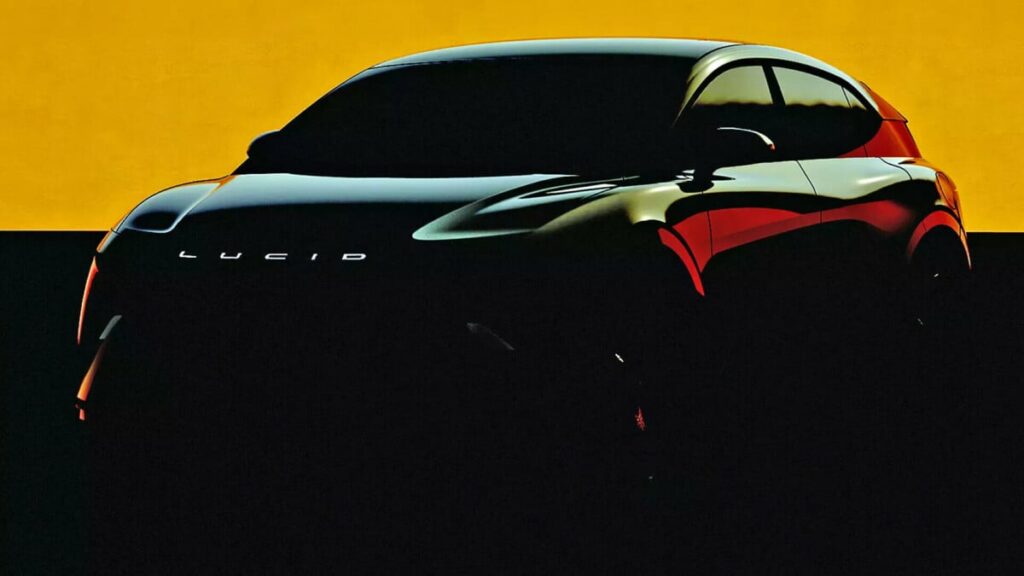
Close-up of the Lucid vehicle, with the logo subtly emerging from the shadows, a symbol of power and innovation. (Credit: Lucid)
Towards AI-driven manufacturing
In addition to driving, Lucid uses NVIDIA’s industrial platform to optimise production. Digitalisation and artificial intelligence make it possible to simulate factories before they are built, to anticipate problems and plan effective solutions. The robots follow optimised trajectories, guaranteeing safety and speed, while reducing production costs.
This strategy paves the way for reconfigurable production lines, capable of adapting to different models and volumes. The use of digital twins also makes it possible to test complex scenarios without interrupting actual production. In this way, Lucid combines vehicle autonomy and factory intelligence to create an innovative end-to-end chain.
A transformed customer experience
For consumers, this evolution promises a future where luxury, performance and autonomy come together. Lucid vehicles will become evolving software platforms, capable of receiving continuous updates. This ensures that each car remains at the cutting edge of innovation, even after delivery.
By integrating NVIDIA DRIVE AV and its scalable architecture, Lucid ensures technological continuity, enabling the addition of new autonomous and safety features. Drivers will be able to enjoy a fluid, intelligent and safe experience, radically transforming the notion of personal driving.
Lucid and the future of electric mobility
Lucid has positioned itself as a major player in intelligent electric mobility. With factories in the United States and Saudi Arabia, the company combines performance, design and energy efficiency. The integration of AI into its vehicles and factories promises to redefine industry standards, while paving the way for mass adoption of autonomous driving.
Thanks to this strategic partnership, the car of the future is becoming a tangible reality, where artificial intelligence and technological innovation offer safe, high-performance, forward-looking vehicles.
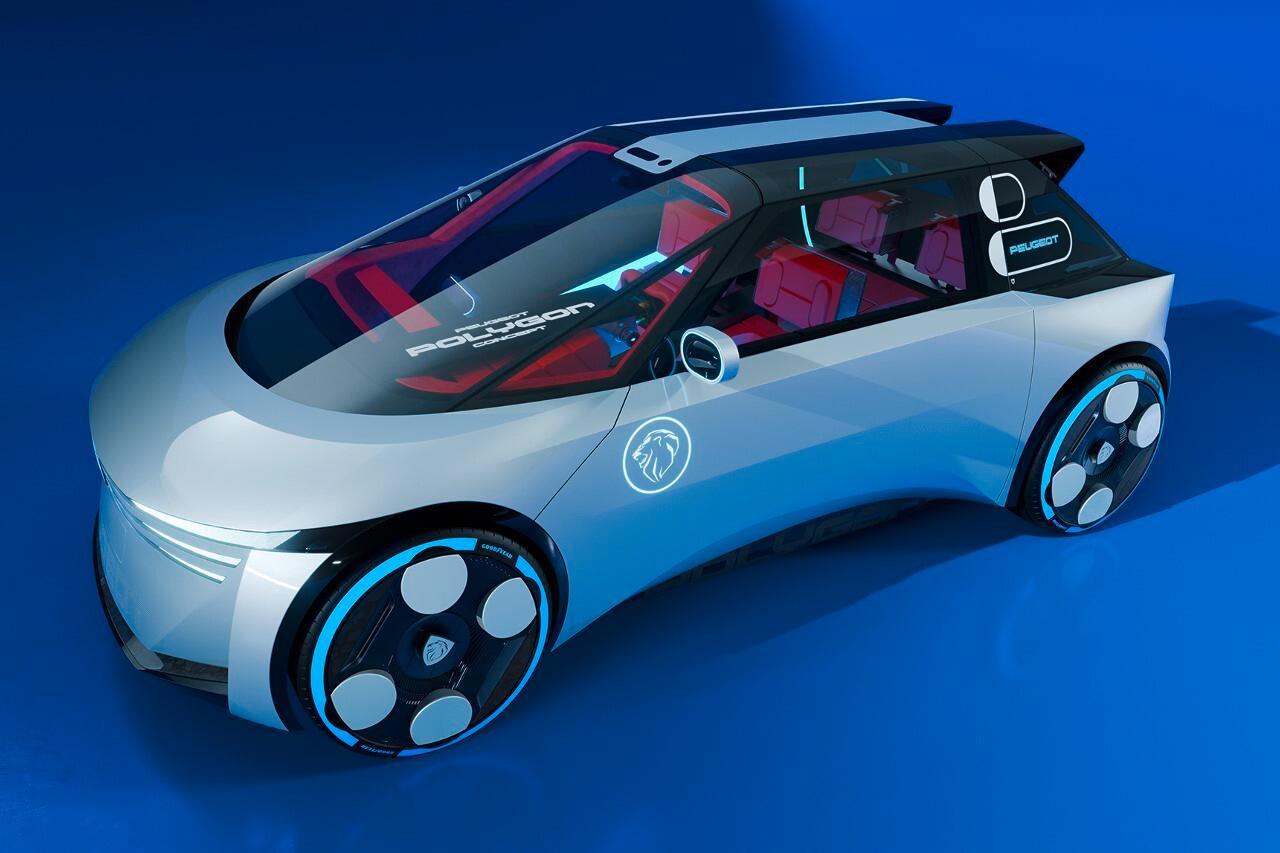
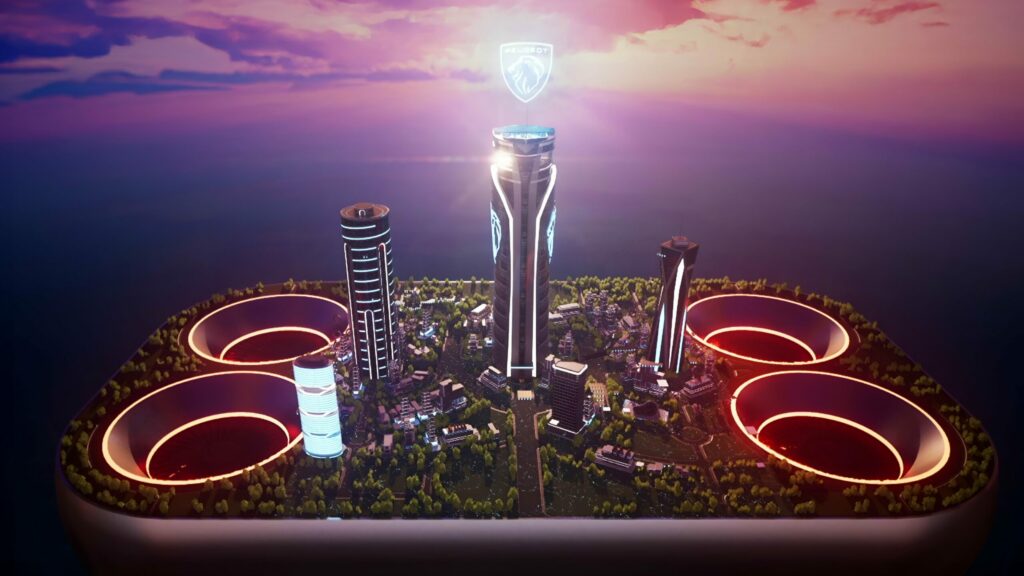
Since yesterday, Peugeot fans and gaming enthusiasts have been able to explore Polygon City in Fortnite. A virtual island dedicated to the Polygon Concept car, before its official unveiling tomorrow. This initiative combines futuristic design, technology and an interactive universe. It offers an unprecedented level of immersion, enabling visitors to discover the vehicle from every angle. With this approach, Peugeot is not only offering a preview of the concept, but also a participative experience that combines fun and creativity.
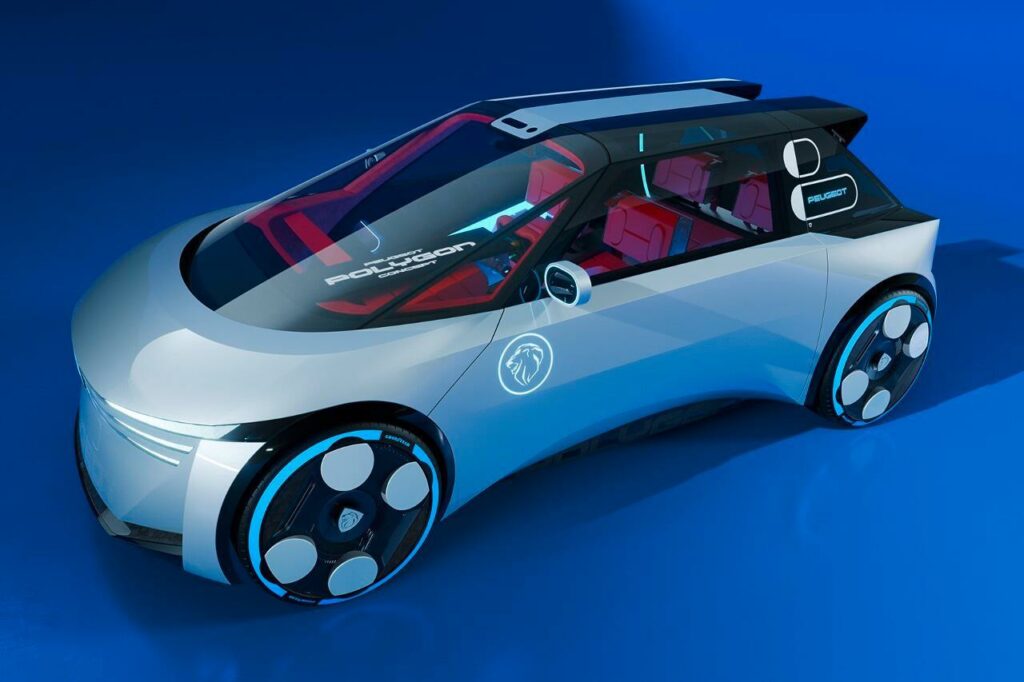
The Peugeot Polygon Concept, combining sculptural design and innovative technology, before its official unveiling. (Credit: Peugeot)
A futuristic concept car with a sculptural design
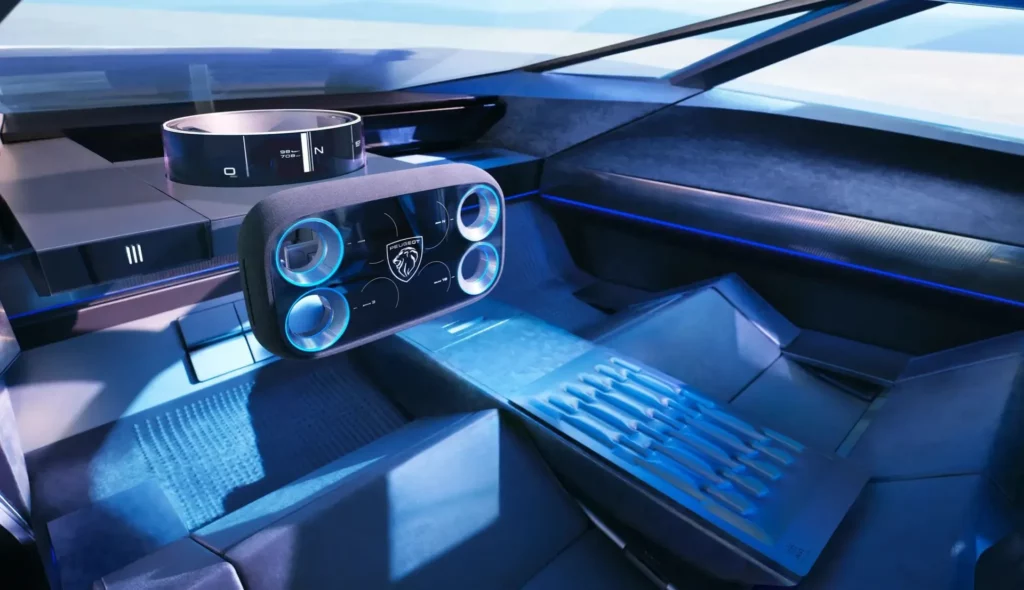
The Polygon Concept reflects all the boldness and feline style so dear to Peugeot. The interior has been completely redesigned around the Hypersquare® steering wheel and Steer-by-Wire technology. These guarantee a fluid, intuitive and totally connected driving experience. Every detail of the vehicle has been designed to transform mobility into a genuine emotion, where technology and sensations meet. The angular, sculptural bodywork illustrates the creativity of the designers and gives the concept a strong visual identity. In this way, the Polygon Concept becomes both an objet d’art and a technological showcase, embodying Peugeot’s vision of the car of the future.
Polygon City: a virtual island to discover the concept
Polygon City has been available in Fortnite since 10 November. This island, created by Gameloft in collaboration with Peugeot designers, reproduces the shapes of the Hypersquare® steering wheel and offers total immersion. Players can fly over the city, discover the concept car and take part in a number of mini-games to earn tokens. These tokens give players the chance to customise the Polygon Concept down to the smallest detail. You can personalise the body colour, the wheels, the Hypersquare® and the light signatures. Players can create their own unique version of the vehicle, combining exploration, creativity and entertainment. This interactive experience brings Peugeot fans and gamers together around a shared vision of automotive innovation.
Explore Polygon City in Fortnite, an interactive island inspired by the Peugeot Polygon Concept car (Credit: Stellantis)
A digital strategy to reach new generations
Polygon City illustrates Peugeot’s desire to engage with new generations through gaming and digital worlds. Phil York, Global Marketing Director, explains that the concept offers “a multi-faceted vehicle”, making it possible to show all the possible configurations of the Polygon Concept even before its official unveiling. Jean-Baptiste Godinot, Vice President of Gameloft for Brands, points out that the island is an interactive expression of Peugeot’s core values and engages younger generations in a fun and immersive experience. This approach demonstrates how the brand is reinventing automotive communications, combining innovation, design and digital culture, while creating a strong anticipation for tomorrow’s event.
An immersive experience before the official reveal
For gamers and fans alike, Polygon City offers the chance to explore a futuristic, interactive and creative environment. The island lets you discover the Hypersquare® shape from the air, explore each district and test the vehicle’s customisation in exchange for tokens. This fun and immersive experience transforms a simple concept car into a truly participative event, combining exploration, fun and creativity. By interacting with the Polygon Concept before its official unveiling, players can make the vehicle their own and experience its unique design in an engaging virtual context.
The Hypersquare® steering wheel in the Peugeot Polygon Concept, a symbol of innovation and intuitive driving. (Credit: Peugeot)
Tomorrow, the official reveal on YouTube
On 12 November at 1pm, Peugeot will officially present the Polygon Concept during a keynote broadcast on its YouTube channel. In the meantime, the Fortnite experience allows you to discover the vehicle, experiment with its customisation and immerse yourself in a world that combines innovation, design and digital culture. Peugeot has succeeded in transforming a concept car into a participative adventure. In this way, the brand offers a vision of the mobility of the future that combines technology, creativity and immersion. This approach demonstrates that the automobile can now be experienced as an interactive event, accessible to all, where each player becomes a player in the discovery.
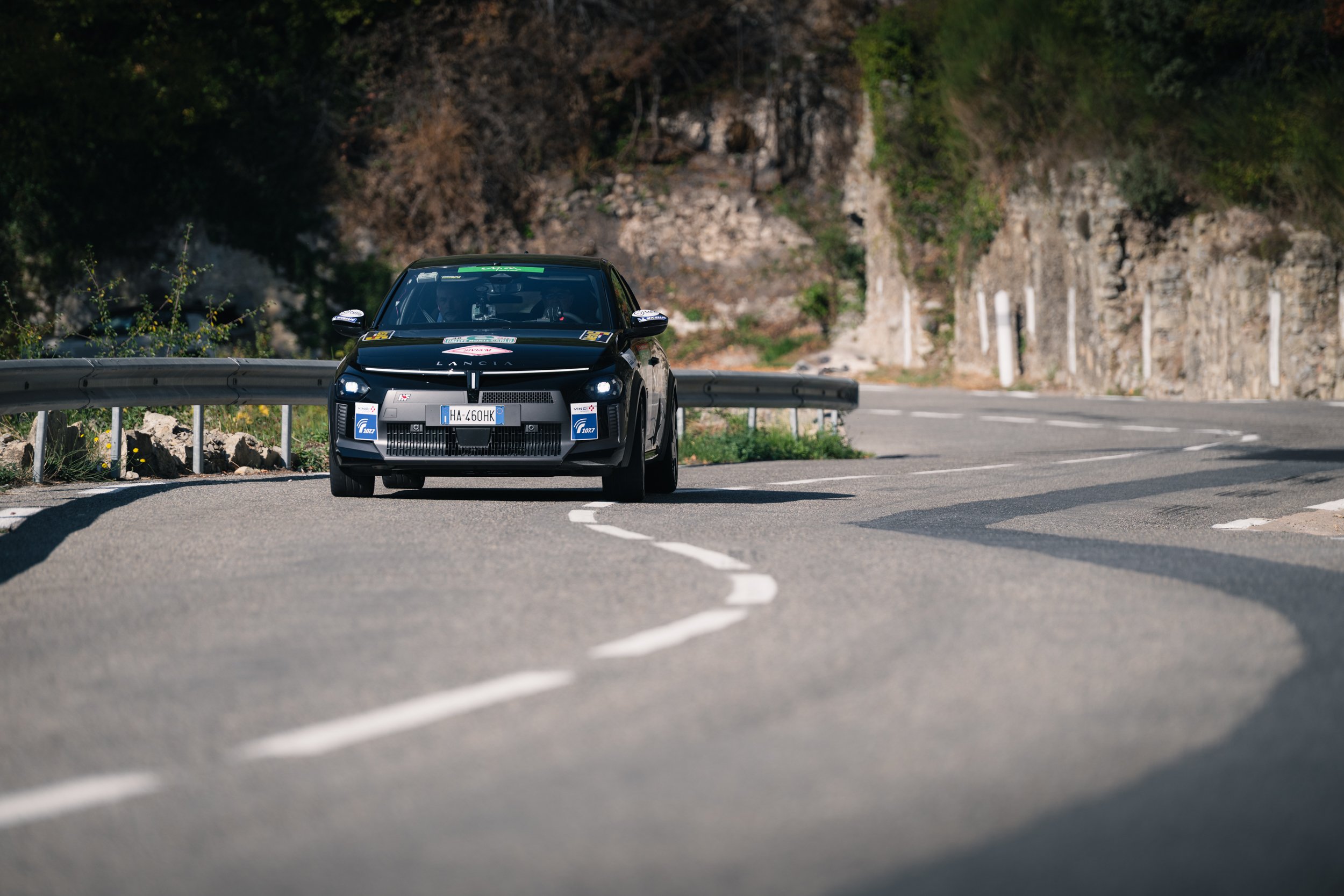
Thirty-seven years after his triumph at the wheel of a Lancia Delta HF 4WD, Bruno Saby returned to the Principality of Monaco. This time, the driver from Grenoble was no longer carried away by the roar of an internal combustion engine, but by the powerful silence of a 100% electric Lancia Ypsilon HF. At 76, the man who left his mark on rallying in the 1980s is proving that passion never dies out. This comeback also symbolises Lancia’s sporting renaissance, on the eve of a major worldwide comeback scheduled for 2026.
The 100% electric Lancia Ypsilon HF takes to the winding roads of the Alps at the 2025 E-Rallye Monte-Carlo. (Credit: Stellantis)
An emotional and symbolic return
When Bruno Saby took the start of the 2025 E-Rally Monte-Carlo, the scenery had changed, but not the spirit. The former winner of the classic Monte-Carlo was back on familiar roads, those of the Col de Turini and the Alpes-Maritimes, this time at the wheel of a 280hp electric compact. At his side was his faithful co-driver Christophe Marquès, who had already been a partner when he won the E-Rallye France Auvergne Rhône-Alpes a few weeks earlier.
For the driver, this return was no mere media stunt. “Returning to Monte Carlo with Lancia is a powerful symbol,” he confided before the start. His career, marked by victory in 1988 and successes in the World Championship, finds a new echo in this modern adventure. Lancia, for its part, has seized the opportunity to celebrate its glorious past while affirming its electric ambitions.
Lancia Ypsilon HF: the bridge between tradition and innovation
The Ypsilon HF is not just a tribute to history. It’s a statement of intent. Beneath its compact silhouette, it conceals a 100% electric motor delivering 280 bhp, a lowered chassis and a Torsen differential. All designed for the winding roads of Monte Carlo, where precision and traction are essential.
During the event, the Lancia stood out for its efficiency and reliability. Despite covering more than 1,000 kilometres, often at altitudes of over 2,000 metres, the Saby-Marquès team only recharged at night. A remarkable performance that underlines the progress made by Italian technology. The duo finished just off the podium, fourth in the regularity ranking and fifth in efficiency. A result that confirmed the competitiveness of the model and the relevance of Lancia’s return to modern competition.
Rally legend Bruno Saby takes the wheel of the 100% electric Lancia Ypsilon HF at the E-Rallye Monte-Carlo (Credit: Stellantis)
Bruno Saby, the undiminished passion of a champion
At 76, Bruno Saby has lost none of his enthusiasm. Having excelled in world rallying, the Dakar and rallycross, he remains an active ambassador for the discipline. Committed to the association Espoir contre le cancer (Hope against Cancer), he is now putting his talent at the service of a worthy cause. “I still love driving. It’s a deep passion that you can’t let go of”, he recently declared.
This vitality has found new impetus in electric regularity rallies. Far from being a minor challenge, these competitions demand precision, strategy and energy management. For Saby, it’s a way of continuing to learn and pass on his experience. Through his example, he embodies the continuity between the golden age of rallying and the electric era, with emotion and innovation.
Lancia’s revival on the world stage
The year 2025 will be Lancia’s big comeback. After years of absence, the Italian brand is preparing its sporting resurrection with ambition. From January 2026, the new Ypsilon Rally2 HF Integrale will make its debut on the Rallye Monte-Carlo, in the WRC2 category. A decisive step for the most successful brand in the history of the World Rally Championship.
Under the impetus of Luca Napolitano, Managing Director of Lancia, and two-time world champion Miki Biasion, Lancia returns to world competition. The programme is based on a complete range: Ypsilon Rally4 HF, Rally HF Racing and now the Rally2 HF Integrale. A range designed for professional drivers and private teams alike, aimed at putting Lancia back at the heart of international motor sport.
The Lancia Ypsilon HF, Rally4 HF and Rally2 HF Integrale come together to illustrate the heritage and future of Italian rallying. (Credit: André Ferreira / DPPI)
A living heritage, a future on the move
The Trofeo Lancia 2025 confirmed this momentum. With an increase in participation and some outstanding victories, the brand was back in touch with its public. The Rallye Sanremo, the final round of the season, crowned Gianandrea Pisani and Nicola Biagi, symbols of the new generation of Lancia ambassadors. On the roads of Italy, passion was passed on from one era to the next, from the Delta Integrale of yesterday to the Ypsilon HF of today.
In the Lancia villages, the public was able to rediscover the legendary models – Delta, 037, Integrale – alongside the electric vehicles of the new era. A reminder that technology does not erase emotion, but rather extends it. Lancia has understood this: to return to the top, it must rely on the soul of its history.
Monte-Carlo, still the common thread
The E-Rallye, Monte-Carlo remains the point of convergence between past and future. Bruno Saby has once again written a fine page in his legend, while Lancia is preparing its world return to these same roads in January. Both demonstrate that the passion for rallying knows neither the wear and tear of time nor the limits of technology.
This joint comeback, between memory and modernity, marks more than just a race. It embodies the rebirth of a legendary brand and the loyalty of a champion to its history. In the silence of electric propulsion, the music of motor sport continues to vibrate.