Blog

  • How regulation is undermining the European automotive industry and strengthening the Chinese one

    How regulation is undermining the European automotive industry and strengthening the Chinese one

    While Europe struggles with increasingly restrictive regulations, China continues to rise thanks to a more pragmatic approach to the energy transition. This contrast perfectly illustrates the way in which the two major automotive powers are approaching the transformation of the sector: on the one hand, highly prescriptive regulation; on the other, an assertive industrial strategy.

    The global automotive industry is currently undergoing one of the most profound changes in its history. The transition to cleaner energies for transport, the development of new technologies and international trade tensions are now the three major challenges facing the sector. After more than a century dominated by the internal combustion engine, the way cars are designed, produced and used is changing radically.

    When regulation becomes a driving force… or a brake

    The European Union and China share a common objective: to significantly reduce their greenhouse gas emissions over the coming decades. But the method differs profoundly.

    On the European side, the EU is legally committed to achieving climate neutrality by 2050. To this end, it plans to reduce net greenhouse gas emissions by at least 55% by 2030, compared with 1990 levels. To achieve this, Brussels is counting in particular on a massive acceleration in the adoption of electric vehicles.

    However, this transition is based on a particularly strict regulatory framework. Manufacturers who fail to meet the emissions targets set by the EU must pay heavy financial penalties. In practice, this regulatory pressure is forcing carmakers to invest billions of euros in zero-emission technologies, with no guarantee that consumer demand will keep pace.
    At the same time, these companies are gradually being encouraged to reduce the production of internal combustion vehicles, which are still their main source of revenue.
    China’s industrial strategy

    China is also pursuing ambitious climate targets. Beijing is aiming for carbon neutrality by 2060, and is planning a gradual reduction in emissions from its economy as a whole from their expected peak in the next few years.
    To achieve these targets, the country is placing a strong emphasis on the development of NEVs (New Energy Vehicles), a category that includes electric, plug-in hybrid and hydrogen vehicles. In the long term, this strategy could reduce emissions from private cars by more than 90%.

    The fundamental difference lies in the place accorded to the automotive industry in the national economic strategy. In China, new-energy vehicles are seen as a major vector for growth and industrial sovereignty.

    The Chinese authorities know that they do not have the same competitive advantage as Western manufacturers in the field of internal combustion engines. However, the transition to low-carbon technologies represents a strategic opportunity to reshuffle the deck.

    source : Anadolu Agency via AFP

    That’s why central and local government are deploying a massive arsenal of subsidies, tax incentives and support programmes to accompany the development of their manufacturers.

    A more constrained transition in Europe

    In Europe, public aid also exists, but the regulations are based above all on a system of constraints and penalties. Manufacturers are speeding up their electrification plans mainly to avoid fines for exceeding emissions limits.

    Against this backdrop, European regulations appear to be less of a support lever than an additional pressure factor for the industry. Between colossal investments, uncertainties about demand and growing international competition, European carmakers today have to make their energy transition in a particularly complex environment.

  • Singapore: the city-state where electric cars already account for more than 45% of sales

    Singapore: the city-state where electric cars already account for more than 45% of sales

    Covering just 725 km², Singapore is becoming one of the world’s most advanced electromobility laboratories. Thanks to a very proactive public policy, the city-state is now showing impressive results, with electric vehicles being adopted much more quickly than in most other major metropolises.

    An explosion in sales of electric vehicles

    The progress of electric vehicles in Singapore has been spectacular, to say the least. At the end of 2022, there were just 6,531 electric vehicles on the island, barely 1% of the total fleet.

    Three years later, at the end of 2025, the situation has changed radically. In fact, 23,684 100% electric cars were registered out of a total of 52,678 new car sales, representing 45% of the market. For the first time, electric vehicles have overtaken both hybrids (38.8%) and internal combustion engines.

    The momentum continues into 2026, with almost 9,000 electric cars already sold between January and February. The total fleet is now approaching 46,000 electric vehicles on the island.

    This rapid growth has been driven in particular by the massive arrival of Chinese manufacturers such as BYD, which has taken the lead over Tesla in the local market.

    One of the densest recharging networks in the world

    To support this transition, Singapore is rolling out one of the most ambitious recharging infrastructures in Asia. In 2022, the city-state already had around 2,500 charging points. By the end of 2025, this figure had risen to more than 6,000 charging points.

    The rollout is being steered by the Land Transport Authority and local operator EVe Charging, with a clear target of 60,000 charging points by 2030.

    source : LIM YAOHUI

    This drive to increase the number of charging points is also evident in public car parks. Since 2024, they have been required to reserve at least 1% of their spaces for charging points. At the same time, a partnership with Huawei has enabled the installation of ultra-fast chargers capable of reaching 360 kW.

    A structured government strategy

    And if these figures are significant, it’s not by chance: the transition is framed by the national Singapore Green Plan 2030, adopted in 2021. It sets a number of key objectives:

    • 2040: 100% clean energy vehicles (electric or hydrogen)
    • 2030: 50% of taxis and buses will be electric
    • 60,000 charging points installed
    source: SG Green Plan

    This strategy is coordinated by the National Electric Vehicle Centre, which oversees research, standardisation and the development of the ecosystem.

    Some of the most aggressive financial support in Asia

    To speed up adoption, the Singaporean government has introduced a particularly generous system of incentives. Under the Early EV Incentive scheme, private individuals can benefit from a tax reduction of up to 45% on the price of an electric vehicle. The installation of home charging points is also subsidised up to 50% of the cost, up to a maximum of S$4,000.

    Businesses have not been forgotten: since the beginning of 2026, electric lorries have been eligible for subsidies, while electric taxis have benefited from an extended period of operation.

    Constraints unique in the world

    Despite these impressive results, Singapore faces a number of structural constraints.

    • The first obstacle is the extremely high cost of the car, linked to the COE (Certificate of Entitlement) system. Even an electric vehicle like the Tesla Model Y can cost in excess of €150,000 once all taxes are included.
    • Extreme urbanisation is another challenge: with almost 5.9 million inhabitants living in an area of 725 km², private car parks are rare, making it difficult to recharge at home.
    • Finally, the local tropical climate, with temperatures around 30°C and high humidity, can reduce the actual range of the batteries by 10 to 15% compared with the WLTP standards.

    The models and players that dominate the market

    The Singapore market is currently dominated by a handful of major players.

    Chinese manufacturer BYD has been the market leader since 2023, thanks in particular to the BYD Atto 3 and BYD Seal models.

    Tesla is still very present with its Model 3 and Model Y, while Hyundai is gaining ground with the Hyundai Ioniq 5 and Hyundai Ioniq 6.

    Public fleets are also playing a leading role: some sixty electric buses are already on the road, and half the taxi fleet should be electrified by 2030.

    A global laboratory for electric mobility

    With 45% of new car sales to be electric by 2025, Singapore is demonstrating that a rapid transition is possible even in an ultra-dense and constrained territory.

    With its massive recharging infrastructure, strong financial incentives and clear policy planning, the city-state is now one of the world’s most advanced electromobility laboratories. A model that could inspire other major cities facing the same urban challenges.

  • Two new products from BYD will remove one of the last obstacles to electric cars

    Two new products from BYD will remove one of the last obstacles to electric cars

    For many years, recharging time has been one of the major obstacles to the adoption of gentler mobility. Now, the promise of recharging as quickly as a full tank of petrol is becoming a reality. And the reason? A technological advance unveiled by BYD that could mark a turning point for electromobility: the Blade 2.0 battery and Flash Charging technology. At the heart of this announcement is an architecture capable of achieving 1,500 kW of charging power, a level never before seen in the automotive industry. Under the best conditions, BYD claims that it would be possible to recover 400 to 500 kilometres of range in just five minutes.

    source : BYD

    A new generation of batteries to break new ground

    After the arrival on the market in 2020 of the Blade Battery, a battery made in BYD, it is now the turn of its second version to see the light of day. The press release confirms that it retains the LFP (lithium iron phosphate) chemistry that made the reputation of the first generation for its safety and durability. But it has evolved significantly on a number of technical points:

    • improved energy density,
    • much higher load capacity,
    • better thermal management,
    • structural architecture integrated into the vehicle using Cell-to-Body technology.

    The results are spectacular: some 100% electric models equipped with this new generation battery can now exceed a range of 1,000 km according to the Chinese CLTC cycle. This is particularly true of the top-of-the-range Yangwang U7 saloon, capable of a range of 1,006 km, and the sporty Denza Z9 GT, which would exceed 1,030 km with this technology.

    source: BYD – R&D representatives of

    Unfortunately, BYD did not provide any information on energy density, apart from the following figure: “+5%”.

    So yes, these staggering range figures are based on the Chinese cycle, which is generally more optimistic than Europe’s WLTP. Nevertheless, they testify to the technological leap made by the world leader in battery technology.

    Recharging almost as fast as a full tank of petrol

    If the batteries haven’t convinced you, wait until you see what the Flash Charging stations are all about. The manufacturer promises a recharge that will take the battery from 10% to 70% in around 5 minutes. Another value: connecting to a Flash Charging point with a vehicle equipped with the Blade 2.0 battery will increase the level from 10% to 97% in less than 9 minutes.

    source : BYD

    For drivers living in extremely cold areas, don’t worry: BYD has thought of everything, and it’s amazing. The Blade 2.0 takes the battery from 20% to 97% in approximately 11 minutes at -20°C and a few seconds more at -30°C.

    To achieve this performance, BYD is relying on a dedicated infrastructure capable of delivering up to 1,500 kW of power, several times the power of current rapid charging stations in Europe.

    And as well as being efficient, they are also designed to make the charging experience more pleasant. You may have wondered why the station is T-shaped? Well, it’s to allow the cable to be suspended with a ‘zero gravity’ system, so that it doesn’t drag along the ground and the customer doesn’t have to bear its weight.

    Source : Autohome

    But is this infrastructure accessible now? The answer is yes, but only on Chinese roads. BYD has already installed 4,239 Flash Charging stations across China and plans to operate 20,000 by the end of the year. The brand promises that the whole world will be able to benefit from these infrastructures, even if no date or strategy has yet been communicated.

    A clear message: electrics just got easier

    The aim behind this technological demonstration is obvious: to do away with what manufacturers call “charging anxiety”. For years, range and charging time have been the two main arguments put forward by sceptics of electric cars.

    From now on, with a range of over 1,000 kilometres and a recharge time of just a few minutes, BYD wants to show that these obstacles are about to become a thing of the past. It remains to be seen whether this performance will be confirmed in mass-market models in China and abroad.

  • Volkswagen Group sets an all-time record at Best Cars 2026

    Volkswagen Group sets an all-time record at Best Cars 2026

    This is the big winner of the Best Cars 2026 competition held in Germany. Volkswagen Group has just achieved an unprecedented performance at the 2026 edition of “Best Cars”, winning ten of the twenty-five categories and taking 28 of the 75 places on the podium. A record in the history of the competition. For the Wolfsburg-based group, these trophies symbolise the public validation of its strategy.

    source: Volkswagen

    “Best Cars: a genuine European barometer

    The ‘Best Cars’ awards are organised by the German motoring magazine auto motor und sport, Europe’s leading motoring magazine. Created in 1976, this readers’ vote is now considered to be the continent’s biggest automobile consultation. For this 50th edition, almost 95,000 readers voted for 480 models in 13 categories.

    The principle is simple:

    • an overall ranking for all brands;
    • an “import” classification, where German brands are not eligible.

    In other words, we’re not talking about a select jury or a prize awarded by experts alone, but a massive vote by customers and enthusiasts. In short, a true indicator of desirability and image.

    Ten victories across all brands

    In detail, the German group comes out on top with :

    • Three wins for Volkswagen (including one for Volkswagen Commercial Vehicles)
    • Two for Porsche
    • One for Audi
    • Three for Škoda in the import rankings
    • One for Bentley

    This diversity illustrates a central point: success is not just based on the top of the range or traditional combustion engines. It cuts across all segments, from city cars to SUVs, not forgetting electric models.

    source: Volkswagen Group

    A massive product offensive in the background

    This record comes after two years of intense renewal of the Group’s portfolio. Around 60 new models have been launched, and more than 20 more are expected this year, including several 100% electric vehicles. The strategy is clear: cover all segments, all engines, all markets. And it’s working.

    In addition to the arrival of a large number of new vehicles, each Volkswagen Group brand is pursuing ambitious energy transition targets:

    • Volkswagen: accelerating towards a predominantly electric range in Europe by 2030, with the ID family gaining considerable momentum.
    • Audi: announced end of development of new internal combustion engines and 100% electric premium positioning in the medium term.
    • Porsche: target of a majority of electrified sales (plug-in hybrids and electric cars) within a decade.
    • Škoda: democratisation of electric vehicles with more accessible models and rapid expansion of its BEV range.
    • Bentley: gradual switch to all-electric power in the luxury segment.

    In other words, even brands that have embarked on a far-reaching transformation, with massive investment in electromobility, continue to win prestigious awards. A strong signal for a sector that is often disparaged by the public.

    Electromobility attracts, it’s a reality

    The fact that electrified models such as the ID. Buzz are among the winners confirms a fundamental trend: electromobility is no longer a gamble, but a market expectation. Consumers are voting. And they are also voting for electric or hybrid vehicles.

    source: Volkswagen

    For the Volkswagen Group, this record at “Best Cars 2026” is not just symbolic. It validates a strategic trajectory: that of a group that wants to remain a world leader while accelerating towards more sustainable mobility.

  • Renault prepares a new strategic chapter: futuREady

    Renault prepares a new strategic chapter: futuREady

    The Renault Group will unveil its new strategic plan, futuREady, at 9am on Tuesday 10 March 2026. In the words of the press release issued on 3 March 2026, this announcement is intended to be much more than just a roadmap: it is a visionary framework designed to respond to the profound challenges of an industry in the throes of change. One day after this announcement, Renault has already begun to lay the foundations for this new era, notably with the unveiling of the new Renault Bridger Concept show car, a symbol of the brand’s strategy of going on the offensive internationally.

    source: Renault Group

    A strategic plan to structure growth

    This famous plan, which promises to be an upheaval for the French brand, was presented in a press release on 3 March 2026. Its ambition is to transform what has until now been a success story into a genuine success system, in other words, a sustainable model for creating value, innovation and competitiveness.

    source : Renault

    According to François Provost, CEO of Renault Group, this plan is based on three major axes:

    • Consolidate our product advantage by offering ever more ‘winning’, and therefore competitive, electric and hybrid ranges that are also tailored to customer expectations.
    • Strengthening technological innovation by anticipating market needs, whether in embedded software, mobility services or battery technologies.
    • Improving operational excellence, to optimise processes, accelerate development cycles and support a resilient growth model.

    The plan is due to be officially unveiled on 10 March 2026 at 9am, live from the Renault Group’s events platform, with a press release available from 7am and versions for each of the brands (Renault, Dacia, Alpine) scheduled for later in the morning.

    A concrete preview: Bridger Concept, symbol of the international offensive

    Even before the plan was presented, Renault chose to send out a strong signal with a new show car: the Bridger Concept, whose name and first images were revealed in a very, very limited way.

    source : Renault

    This vehicle is presented as a bold urban SUV, compact (less than 4 metres) yet surprisingly spacious inside. Its silhouette and design are not just aesthetically pleasing: they embody a renewed vision of the urban vehicle, designed to meet the changing lifestyles of the growing number of families living in the city.

    In the press release, Sylvia dos Santos, Head of Renault Naming Strategy, explains: “With Bridger, we are adding to our family of names derived from English words. Constructed from the word ‘bridge’, to which the identifying final ‘ER’ has been added, the Renault Bridger name is in line with the Renault Duster name. A powerful, robust and versatile name, perfect to embody our new urban SUV show car and open a new page in our international offensive!

    But while we might expect a production vehicle that could benefit everyone, that’s not really the case. In fact, it is intended for India, a market that Renault has identified as strategic for its global development. This isn’t the first vehicle that the brand has designed to be sold outside Europe: Luca de Meo has already relied on this export strategy. This has already been the case with the Kardian, the Filante and also the Boreal.

    source : Renault

    Pending the full presentation, Renault Group has announced that Dacia will unveil the name of its new crossover on 5 March at 8am.

    An international strategy based on solid fundamentals

    The announcement of the Bridger Concept is nevertheless consistent with the way in which Renault has structured its international growth in recent years. In particular, the group has consolidated its presence in India by becoming the sole owner of its Chennai plant and developing an international engineering and design centre there.

    source : Renault

    These moves are part of a broader drive to make better use of high-growth regions, while adapting products to local needs and strengthening Renault’s industrial autonomy on a global scale.

    Challenges and prospects

    On 10 March, Renault will unveil its full vision for the next decade, and we’ll be able to measure whether the strategy is up to scratch.

    At the previous presentation of the Group’s strategic plan, the return of the Renault 5 was announced. As well as sparking a great deal of interest, the announcement also had many enthusiasts on the edge of their seats. So we’re expecting an announcement that’s just as appetising.

  • Alfa Romeo’s year 2025: records and transition on the way

    Alfa Romeo’s year 2025: records and transition on the way

    At the beginning of March, Alfa Romeo published its sales results for 2025. The results? The Italian brand has recorded worldwide growth of over 20% compared to 2024, with more than 73,000 vehicles sold internationally. In a car market that is still uneven and under pressure, this growth shows that the Italian brand is back, but above all that it is moving forward in a thoughtful way with the energy transition.

    source: Alfa Romeo

    Solid momentum in Europe and beyond

    According to the press release issued by the Stellantis Group on Tuesday 3 March 2025, Europe remains the main growth driver for the Italian brand, with sales up by more than 31%. The United Kingdom (+80.1%), France (+41.9%), Italy (+20.7%), Germany (+20.5%) and Spain (+15.1%) posted particularly strong increases, symbolising the relevance of Alfa Romeo’s product repositioning, particularly in the compact premium segment.

    Important figures for Europe, but that’s not all. Alfa Romeo also recorded significant growth in other key markets. In the Middle East & Africa region, growth reached 16.3%. In Morocco, the brand ranked second in the premium market in terms of growth, with an impressive 65% increase in registrations, while in Turkey it posted growth of 38.7%.

    But it is in Asia that the dynamic is even more marked, with +43.8% compared to 2024. Japan stands out with exceptional growth of +71.4% over the year. Alfa Romeo announced that it had relaunched its presence in Taiwan and Malaysia. These results speak for themselves: the brand is enjoying international success, particularly in these dynamic emerging markets.

    source : Alpha Roméo

    Electrification at a gentle pace

    Alfa Romeo is adopting a strategy of gradual electrification, moving slowly towards the energy transition rather than rushing its customers. The brand is combining combustion, hybrid and 100% electric powertrains, in order to retain the sporty, premium DNA for which it is renowned. For the time being, the Junior remains the only 100% electric model actually available, illustrating this cautious approach: of the 60,000 vehicles distributed in 41 markets by 2025, this zero-emission variant represents a minority share of deliveries, showing that electromobility is making progress, but at a measured pace, far from immediate mass adoption.

    Santo Ficili, CEO of Alfa Romeo, sums up this approach perfectly:

    • “Exceeding 20% growth worldwide, with Europe at +31%, means one thing is very clear: Alfa Romeo is back in the race. But what matters most is the quality of this trajectory. Junior has broadened our customer base while remaining true to the brand’s sporting DNA. Tonale is now entering its first full year with the new model and is a strategic pillar for 2026.
    source: Alfa Romeo

    While the initial target was an all-electric range by 2027, the brand is now adopting a more pragmatic approach, incorporating light hybrids and plug-in hybrids into this objective. The idea is to adapt the range to the realities of different markets, where the level of infrastructure, public incentives and demand vary greatly.

    It’s a questionable strategy, however, because while it limits the risk of destabilising current customers, it could also penalise Alfa Romeo in the face of competitors who are speeding up their transition to electric vehicles.

    “BEST CARS 2026”: Alfa Romeo Giulia and Tonale are the winners

    As success never comes on its own, these commercial achievements have been accompanied by international recognition. Just recently in Germany, the Giulia and Tonale were honoured in the “Best Cars 2026” competition.

    source: Alfa Romeo

    These awards help to reinforce the perceived value of the vehicles which, it should be remembered, are both available in hybrid versions and therefore support the transition strategy. They show that it is possible to electrify a range while retaining the sportiness and design for which Alfa Romeo is renowned.

    A pivotal year before acceleration

    The 2025 financial year, which recently came to a close, represents an intermediate but structuring stage. With the figures published, which concern not only Europe but also the rest of the world, Alfa Romeo is demonstrating that it is possible to achieve significant growth while initiating a smooth energy transition. It remains to be seen whether the launch of other models in the BEV segment will find their customers.

  • XPENG announces worldwide delivery of the VLA 2.0 in 2027 with Volkswagen as launch partner

    XPENG announces worldwide delivery of the VLA 2.0 in 2027 with Volkswagen as launch partner

    On 1 March 2026, via an official press release and an internal memo from He Xiaopeng dated 24 February, XPeng Motors announced that global delivery of its second-generation intelligent driving system, VLA 2.0, will begin in 2027. In this global roll-out, Volkswagen is confirmed as the first launch partner in the Chinese market.

    source: XPENG

    A change in architecture: from sequential pipeline to end-to-end AI

    The big news behind this announcement, apart from the fact that worldwide deliveries of its intelligent driving system will begin in 2027, is that VLA 2.0 (Vision-Language-Action) marks a major conceptual break with traditional in-vehicle systems. Traditionally, automated driving architectures operate according to a three-stage logic:

    • Perception (Vision)
    • Translation into intermediate language
    • Decision/Action

    The problem with the so-called ‘traditional’ model is that it creates latency, like a translator between the eye and the foot on the brake pedal.

    With version 2.0, XPENG breaks this pattern: the vision goes directly to the action, without passing through an intermediate language stage. The system creates what some describe as “implicit tokens”: a computer language internal to the AI that enables faster, smoother interpretation of driving situations.

    This approach is expected to offer a number of operational advantages:

    • Drastic reduction in processing times
    • More real and more human reactions
    • Ability to manage complex scenarios without detailed HD maps
    • Dynamic recognition of road signs, gestures or changes in context
    Source : Volkswagen

    Public road tests and “drive anywhere” capabilities

    The first vehicles equipped with VLA 2.0 have begun testing on open roads in China, with public trials scheduled for later in 2026. According to various statements by the Chinese brand, the system is now capable of handling difficult environments:

    • heavy urban traffic
    • narrow lanes
    • irregular or unmapped roads
    • standstill starts and complex interactions

    Based on early test data, XPENG claims that VLA 2.0 delivers a ~23% improvement in driving efficiency, with peak hour performance in Guangzhou comparable to that of experienced human drivers, and significantly better than traditional Level 2 systems.

    Hardware power: the Turing chip, the heart of the reactor

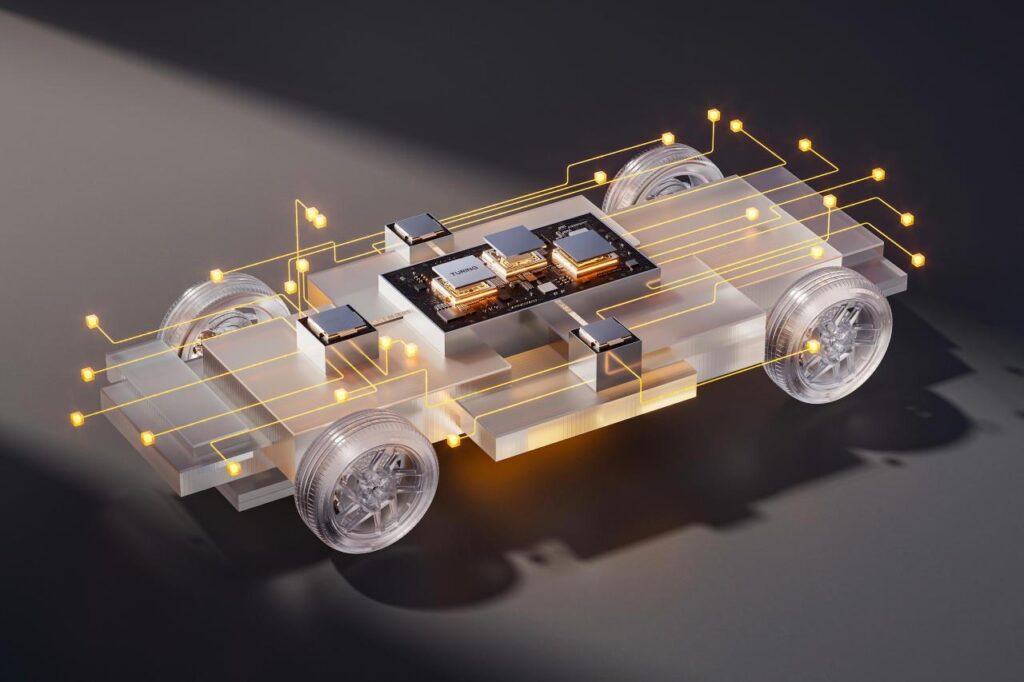
    To operate and be so promising, the VLA 2.0 relies on the Turing AI chip designed in-house by XPENG, capable of delivering up to 2,250 TOPS (trillions of operations per second) per unit in the most powerful versions.
    This massive computing power means that very large AI models can be run directly in the vehicle, without relying on the cloud. It is this on-board power that guarantees ultra-fast reactions – essential when you need to anticipate an unpredictable cyclist or a pothole in a fraction of a second.

    Volkswagen, a strategic and now historic partner

    The announcement that Volkswagen is now the first launch partner for VLA 2.0 on the Chinese market sends out a strong signal.
    Firstly, it is a symbolic milestone: it is the first time that a major historic Western manufacturer has adopted an advanced autonomous driving platform developed by a Chinese manufacturer to equip its own vehicles.

    source: Volkswagen

    Secondly, the agreement is not limited to simple software integration. Volkswagen will also be adopting the proprietary Turing AI chip developed by XPeng Motors, the computing heart of the VLA 2.0. In other words, the system’s hardware and software architecture will be based directly on the XPENG technology ecosystem.

    And it’s worth remembering that this partnership didn’t come out of nowhere. In 2023, Volkswagen invested around $700 million to acquire a 4.99% stake in XPENG, as part of a wider agreement to jointly develop electric vehicles for the Chinese market. This stake means that the German manufacturer already has a direct interest in the industrial and technological success of its partner.

    Objective: total autonomy within 1-3 years

    He Xiaopeng, Managing Director of XPeng, confirmed: “XPENG’s VLA 2.0 is the first version designed to achieve fully autonomous driving and will evolve at an unprecedented rate. We expect full autonomy to arrive within one to three years, making autonomous driving a natural part of people’s daily journeys.”

    This ambition is part of XPENG’s wider “Physical AI” strategy, in which the same AI model could eventually power other platforms operating in real environments:

    • humanoid robots
    • modular flying vehicles
    • autonomous mobility services
    source: XPENG

    A turning point for automotive AI

    With a plan for global deployment in 2027 and a major Western carmaker already committed to the technology in China, XPENG is entering a new phase of expansion. The alliance with Volkswagen could become a textbook case in the industry: a traditional carmaker boosted by Chinese on-board intelligence technology.

    It remains to be seen whether the VLA 2.0 will really be able to compete with the autonomous systems promised by Tesla, Waymo and other technology players.

  • February 2026: record EV sales in France, despite a falling market

    February 2026: record EV sales in France, despite a falling market

    For the electromobility sector, February 2026 will go down in the annals: 32,370 electric cars registered (passenger cars + light commercial vehicles), up 27.8% on February 2025. This represents a market share approaching 27%, an all-time record for February. Over the first two months of the year, the cumulative total reached 62,677 EVs, up 21% on 2025. According to AAA Data, the trend is clear: despite a declining overall market, electric vehicles are continuing to establish themselves as the engine of the future.

    source : Tesla

    Market context

    To say the least, the French vehicle market is not in the best of health. In fact, 120,764 personal vehicles were sold in February 2026, down 14.7% on the previous year.

    The main factor is that diesel sales collapsed again this month, reaching just 2.6% of the market. By comparison, sales of cars running on LPG represent 2.3%, while plug-in hybrids are up slightly at 5.5%.

    Electrics are now the leading energy source on the market, ahead of non-rechargeable hybrids. In short, while the overall market is shrinking, electric cars are gaining ground month by month.

    Top electric models

    One of the big news is that the Tesla Model Y is back in first place in February with 3,034 units, a position it has not held since last September. It is closely followed by its rival, the Renault 5, with 2,639 units sold, and by the Renault Scénic, with 2,127 units.

    source : Tesla

    This is a real rebound for Tesla, which had a difficult January, with a total of 3,715 vehicles (Model Y + Model 3). For Renault, the cumulative total for February was 6,492 EVs, or 20% of the electric market, confirming the brand’s dominance of the mass-market segment.

    In addition to the top 3, other models stand out: the Citroën ë-C3 (1,337), the Peugeot e-208 (1,150) and the Volkswagen ID.4 (1,003).

    source: Citroën

    Renault in the lead, the big manufacturers in ambush

    What really interests the market is who sells what at the end of the month. In this area, Renault remains the undisputed leader, with 6,492 electric vehicles registered in February and a market share of 20%. This position has been consolidated since September 2025, boosted by the Renault 5 and the Scénic E-Tech.

    As already mentioned, Tesla was more convincing than in the previous month, with 3,715 electric vehicles sold in February. The figures show that the American manufacturer remains a major player, even though Renault still dominates the consumer segment.

    At Stellantis, sales oscillate: Peugeot follows with 3,896 EVs, with Citroën and Volkswagen rounding out the top 5. The data confirms a clear trend: the French EV market is now concentrated around a few leading players.

    A falling market, but not for everyone

    Yes, February 2026 was a record month for electric cars, but it must be stressed once again that the overall market continues to shrink. With 120,764 cars sold in February 2026, that’s 14.7% fewer than last year, and 6.55% fewer than in January 2026.

    So why is the market falling? Well, first of all, the tax system is taking its toll: weight-related penalties affect almost 70% of passenger cars. A family SUV weighing over 1.6 tonnes can cost between €10,000 and €30,000 in tax, and CO₂ charges can push up the bill from €10,000 for 50 g/km to €40,000 for 130 g/km. As a result, family models are becoming virtually inaccessible to many buyers.

    Business fleets are also under pressure: down 13.9% in February (34,178 cars), held back by the wait-and-see attitude of the tax authorities and the weight penalty, which is holding up renewal. When it comes to internal combustion engines, the situation is almost the same: diesel at 2.6% (-54%), petrol -48%, LPG -52%, non-rechargeable hybrids -7%. In short, overall demand is weak, volumes are falling, and the economic situation is weighing on purchasing decisions.

    And yet, despite this context, electric cars shine. This paradox can be explained by four specific factors:

    • Social leasing 2025 deliveries: orders placed last year were converted into deliveries in January and February 2026, totalling 27,000 units, an artificial dynamic that inflates sales before they run out in mid-February.
    • Revalued ecological bonus: the doubling of the EEC (€2,000-4,000) led to a surge in orders following the revaluation.
    • Obligations for B2B fleets: decree requiring a minimum of 25% EVs in fleets of more than 100 cars/year.
    • Renault bestsellers: Renault 5 E-Tech (2,639 units) and Scénic (2,127) benefit from local production, which enables rapid deliveries and supports volumes.
    source : PFA

    According to the Plateforme Française de l’Automobile (PFA), the trade federation representing vehicle manufacturers and importers in France, this level of sales “is the result of a range that is now very wide, the obligation to make fleets greener, and a social leasing effect. While the first two factors will continue to drive the market over the coming months, the positive impact of social leasing will fade.

  • XPeng unveils the GX: a genuine “Chinese Range Rover

    XPeng unveils the GX: a genuine “Chinese Range Rover

    At the beginning of February 2026, XPeng lifted the veil on its new flagship: the GX, for eXploration. An electrified SUV over 5.26 metres long, with 6 seats, ultra-technological… and a design that clearly evokes the Range Rover Electric still under development. The message is clear: it’s possible to build a massive, high-tech SUV with status… for half the price.

    source : Xpeng

    A large, ultra-technological electric (and hybrid) SUV

    The real difference between the GX and the G9 (in the same segment) is not immediately apparent: it lies beneath the bodywork. The SUV is based on the SEPA 3.0 platform (Smart Electric Platform Architecture), the most advanced technological base developed by XPeng to date. It’s not just an electric platform: it’s an architecture designed from the outset to integrate artificial intelligence at the very heart of the vehicle.

    With the GX, artificial intelligence is not limited to screens or voice commands. It plays a direct role in the way the vehicle handles. Indeed, the GX adopts 100% steer-by-wire steering combined with four-wheel steering capable of turning the rear wheels by up to 10 degrees. In addition, the air suspension, steering and engine torque management are controlled in real time by algorithms capable of anticipating body movements, road conditions and driving style.

    source : Xpeng

    Two engines are planned:

    • a 100% electric version, with rear-wheel drive or all-wheel drive, 800 V architecture and ultra-fast 5C recharging (10 to 80% in around 15 minutes under optimum conditions);
    • an EREV (Extended Range Electric Vehicle) version, combining a battery with a combustion engine that acts solely as a generator. Cumulative range: over 1,000 km in the Chinese CLTC cycle.

    An obvious target: the Range Rover

    It’s hard not to see the inspiration. With its upright front end, massive proportions and perfectly horizontal roofline, the GX takes its cues from the benchmark British SUV, the Range Rover.

    We’re starting to get used to it: it’s not just on technology that the Chinese are hoping to compete with the market leaders, but on price. Positioned above the G9 (China price: ~350,000-460,000 yuan, or €35,000-46,000), XPeng’s current top-of-the-range SUV, the GX starts at ~400,000 yuan (< €50,000 in China) according to CnEVPost, three times cheaper than an electric Range Rover expected to cost at least €140,000.

    source : Range Rover

    Behind the GX, a clear international strategy

    The GX does not stand alone in the range. It is part of XPeng’s global expansion. After a record year in China in 2025, with 429,445 sales worldwide (up 126% on 2024), including 45,008 export sales (up 96%), the brand is preparing its European offensive (factories in Germany and Hungary from 2026). XPeng has set an ambitious target: to generate 50% of its sales outside China by 2028.

    The idea is clear: to show that a Chinese manufacturer can produce a large premium SUV that is credible in the face of European benchmarks such as the BMW iX or the Tesla Model X, while retaining a price advantage.

    The presence of an EREV version also illustrates a pragmatic approach to international markets. XPeng knows that not all countries yet have a uniform recharging network. Offering a cumulative range of over 1,000 km removes a major psychological barrier, particularly in rural Europe and certain emerging countries.

    source : Xpeng

    When will it be released?

    The official world premiere is expected at the Beijing Motor Show in April 2026. The commercial launch in China is scheduled for late 2026 or early 2027.

    As far as Europe is concerned, nothing is less certain. If it were to cross borders, between homologation, regulatory adaptation of steer-by-wire and organisation of the after-sales network, an arrival before 2028 seems unlikely.

    But one thing is certain: if XPeng manages to maintain a competitive price positioning outside China, the GX could become one of the models that symbolise the Chinese offensive in the premium segment.

  • AURA AERO signs the first order for its ERA hybrid-electric regional aircraft

    AURA AERO signs the first order for its ERA hybrid-electric regional aircraft

    On 2 March 2026, AURA AERO officially signed the first order for its ERA hybrid-electric regional aircraft. The lucky buyer, Pan European Air Service (PEAS), becomes the first customer to make a contractual commitment for this 19-seater aircraft designed to decarbonise regional aviation. With nearly 700 order intents, valued at $12 billion, ERA has reached a significant milestone.

    Source: AURA AERO

    ERA: an aircraft designed to revive regional aviation

    In the same press release, ERA is presented as a lever for transforming regional air transport. This flying machine is based on a hybrid architecture.

    The aircraft will be equipped with 8 ENGINEUS electric motors developed by Safran and 2 SAF (Sustainable Aviation Fuel) compatible turbogenerators. This configuration enables the aircraft to alternate automatically between electric and hybrid phases depending on the flight profile. The announced range is 900 nautical miles (around 1,500 kilometres), covering a large part of intra-European routes.

    source : Safran

    According to the manufacturer, the ERA could reduce CO₂ emissions by up to 80% compared with combustion-powered aircraft in the same category. In addition to reducing carbon emissions, the aircraft also aims to revitalise a weakened segment: regional routes.

    Versatility at the heart of the business model

    The ERA is not just positioned as a conventional regional aircraft. It can be configured for passenger transport, business aviation and light freight, as well as critical operations and emergency response.

    This modularity broadens the field of application and enables the manufacturer to address a wider range of operators than just the traditional regional companies.

    Source: AURA AERO

    Pan-European, first committed operator

    The press release highlights AURA AERO as the first buyer. Based in Chambéry and Lyon, Pan Européenne Air Service currently operates five Embraer aircraft (from 5 to 49 seats) and serves up to 500 destinations in Europe, North Africa and the Middle East.

    The company has been supporting the ERA programme since its inception. It recently took part in electric flight tests with INTEGRAL E, another AURA AERO programme.

    In the press release, Antoine Foessel and Clément Jacquot, co-directors and owners of Pan Européenne, explain:

    “AURA AERO’s ambition and values are perfectly aligned with our vision of tomorrow’s aviation. The technological and industrial choices made in the design and production of the ERA since the company was founded have always proved to be extremely relevant, and it is only natural that we should have chosen this aircraft in order to be able to offer the first carbon-free air transport in history.

    As well as enjoying a state-of-the-art, ethically responsible aircraft, the objective is clear: to become one of the first airlines in the world to operate a hybrid-electric aircraft with fare-paying passengers.

    A strategic turning point for AURA AERO

    For AURA AERO, this order is more than just a commercial opportunity. Together, they seem to be working hand in hand to drive forward the French and global aeronautics industry.

    Jérémy Caussade, chairman and co-founder of the manufacturer, stresses in the press release:

    “Pan Européenne is much more than a launch customer; it is a trusted partner that has been with us since the start of the ERA programme. We are very proud to count on the commitment of a company that chooses to support a French manufacturer, because we share the same values and the same vision.”

    source : Laref

    A regulatory environment favourable to hybridisation

    And this sale is taking place against a backdrop of increasing regulatory pressure on European air transport in 2026.

    Indeed, the sector accounts for around 2-3% of global CO₂ emissions, and European mechanisms such as the extension of the EU ETS or the Fit for 55 target are pushing operators to speed up their transition.

    In this context, regional aviation appears to be a realistic area for experimentation:

    • shorter distances,
    • more controlled energy needs,
    • infrastructures that can be adapted more quickly than for long-haul flights.

    An industrial equation yet to be demonstrated

    While this first firm order marks a major symbolic milestone, a number of unknowns remain. The ERA programme still has to pass the crucial certification stage, a long and demanding process for an aircraft incorporating a hybrid-electric architecture unprecedented on this scale.

    The industrial timetable will also be decisive. AURA AERO is aiming for entry into service by 2028-2029, but whether this trajectory is met will depend as much on regulatory approvals as on the industrial ramp-up.

    Another major challenge is controlling costs and the supply chain. The integration of eight electric motors, complex hybrid systems and sustainable fuels requires efficient and intelligent industrial coordination.

    Source: AURA AERO

    From prototype to market

    Signing with Pan Européenne does not in itself guarantee the industrial success of ERA, but it does mark a change in status: the programme is moving from a dynamic of innovation to one of commercial realisation.

    If the aircraft lives up to its promise in terms of performance, emissions reduction and operating costs, it could open up a new path for European regional aviation.