As electric mobility gains ground, the question of recharging infrastructure becomes central. Recharging your vehicle should no longer be a constraint, but a formality, accessible throughout the country.
France currently has more than 163,000 charging points open to the public, spread across all its regions. Behind this figure lies a genuine transition effort, led by both public and private players to support the growth of electric vehicles.
This map, published by the Association nationale pour le développement de la mobilité électrique (AVERE), shows the number of charging points open to the public, region by region. Its role is to inform users about the current momentum, driven by a shared desire to guarantee fair access to recharging and to support motorists in this transition.
As part of this energy transition, the government has set a target of 200,000 charging points by 2026, and 400,000 by 2030, including at least 50,000 fast-charging points. This is a major ambition, designed to meet the growing demand for infrastructure for electric vehicles.
With more than 30,000 registrations in 2024, France will account for almost 50% of licence-free car sales in the European market.
Long marginalised, these no-licence cars (VSPs) are enjoying a second lease of life in France, thanks in particular to electrification and modern communication aimed at attracting (very) young drivers – from the age of 14! – but also city-dwellers keen to reduce their environmental impact and make their cars more practical. With the ecological transition playing an increasingly important role in the minds of the French, and city traffic becoming more and more difficult for conventional combustion-powered vehicles, electric MPVs are an extremely attractive alternative.
Why are electric licence-free cars so popular in France?
Electric MPVs are continuing to win market share from their combustion-powered rivals, as well as from ‘conventional’ cars, because they appear to be a natural response to many of today’s problems. For example, the ever-increasing cost of a driving licence, which for more and more urban dwellers is no longer as useful as it once was, and the spread of populations, which means that people living in more isolated areas are choosing the car at an ever younger age, are the two main factors behind the overpopulation of PSVs in France.
But we can also add to this the lower speed limits in town (a licence-free car is limited to 45 km/h), the elimination of parking spaces and the increasing costs associated with the use of a conventional car (insurance is generally less expensive and roadworthiness tests are less frequent).
Finally, the electric version cuts the bill even further by reducing maintenance and fuel costs. To sum up: a licence-free car is full of advantages for an ever-growing proportion of the French population… and its electric version is even more advantageous!
Incumbents vs. traditional builders: beneficial emulation
Historically dominated by combustion engines, the French PSV market seems to be moving slowly but surely towards electric power. The boom of the Citroën Ami, launched in 2020, has had a lot to do with this, with more than 65,000 units sold in 5 years. It has recently been joined by another small electric no-licence car from a major manufacturer, the Fiat Topolino. These two models have enabled their manufacturers to take second and fourth place respectively in the rankings of the biggest sellers of licence-free cars in France in 2024.
All this in the face of players who are already well established and, above all, specialised. Pioneers who are not giving up, however, since the leader, Aixam, has added a 100% electric range, as has Ligier which, after seeing Citroën overtake it, was only a few thousand sales away from seeing Fiat do the same! The fact remains, and this is good news for everyone, that sales of the four brands mentioned have risen sharply between 2023 and 2024. This competition is good for a market that was once considered old-fashioned, as it has encouraged the Stellantis giants to invest in innovation around this soft mobility that they had sidelined for too long, and also the traditional players to speed up their electrification. All this while glamorising electric PSVs with marketing campaigns!
In the space of just a few years, licence-free cars have gone from being a “punishment for those who lose their licence” to a highly desirable form of soft mobility. And in this market, it’s a case of give and take: on the one hand, electric cars have given a boost to the PSV, and on the other, the growth of the PSV means that the French car fleet can be electrified more quickly.
Top 4 PSV manufacturers in France (2024) 1- Aixam / 10,771 sales / Growth of 8.7% / Combined heat and power / 33.9% of the market 2- Citroën / 9,267 sales / Growth of 4.2% / All electric / 29.3% of the market 3- Ligier / 5,869 sales / 8.4% growth / combustion and electric / 18.5% of the market 4- Fiat / 4,567 sales / First year / All electric / 14.3% of the market ( Voltandgo figures)
Sales of electric cars continue to grow at breakneck speed in Europe, and 2025 looks set to be a pivotal year for electromobility.
According to the latest figures from theEuropean Automobile Manufacturers’ Association, sales of 100% electric cars (BEVs) rose by 26.4% between January and April, reaching more than 558,000 registrations. This now represents 15.3% of the total new car market, up sharply on last year. In Western Europe as a whole, the market share of electric vehicles has even risen to 18.4%, compared with 14.3% for the same period in 2024. Hybrids saw an increase of 20.8%, with France the leading market, where sales rose by 44.9% over the year.
This growth can be explained by a rather favourable context. Despite the end of the ZFE in France, European regulations continue to put pressure on manufacturers to reduce their emissions. At the same time, the catalogue of electric models available on the Old Continent is becoming increasingly extensive, with more than 160 new models already available or planned for 2025, according to the Financial Times. Added to this are the various bonuses and reductions still in force in many European countries, as well as a growing interest among customers in electric and hybrid vehicles, which are certainly more fuel-efficient, but also less expensive to run.
Spain takes second place, France votes for Renault
The example chosen by ECO MOTORS NEWS to illustrate the breakthrough in car sales in Europe in the first half of 2025 is Spain. A country that has been slow to embrace electrification, but whose momentum seems to be firmly established: sales of electrified cars jumped by 72% in the first five months of the year, according to Reuters. This spectacular growth was driven by the massive arrival of Chinese models on the market: MG grew by 87%, Omoda by 213% and BYD saw its sales soar by 745%!
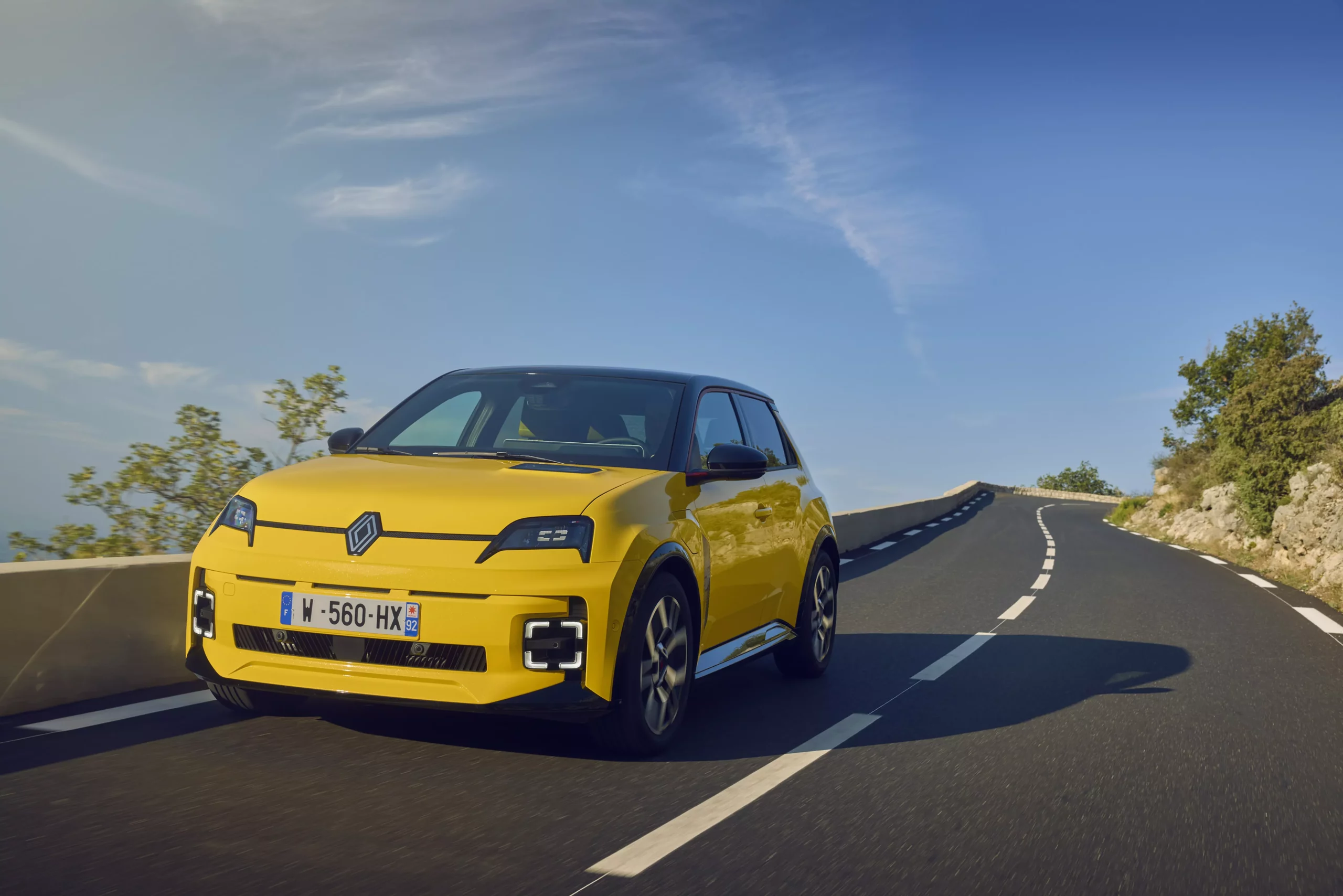
In France, it is hybrids that are driving the electrification of the car fleet, as we saw in the introduction. But what’s most interesting is to look at the rankings for the best-selling electric cars in France in the first quarter. The Renault 5 E-Tech, launched at the beginning of the year, is by far the best-selling electric car. At the end of April, it was ahead of the Citroën e-C3 and… the Scénic, also from Renault. In fact, the French manufacturer with the diamond-shaped badge has regained first place in the national ranking of electric car sales, with a 16.9% market share, ahead of Tesla, whose Model Y was relegated to fourth place, ahead of two Peugeot models. It’s clear that the French market is particularly keen on Renault, but also on French manufacturers in general.
Credit: Renault
Electric car sales: Tesla begins to share the cake
As we have seen, despite good sales figures in the electrified vehicle market, Tesla, long the undisputed leader, is experiencing a marked slowdown across Europe. The American manufacturer has seen BYD overtake it on the Old Continent. In addition to the antics of its founder, Elon Musk, some observers explain this fall in sales by a lack of diversity in the products on offer, but also by the electrification of the market, which is seeing more and more electric (and hybrid) models competing with the American giant, which nevertheless remains well positioned and whose 2025 Model Y is a benchmark.
Credit: Mathis Miroux
The year 2025 marks a turning point in the European automotive landscape. On the one hand, electric cars are making their mark at a rapid pace, and on the other, the market no longer resembles a Tesla monopoly, but rather a diversification, or even an upheaval, of the hierarchy of manufacturers in Europe. The Renault 5 E-Tech is a symbol of this successful transition in France.
While there are local specificities from one country to another, the major trends in the global second-hand electric vehicle (EV) market are emerging with striking similarities. Whether in the UK, France, the United States or China, a common dynamic is observable: a surge in supply, growing buyer interest, and a significant price drop. These combined factors are naturally boosting the volume of transactions. While range anxiety remains the main barrier to buying a new EV, the second biggest obstacle is undoubtedly the purchase price. The second-hand market now offers a tangible solution to this issue.
A More Mature Market, a Broader Supply
In just a few years, the second-hand EV market has matured significantly. The steady rise in new electric vehicle sales year after year is now being reflected in the used car market. Over 17 million electric vehicles were sold worldwide in 2024—an impressive increase of nearly 3 million units compared to 2023—which is mechanically feeding the second-hand market. As a result, the stock of used EVs is rapidly growing, especially in Europe and the United States. For instance, the Society of Motor Manufacturers and Traders (SMMT) recently reported a record rise in used EV sales in the UK in early 2025, with a year-on-year growth of 57% in the fully electric vehicle segment. Across the Channel, in France, second-hand EV transactions have risen by 54%, driven by the growth of social leasing schemes and fleet renewals. In the U.S., the figure reaches as high as 60%. This increase in supply is accompanied by a natural consequence: falling prices.
Crédit : DR
The Good News: Falling Prices
Another key driver of this new market momentum is the rapid depreciation of electric vehicles. Their value drops faster than that of combustion engine models in the first few years. In 2024, some of the most popular electric models lost up to 30% of their value in just one year! While this may be concerning for first owners, it is excellent news for potential buyers, making it possible to purchase a used EV at very competitive prices—sometimes for under €15,000 on the French market, for example. In the UK, the average price of a second-hand EV dropped by nearly 20% in a year, and by 15% over the same period in the U.S. This price drop is finally opening up the electric vehicle market to a broader customer base, often excluded from buying new, leading to a kind of “democratization” of the electric vehicle. This is even more evident in the world’s largest EV market: China. There, the average price of a second-hand electric vehicle is around €10,200—still higher than the average price of a used combustion vehicle (€6,500). But it’s worth noting that more than half of second-hand EV transactions take place below the €6,000 mark, meaning they’re in fact cheaper than the average combustion vehicle. Add to that the fact that used EVs for sale in China are on average less than four years old, and it becomes clear that one can now afford a cheaper and more recent electric vehicle than a comparable combustion model. The second-hand market is now playing a crucial role in the transition toward more sustainable mobility. More accessible and more diverse, it’s becoming a strategic gateway for many households looking to drive clean without breaking the bank. As prices continue to drop and supply expands, 2025 could well be the tipping point for the second-hand EV boom—a turning point that may accelerate the global adoption of electric mobility, far beyond the early adopters.
In the face of the climate emergency and the need to decarbonise mobility, France is speeding up the transition to cleaner public transport. From one end of the country to the other, from metropolises to rural areas, projects are accelerating in favour of electric transport. An overview of a major transformation.
Credit: RATP
Île-de-France on the front line
The Paris region is at the heart of the energy transition in the public transport sector. With its ambitious ” Bus2025 ” programme, RATP plans to convert all of its 25 operational centres to electric and biomethane engines by the end of 2025. Eventually, 1,000 electric buses and 1,300 buses running on renewable gas will be on the roads in Paris and its inner suburbs. This project should make it possible to halve CO₂ emissions linked to bus traffic. It is part of RATP’s overall objective to reduce its greenhouse gas emissions by 50%.
At the same time, Île-de-France Mobilités is continuing to extend the transport network, with metro line 14 reaching Villejuif-Gustave Roussy station in early 2025. The launch of the Tzen 4 bus line, replacing line 402 between Viry-Châtillon and Corbeil-Essonnes, is also planned. Tzen 4 is a world first: it will be the first 24-metre bi-articulated bus, 100% electric, with ground recharging in less than five minutes.
Electric cars are gaining ground in major cities
In France’s major cities, electric vehicles are playing an increasingly visible role in urban transport networks.
Lyon is planning a far-reaching transformation of its network, with the integration of electric vehicles into the future unified TCL network from September 2025. The city is also adapting its infrastructure to accommodate new electric buses and test pilot lines on the outskirts.
In Bordeaux, the deployment of express bus lines is based in part on electric vehicles, with the first service scheduled for 2025. The already electrified tramway lines are also being extended (lines E and F), strengthening the non-polluting offer in the city.
In Marseille, the “Marseille en Grand” plan includes electrified BRTs (Bus à Haut Niveau de Service). Line B4, due to enter service in 2025, will operate with an all-electric fleet. The city also plans to integrate more electric buses into its RTM network.
Credit: B4 BRT public consultation file
In the regions: major projects
Looking beyond the metropolises, France intends to strengthen inter-urban and peri-urban mobility via the Regional Metropolitan Express Services (SERM), a concept inspired by the RER in the Paris region. Fifteen projects have been approved, covering cities such as Strasbourg, Lille, Nantes and Grenoble. These SERMs combine trains, express coaches, safe cycle paths and unified pricing to facilitate access to clean mobility.
Urban and interurban logistics are also concerned: 972 charging points for electric HGVs have been deployed in depots, and 24 public charging stations for HGVs opened on 1 January 2025. These infrastructures are strategic for supporting the decarbonisation of freight.
Electricity grid: an essential link
The widespread use of electricity raises the question of energy infrastructure. RTE, the operator of the public electricity transmission network, is planning massive investment between now and 2040. The aim is clear: to adapt the network to support the growth in electric mobility, while guaranteeing the reliability of supply.
A still fragile transition
While the momentum is there, the transition is still fraught with obstacles. The cost of the projects, the slowness of certain local consultations and the problems of maintenance or training in the new technologies are sometimes holding back the momentum. Social acceptability, particularly in rural areas or areas with poor access, remains a major challenge.
France is well and truly engaged in a profound transformation of its public transport system. While the major cities are playing a leading role, the widespread use of electric mobility will also depend on regional planning, infrastructure and the collective ability to make this transition a lever for cohesion and sustainable development.
As the summer holidays approach, many French people will be embarking on a long journey by car… and in this respect, electric vehicles are often a source of concern… Organising a holiday trip by car requires a great deal of organisation, whether you’re driving a combustion engine or an electric vehicle! So before you embark on those interminable hours on the road, the editors have a few tips to help you prepare for your motorway adventure this summer…
Credit: Gustavo Fring
Before setting off, a basic technical check of the vehicle is essential: tyre pressure, the condition of the brake discs, the various lights, the windscreen wipers, the brake fluid levels, etc. These aspects may seem trivial, but all these small items of wear and tear can affect the distance travelled. These aspects may seem trivial, but all these small-scale wear and tear can have an impact on the vehicle’s driving distance. So a well-maintained car means optimum range, and naturally a smoother, more stress-free journey. Speaking of range, the one claimed by the manufacturer remains theoretical… To prepare as well as possible, and to know the real distance that the vehicle can cover, testing it in long-distance conditions is highly recommended. With the boot loaded, the air conditioning switched on, and on the motorway if possible, these are ideal conditions for getting a more reliable estimate of your vehicle’s capacity.
Another essential rule is not to wait until the battery is below 30% before recharging. Some charging points are very popular at peak times. It’s best not to recharge at the last minute, especially when approaching areas with heavy traffic. Also, before setting off, it’s a good idea to look out for the fast-charging stations available along your route. The network has certainly become denser, but it still varies from region to region.
The watchword: organisation
The best way to avoid last-minute detours (or even breakdowns…) is to plan ahead. To recharge without unpleasant surprises, it’s important to find out about the methods of payment at the charging points you identify beforehand. Some of them don’t accept credit cards, or are only available to vehicles capable of accepting particularly high charging power… The risk? Arriving at an unusable fast-charging point with little battery and not enough range to find another…
Credit: Bastien Neves
One final point not to be overlooked: remember to take a “Type 2” cable with you. This European standard is still essential at many charging points, which are not always equipped with self-service cables… In short, there’s one factor above all else: anticipation, so that you can drive, albeit at the mercy of a battery… but relaxed!
Who would have bet that a phone manufacturer, Xiaomi, would come and beat Porsche on its favourite home turf, the Nürburgring?
In the space of just a few months, Xiaomi, the Chinese consumer electronics giant, has turned the established codes of the automotive industry on their head with an extra-fast time at the Nürburgring… But to fully understand the significance of this dazzling achievement, we need to look back at the chronology.
The SU7, Xiaomi‘s first electric GT sports car, went on sale in China in March 2024. At the same time, a much more extreme prototype called the SU7 Ultra (more powerful, lighter and optimised for the track) was tested on the legendary German circuit the following summer. On 28 October 2024, a prototype of this SU7 Ultra completed the Nürburgring Nordschleife in just 6 minutes and 46 seconds… A disconcerting time for the German competitors, but achieved with a vehicle that was not really up to standard… Roll-over bar, racing tyres and specific components not available on the production version! In short, this version achieved an incredible time, but is not part of any championship, and therefore has no official value… (in this case, the category is ‘Electric Production Cars’).
A record at the Nürburgring, a royal entry into the big leagues for Xiaomi
The real record came just a few months later. On 1 April 2025, Xiaomi took another lap of the track with a production SU7 Ultra in just 7 minutes 04 seconds, this time validated in the Electric Production Cars category. It’s a feat that sent shockwaves through the world, as the time above dethroned the Porsche Taycan Turbo GT! (The former queen of the category…) So it’s at this precise moment that Xiaomi strikes hard. On its very first attempt, a very young car brand has surpassed one of the most emblematic names on the Nürburgring. The Nürburgring has always been dominated by European manufacturers, and Porsche has reigned supreme here for decades as a national symbol of performance and precision.
Credit: Xiaomi France
But to achieve such a result, Xiaomi has spared no expense. The SU7 Ultra packs more than 1,500bhp from three electric motors, as well as Pirelli semi-slick tyres, carbon-ceramic brakes and a chassis that’s sharper than ever. Features that make this model much more than just a GT sports car: it’s a real technological showcase, demonstrating China’s ambitions in the high-performance electric sector.
No oil changes to be made, no spark plugs or cylinder head gaskets to be changed, and even less descaling to be planned: maintenance on an electric car is much less frequent – and less costly – than on a combustion car, except in one crucial area: tyres. Sometimes this is due to a simple oversight (some owners of electric cars, packed with technology and with no apparent engine, tend to believe that their steed will never see a mechanic in its life), but more often than not, tyre-related problems are due to the fundamental differences between combustion-powered cars and electric cars. There are, however, tyres dedicated to electric cars, as well as best practices for extending their life.
Credit: Robert Laursoo
Faster wear and tear
The characteristics of electric cars have a direct impact on tyre wear. Firstly, as the battery is often heavy, an electric car will weigh more than a combustion engine car of the same model, with a difference of 400 kg for a city car and up to 600 kg for an SUV. The first victims of this excess weight are none other than the tyres, which are subjected to higher pressure, which affects both their deterioration and braking distance, generally compensated for by harder braking which, although it may be regenerative and therefore good for range, accelerates the wear and tear on electric car tyres even further. As if that weren’t enough, the instant torque delivered by electric cars, again one of their main advantages, puts a greater strain on tyres during each acceleration than a combustion model. Several studies have shown that, on average, the tyres on electric vehicles need replacing around 10,000 km earlier than those on combustion engines.
Acoustic tyres?
The silent operation of electric cars amplifies the perception of the noise produced by contact between the tyres and the road, known as rolling noise. This sound is also produced by combustion-powered cars, but is masked by the noise of the engine. In town, at moderate speed, the discomfort is limited, but on the motorway or when you come across cobblestones, it can quickly become uncomfortable. To reduce this discomfort, all the giants in the sector have developed their own so-called ‘acoustic’ tyres. Generally speaking, this involves incorporating an absorbent foam inside the tyre, capable of reducing vibrations and, consequently, reducing the volume of rolling noise. Leading French tyre manufacturer Michelin claims a 20% reduction in noise. Continental is promising a reduction of nine decibels, compared with three at Pirelli.
Credit: Michelin
But when these manufacturers and their competitors design tyres dedicated to electric and electrified vehicles, noise is not the only factor they take into account. As we saw earlier, the main concern is that tyres on electric cars wear more quickly than their internal combustion counterparts. So tyres for electric cars have a number of technical features that differentiate them from those for internal combustion vehicles. Without going into too much detail about their ‘recipes’, manufacturers assure us that the materials used to make dedicated tyres are designed to withstand the high weight and instant torque of these cars. Their structure is also reinforced, with the same objective: to delay wear. These tyres offer a lighter resistance to movement, limiting friction and preserving the vehicle’s autonomy. An experiment carried out by Tire Rack, which compared the behaviour of specialised tyres and conventional tyres in real conditions, on the same electric car and following the same route, proved that fuel consumption was much lower with “electric tyres”.
Best practice
To optimise the life of the tyres on an electric car, there are a number of good practices to follow. First of all, you need to check your tyre pressure regularly, once a month if you drive regularly. The right tyre pressure ensures good range and slower wear. We also recommend that you rotate your tyres every 8,000 to 10,000 km, to spread the wear more evenly. It’s worth noting, even for drivers of internal combustion vehicles, that it’s advisable to adopt a supple driving style, avoiding hard acceleration – which is certainly tempting when all the torque is instantly available – and hard braking. The same goes for wheel alignment and balancing, which are often overlooked when it comes to maintenance. By following this good advice, as well as choosing dedicated tyres – even if they are a little more expensive – you can not only extend the life of your tyres, but also, and above all, improve your driving experience.
A young American company, Dacora Motors, has just presented its first neo-retro concept car, inspired by the cars of the inter-war years, modernised and 100% electric.
If there’s one thing that car enthusiasts, whether they run on watts or benzine, can agree on, it’s their love of concept cars. And the one that Dacora Motors, a young American company founded by Kristie D’Ambrosio-Correll, an engineer, and her husband Eric, has just presented is likely to put everyone on the same wavelength. It combines the slightly Art Deco elegance of 1930s design with 100% electric performance and modern standards.
Credit: Dacora Motors
With its long, solid walnut bonnet, a cabin crammed with analogue dials, backlit buttons and wood veneers, and dizzyingly massive curves reminiscent of an old Cadillac, it almost feels like you’re on the streets of a mafia-ridden Chicago at the height of Prohibition, but certain technical and technological details, notably the screens and haptic buttons, take us back to 2025. Still at the concept stage, this large saloon, which could well be driven by any Batman villain, could nonetheless go into production very soon, according to Dacora Motors.
Dacora Motors, 800 bhp, 600 km range and… 500,000 dollars!
In terms of power, this Dacora develops the equivalent of 800 bhp and has a claimed range of 400 miles (643 kilometres), enough to cover the distance between Los Angeles and Las Vegas without recharging, despite weighing almost three tonnes. That’s if you’ve still got a bit of change to put in the red at the roulette wheel, because to buy the Dacora you’ll have to shell out 500,000 dollars. At that price, owners will be able to personalise their cars, from the livery to the colour of the leather and the wood types. The least they can do.
Credit: Dacora Motors
Electricity seems to have given the traditional manufacturers the runaround, and on the whole they are playing it safe with minimalist, futuristic and repetitive designs, gradually losing their visual identity. So it’s rather refreshing to see young upstarts like Dacora Motors going in the opposite direction with a car with such an assertive character. It remains to be seen whether this will be enough to overshadow Rolls-Royce and its electric Spectre, which costs almost €400,000. For that to happen, the Dacora saloon would have to go from concept to production. And while it’s important to remain cautious, the buzz around this type of neo-retro model is very strong, and it wouldn’t be surprising to see the first Dacora Motors leave the factory in a small production run. Indeed, according to Kristie and Eric, pre-orders have already exceeded their production capacity! One thing’s for sure: it will be made in the United States, with the added expertise of Pininfarina… and that’s saying something!
As modern vehicles, and even more so electric vehicles, become increasingly connected, their vulnerability to cyber attacks continues to grow. Gaël Musquet, ethical hacker and cybersecurity specialist, warns of the vulnerabilities of these connected systems from the Campus Cyber in the heart of the La Défense district, a place that brings together many cybersecurity players. And for him, no technology is infallible. His watchword? Resilience. Interview.
A windy afternoon in the La Défense district. Gaël Musquet, a meteorologist by training, ethical hacker and Chevalier de l’Ordre national du Mérite, welcomes us to his HQ, the Campus Cyber, a “totem pole” bringing together hundreds of companies dedicated to cybersecurity. He takes us on a tour with what he familiarly calls his “toys” in his arms: drones, a whole bunch of cables, screens and printed circuits that he uses and/or makes in his lab. His current project? A rover that can be remotely piloted and used in military operations.
Credit: Mathis Miroux
But Gaël Musquet’s biggest toy is his car. A Toyota C-HR hybrid that, from the outside, looks no different from the production model. Named ‘Red Pearl’ (in reference to the colour of the livery and the Caribbean origins of its owner, who is technically… a pirate of the Caribbean), it is a ‘show car’ hacked by Musquet himself, which he dismantles and hacks in public at conferences and which, at the touch of a button on the cruise control, transforms itself into an autonomous vehicle, with the exception of detecting tolls and a few problems with roundabouts.
Credit: Mathis Miroux
After taking ECO MOTORS NEWS on board for a demonstration of the almost limitless possibilities of car hacking – the car detects blind spots better and manages its braking better than the person writing these lines, to be honest – the ethical hacker took the time to sit down for a few minutes with us, for an interview.
What do you think are the main cyber risks facing electric cars today?
Gaël Musquet: Electric vehicles present five major attack surfaces. The first is physical: opening, theft of the vehicle, access to the passenger compartment, etc. The second is radioelectric: for example, NFC badges or contactless keys are targets. The second is radio: for example, NFC badges or contactless keys are targets. Then there are electronic vulnerabilities, via on-board data buses. Once physical or radio access has been compromised, action can be taken via these interfaces. The last two concern software installed on ECUs and on-board computers and data produced or received by the vehicle, such as connections to websites or manufacturer services. These are all entry points for cybercriminals.
You’ve hacked into your own car, which you use as a show car for your business. Can you tell us about it?
Gaël Musquet: I wanted to show these vulnerabilities in a concrete way. It’s important not to get bogged down in rhetoric or abstract standards. We’re talking about 140,000 car thefts in 2024 in France, that’s one every four minutes! So I’ve created a ‘show car’ which, as well as being autonomous, is above all a guinea pig that I can take apart, test and show. I use it to illustrate real issues and to advise customers and partners.
Credit: Mathis Miroux
And it’s all available as open source…
G.M. : Absolutely. My vehicle is based on open source software and hardware. The idea is that everything I demonstrate should be reproducible. Open source software allows the code to be collectively audited, which strengthens security. And it also guarantees a degree of technological sovereignty, since it is not dependent on a private player or a foreign state.
In your work on critical infrastructures, you often talk about resilience. How vulnerable is the recharging network to cyber attacks?
G.M. : No system is invulnerable. The real question is: how long will it take an attacker to bring it down? To build a resilient network, we need diversity in technical solutions and a culture of audit: penetration tests, code reviews, contributions from open source communities (such as the Linux foundation or the EVerest project). Some countries, such as Japan, are already opting for this openness, which makes their systems more resilient.
Credit: Mathis Miroux
Is there a need for an “audit culture” in the automotive sector, as there is in the banking and energy sectors?
G.M. : Yes, it’s essential. For the past two years, manufacturers have been required to incorporate cyber security into vehicle design. But this is still not enough. We need to give hackers access to vehicles so that they can audit them and organise bug bounties, rewarding those who find flaws. And above all, we need to think about cyber maintenance: developing standards, processes, updates, etc. We need cybersecurity crash tests, just as we do for physical security.
With the advent of bi-directional charging (V2G), cars can inject energy into the network. Is this a new entry point for cyber threats?
G.M. : Yes, clearly. It’s no longer just an exchange of fuel, but an exchange of data and energy. It also involves new players: energy suppliers, payment operators, network managers. The stability of the entire electricity network is at stake.
Credit: Mathis Miroux
As consumers, what can we do to protect ourselves from these attacks?
G.M. : There are a few simple things you can do: lock your vehicle and, when you get home, keep your keys away from your door and windows, especially if they are contactless; apply software updates to your vehicle, as you would to your smartphone; and protect access to your vehicle by parking it in supervised areas, or by using mechanical anti-theft devices such as the steering wheel lock. These measures may seem anachronistic, but they are still effective in delaying or deterring an attacker.
Are you optimistic about the development of automotive cyber security?
G.M. : Yes, very much so. At Campus Cyber, I see an active ecosystem, exchanges between peers, but also with passionate young people. In fact, I’m taking on eight of them on work placements this month! The automotive industry needs to be promoted among young people. The technical professions (mechanics, electrical engineers, etc.) are noble and essential to electromobility. It’s up to us to pass on this passion. There are 60,000 vacancies in the cyber sector today, and they will be essential tomorrow.
Credit: Mathis Miroux
You often talk about “getting your hands dirty”. Is this an important part of your approach?
G.M.: Absolutely. The manual side of things is sometimes devalued, but we need people who touch, test and manufacture, whether it’s hardware or code. My job is 80% human and 20% technical. Understanding fears, needs and emotions is what enables us to create effective solutions. Technology alone is not enough if we don’t know how to explain, support and create meaning.