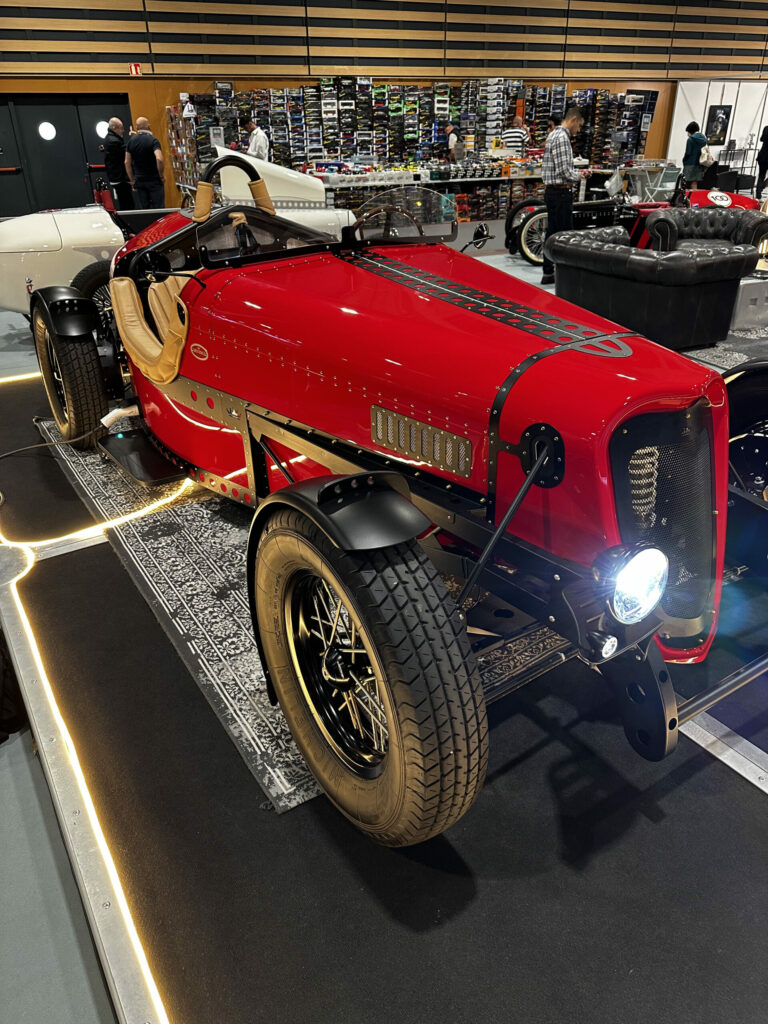
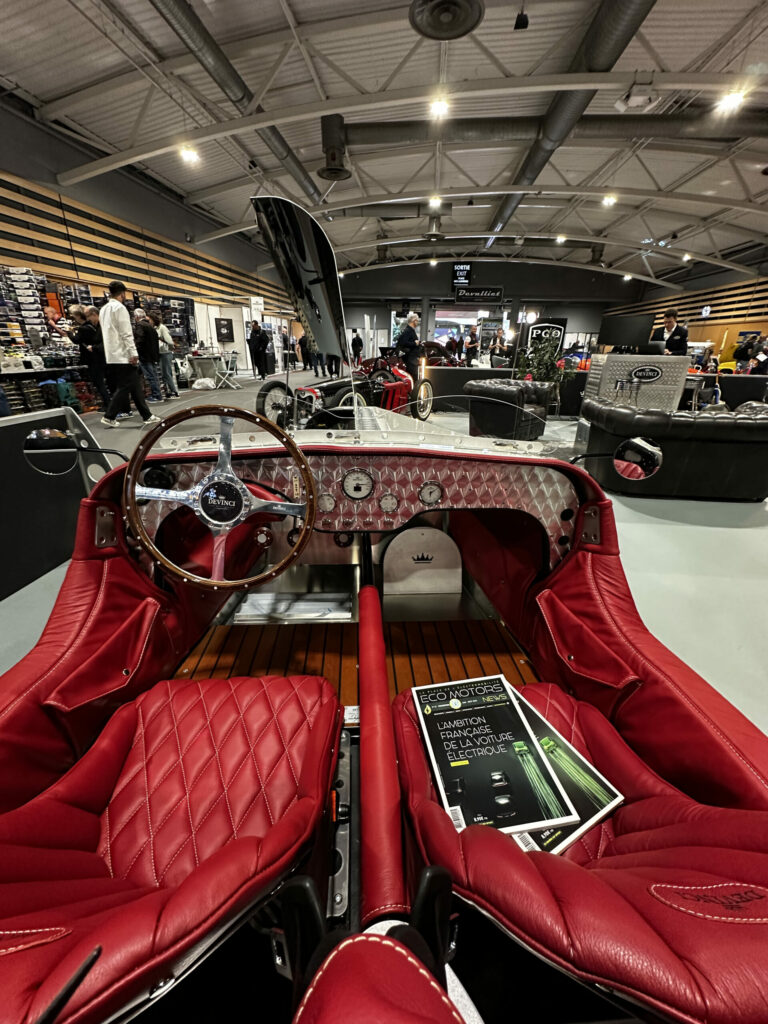
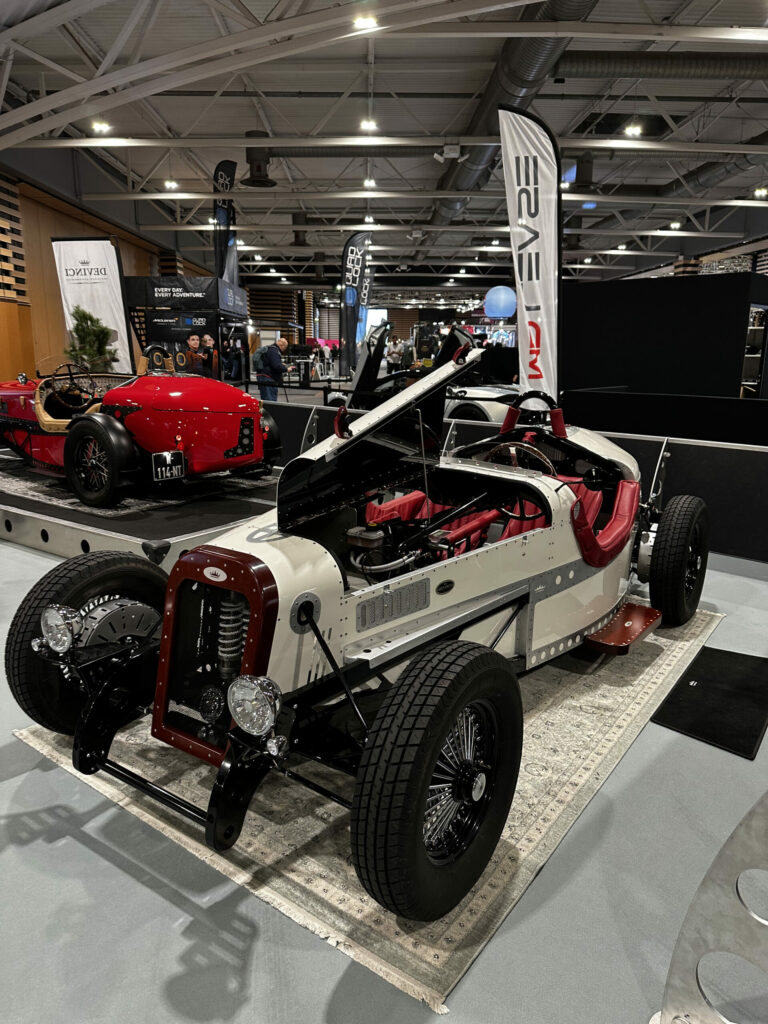
The editorial team had the opportunity to meet the Devinci teams on their stand at the Lyon Motor Show, to find out more about this real UFO of French car manufacturing.
As we wandered the aisles of the Lyon 2025 Motor Show, our eyes fell on a stand that stood out from the rest, that of Devinci. Cars with the racing style of the 30s and 40s, but powered by 100% electric motors, obviously speak to us at ECO MOTORS NEWS. But Jonathan Rouanet, the French manufacturer’s Sales Director, stops us dead in our tracks: the cars are designed and assembled in their workshop at St-Sulpice-la-Pointe in the Tarn region, using parts made by craftsmen, usually in the region and more rarely in the rest of France. Only the electric motors come from abroad, but from neighbouring countries (Germany, Italy). And the batteries? French, but incorporating imported cells. All these details pique our curiosity a little more, and we took some of Mr Rouanet’s time to tell us a little more about Devinci.
Credit: ECO MOTORS NEWS
And we start by taking a step back in time. The brand was created in 2017 by its founder Jean-Philippe Dayraut, a designer and racing driver. Named Devinci, in a nod to the great Leonardo, “acomplete artist and engineer, a visionary inventor and creator of timeless works” with whom the company “shares this vision of know-how that is both technical and artistic” according to Jonathan Rouanet, it presented its first prototypes, the D417s, at the 2018 Rétromobile show. These first cars were “deliberately simple, with leaf spring front suspension, front and rear drum brakes, proportions inspired by the 1930s and a range of around 140 km“. The result? 30 orders! In the industry, for a niche manufacturer just starting out, that’s what we call a hit.
Devinci, objet d’art and… marketing tool
In 2019, Devinci inaugurated its current line-up, comprising four finishes of the same model, improved each year: Brigitte (40 examples), Adèle (10 examples), Marianne (10 examples) and Eugénie (5 examples, one for each continent), priced at €58,000, €75,000, €150,000 and €200,000 respectively (excluding tax). This is an important point, because although Jonathan Rouanet doesn’t identify a typical customer – “my youngest customer is in her twenties, my oldest is in her eighties” – he does note that, in addition to “car collectors and lovers of art or beautiful objects, who don’t necessarily own other cars“, most owners of Devinci models are “company directors who use the vehicle as a marketing tool, for example for estate agencies or 5-star hotels“. In fact, he claims that, more than just cars, Brigitte, Marianne, Adèle and Eugénie serve above all to transcribe values and convey a message more effectively than with more traditional means of communication. And that’s thanks to its positioning.
Credit: ECO MOTORS NEWS
“We are positioned in a completely atypical niche, at the crossroads of several worlds: art and the automobile, industry and craftsmanship, the ancient and the modern“. The result is a real car, thanks to the founder’s “solid experience in motor racing – Formula Renault 3.5, Super Touring, rallies such as the Dakar“, but with the look of a rolling, chic, vintage work of art, all powered by modern electric power. The brand has already delivered its cars to some twenty countries around the world, and generates more than half its sales abroad.
Big ambitions
And there’s no end in sight for this “continuous and permanent improvement” manufacturer, which has just presented a new front end for its Eugénie model, as well as new Italian engines reserved for the top-of-the-range versions. As Jonathan Rouanet sums up, “each change is an opportunity for a new homologation“, but always with the same ambition: “Tocontinue to promote French excellence on the border between art and the automobile“. And it seemed to work at the Lyon 2025 Motor Show, as the Devinci stand was packed with people, all intrigued by these vehicles that were as anachronistic as they were desirable – further proof, if any were needed, that electric can go hand in hand with chic.
The wooden grille is a perfect illustration of the brand’s retro, artisanal, technical and industrial identity. Credit: ECO MOTORS NEWS
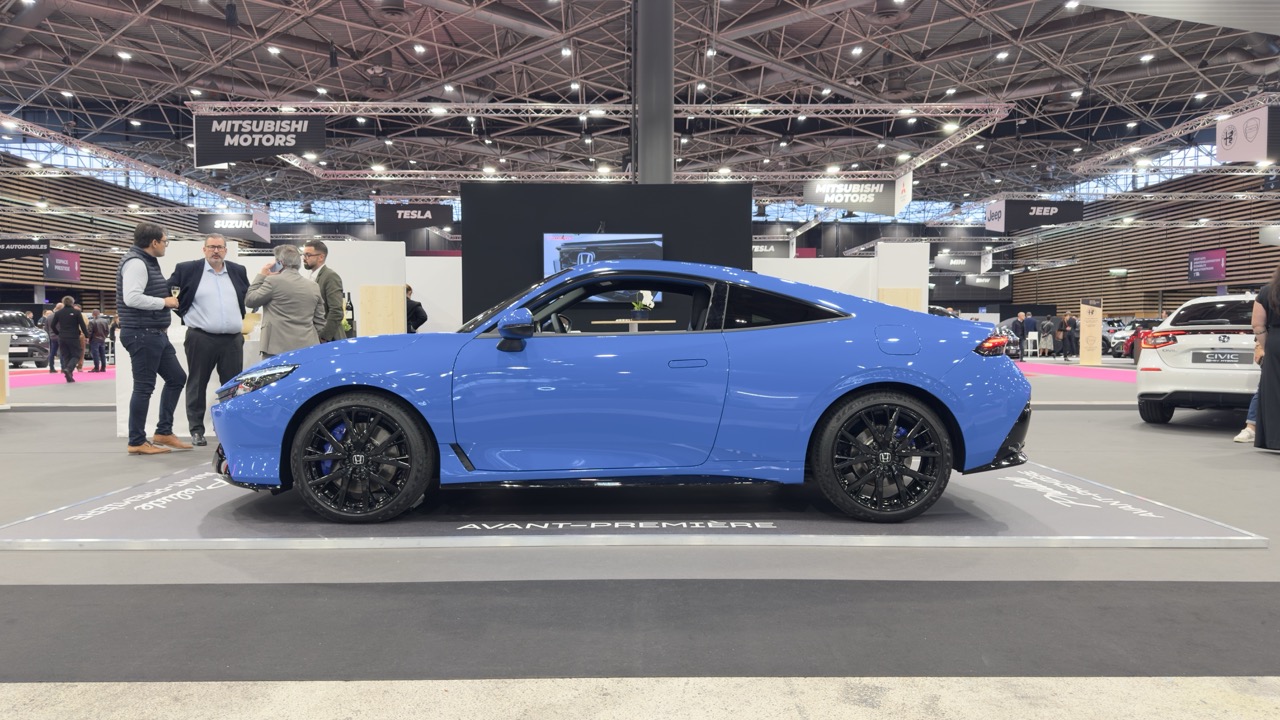
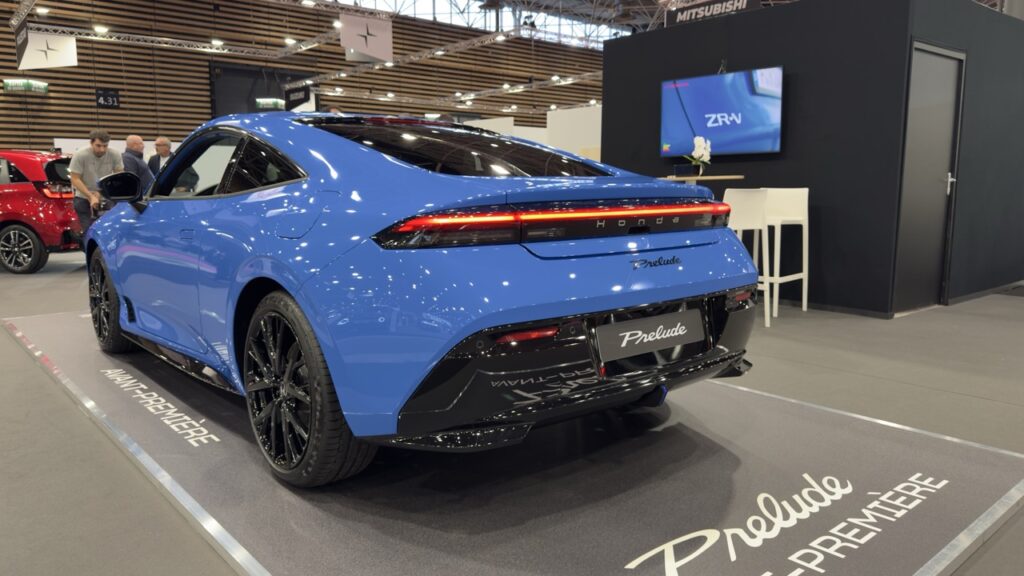
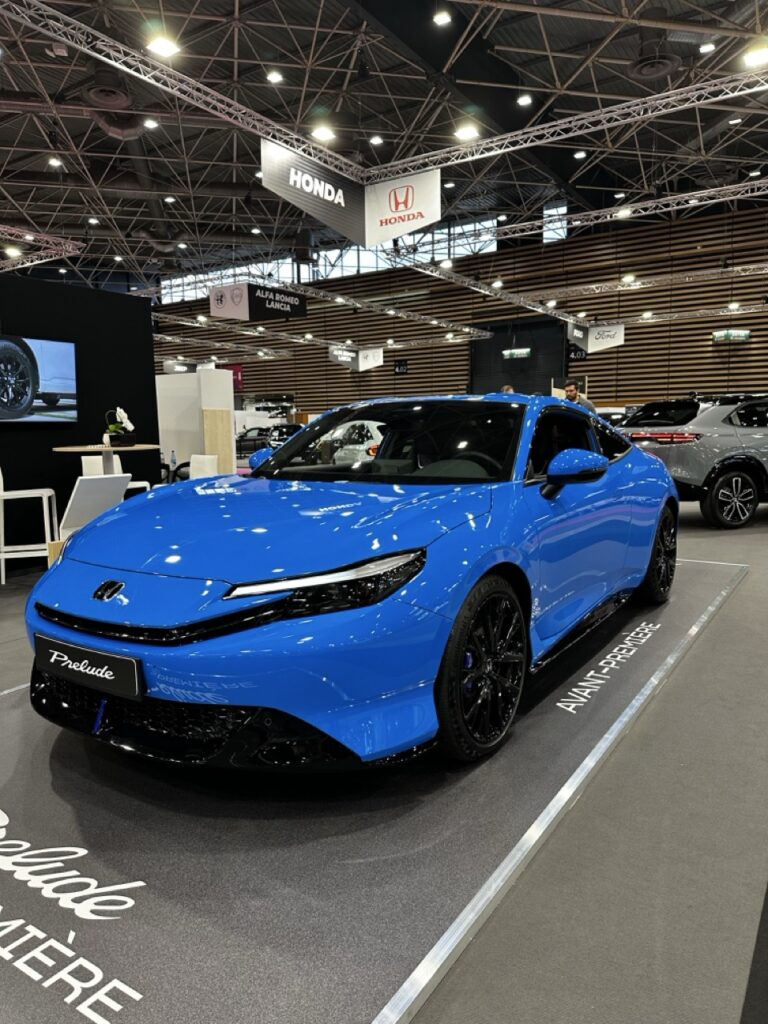
It’s when you stop expecting them that the nice surprises come! That was the case when we discovered the new look of the 6ᵉ generation Honda Prelude in the bays of the Lyon 2025 Motor Show. More than twenty years after it ceased production, the Japanese sports car that marked an entire generation is making its grand return to Europe.
A successful blend of heritage and modernity
At first glance, it’s obvious: the Prelude of 2026 is not the car of yesteryear. Like its ancestors, it retains its sporty silhouette, low lines and dynamic profile – in short, the codes that made it such a success. There’s a sharp front end and a distinctive light signature. The modern touch, meanwhile, is reflected in its compact appearance, aerodynamic details and unmistakable refinement, confirming Honda’s desire to make a sports coupé that is as seductive as it is efficient.
Powertrains and performance: hybrid as a matter of course
The powertrain has been confirmed: the Honda Prelude will be equipped with an e:HEV hybrid powertrain, combining a combustion engine and two electric motors. The chassis is strongly inspired by that of the Honda Civic Type R, a guarantee of sportiness, and the brand is introducing a new S+ clutch mode, which simulates automatic gear changes for a more engaging driving experience. All the more reason to take full advantage of the 200bhp developed by this sports car.
In Lyon, the new Honda Prelude was presented as a model steeped in history, with a modernised silhouette and a hybrid powertrain, a sign that Honda wants to combine heritage and energy transition. It remains to be hoped that this version, which is due to arrive in Europe in early 2026, will be able to stand on its own two feet and not remain in the shadow of its predecessors.
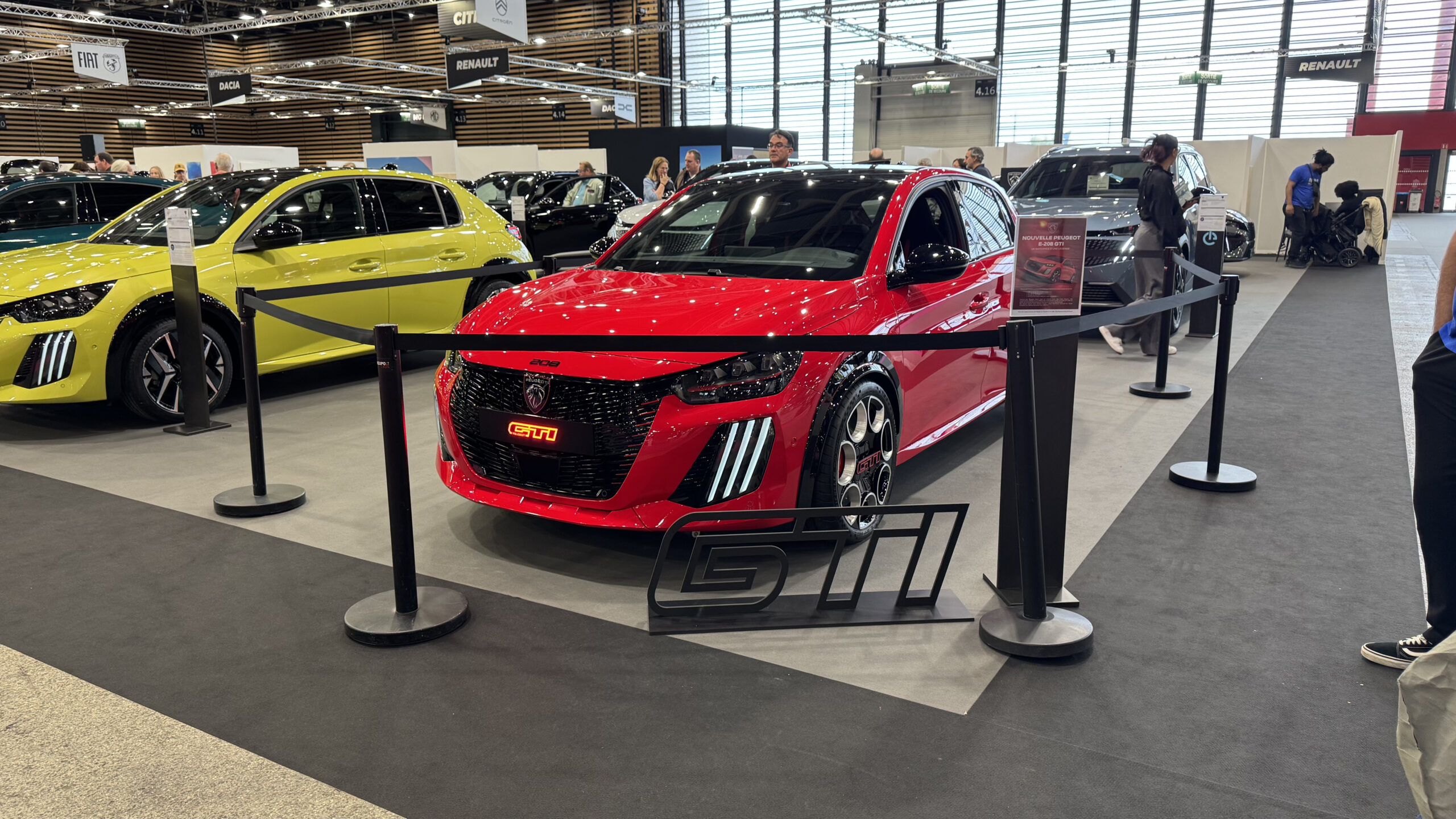
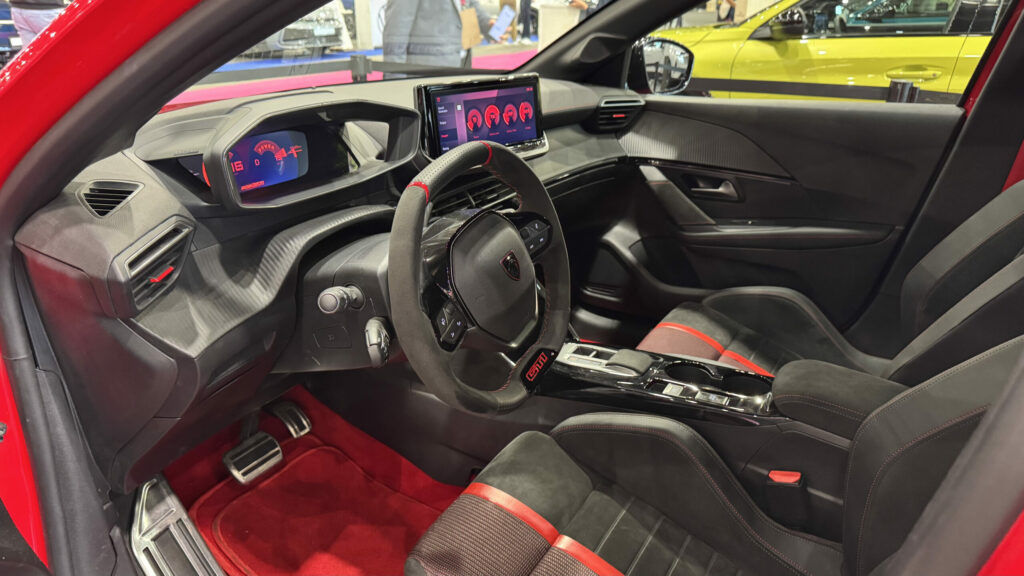
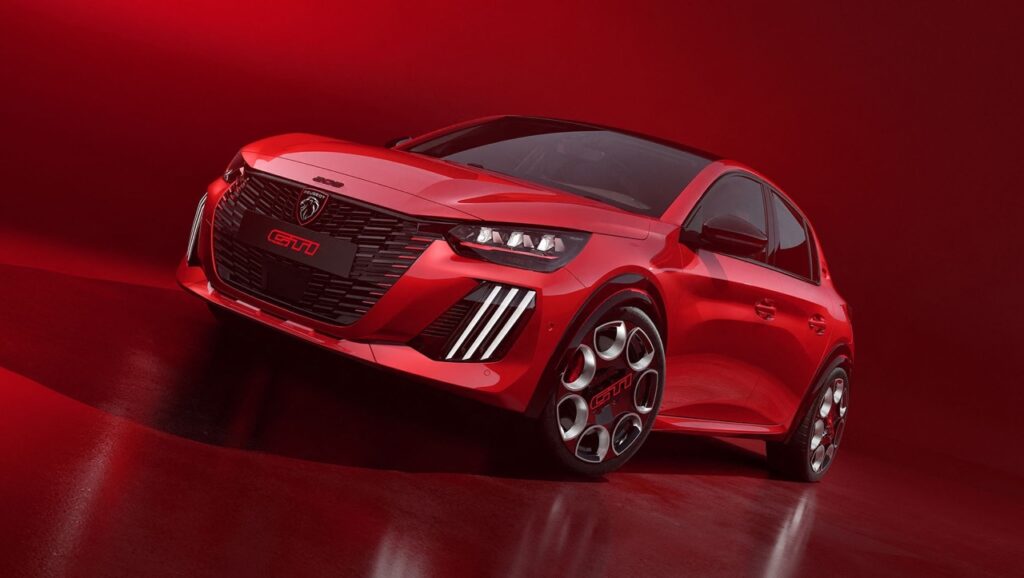
The star of the Peugeot stand at the Lyon 2025 Motor Show is undoubtedly the E-208 GTi show car, which combines desirable design, great performance and passion, all in 100% electric form.
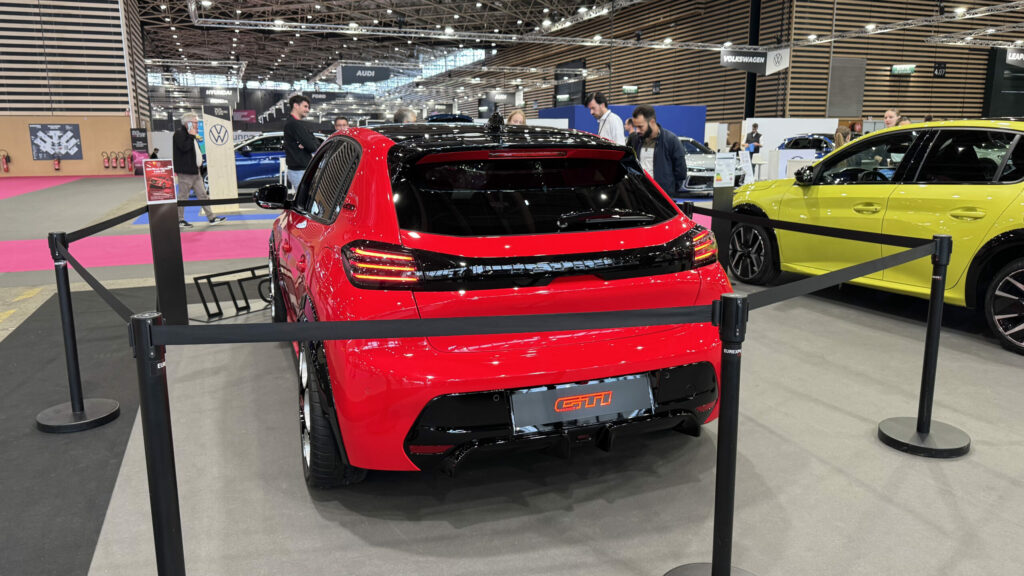
Presented at Le Mans last June, the Peugeot E-208 GTi had not yet reached the general public. Now it has, in the form of a show car – a car that is very close to the production model, but not yet 100% – at the Lyon Motor Show, which runs until September 28 in the capital of France. The red livery is a real eye-catcher, attracting journalists and visitors alike. ECO MOTORS NEWS was no exception to the rule, and was mesmerised…
Credit: ECO MOTORS NEWS
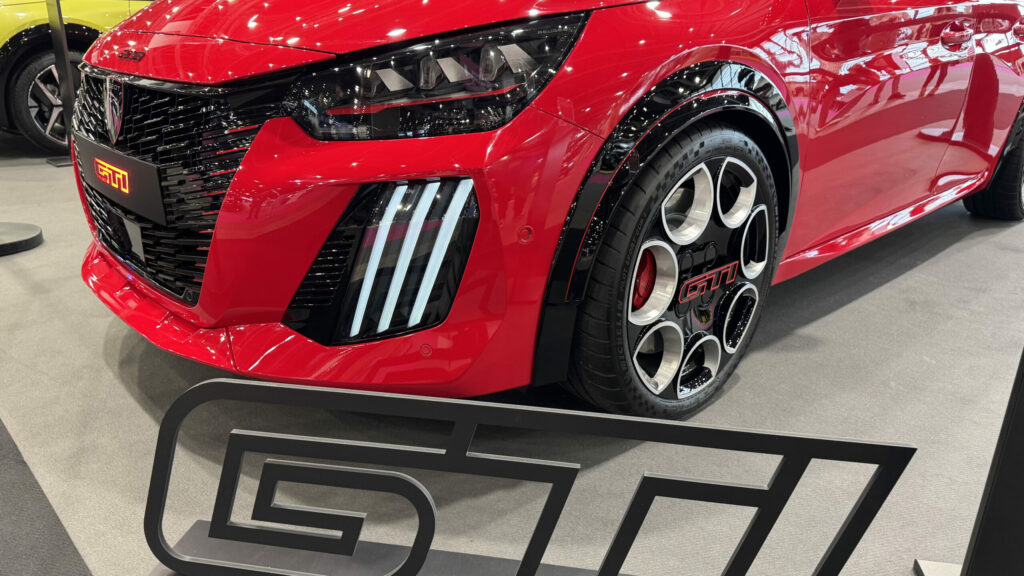
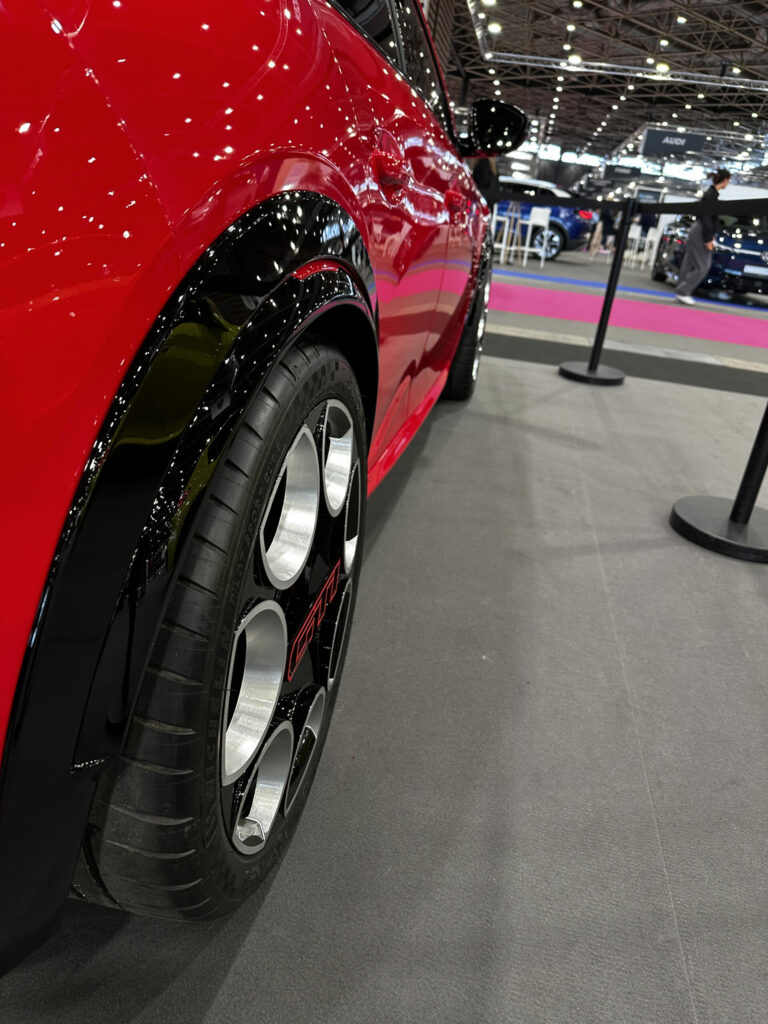
Firstly, there’s the design. This E-208 GTi respects the codes of the more classic version. But some details seem to be infused with sportiness. 18-inch wheels in XXL wheel arches, spectacular diffusers at the rear, wider wings and a lowered chassis are rather subtle, but this was also the case with the 205 GTi, for example. There are plenty of references to the latter, particularly inside, with the return of the red carpet, 205-inspired seats and aluminium pedals.
Credit: ECO MOTORS NEWS
The technical specifications of the Peugeot E-208 GTi are mouth-watering
It now remains to be seen whether this E-208 GTi will be able to stand up to the comparison with its illustrious ancestor. Designed entirely by Peugeot Sport, it promises 280 bhp, a 0 to 100 kph time of 5.7 seconds and a torque of 345 Nm – which is immediately accessible, as is also the advantage of electric over petrol engines. In other words, the 205 GTi’s signature ‘kick in the pants’ should also be found behind the wheel of this E-208 GTi. Peugeot has also announced a range of 350 km, which is rather respectable, even if, on a model of this type, this seems rather secondary…
Credit: ECO MOTORS NEWS
Still at the show car stage, Peugeot’s electrically-powered compact should, of course, go into series production. There’s no exact date on the stand yet, but spring 2026 seems an achievable target…
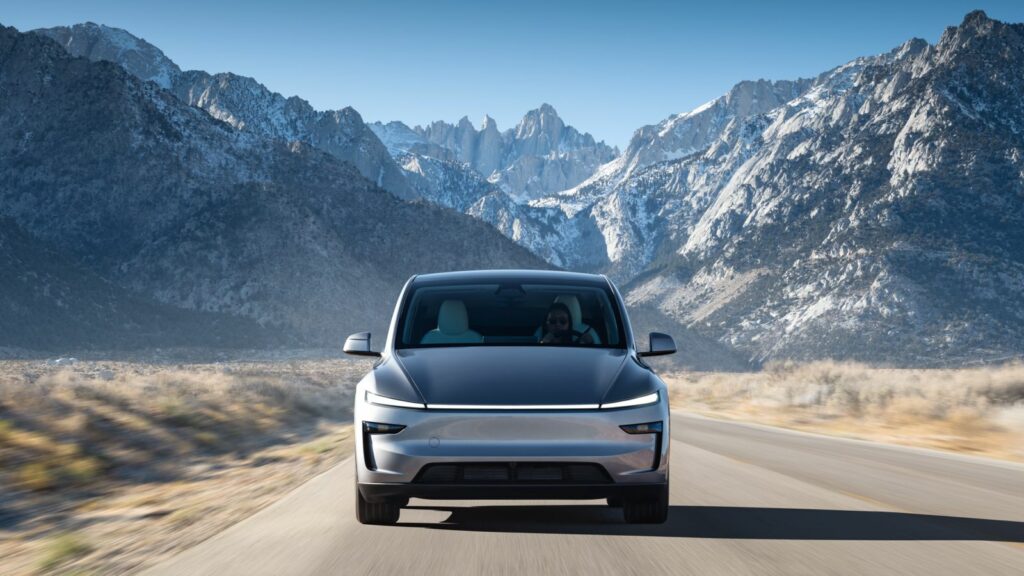
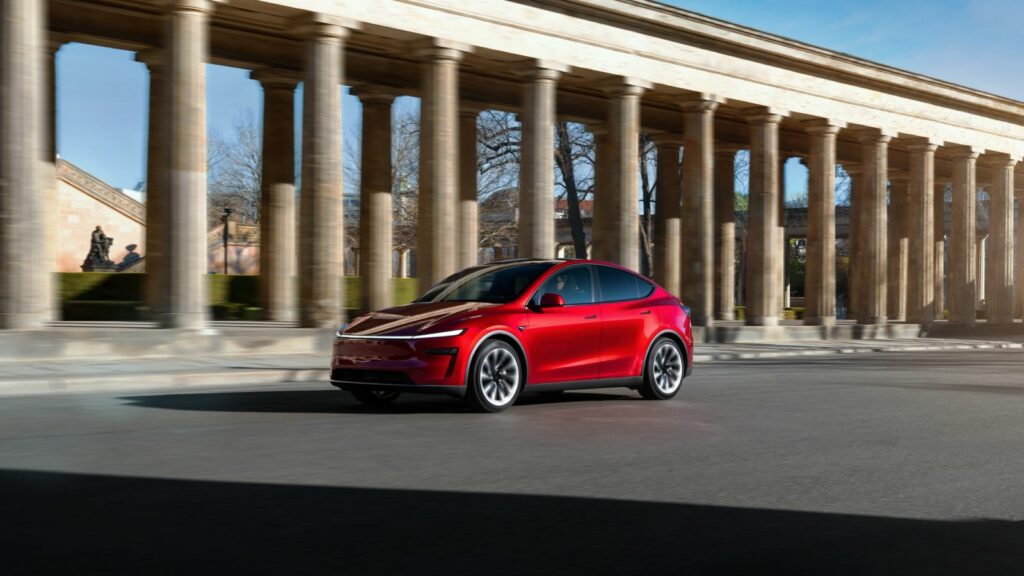
A big part of the reason why Tesla is facing trouble nowadays is the Model Y. It is the brand’s most popular product and yet it is recording big sales drops across Europe. The increasing competition, its old age, and the facelift introduced in Q1 2025 are all contributing to a 34% drop on its registrations through July 2025.
Nevertheless, this compact to midsize SUV was still the region’s top-selling pure electric vehicle. The data from JATO Dynamics indicates that between January and July Tesla registered almost 74,500 units of the Model Y. This is considerably lower than the 112,100 units registered during the first seven months of 2024, but enough to put it in the top spot in the BEV sales ranking by models.
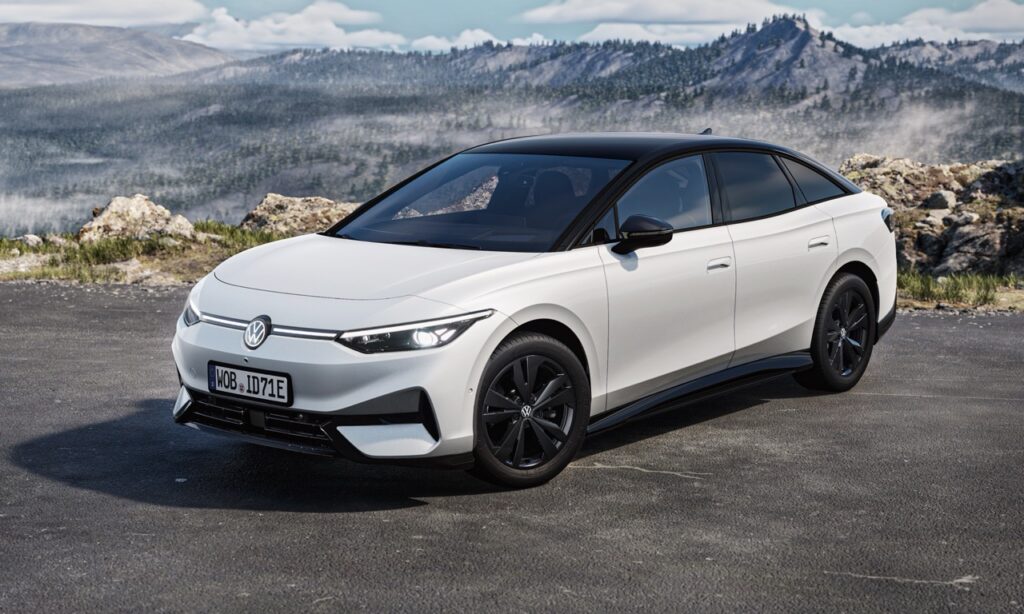
The result is even more remarkable after seeing the strong growth posted by the following models in the ranking. The data shows three Volkswagens at the second, third, and fourth positions, with all of them posting double- and triple-digit growth. The Volkswagen ID.4 increased its volumes by 35% and yet it was almost 28,000 units behind the Model Y.
Volkswagen IDs products’ increases came at the expense of a lower position of the Tesla Model 3, which was outsold by the Volkswagen ID.7. In January-July 2024, the Model 3 was Europe’s second most popular BEV, falling to the 5th position this year. This Tesla is already 9 years old.
The other winners
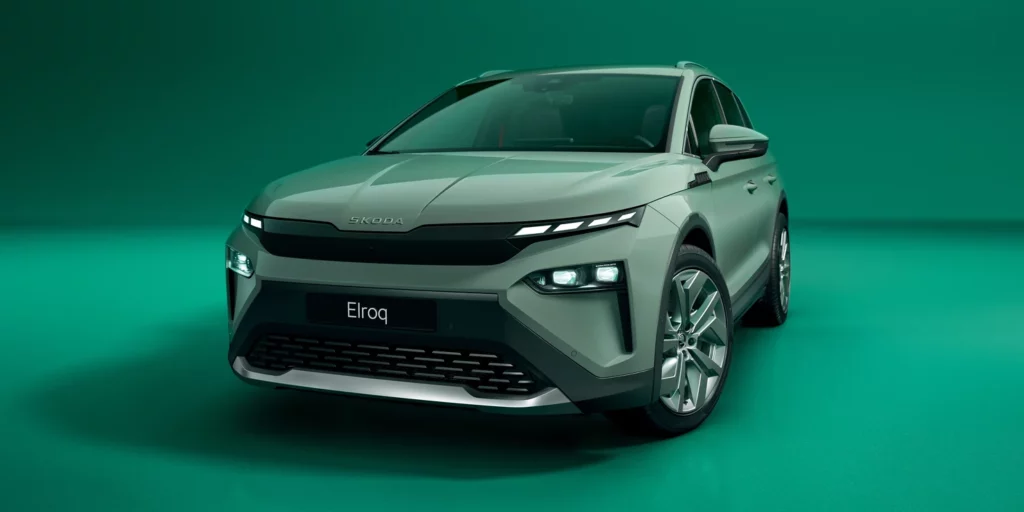
The Skoda Elroq was the most successful recent BEV launch in Europe with almost 43,000 units, at 6th position. It was followed by the also recently introduced Kia EV3 with 40,900 units, and the new Renault 5 with 39,900 units. None of them were available a year earlier. They are proving to be successful within the small BEV world. The top 10 was completed by the Skoda Enyaq with 38,900 units, and the BMW iX1 with 37,800 units.
Further down the list the Audi Q6 e-tron at 11th position registered 28,900 units, while Citroen registered 24,900 units of the electric C3, becoming the top-selling BEV from Stellantis occupying the 16th position in the BEV ranking. Ford seems to have finally taken off with the Explorer EV with 22,500 units, outselling others like the Renault Scenic (20,900 units), Hyundai Kona (19,900 units), and the Kia Niro (5,900).
In contast, the initially successful Volvo EX30 has lost ground with its volumes down by 43% (partly affected by the tariffs on Chinese BEVs), as well as its bigger brother the EX40, down by 37%. Another Chinese BEV to drop dramatically was the MG4 (-54%). Stellantis saw mixed results as the Peugeot 3008 was up by 156% to 12,900 units while the volumes of the Peugeot 2008, Fiat/Abarth 500, and Peugeot 208, fell by 19%, 49%, and 57%, respectively.
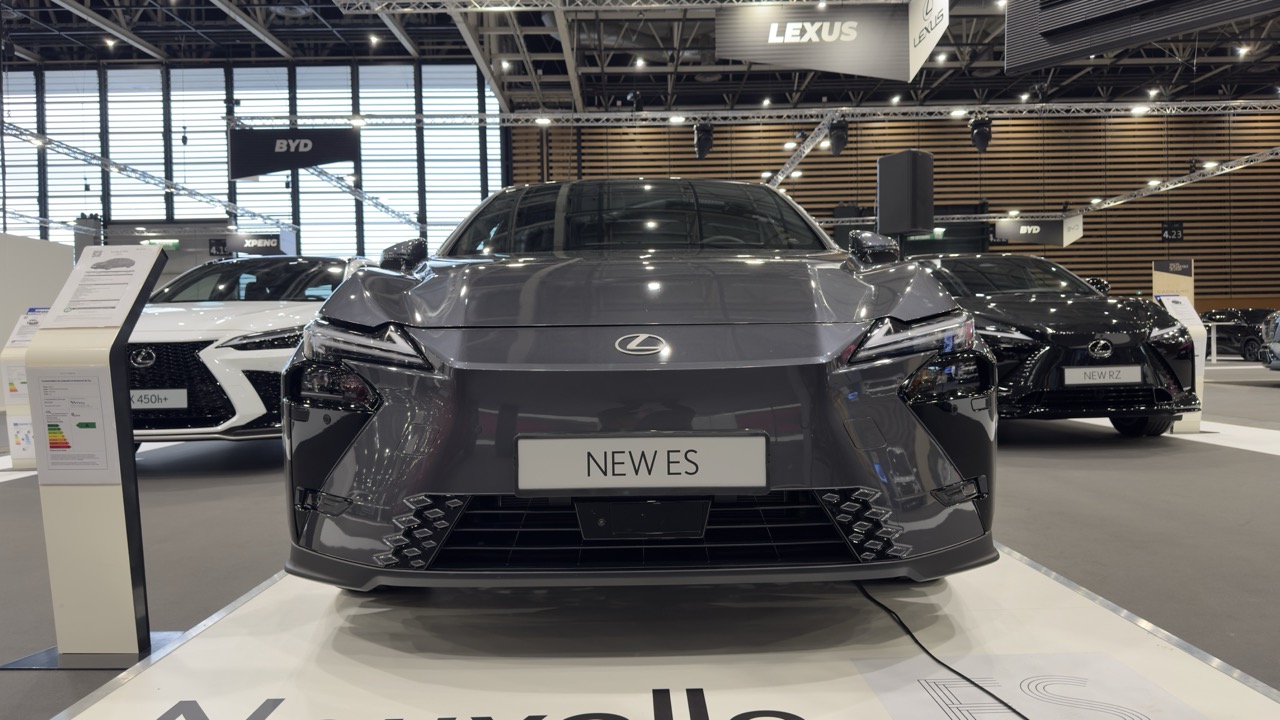
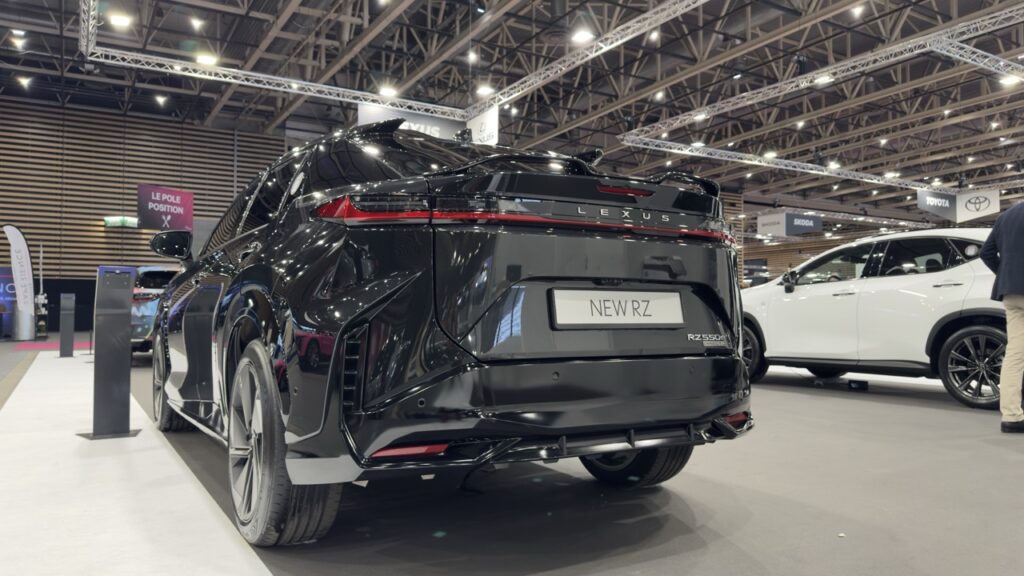
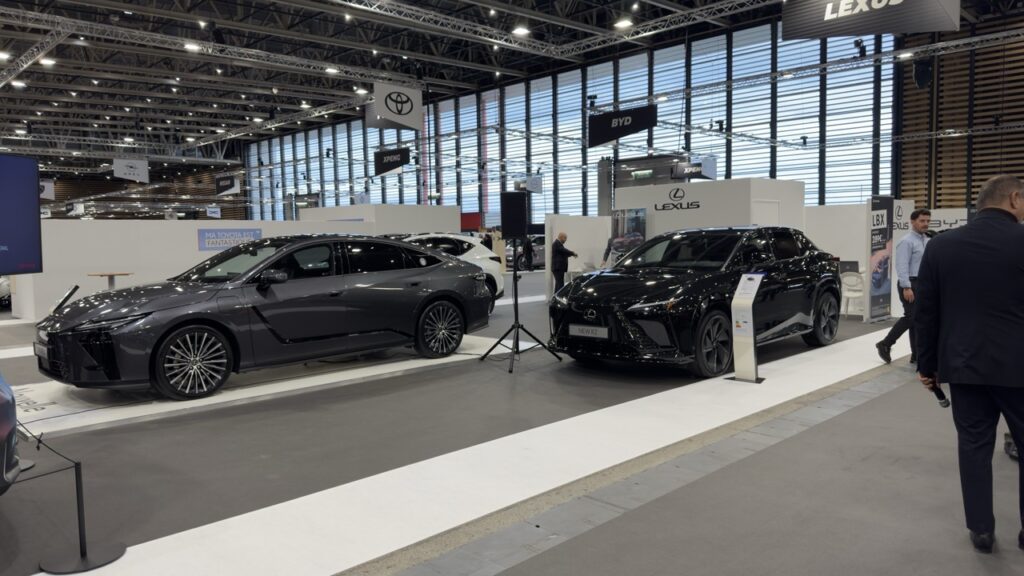
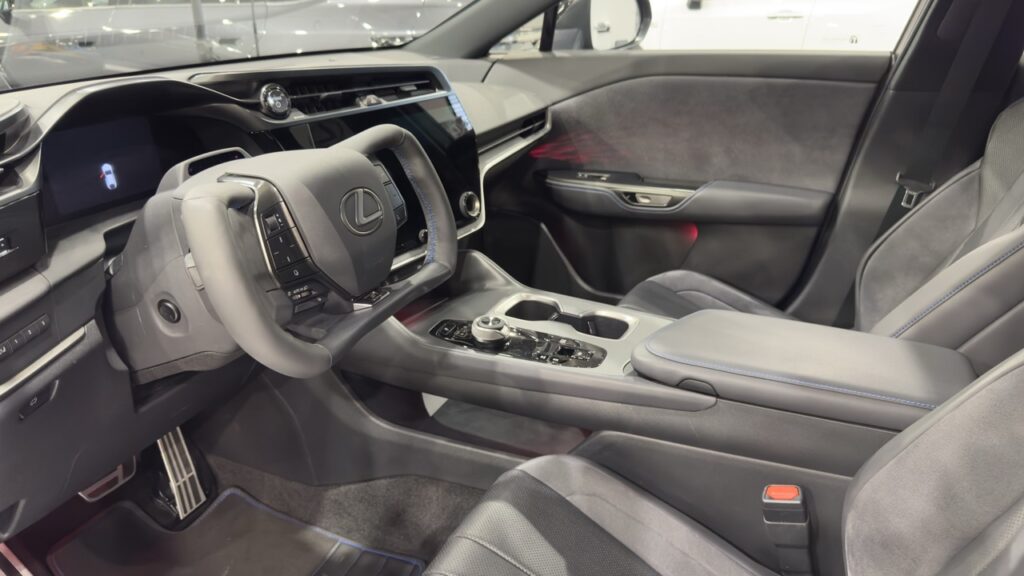
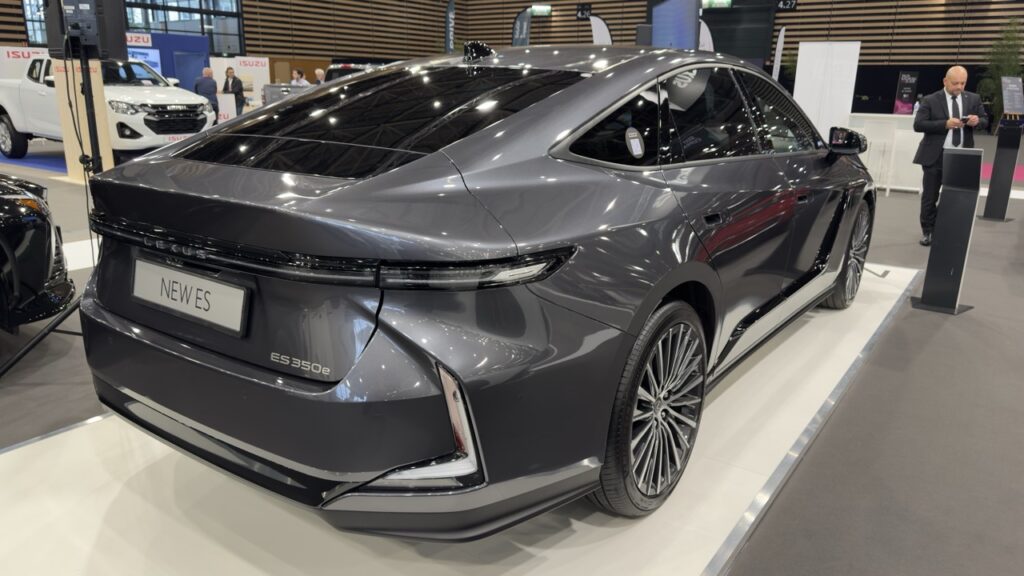
ECO MOTORS NEWS was at the Lyon Motor Show for its second edition. This year, Lexus made its mark by presenting two brand new models for the first time in France: the new ES saloon and the RZ electric SUV. These two vehicles embody the Japanese premium brand’s multi-technology strategy and confirm its ambitions for the European market.
The new Lexus ES: elegance and electrification
This year, the 8th generation of this large saloon is being updated. At 5.14 metres long, the new Lexus ES boasts a refined design, with clean, assertive lines. Inside, Lexus is true to its image: the emphasis is on sobriety and quality, with the use of noble materials such as bamboo.
When it comes to engines, the Toyota Group brand will offer you a choice: either its hybrid version or its 100% electric version with a range of 530 km. It’s a strategy that could pay off in the competition with European premium saloons. The launch is scheduled for summer 2026.
The Lexus RZ: sporty and innovative
On the same Lexus stand, the RZ plays the dynamism card. A 100% electric SUV, it focuses on driving pleasure and features the latest Lexus innovations, including a steer-by-wire system and a Formula 1-style steering wheel. As for the engine, Lexus is clear: the driver must be able to have fun with this SUV. And indeed, with 400 bhp, the promise seems to be kept. As for the announced range, Lexus’s Managing Director for France admits that, at 588 km, it is not one of the best performers on the market, but that it is the quality of the user experience that is prioritised.
The RZ will cost between €61,000 and €80,000, depending on the range. It will be available in March 2026.
The Toyota Group, a definite sales force
These launches were of great interest, especially as the parent brand Toyota unveiled three new vehicles at the same time: the Toyota BZ4X, the CH-R+ and the AYGO Cross Hybrid. Once again, the Japanese brand is proving that its strength lies in 3 principles: reliability, quality and adaptability to customer needs.
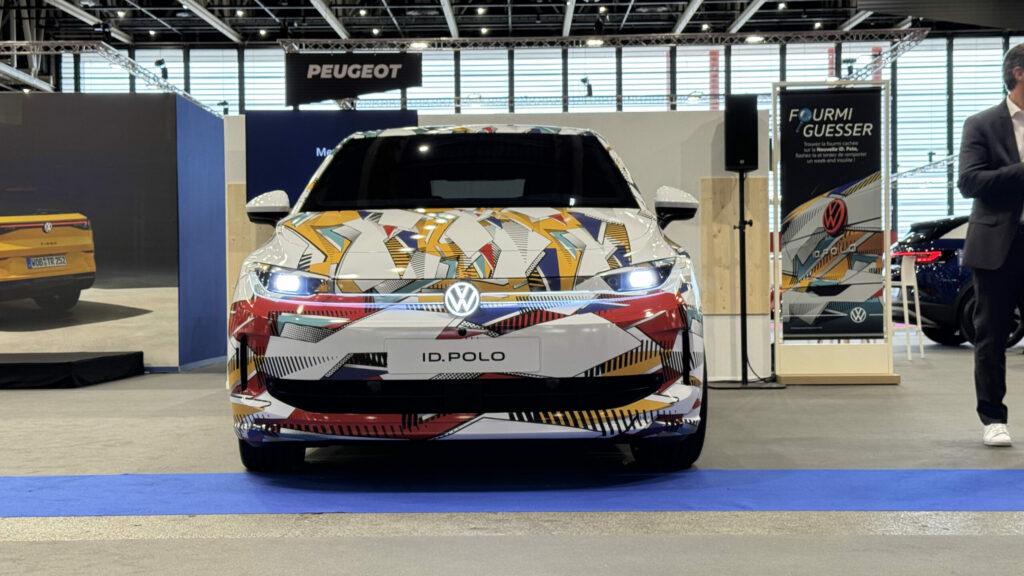
Live from the Lyon Motor Show, ECO MOTORS NEWS witnessed the first appearance in France of two models of vital importance to Volkswagen: the new T-Roc and, above all, the eagerly-awaited ID. Polo 100% electric.
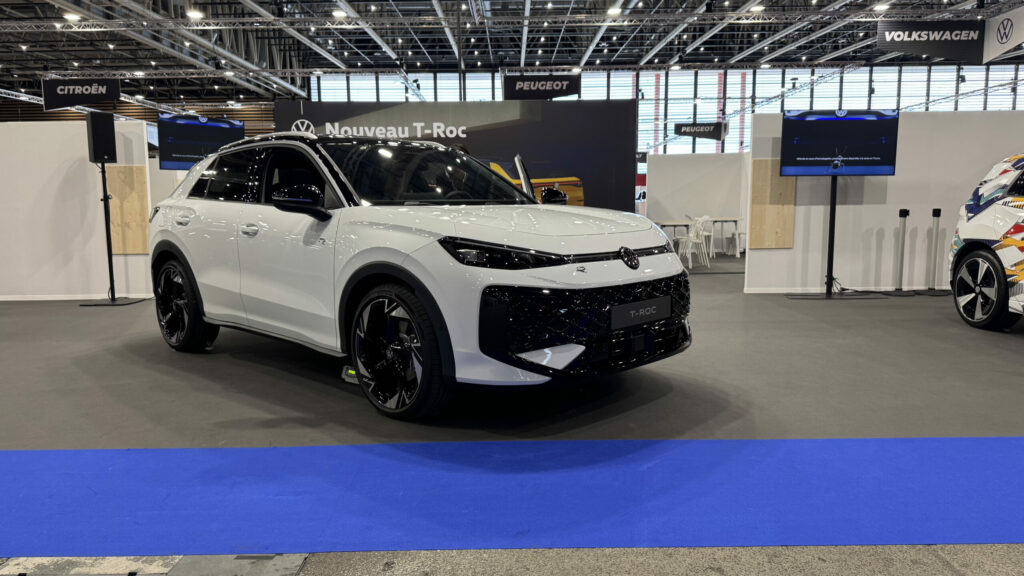
It was a long-awaited announcement, and it was sure to be one of the highlights of the 2025 Lyon Motor Show. At the heart of its imposing stand in the centre of Eurexpo, Volkswagen presented, for the first time in France, the new version of its two best-sellers in France: the T-Roc, in second place, and the Polo, in first place.
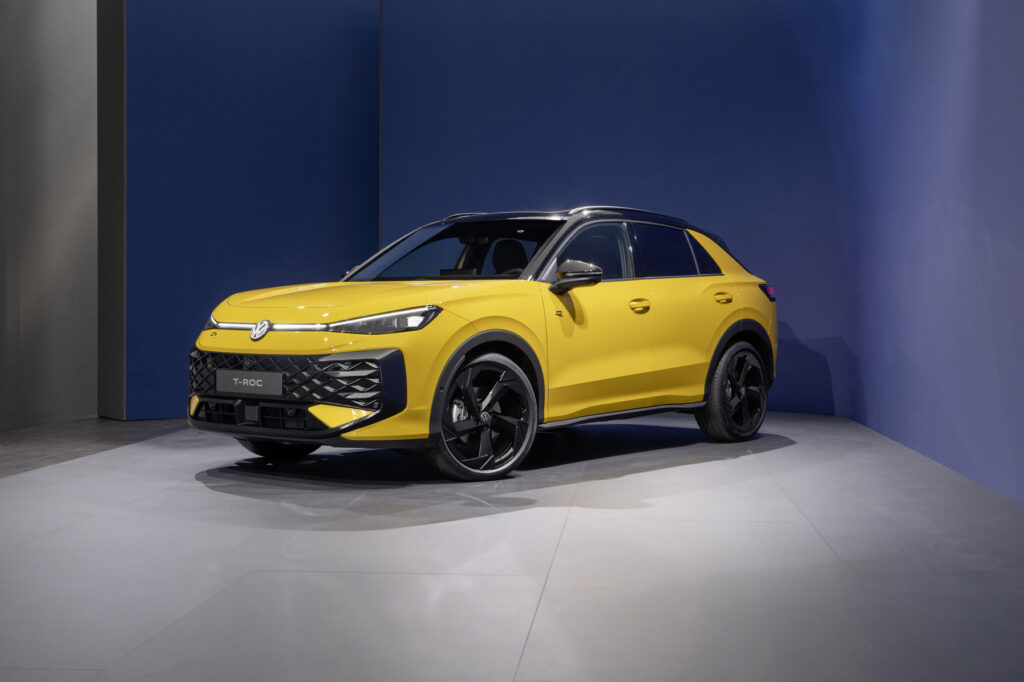
The 2026 version of the T-Roc crossover is being described as a ‘baby Tiguan’, as it benefits from technological improvements that bring it closer to its more upmarket companion – Park Assist, augmented reality head-up display – and shares its platform. 12 cm longer than the previous version, the ‘little’ SUV will be offered with a full hybrid engine.
Credit: ECO MOTORS NEWS
ID. Polo, small but strong
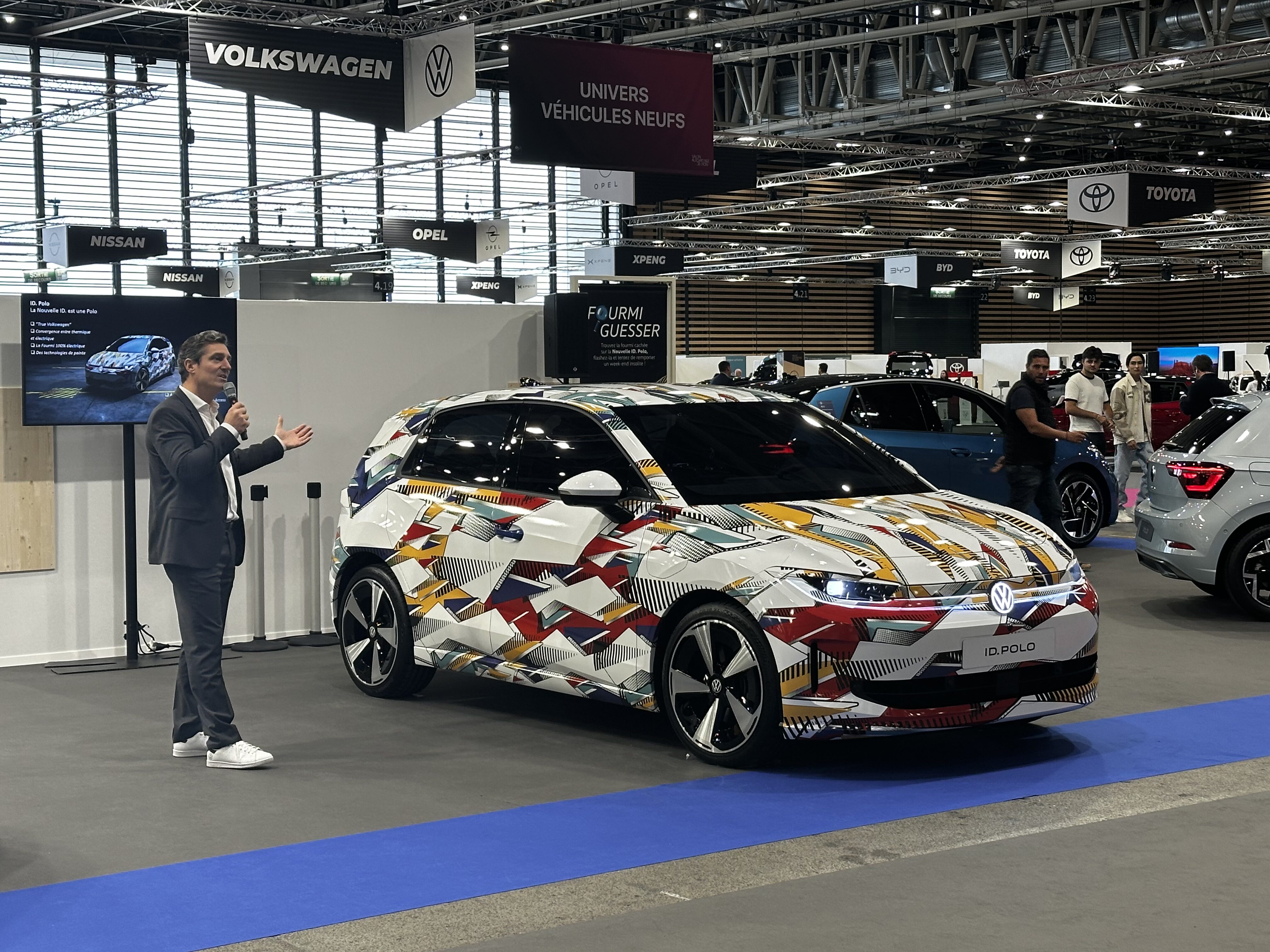
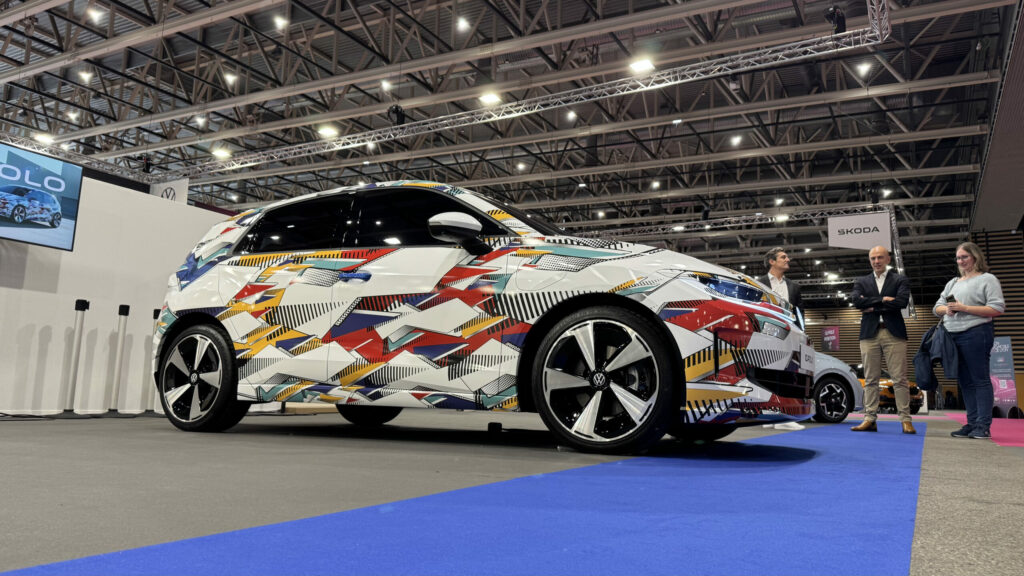
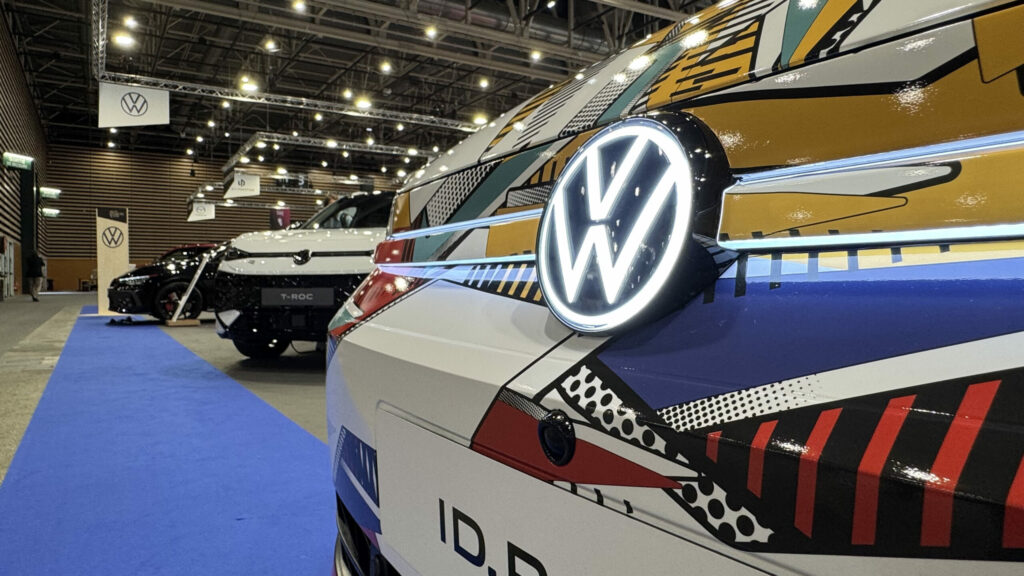
But what interested us most was when the tarpaulin went up to reveal the new ID. Polo. Well, unveiling is a big word, as it retains its camouflage, in this case a nod to the iconic Polo Harlequin of the 1980s. During the presentation, VW did not mince its words: it was a ‘revival’, but also ‘a return to the source’. A new backlit light signature has been added to the Polo’s emblematic sturdy wheel arches and inverted C-pillar. It’s hard to say much more about the design, as this is still a camouflaged version, and the interior is not yet in its final form. But we do know that it will be just over 4 metres long and, despite a wider front end, will still be the city car we’ve been waiting for.
Credit: ECO MOTORS NEWS
As for the technical specification, there’s not much to go on here either, but this electric ID. Polo electric, in its most powerful version, will offer, according to Volkswagen, a range of up to 450 kilometres. What’s more, it will be the group’s first electric traction car!
“Quality, robustness and accessible innovation“.
The group is very enthusiastic, and insists that the ID. Polo, whose launch coincides with the model’s 50th anniversary, will retain everything that has made previous generations so successful: “quality, robustness and accessible innovation“. As far as the first two points are concerned, we’ll have to wait for more information and, why not, the car in our hands.
Credit: ECO MOTORS NEWS
In terms of affordability, Volkswagen says its ID. Polo will start at €25,000 for the French market. Manufactured in Spain at Volkswagen’s Pamplona plant, it will go on sale in May 2026, with deliveries scheduled for the following autumn. Just in time for a new social leasing campaign? That seems to be the brand’s objective…
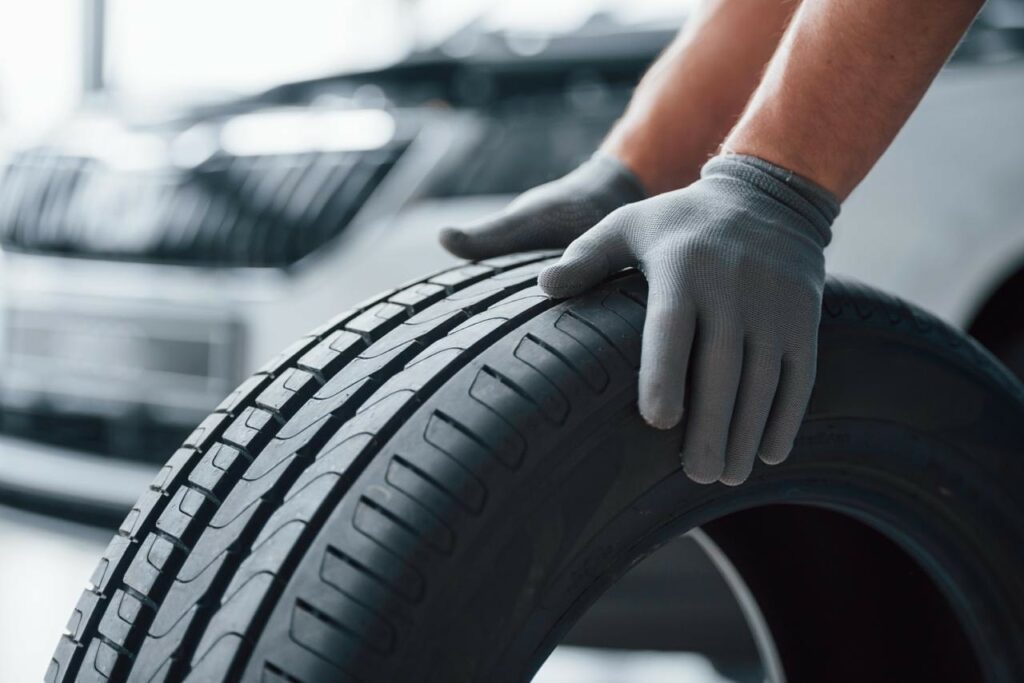
Innovation knows no bounds. The latest example is continental’s idea to reuse cooking oil in the creation of their tyres.
Known as one of the leaders in the global tyre market, the German tyre manufacturer is continuing its journey towards carbon neutrality. Following in the footsteps of recycled polyester and natural rubber, Continental is making further progress, this time using used cooking oil to produce rubber. By 2024 almost 26% of the raw materials used by the company were renewable or recycled. The objective is clear: to reach 40% by 2030 and aim for 100% sustainable materials by 2050.
How does it work?
After being harvested and treated, the cooking oil is processed to obtain a raw material that can replace synthetic rubber. A tyre is made up of two types of rubber: natural rubber, which is extremely resistant to wear, and synthetic rubber, which has superior braking and rolling resistance characteristics. By replacing part of the latter, Continental limits the use of fossil resources while guaranteeing identical performance and lifespan according to its own tests.
A market where innovation makes the difference
Faced with competitors such as Bridgestone, Michelin and Goodyear, Continental is banking on its lead in sustainable tyres to stand out from the crowd. In a sector where the reduction of emissions and the circularity of materials are becoming major criteria, the German firm is establishing itself as a major player. It remains to be seen whether this innovation will catch on on a large scale and pave the way for other similar initiatives.
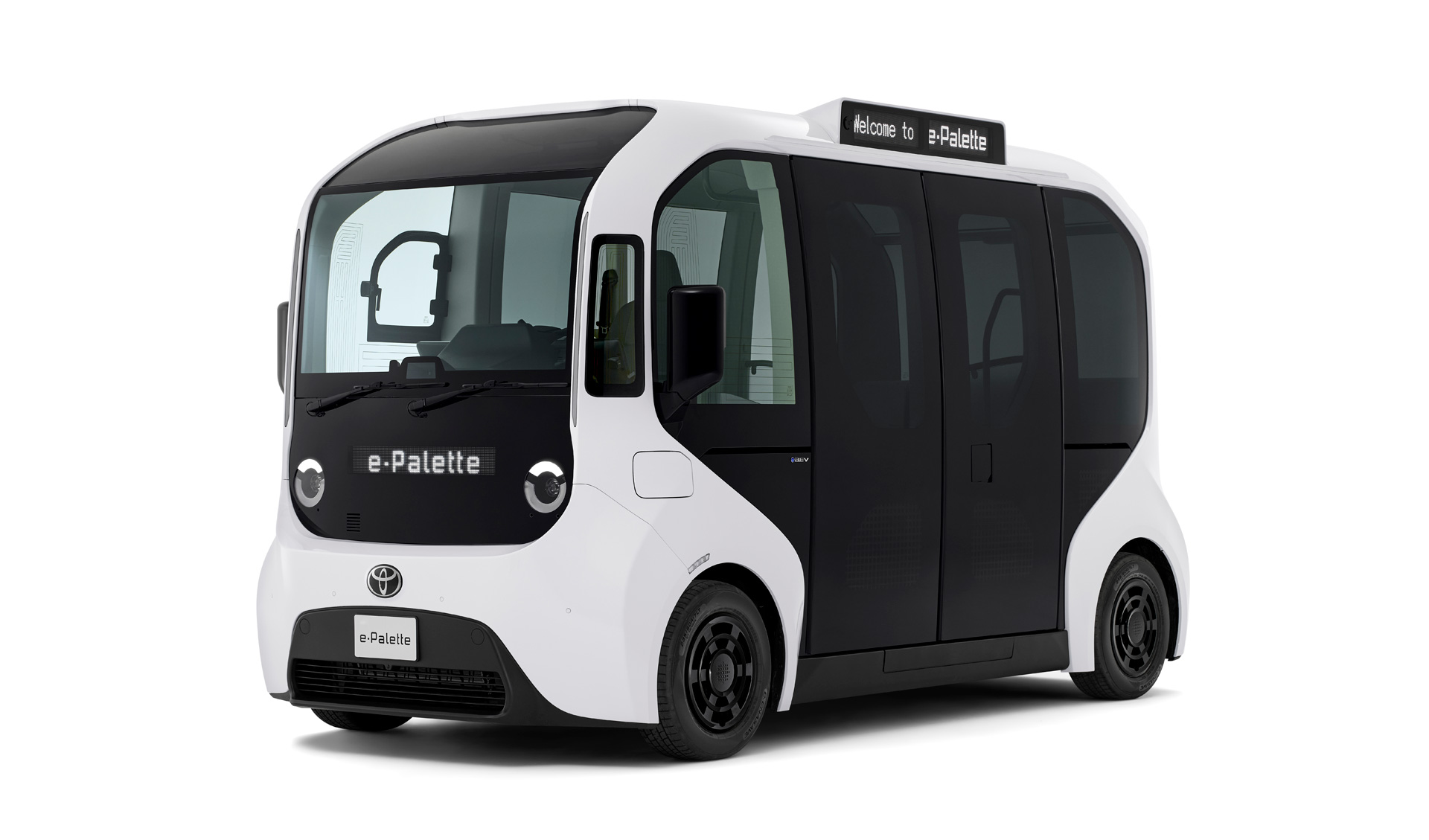
The e-Palette, Toyota’s autonomous (and inevitably electric) shuttle, is one step closer to the of the future as our ancestors imagined it. Not a flying car, of course, but a multitasking vehicle that can adapt to any situation.
Let’s delve into our childhood memories: a comic strip, a film, a book about the future. “future”. There’s no escaping flying cars, no escaping ‘intelligent’ robots, and no escaping omnipresent ubiquitous screens, ditto. And, more often than not, in this fantasised future, people no longer on the cow floor in a car. No, they climb into autonomous vehicles autonomous vehicles, which can be fitted out as they please and asked to go anywhere. anywhere. Toyota has ticked that last box with the e-Pallet.
Toyota credit
Initially used in prototype form at the Tokyo Olympics in 2021 as a showcase for the Japanese giant’s technological know-how, it will finally see the light of day, “for real”. the Japanese giant’s technological know-how, it will finally see the light of day, “for real”, first in Japan, before perhaps conquering the world. Of course, its prohibitive price tag of €165,000 makes it primarily a vehicle for connected cities, or those in the process of becoming ‘smarter’. “These are likely to flourish over the next 10 years.
Ultra-modular architecture
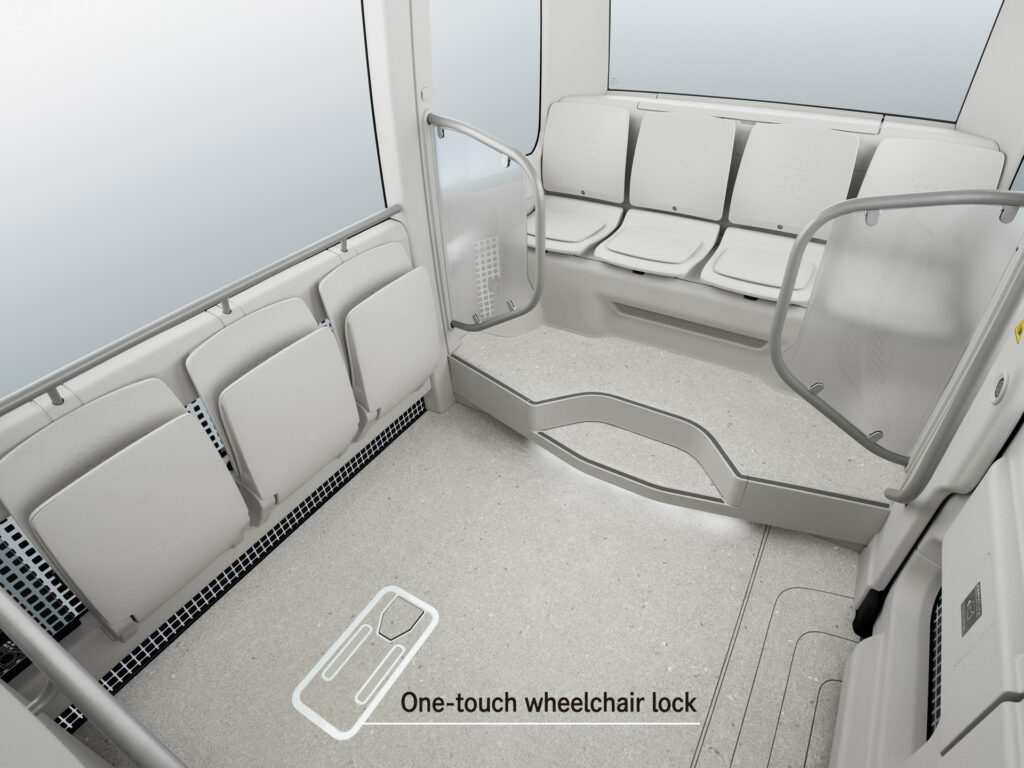
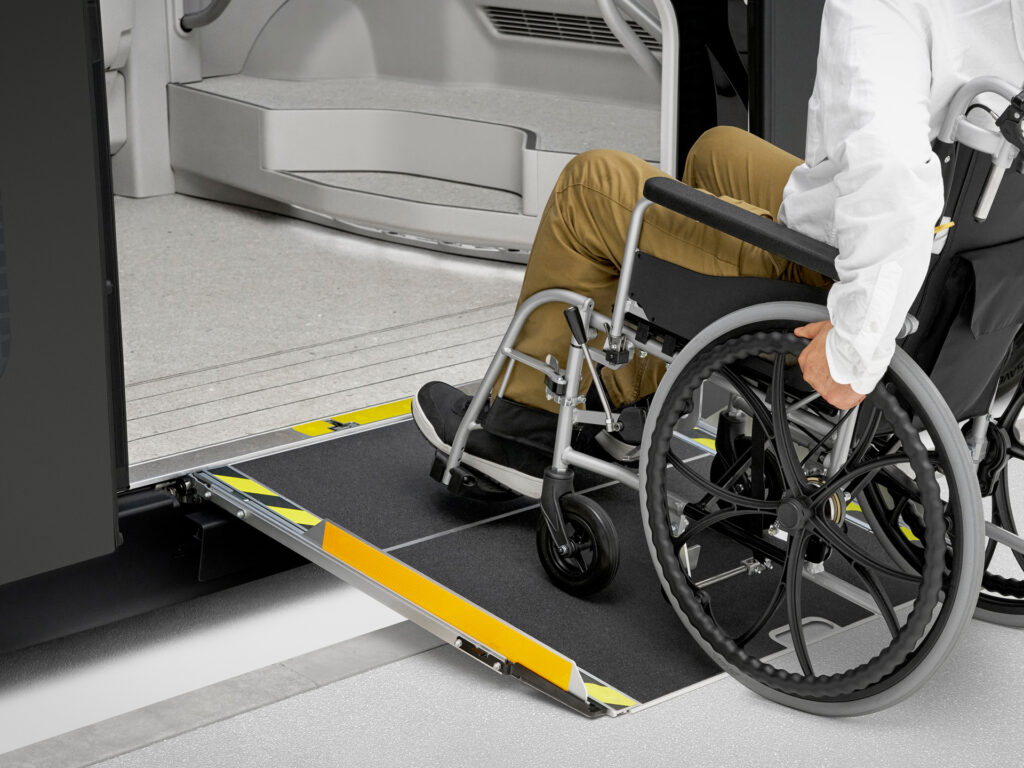
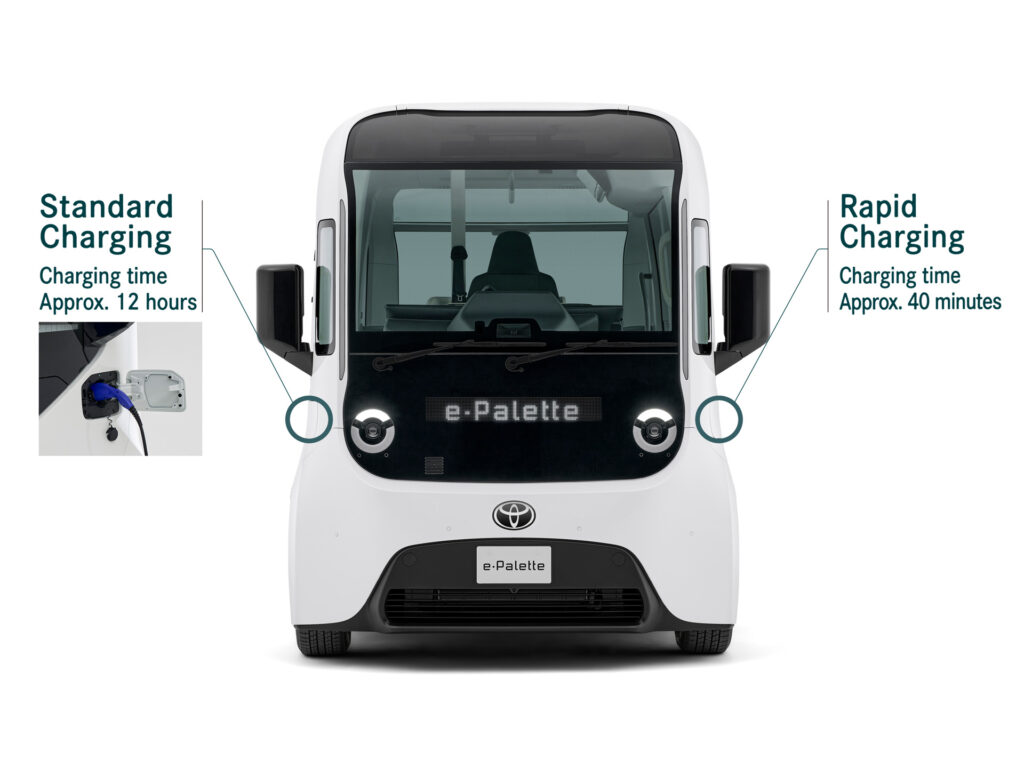
Enough chit-chat about the concept, the idea, the motivations. Now that it’s really coming out, we can we can talk about something concrete. This Toyota e-Pallet is almost 5 metres long, 2.65 metres high and 2 metres wide. That’s plenty of space inside, but the reduced driving position and the absence of an imposing combustion engine. More than volume, it’s above all the e-Palette’s versatility.
Toyota Credit
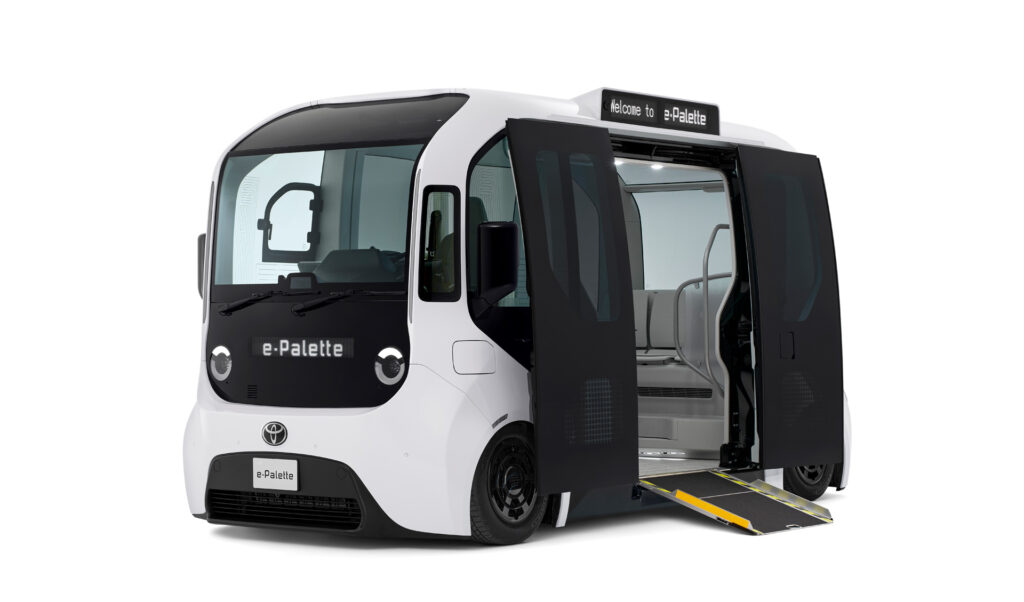
It’s like a blank sheet of paper on wheels, so you can transform it as you wish, depending on how you want to use it. as you like, depending on what you want to use it for: a medical vehicle, a mobile pop-up mobile pop-up store, taxi lounge, why not a coffee-shop or simply an XXL trunk? In short, we can imagine it transporting patients from one hospital wing to another, or simply from the airport to their hotel in a cosy space, enabling a shop to pick up customers rather than bringing them in, or delivering parcels. parcel delivery.
Toyota Credit
All with enough power to go the distance. The e-Palette is equipped with a battery of almost 73 kWh battery and a 150 kW electric motor. Not enough to set the Le Mans race Le Mans, but it is claimed to have a range of nearly 250 km. That’s pretty good for a commuter! And to be really useful all the way, Toyota has thought of the possibility of transforming its e-Palette into an electric generator if required. e-Palette into an electric generator if required.
100% autonomous by 2027?
In the introduction, I talked about autonomy. Then, later in the article, I mentioned the driving driving position. It’s not a mistake on my part, I’m just getting ahead of myself. For the time being, the e-Palette only benefits from level 2 assisted driving, which gives it a good deal of autonomy, but still requires a great deal of preparation. This gives it a great deal of autonomy, but still requires the presence of a driver. Level 4 autonomy, which enables the vehicle to be driven without a driver (on defined stretches of road known to the vehicle), will be available in the future. known to the vehicle) is planned by Toyota for 2027. That’s tomorrow.
Toyota credit
A pioneer in hybrids when no-one believed in them, then in ‘smart cities’ with its Woven City, when it was just a distant idea, Toyota continues to give us glimpses of the future before anyone else. the future before anyone else, this time with a simple electric shuttle that we could well see (it or the models that follow it). be seen on our streets in large numbers in the next decade. decade.
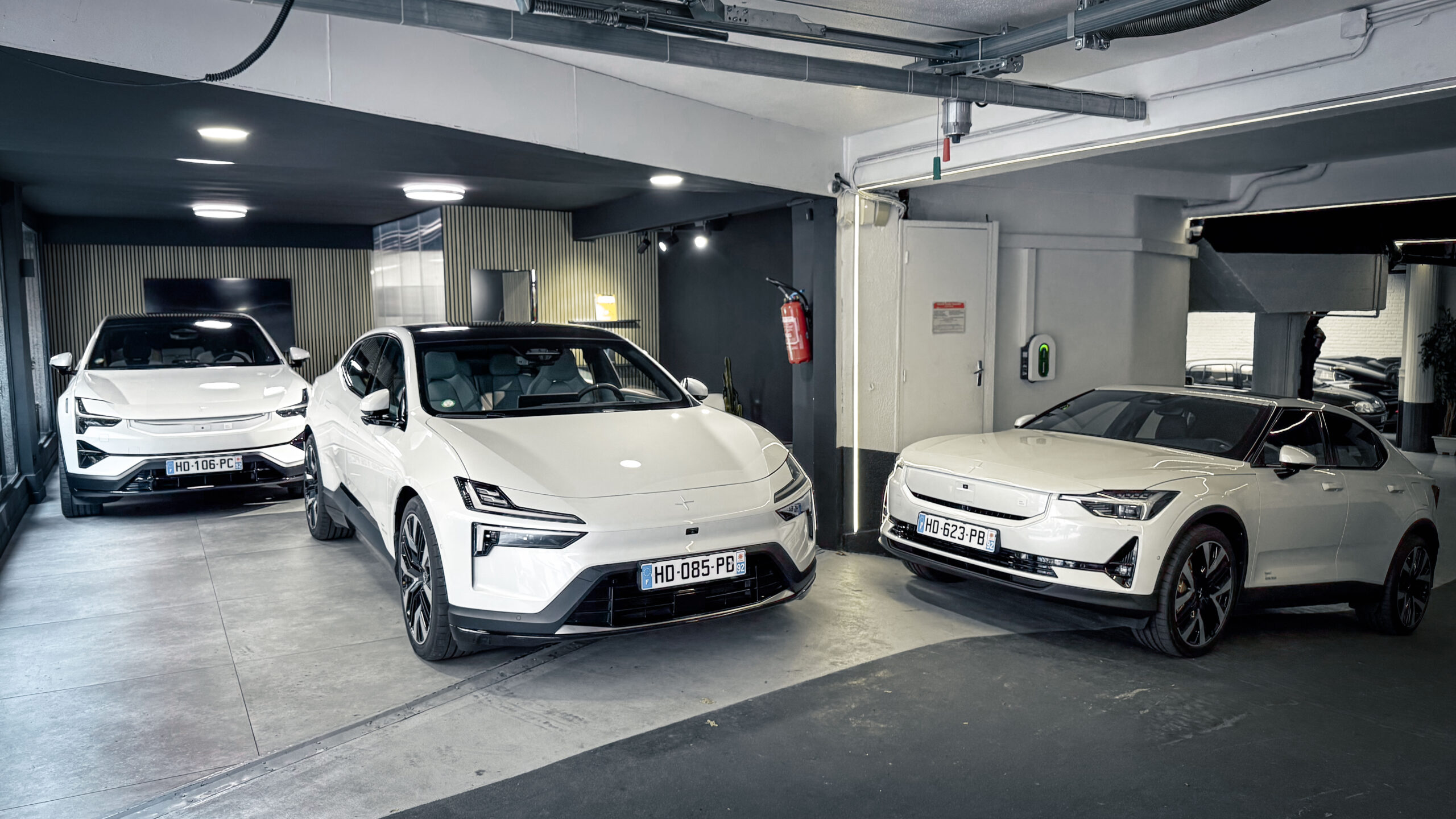
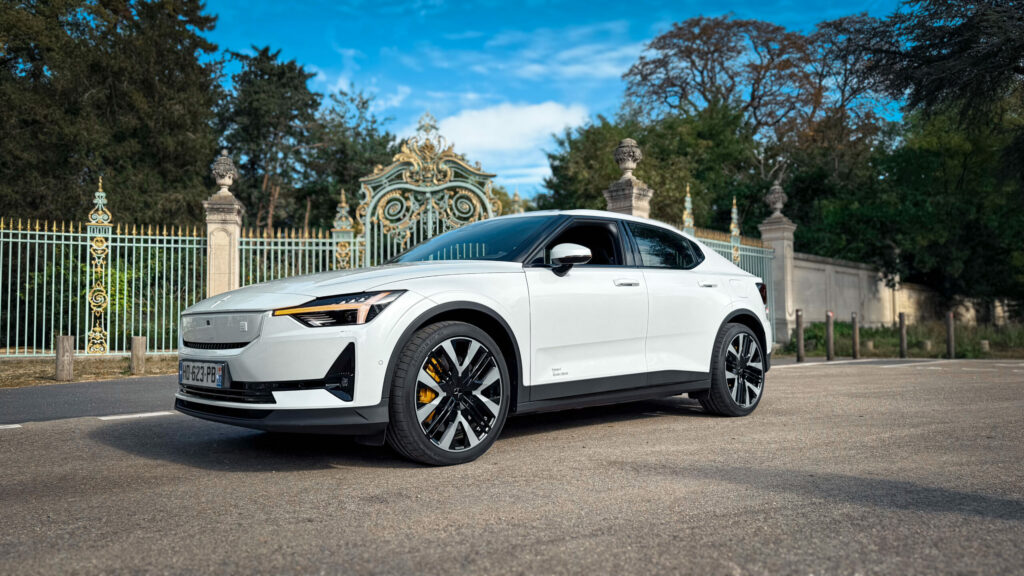
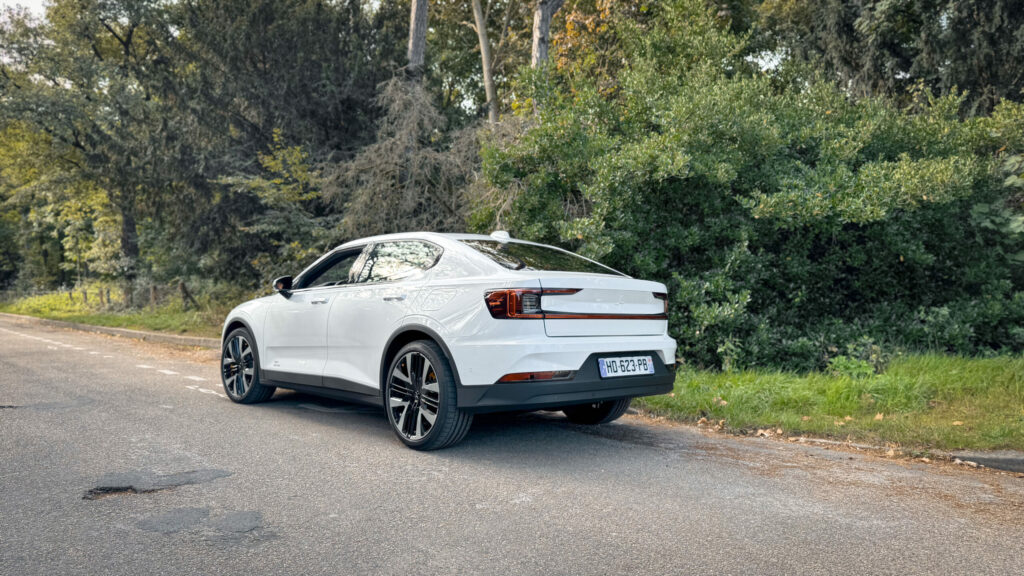
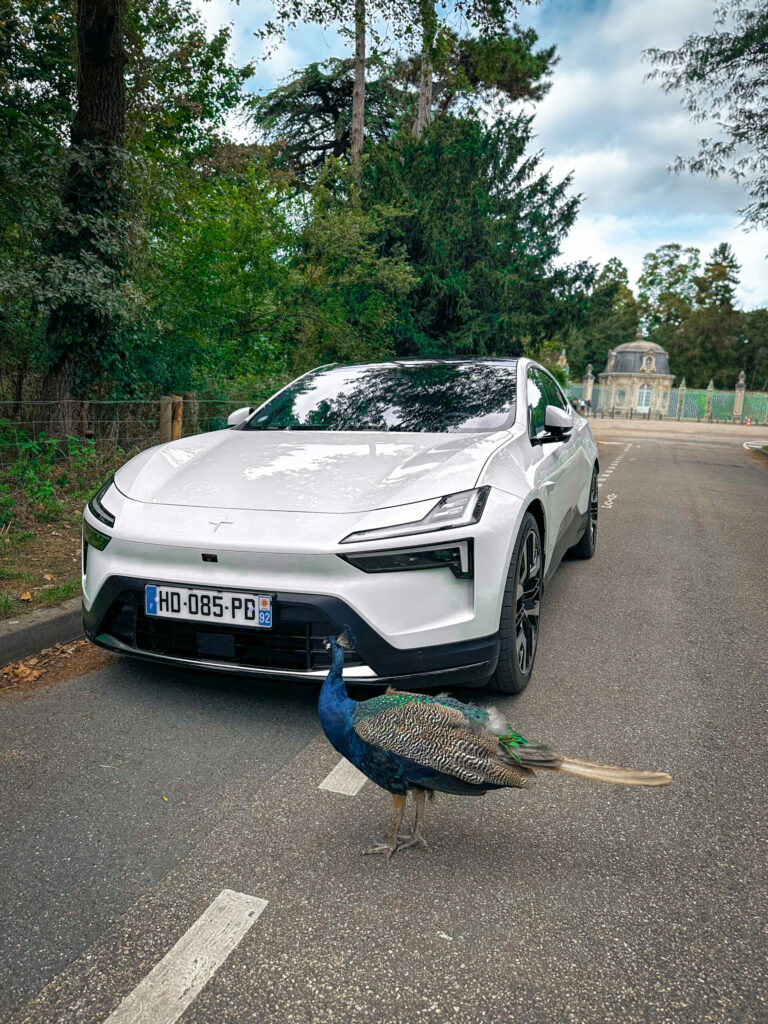
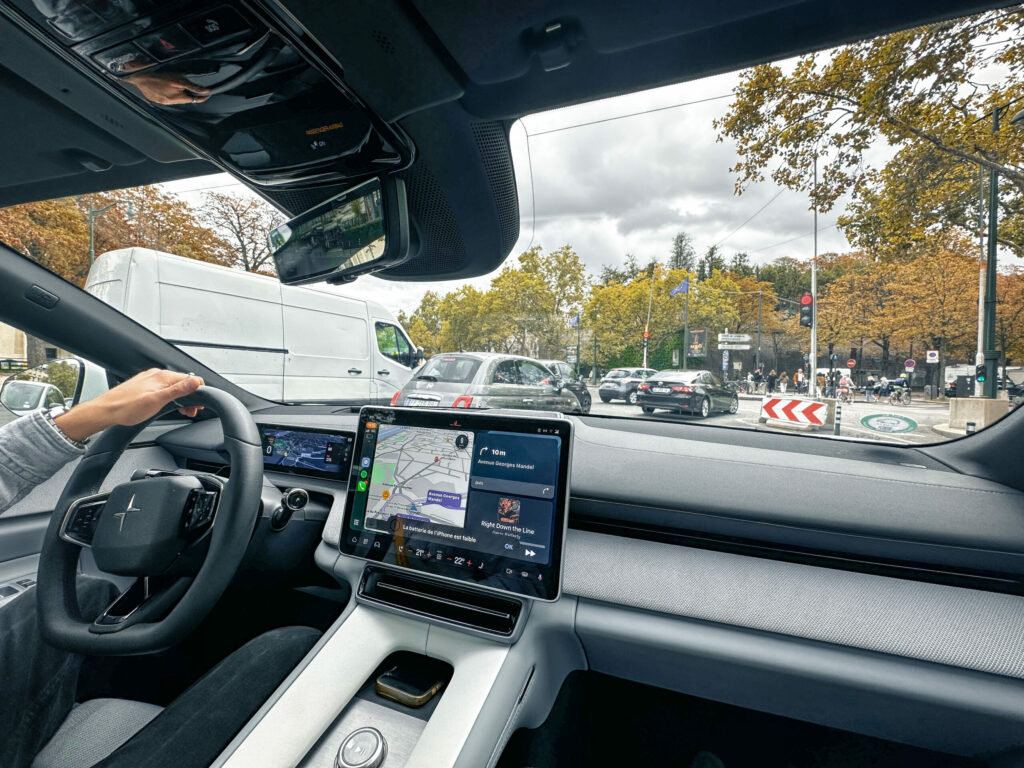
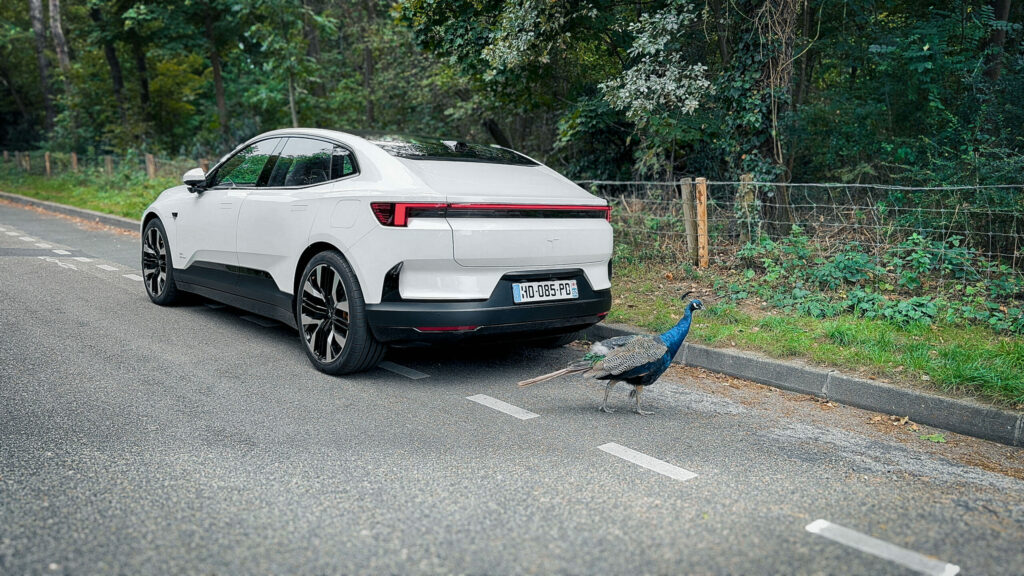
ECO MOTORS NEWS took the three Polestar models – soberly named 2, 3 and 4 – for a triple test drive to find out who they are designed for and what they are used for.
Polestar 2, 3 and 4. (Credit: ECO MOTORS NEWS)
Polestar is a Swedish brand, spearheading the Volvo Group’s premium electric range. In 2020, it will hit the market with its first production model, the Polestar 2. But it would be a long time before it arrived in France, because of a legal imbroglio with a famous French brand that thought the Polestar logo looked too much like the chevrons. So it was in June 2025 that the firm from the cold finally put down its wheels in France. But a lot has happened in 5 years! Since the release of the Polestar 2, models 3 and 4 have appeared in the catalogue, and they too are available here. The story was too good for ECO MOTORS NEWS to pass up, so we decided to test not one but all three Polestar models! This is an opportunity to draw up a comparison based on our feelings and sensations behind the wheel of these top-of-the-range electric nuggets which, for the time of our test, swapped the Arctic Circle for the cobbles of Paris, the ring road and the woods that dot the inner suburbs. It’s worth noting that the models we tested are all equipped with the Performance Pack and the Long range Dual motor, the most premium configuration.
Polestar 2, the urban car that’s out of the ordinary
The brand’s inaugural production model, Polestar had the onerous task of conveying the brand’s philosophy from the outset: comfort, safety, premium quality and driving pleasure. And it does just that, with 476bhp and 740Nm of torque, more than enough to get you out of tricky situations in town – when you’re coming out of a roundabout or in the wrong lane – and of course on the motorway. Because even if this is not its basic mission, we have no doubt that this Polestar 2 will have no trouble swallowing up the kilometres, with a claimed range of 568 km that is not so far off the reality of our test, despite several greedy accelerations and decelerations.
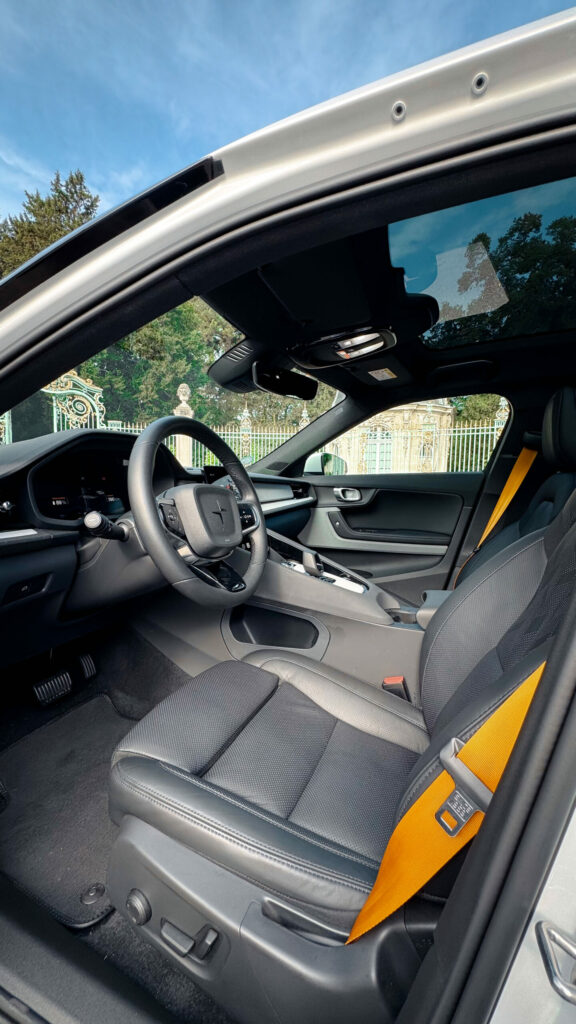
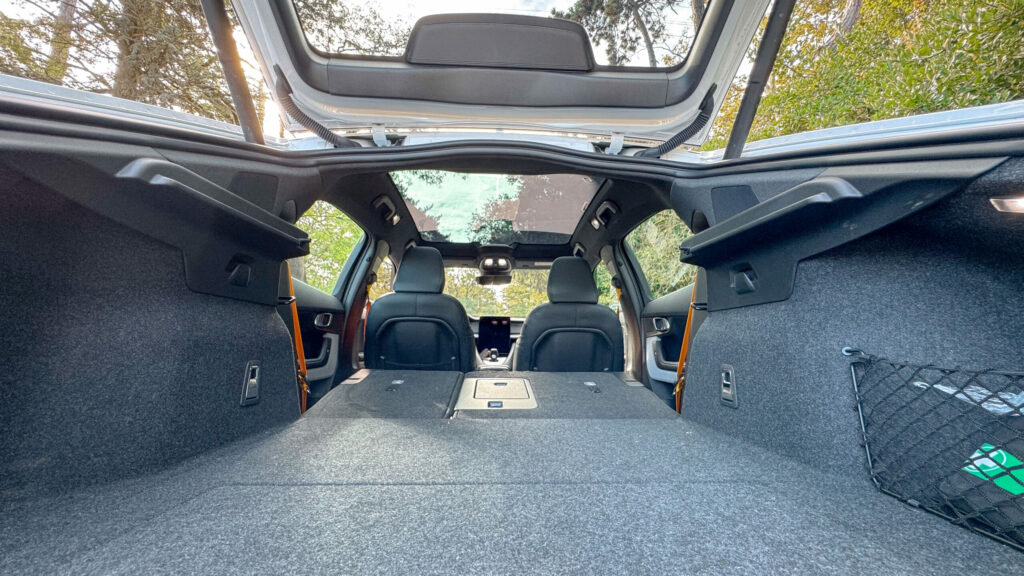
Even so, the target audience is urban: city dwellers who want a ‘small’ saloon – 4.6 metres long – for their daily commute, but with enough room to take the family away for the weekend. Once again, the promise is kept. There’s plenty of room in the front and rear seats, as well as in the boot, which boasts 407 litres with the seats up and 1,097 litres with the seats down. The cabin is uncluttered, and the 11-inch vertical screen is big enough to manage everything without a problem, but blends in well enough not to get in the way. It lets you adjust almost everything in the vehicle, offering several options at a time. For our part, we really liked being able to tighten up the feel of the steering wheel or select a less lively ‘One Pedal’ mode.
The centre pillar, which is rather bulky, may please those who appreciate the ‘cocoon’ aspect for the driver, but we found that it made us a little less comfortable. In fact, that was one of the downsides of our test drive: the upholstery is a little stiff and you can feel it after several hours’ driving. Finally, the turning circle of 11.5 m, while not ridiculous, can sometimes be a little tight for a city car. All this is compensated for by the ‘slow speed’ mode which, particularly during manoeuvres, proves very useful in limiting unintentional excessive acceleration when starting off (available on all Polestar models).
In brief:
As the entry-level model in Polestar’s range (starting at €46,900), the Polestar 2 inevitably suffers a little in comparison with the other models in the catalogue. But if we look at its competitors in the city saloon market, it offers one of the best value for money. Above all, the 2 is practical, ultra-customisable, a real pleasure to drive and slips along quite nicely between boulevards and main roads.
Technical data (model tested) :
Transmission: all-wheel drive (Dual Motor)
Power: 350 kW / 476 bhp
Torque: 740 Nm
0-100 km/h: 4.2 s
Maximum speed: 205 km/h
Towing capacity: up to 1,500 kg
Battery: 400 V lithium-ion, 82 kWh capacity
WLTP range: 568 km
Fast charge up to 205 kW: 10% – 80% in 28 min
Length: 4,606 mm
Width including mirrors: 1,985 mm
Height: 1,473 mm
Wheelbase: 2,735 mm
Wheels : Performance 20″ wheels
Price: €63,300
Polestar 3, the (very) top-of-the-range SUV
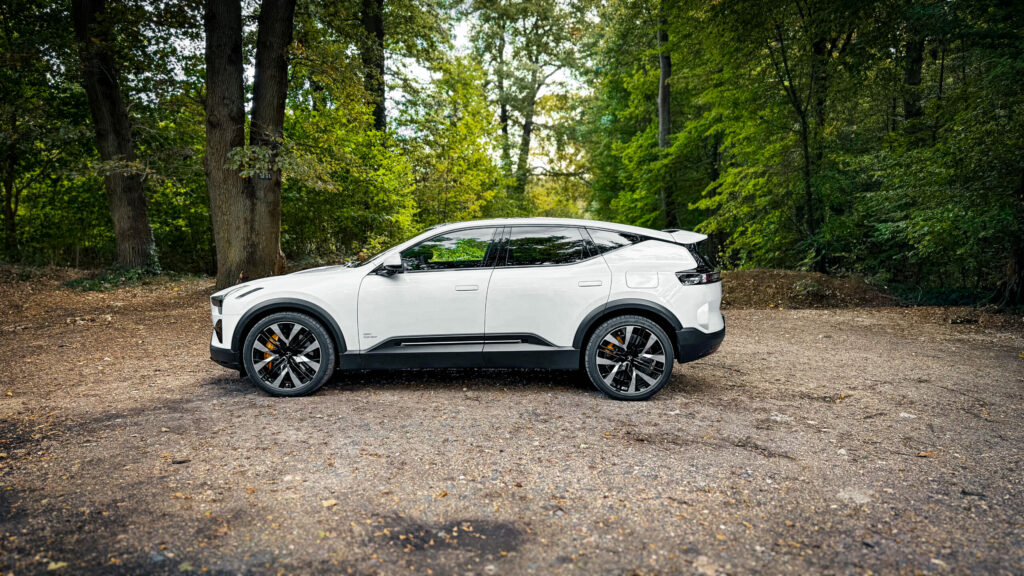
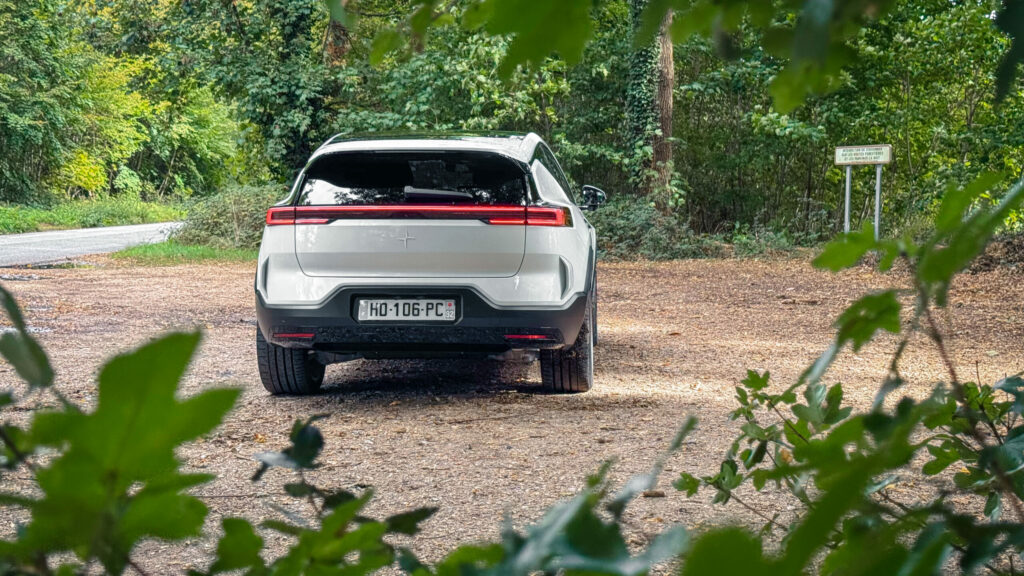
Spoiler alert: this is our favourite model. It’s also the most expensive. It’s only a short step from saying that we at ECO MOTORS NEWS have expensive tastes. And one step is all it took for us to fall under the spell of this sleek SUV. Even before we put our foot down, we loved the elegant design, with its razor-sharp lines and voluptuous curves. The killer detail? The spoiler on the bonnet, “for aerodynamics”, we’re told by Polestar. Aerodynamic or show-off, it doesn’t matter, it’s very pretty and that’s good enough for us.
Let’s get behind the wheel. For once, we’ll start with the drawbacks. Or rather, the downside, in the singular: range. We’re told that the SUV has a WLTP range of 563 km, and after just one hour’s city driving, a bit of national highway driving and some acceleration to see what it’s made of, the SUV had already lost more than 5% of its battery. Admittedly, this would give us a range of between 480 and 500 km, so not too far off the advertised figure, but on the motorway, it could drop even further…
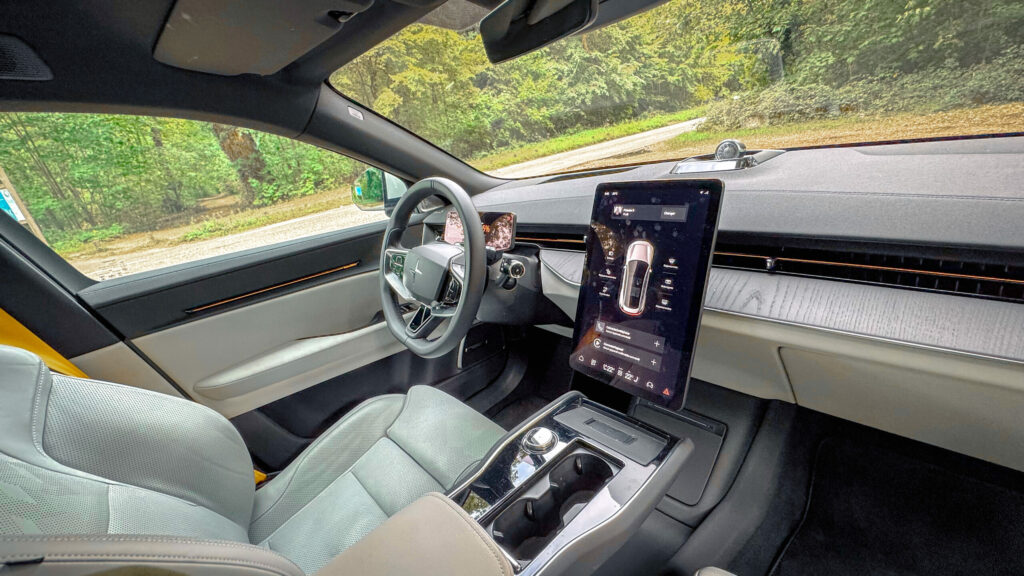
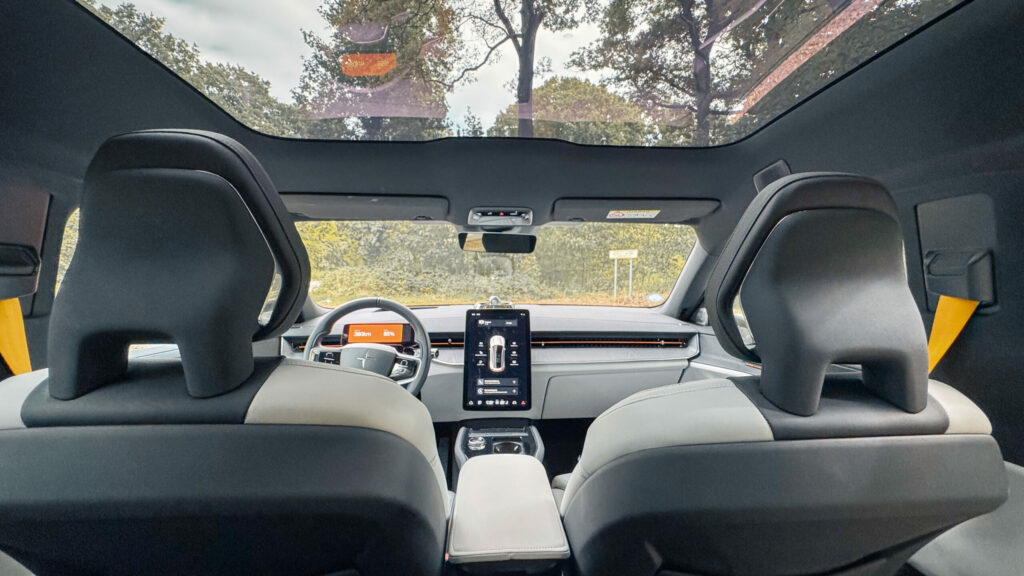
So much for the negative. Now for the positive: everything else. Inside, as on other models from the brand, everything is adjustable and customisable from the central screen. The bonus here is a Bowers & Wilkins audio system – of the highest order – and dozens of options for personalising your experience. By choosing studio mode, it was as if Johnny Cash was in the car with us. Amazing. And if he was really in the back seat, he would certainly have pointed out that he had plenty of legroom! In terms of comfort, it’s 10/10, particularly the quality of the seats, the ergonomics, and the lower, less imposing centre column, which opens up the cabin a little.
It feels much lighter than its 2.6 tonnes, and its large dimensions – almost 5 metres long and more than 2 metres wide, including the rear-view mirrors – are not noticeable when you’re driving, apart from the advantages of the interior space.
In brief:
It’s the most expensive, but it’s not the most powerful, nor the most compact, nor the one with the longest range. So why is it our favourite? For its versatility, for one thing, its comfort, its driving pleasure – without exaggerating, I felt more rested after driving it – and a more than adequate power output of 517 bhp and 910 Nm of torque. In short, it does everything (very) well. Special mention must go to the Bowers & Wilkins audio system, which is a real favourite. The ideal family SUV?
Technical data (model tested) :
Transmission: all-wheel drive
Power: 380 kW / 517 bhp
Torque: 910 Nm
0-100 km/h: 4.7 s
Maximum speed: 210 km/h
Towing capacity: up to 2,200 kg
Battery: 400 V lithium-ion, 111 kWh capacity
WLTP range: 563 km
Fast charge up to 205 kW: 10% – 80% in 30 min
Length: 4,900 mm
Width including mirrors: 2,120 mm
Height: 1,614 mm
Wheelbase: 2,985 mm
Wheels: 22″ Performance
Price: €91,800 inc.
Polestar 4, the powerful sports coupé
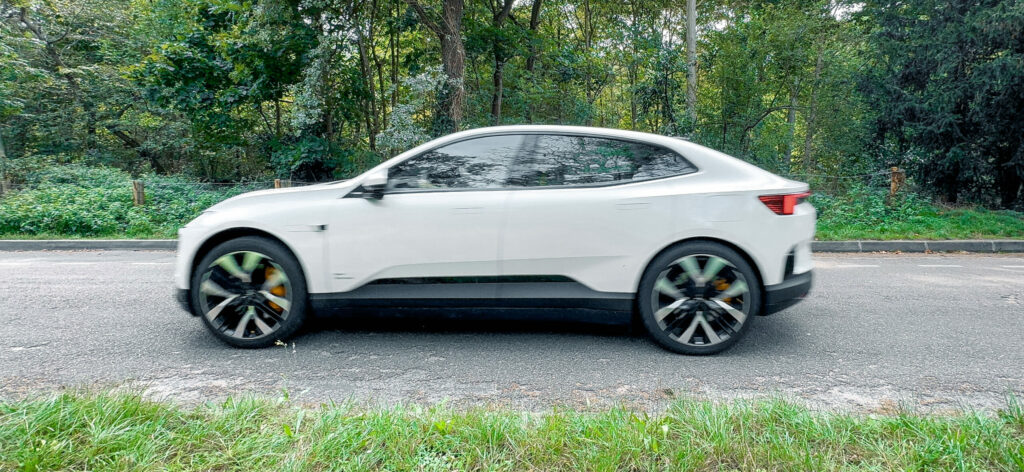
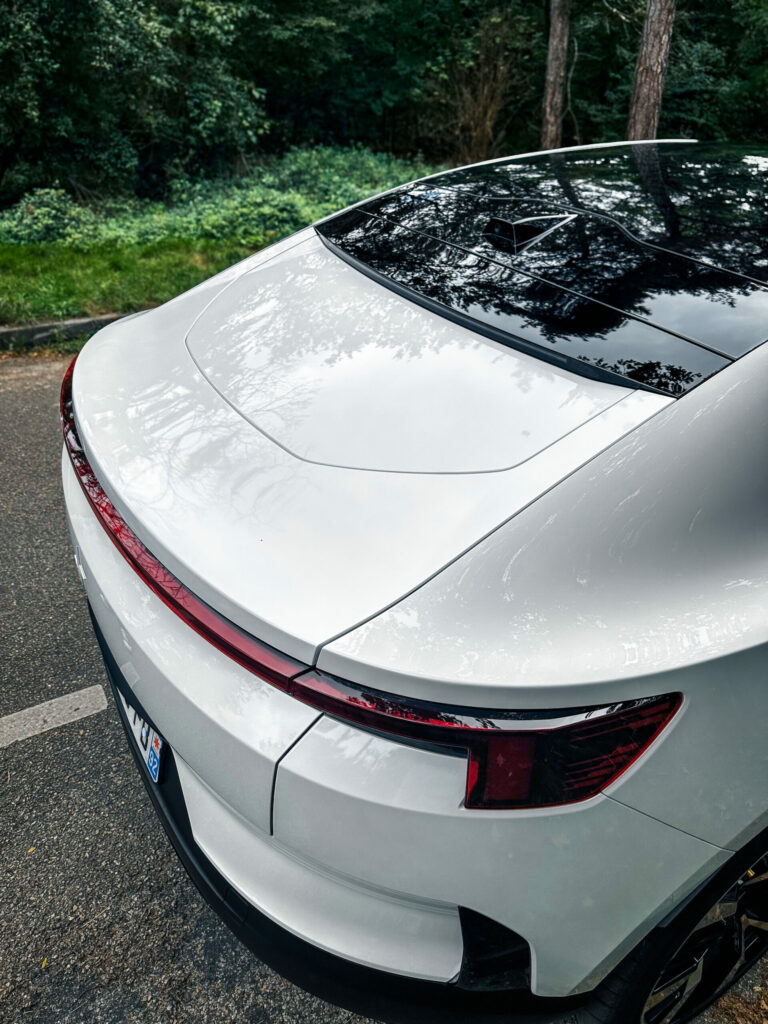
The 4 is the latest addition to the Polestar catalogue, while we wait for the Polestar 5. According to the brand, it’s a large SUV coupé, but visually it looks more like a family saloon. It’s a family car because, at 2.14 m wide and 4.84 m long, it’s a handsome baby with plenty of room in the back, despite a plunging roof that can shave the heads of even the tallest passengers. Above all, it’s the most powerful of the three models at our disposal, putting out 544bhp. And that’s what we liked best about our test drive: standing up from a standing start. In sport mode, you take off, you soar, and a 0-100 kph time of less than four seconds really puts butterflies in your stomach.
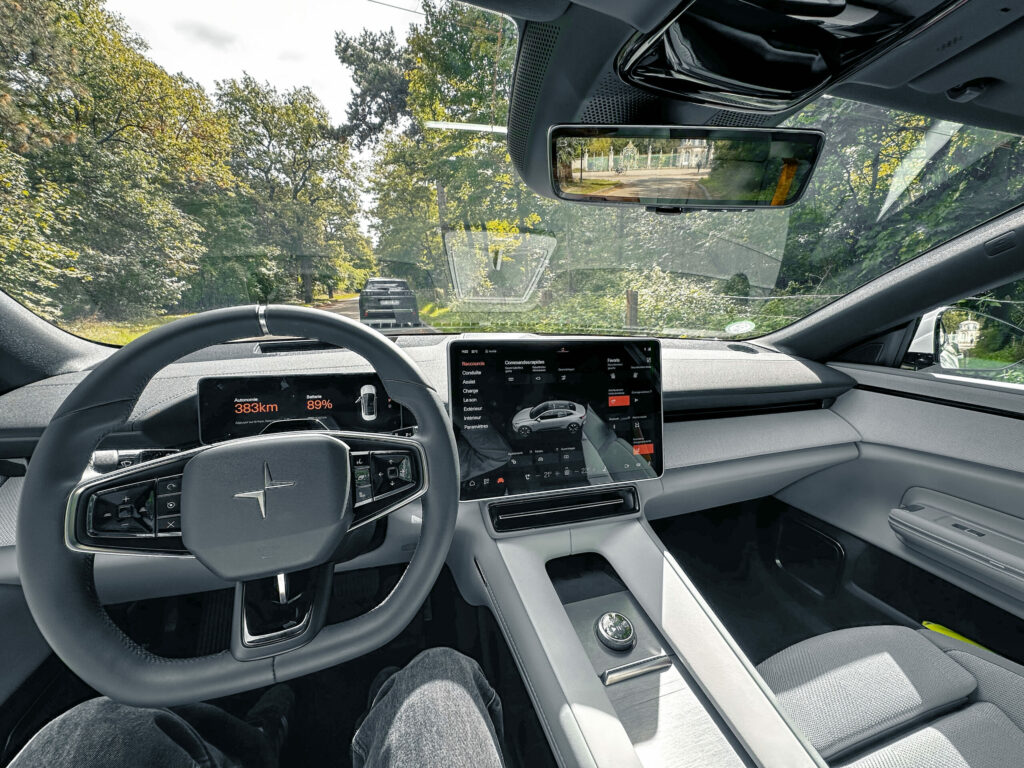
The exterior design is classic, very Volvo in spirit: sleek, elegant, simple and effective. That is, until you go round the corner and find yourself ‘up the arse’ of the car. No rear window! Instead, there’s a camera that sends the image back to the screen that serves as the rear-view mirror. It’s a bit confusing at first, but you get used to it, and then you love it.
The screens are another strong point of the Polestar 4. The central 15.4-inch screen is horizontal and imposing, but doesn’t interfere with driving or concentration. The screen on the dashboard blends in perfectly with the cockpit, and the head-up display is superbly legible. Comfort is high, as are the premium materials, many of which are recycled – a welcome nod to the environment.
The pleasant surprise is the 11.64 m turning circle. That may sound like a lot, but it’s a lot less than the 12.13 m of the Tesla Model Y 2025, for example, and it means you won’t have the drops on your forehead when entering a car park. Add to that a battery of 360° cameras and driving aids (also present on other models, but particularly practical on this beautiful beast that is the Polestar 4), and you’d almost forget its XXL dimensions.
And we say ‘almost’, because in reality, 2.13 m wide is a lot. And that’s one of our downsides, as it inevitably reduces practicality a little. Another negative point is visibility. Nothing dangerous, but the structure of the car takes up a lot of space, particularly to the left of the driver, forcing him or her to do a bit of gymnastics in certain situations.
In brief:
The Polestar 4 is the missing link between the Polestar 2 city saloon and the Polestar 3 family SUV. With a little of both worlds, this SUV coupé/large saloon will appeal to fans of power, comfort and technology. But it will also appeal to consumers who want to stand out from the crowd by owning a car that is one of a kind and, let’s not forget, without a rear window!
Technical data (model tested) :
Transmission: all-wheel drive
Power: 400 kW / 544 bhp
Torque: 686 Nm
0-100 km/h: 3.8 s
Maximum speed: 200 km/h
Towing capacity: up to 2,000 kg
Battery: 400 V lithium-ion, capacity 100 kWh (110 cells)
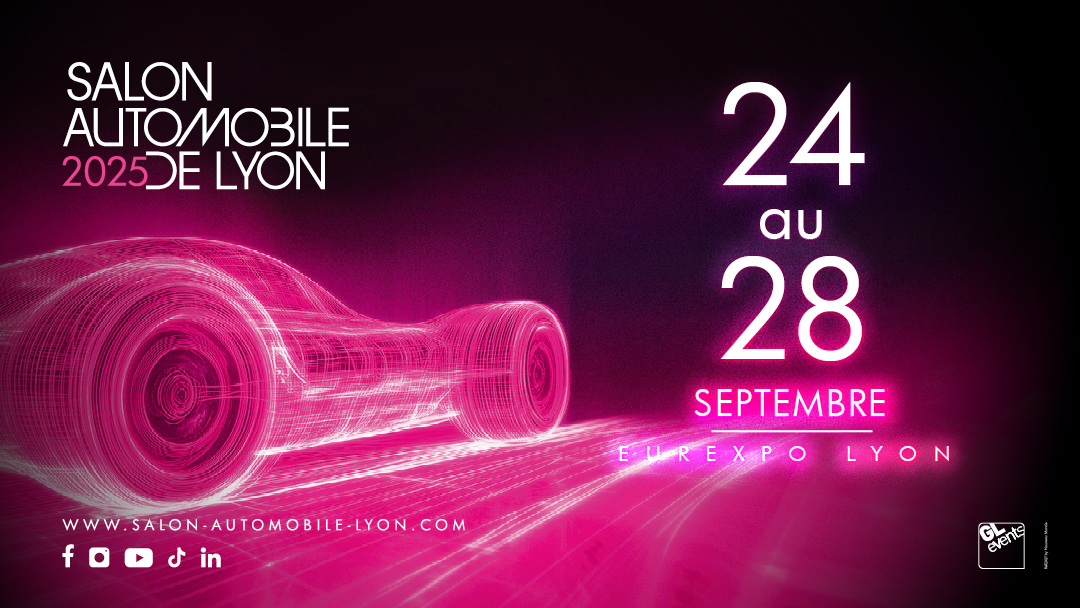
The Lyon Motor Show 2025 will take place from 24 to 28 September. Held every two years, alternating with the Paris Motor Show, it has established itself as the second most important motor show in France. After a successful 2023 event, the 2025 edition will feature a host of new products, including electrified vehicles, and a number of test drives.
Lyon’s Eurexpo centre is getting ready to host the 2025 edition of the Lyon Motor Show from 24 to 28 September. In all, 57 manufacturers are expected to be on hand to present their new products over an area of almost 50,000 m2, some of which will be unveiled to the French public for the first time, others for the first time at all, and some of which will even be previewed. It’s an interactive show that puts the public at the heart of its operation: at the last edition, in 2023, nearly 400 cars were available to test drive, and we’re expecting at least the same number this year.
Credit: GL Events
The Lyon 2025 Motor Show is organised around seven ‘universes’: used vehicles, commercial vehicles, motorsport, van life, services and accessories, ecomobility and new vehicles. Of course, it’s these last two that interest us most, but the editorial team will of course take the time to visit all the stands. And yes, ECO MOTORS NEWS will be there, from the press day on September 23! In the meantime, here’s an overview of the new products that have been announced and/or are expected, although we can’t rule out a few surprises… For that, we’ll have to wait until the big day.
French cars out in force at the Lyon Motor Show
As the capital of the Gauls, the Lyon Motor Show is bound to be a showcase for national cars. DS will be showcasing its new spearhead, the N°8 top-of-the-range saloon/SUV electric coupé, on which the brand is betting big. The company will also be previewing the restyled N°4.
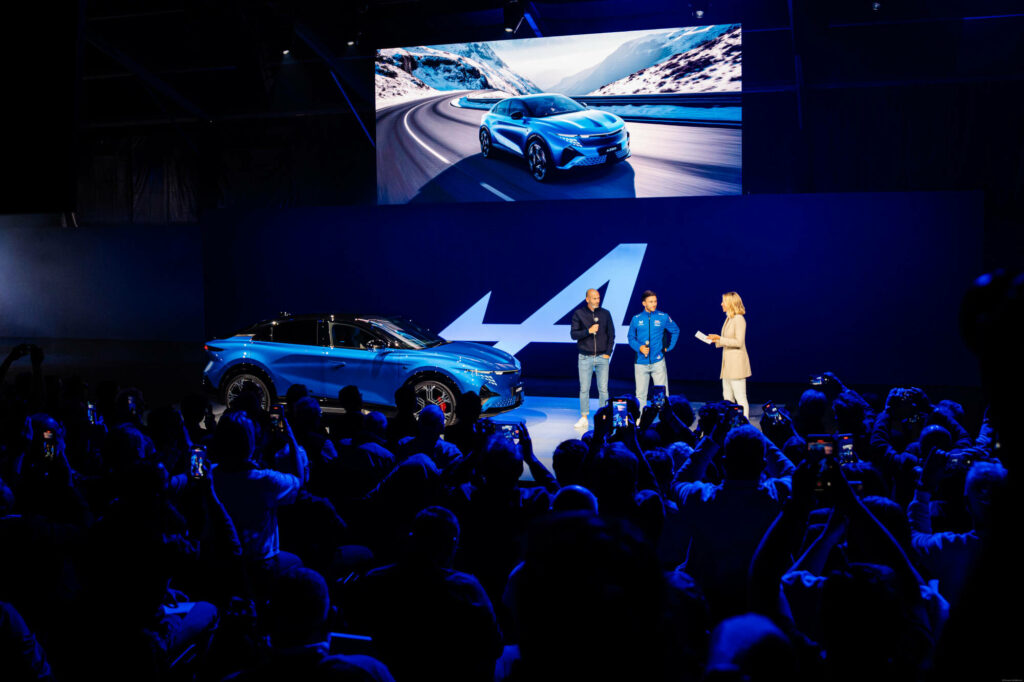
On the Alpine side, the new A390 SUV, unveiled last May at Dieppe, will be making its debut. Following on from the warm welcome given to the A290 city car, which has enjoyed fairly decent sales in this niche segment, this will be an opportunity to confirm the popularity of Alpine electric sauce with a second model positioned in a much tighter market, that of top-of-the-range electric SUVs.
Credit: Alpine Cars
Peugeot’s main attraction will be the presentation of the new e-208 GTI, which is expected to be a showpiece, while Citroën will be highlighting the C3 and C5 Aircross. Finally, Renault will be present with the Clio 6 in the spotlight, already presented in Munich a few days ago.
Manufacturers from all over the world at Lyon
Of course, it’s not just the French manufacturers who will be presenting their new electrified models in Lyon. The giants will be there, including Tesla with the Performance version of its Model Y, and BYD, which is still struggling to sell its 100% electric cars in Europe, and has decided to focus on the Seal 6 hybrid. Still on the subject of giants, Volkswagen, which was already very active in Munich at the beginning of the month, will also be taking up a lot of space in Lyon, notably with the new T-Roc and the still camouflaged version of its ID.Polo.
Credit: Volkswagen
On the other side of the Atlantic, Jeep is planning to present its new Compass to the French public, a compact SUV in which the brand has high hopes, and which will be available in both electric and hybrid versions. Cadillac, the legendary firm from Detroit, is likely to shock the world with two 100% electric monsters: the Lyriq, which we already know, and the Vistiq, even more massive, exceeding 5 m in length and 2 m in width.
What about Japan? Well, the beautiful Lexus ES saloon will be making its first appearance on French soil, as will the upgraded version of the RZ SUV. The Lyon Motor Show will also provide an opportunity to see the new 100% electric Mitsubishi Eclipse Cross in the flesh, as well as the 100% electric version of Isuzu’s legendary D-Max pick-up.
It’s a short step from Munich to the Lyon Motor Show
ECO MOTORS NEWS may have been lucky enough to attend the IAA Mobility show in Munich at the beginning of September, but not everyone else was. But don’t panic, the Lyon Motor Show will be the perfect opportunity to catch up. The Clio 6, as mentioned above, will be making its French debut, and the impressive Skoda Vision O and Audi Concept C will be on show, along with the Xpeng P7+ and some very promising new models from Opel.
Finally, there are a number of models that aren’t exactly new, but which we can’t wait to get close to – and try out? – including the spectacular Lotus Eletre SUV and the already cult Tesla Cybertruck. And, who knows, we might even take a look at the Prestige area and the Hypercars Zone, which, even though they mainly feature combustion-powered cars, will be well worth the diversions with the presence of Aston Martin, Bentley, Ferrari, Lamborghini, Lotus, Maserati, McLaren and Porsche. It’s sure to be a sight to behold!