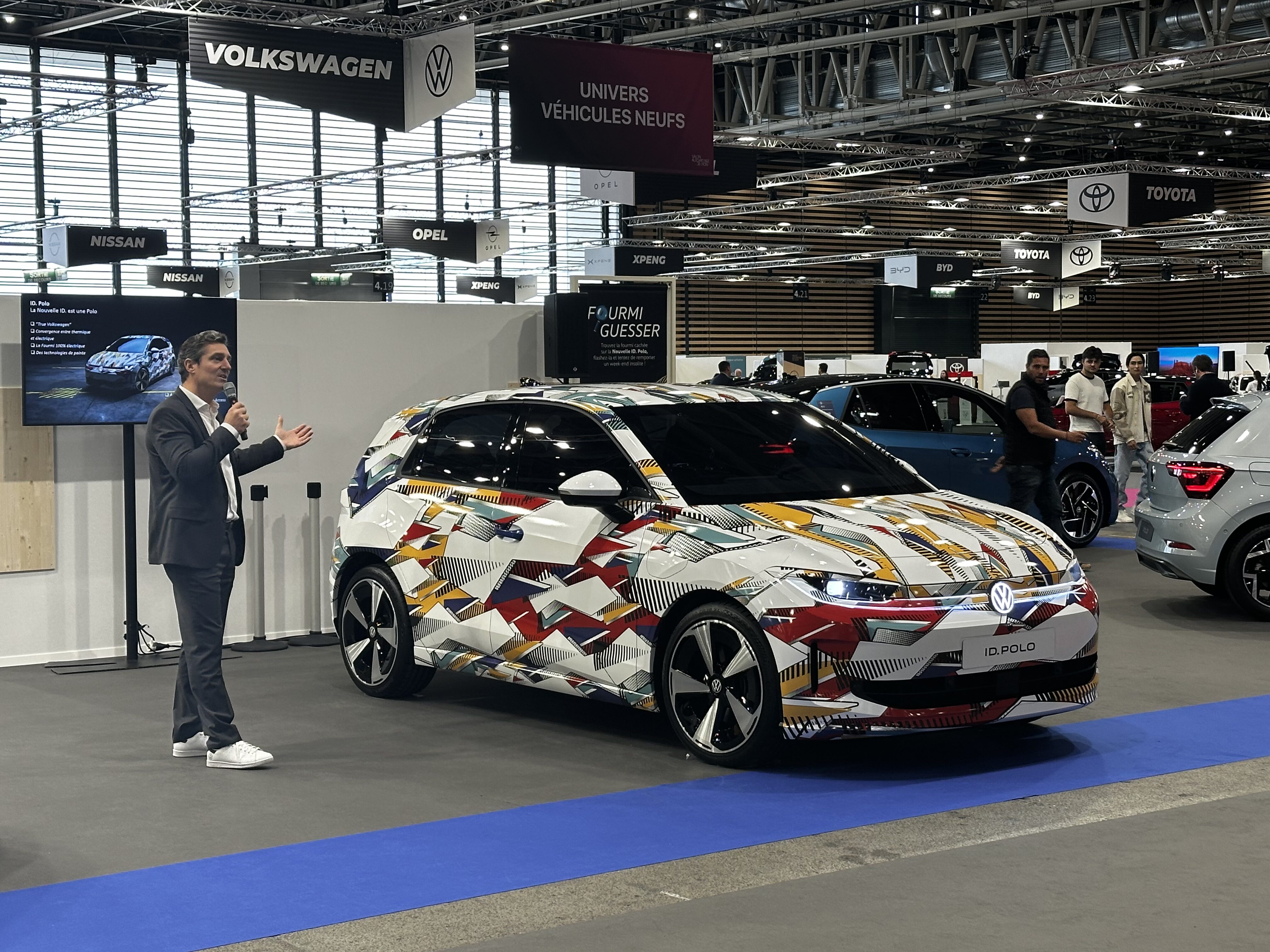
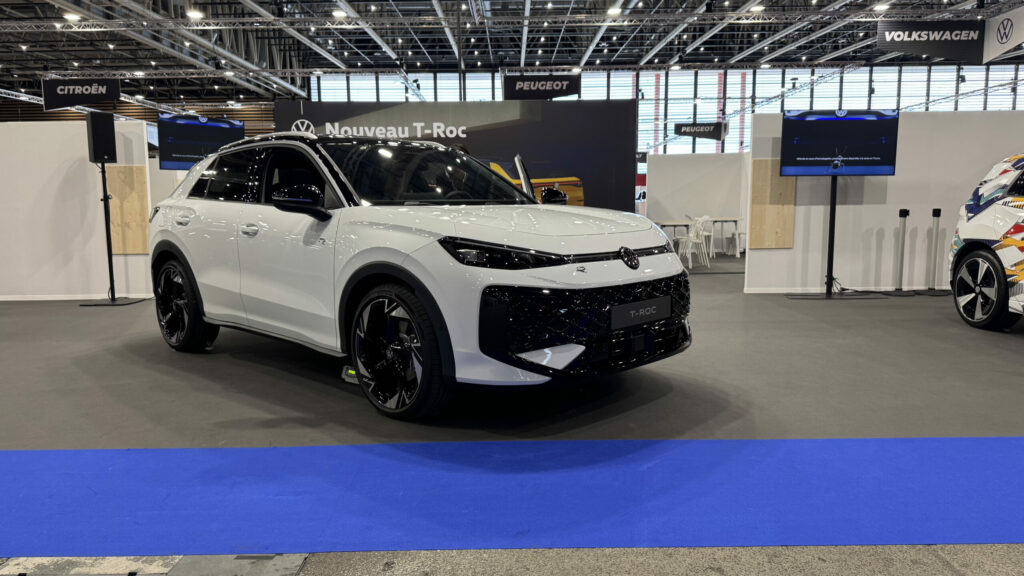
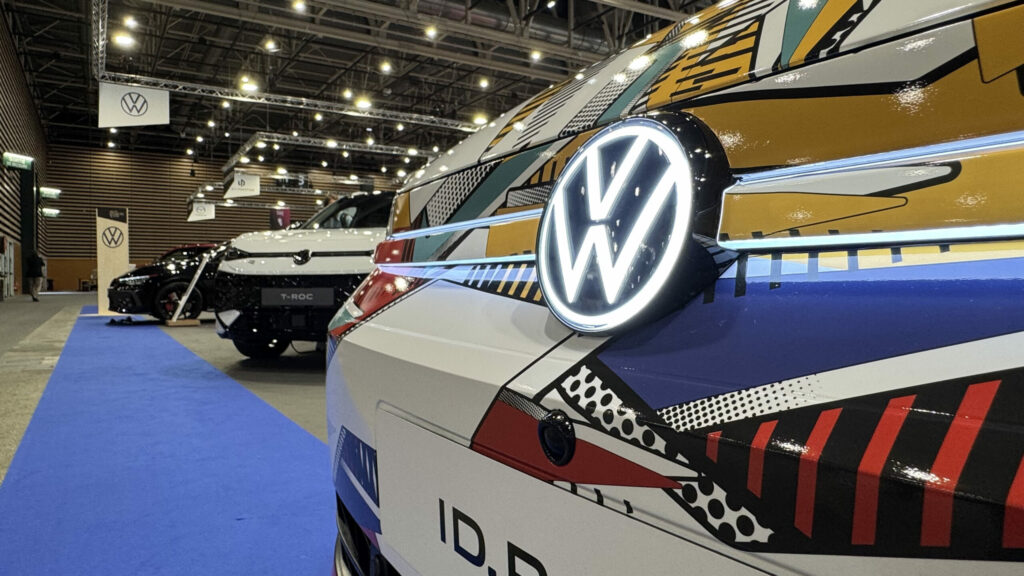
Live from the Lyon Motor Show, ECO MOTORS NEWS witnessed the first appearance in France of two models of vital importance to Volkswagen: the new T-Roc and, above all, the eagerly-awaited ID. Polo 100% electric.
It was a long-awaited announcement, and it was sure to be one of the highlights of the 2025 Lyon Motor Show. At the heart of its imposing stand in the centre of Eurexpo, Volkswagen presented, for the first time in France, the new version of its two best-sellers in France: the T-Roc, in second place, and the Polo, in first place.
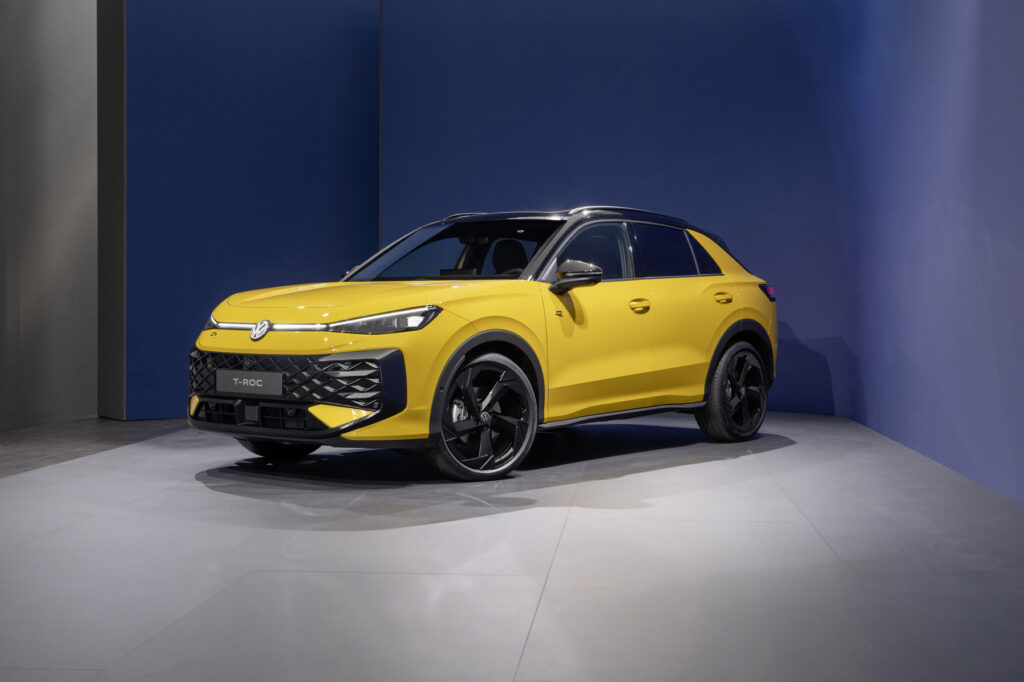
The 2026 version of the T-Roc crossover is being described as a ‘baby Tiguan’, as it benefits from technological improvements that bring it closer to its more upmarket companion – Park Assist, augmented reality head-up display – and shares its platform. 12 cm longer than the previous version, the ‘little’ SUV will be offered with a full hybrid engine.
Credit: ECO MOTORS NEWS
ID. Polo, small but strong
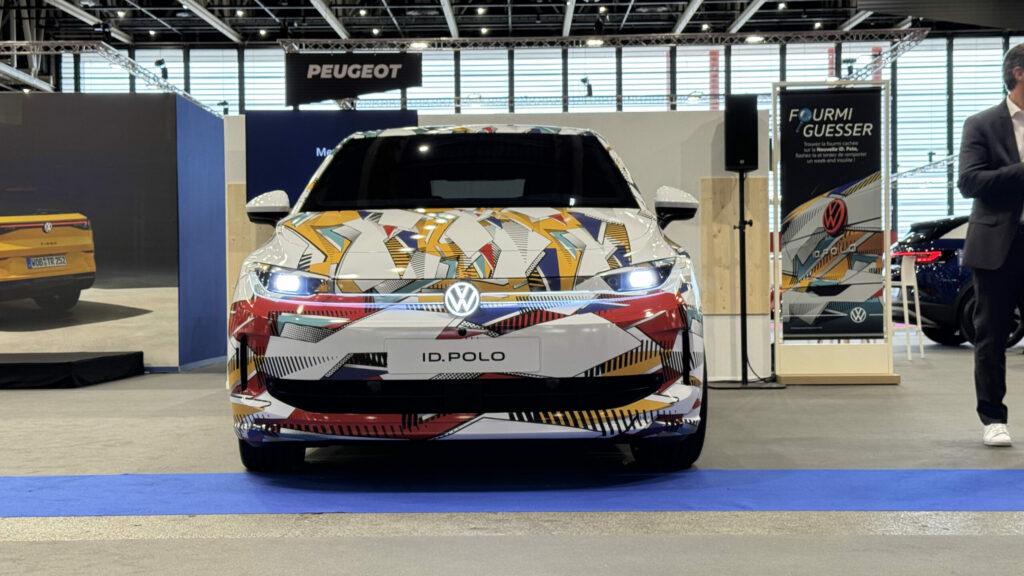
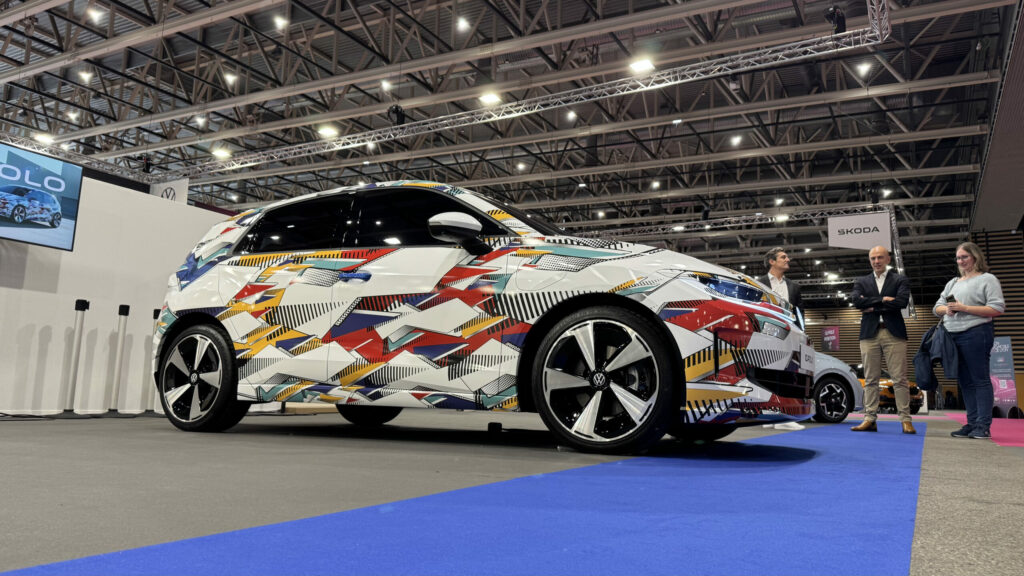
But what interested us most was when the tarpaulin went up to reveal the new ID. Polo. Well, unveiling is a big word, as it retains its camouflage, in this case a nod to the iconic Polo Harlequin of the 1980s. During the presentation, VW did not mince its words: it was a ‘revival’, but also ‘a return to the source’. A new backlit light signature has been added to the Polo’s emblematic sturdy wheel arches and inverted C-pillar. It’s hard to say much more about the design, as this is still a camouflaged version, and the interior is not yet in its final form. But we do know that it will be just over 4 metres long and, despite a wider front end, will still be the city car we’ve been waiting for.
Credit: ECO MOTORS NEWS
As for the technical specification, there’s not much to go on here either, but this electric ID. Polo electric, in its most powerful version, will offer, according to Volkswagen, a range of up to 450 kilometres. What’s more, it will be the group’s first electric traction car!
“Quality, robustness and accessible innovation“.
The group is very enthusiastic, and insists that the ID. Polo, whose launch coincides with the model’s 50th anniversary, will retain everything that has made previous generations so successful: “quality, robustness and accessible innovation“. As far as the first two points are concerned, we’ll have to wait for more information and, why not, the car in our hands.
Credit: ECO MOTORS NEWS
In terms of affordability, Volkswagen says its ID. Polo will start at €25,000 for the French market. Manufactured in Spain at Volkswagen’s Pamplona plant, it will go on sale in May 2026, with deliveries scheduled for the following autumn. Just in time for a new social leasing campaign? That seems to be the brand’s objective…
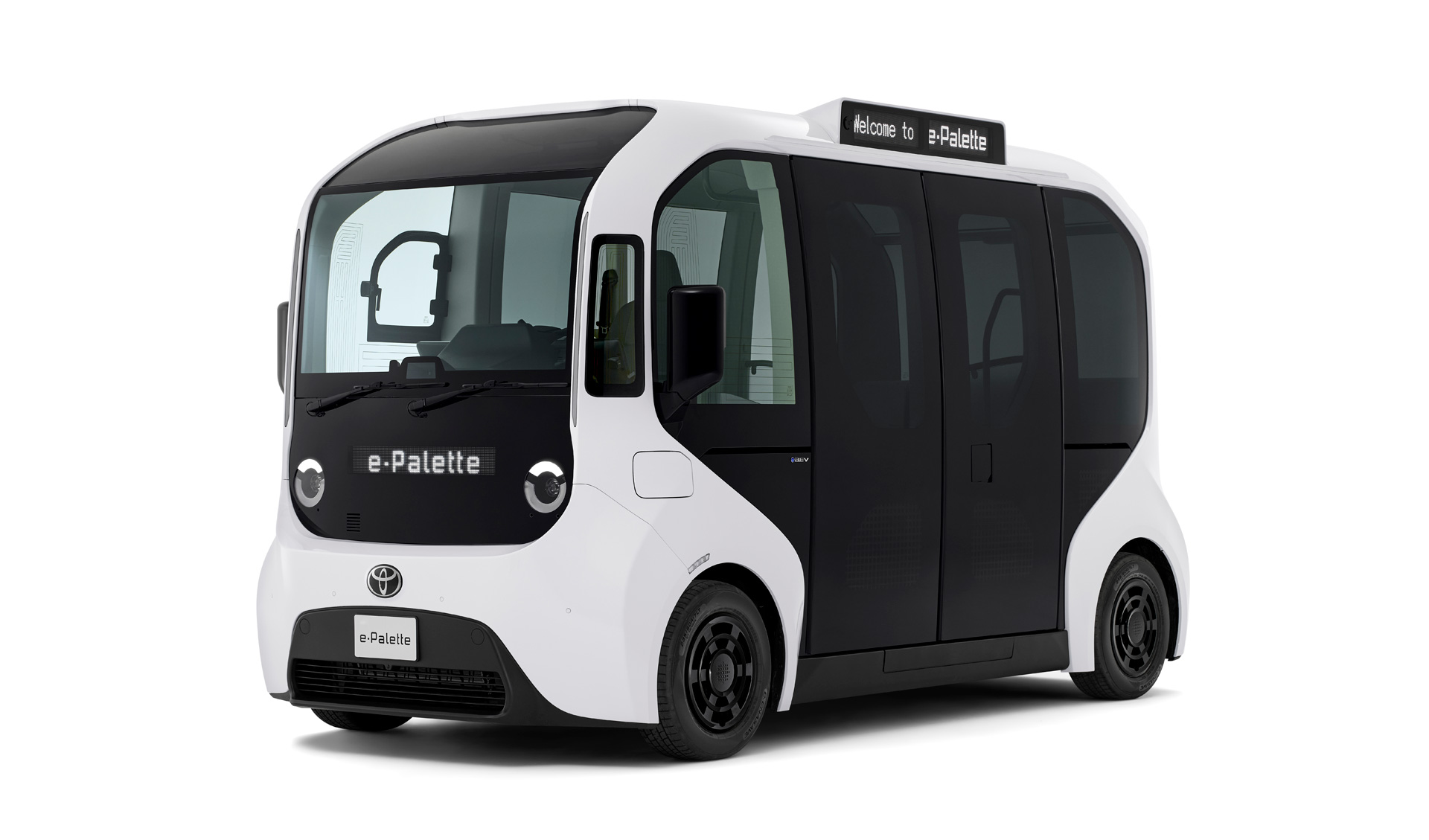
The e-Palette, Toyota’s autonomous (and inevitably electric) shuttle, is one step closer to the of the future as our ancestors imagined it. Not a flying car, of course, but a multitasking vehicle that can adapt to any situation.
Let’s delve into our childhood memories: a comic strip, a film, a book about the future. “future”. There’s no escaping flying cars, no escaping ‘intelligent’ robots, and no escaping omnipresent ubiquitous screens, ditto. And, more often than not, in this fantasised future, people no longer on the cow floor in a car. No, they climb into autonomous vehicles autonomous vehicles, which can be fitted out as they please and asked to go anywhere. anywhere. Toyota has ticked that last box with the e-Pallet.
Toyota credit
Initially used in prototype form at the Tokyo Olympics in 2021 as a showcase for the Japanese giant’s technological know-how, it will finally see the light of day, “for real”. the Japanese giant’s technological know-how, it will finally see the light of day, “for real”, first in Japan, before perhaps conquering the world. Of course, its prohibitive price tag of €165,000 makes it primarily a vehicle for connected cities, or those in the process of becoming ‘smarter’. “These are likely to flourish over the next 10 years.
Ultra-modular architecture
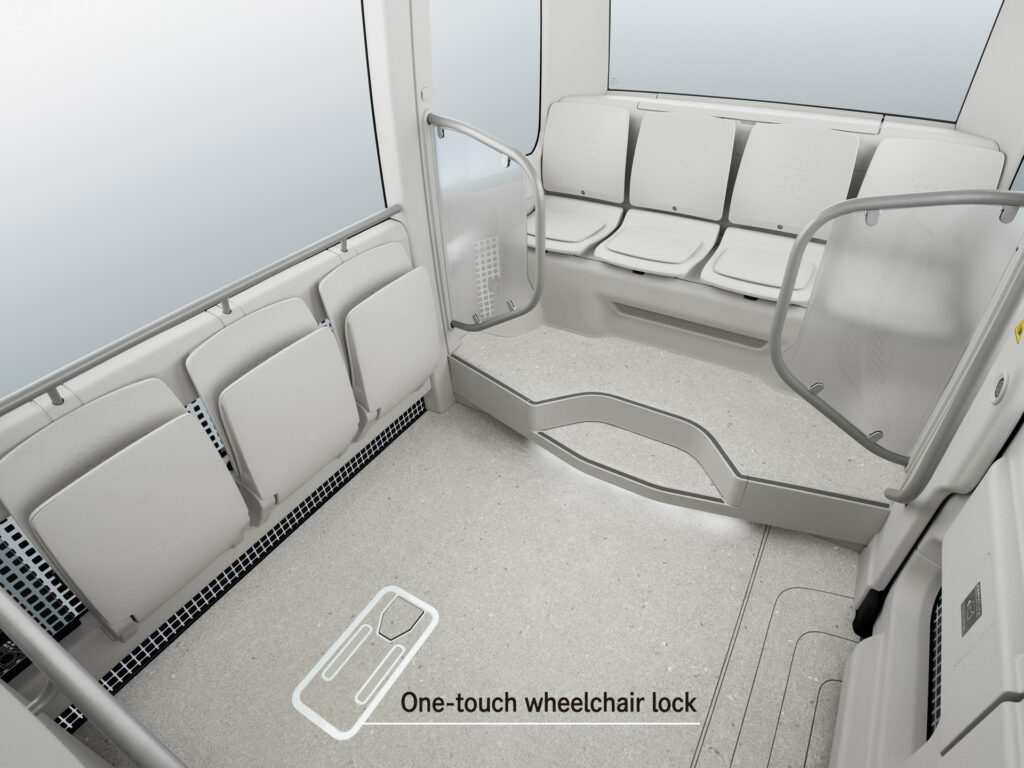
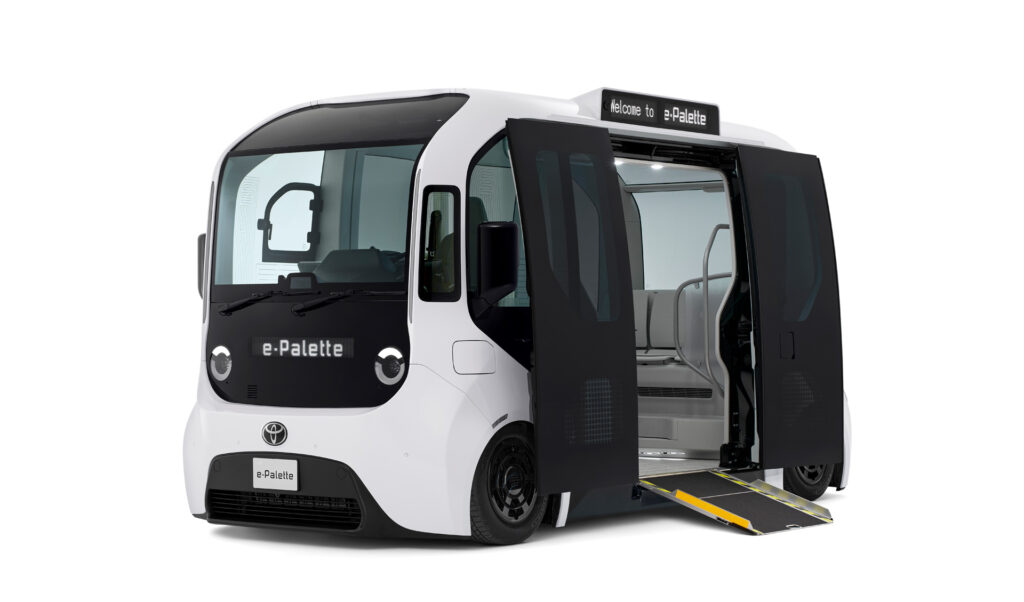
Enough chit-chat about the concept, the idea, the motivations. Now that it’s really coming out, we can we can talk about something concrete. This Toyota e-Pallet is almost 5 metres long, 2.65 metres high and 2 metres wide. That’s plenty of space inside, but the reduced driving position and the absence of an imposing combustion engine. More than volume, it’s above all the e-Palette’s versatility.
Toyota Credit
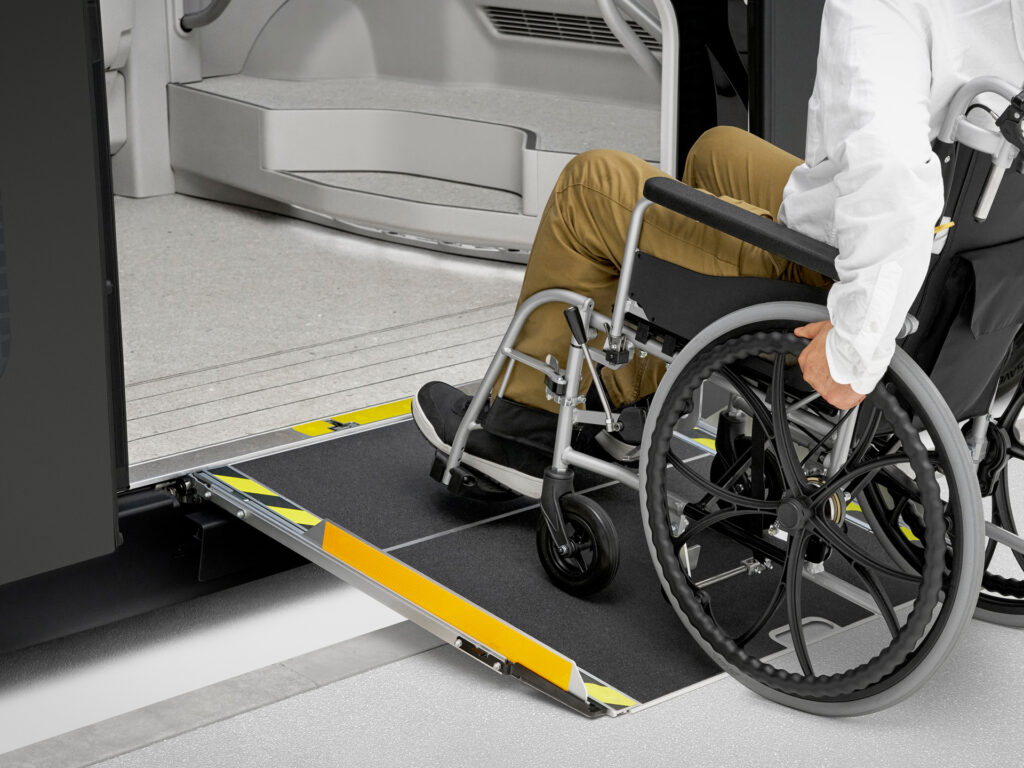
It’s like a blank sheet of paper on wheels, so you can transform it as you wish, depending on how you want to use it. as you like, depending on what you want to use it for: a medical vehicle, a mobile pop-up mobile pop-up store, taxi lounge, why not a coffee-shop or simply an XXL trunk? In short, we can imagine it transporting patients from one hospital wing to another, or simply from the airport to their hotel in a cosy space, enabling a shop to pick up customers rather than bringing them in, or delivering parcels. parcel delivery.
Toyota Credit
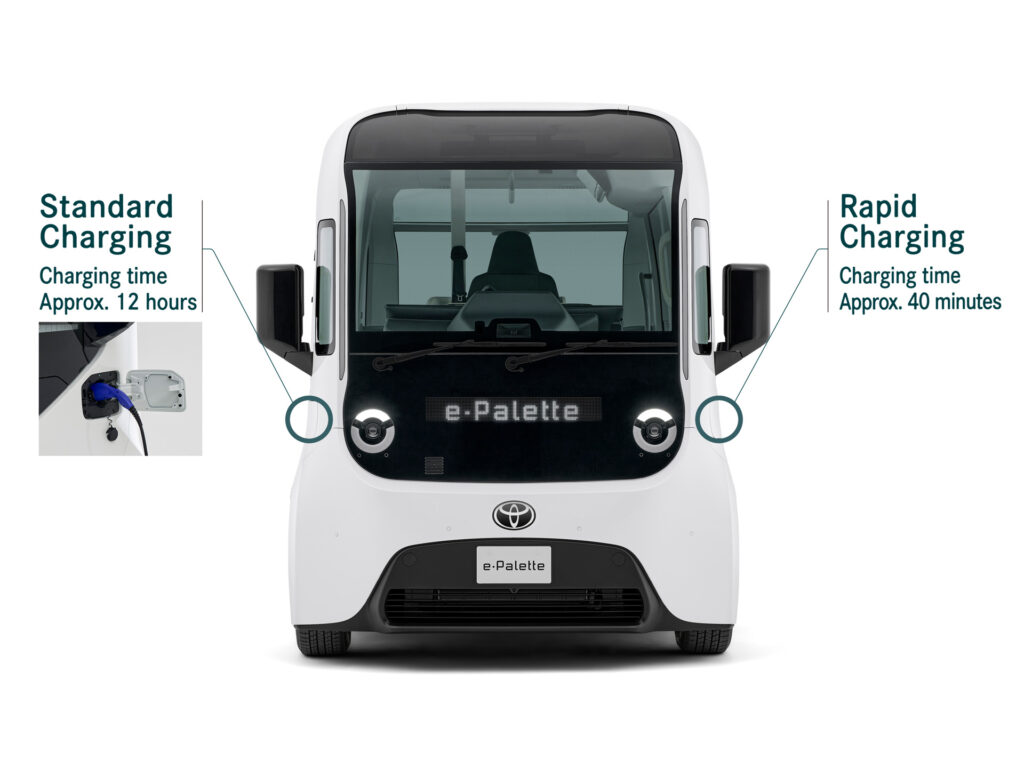
All with enough power to go the distance. The e-Palette is equipped with a battery of almost 73 kWh battery and a 150 kW electric motor. Not enough to set the Le Mans race Le Mans, but it is claimed to have a range of nearly 250 km. That’s pretty good for a commuter! And to be really useful all the way, Toyota has thought of the possibility of transforming its e-Palette into an electric generator if required. e-Palette into an electric generator if required.
100% autonomous by 2027?
In the introduction, I talked about autonomy. Then, later in the article, I mentioned the driving driving position. It’s not a mistake on my part, I’m just getting ahead of myself. For the time being, the e-Palette only benefits from level 2 assisted driving, which gives it a good deal of autonomy, but still requires a great deal of preparation. This gives it a great deal of autonomy, but still requires the presence of a driver. Level 4 autonomy, which enables the vehicle to be driven without a driver (on defined stretches of road known to the vehicle), will be available in the future. known to the vehicle) is planned by Toyota for 2027. That’s tomorrow.
Toyota credit
A pioneer in hybrids when no-one believed in them, then in ‘smart cities’ with its Woven City, when it was just a distant idea, Toyota continues to give us glimpses of the future before anyone else. the future before anyone else, this time with a simple electric shuttle that we could well see (it or the models that follow it). be seen on our streets in large numbers in the next decade. decade.
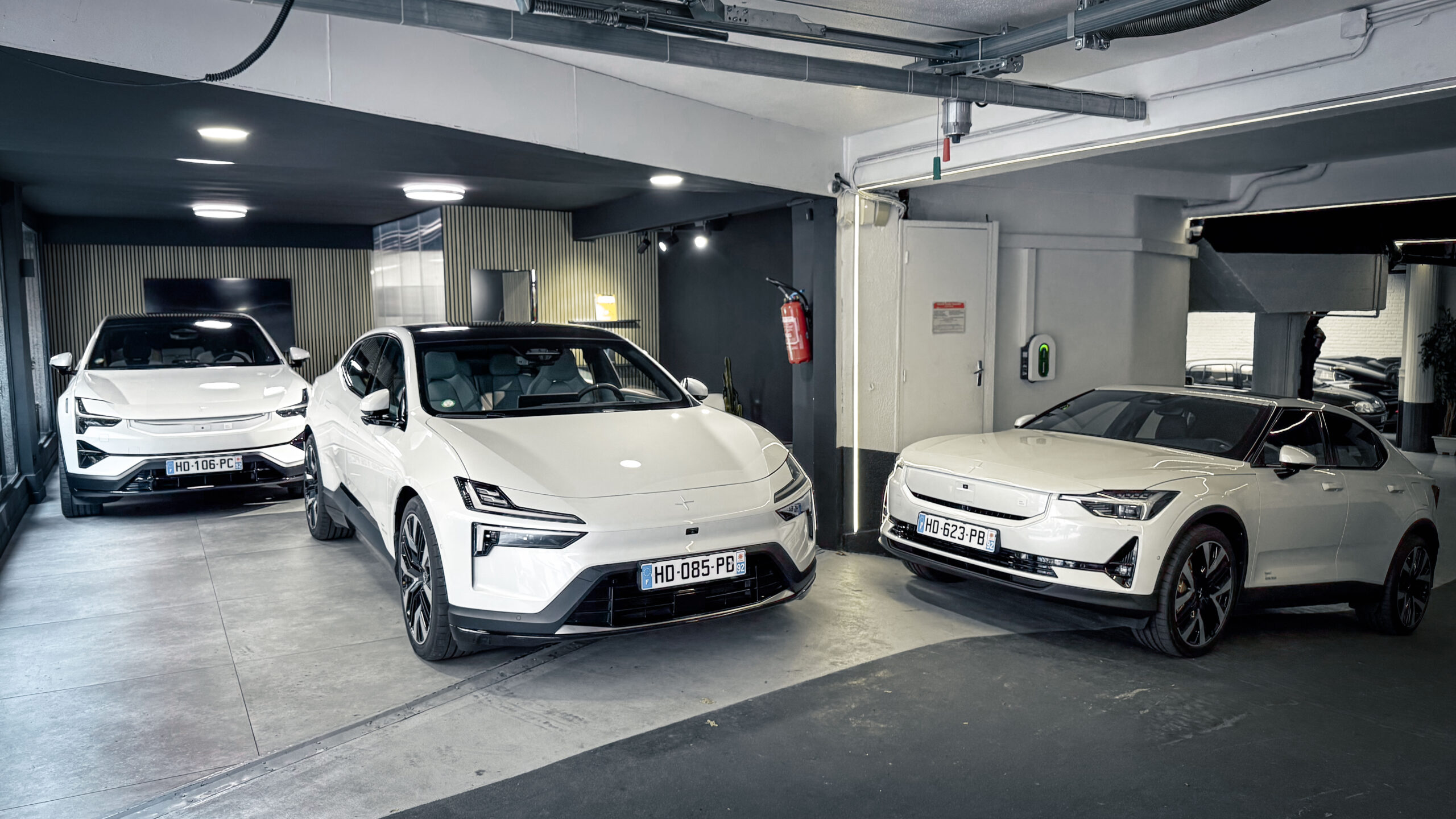
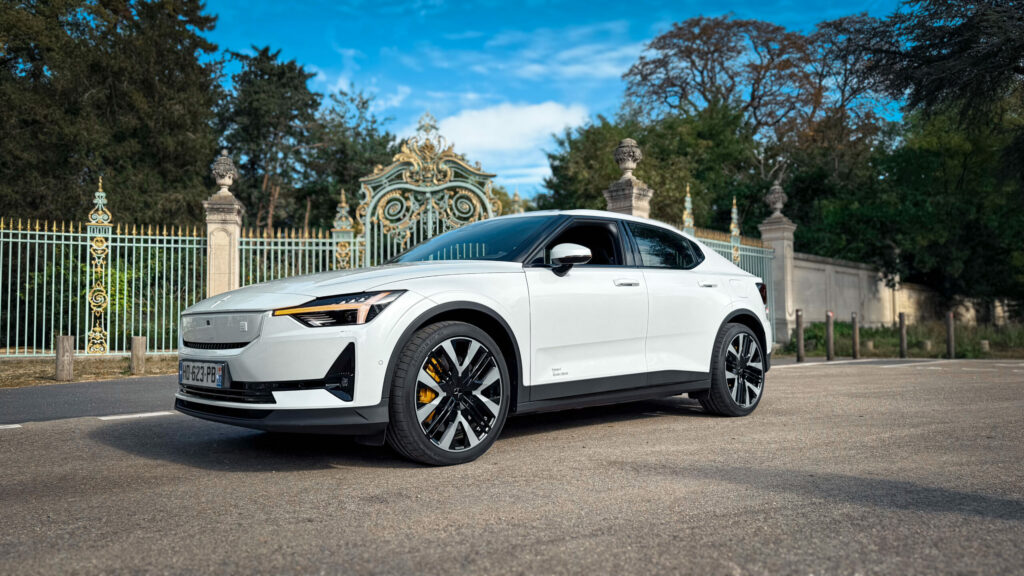
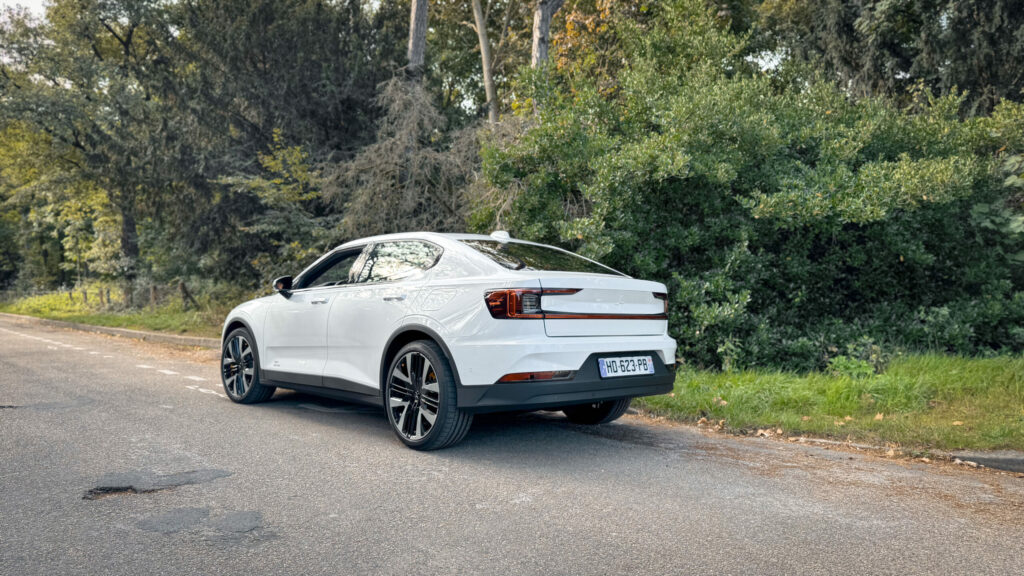
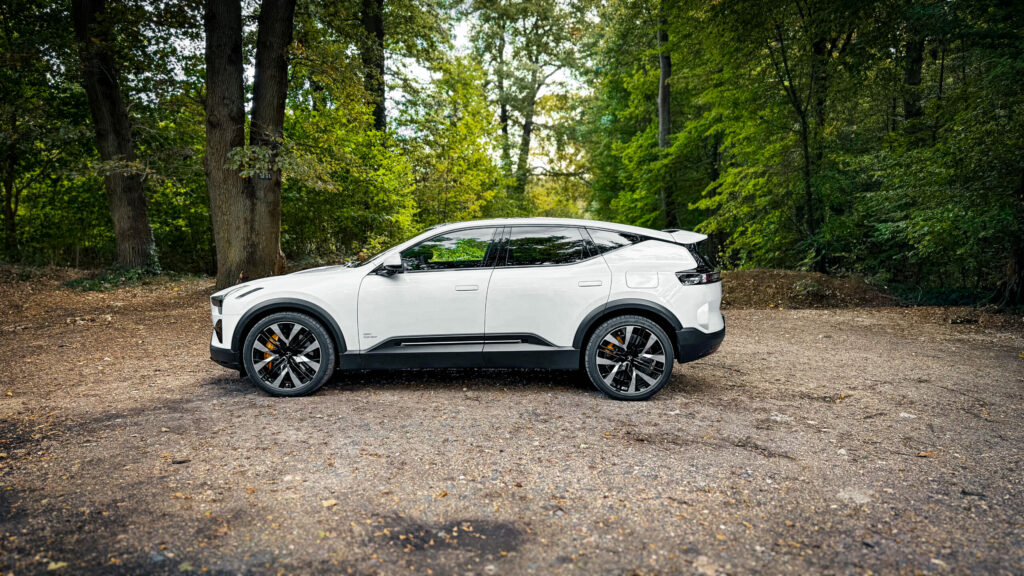
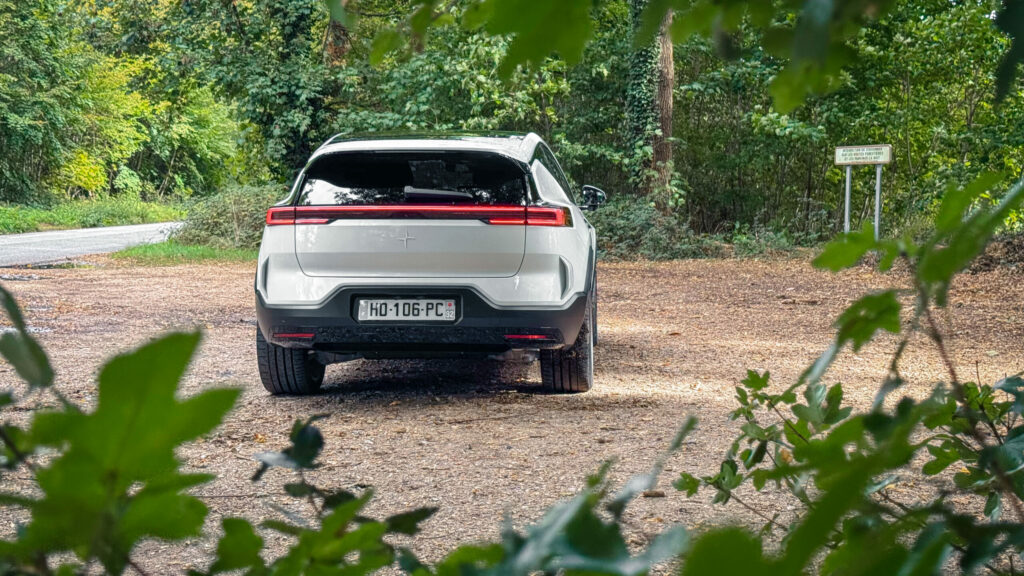
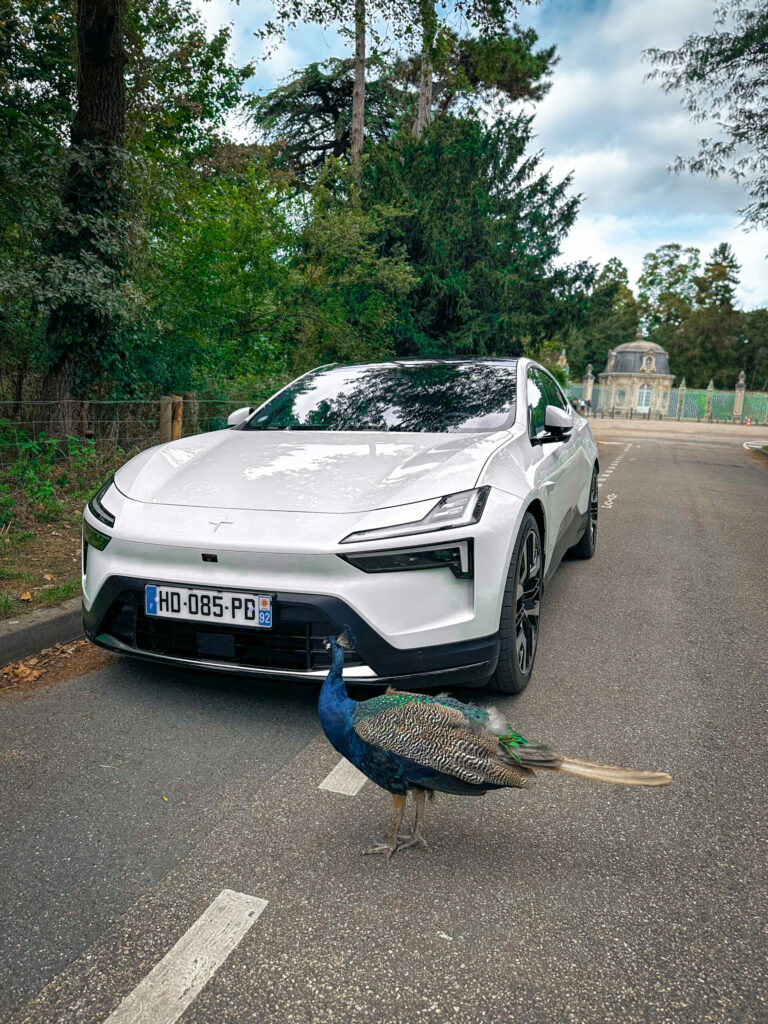
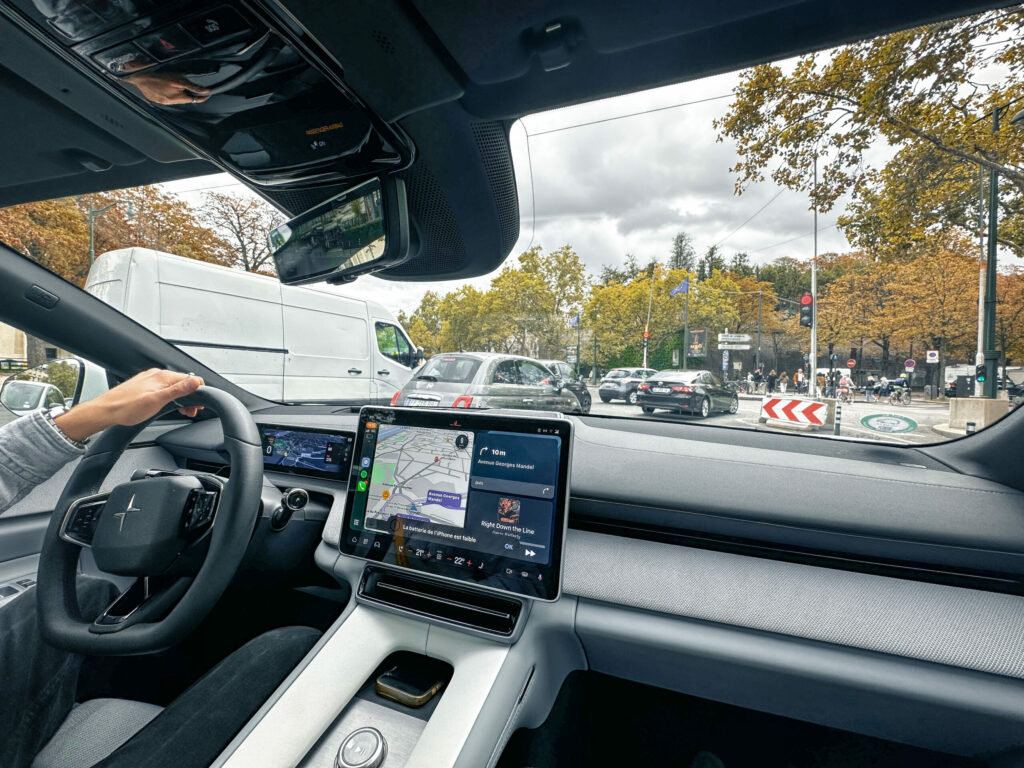
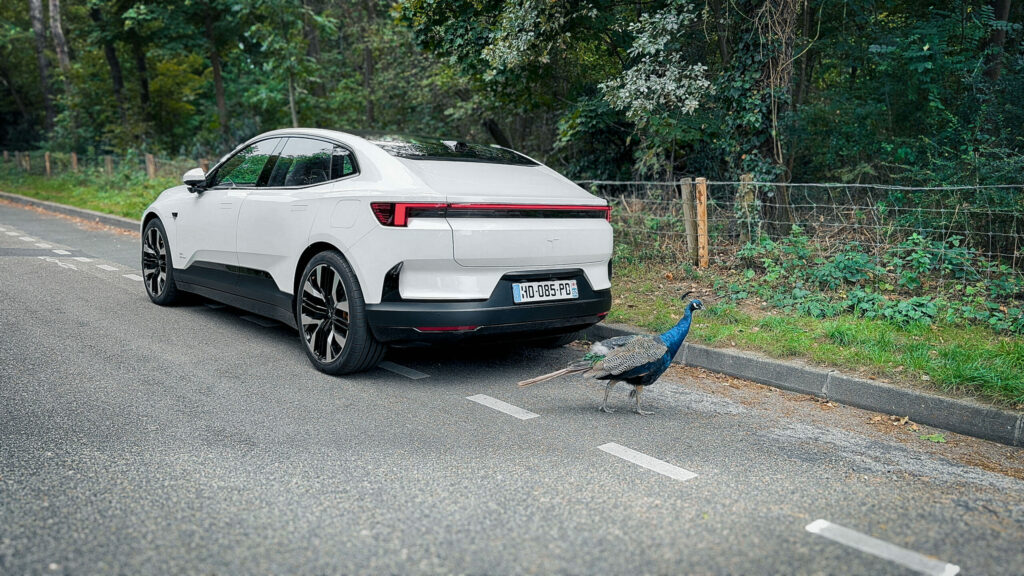
ECO MOTORS NEWS took the three Polestar models – soberly named 2, 3 and 4 – for a triple test drive to find out who they are designed for and what they are used for.
Polestar 2, 3 and 4. (Credit: ECO MOTORS NEWS)
Polestar is a Swedish brand, spearheading the Volvo Group’s premium electric range. In 2020, it will hit the market with its first production model, the Polestar 2. But it would be a long time before it arrived in France, because of a legal imbroglio with a famous French brand that thought the Polestar logo looked too much like the chevrons. So it was in June 2025 that the firm from the cold finally put down its wheels in France. But a lot has happened in 5 years! Since the release of the Polestar 2, models 3 and 4 have appeared in the catalogue, and they too are available here. The story was too good for ECO MOTORS NEWS to pass up, so we decided to test not one but all three Polestar models! This is an opportunity to draw up a comparison based on our feelings and sensations behind the wheel of these top-of-the-range electric nuggets which, for the time of our test, swapped the Arctic Circle for the cobbles of Paris, the ring road and the woods that dot the inner suburbs. It’s worth noting that the models we tested are all equipped with the Performance Pack and the Long range Dual motor, the most premium configuration.
Polestar 2, the urban car that’s out of the ordinary
The brand’s inaugural production model, Polestar had the onerous task of conveying the brand’s philosophy from the outset: comfort, safety, premium quality and driving pleasure. And it does just that, with 476bhp and 740Nm of torque, more than enough to get you out of tricky situations in town – when you’re coming out of a roundabout or in the wrong lane – and of course on the motorway. Because even if this is not its basic mission, we have no doubt that this Polestar 2 will have no trouble swallowing up the kilometres, with a claimed range of 568 km that is not so far off the reality of our test, despite several greedy accelerations and decelerations.
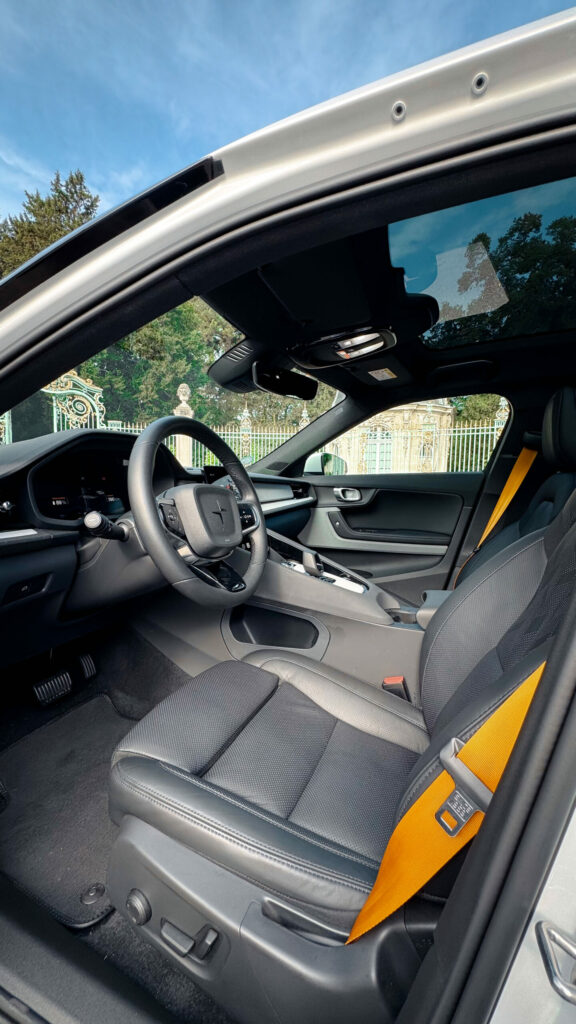
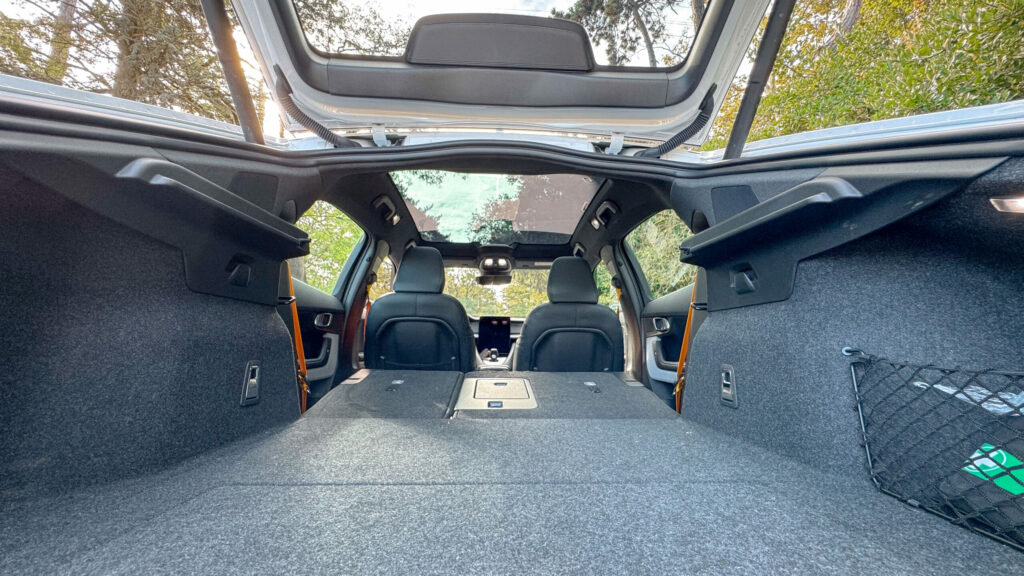
Even so, the target audience is urban: city dwellers who want a ‘small’ saloon – 4.6 metres long – for their daily commute, but with enough room to take the family away for the weekend. Once again, the promise is kept. There’s plenty of room in the front and rear seats, as well as in the boot, which boasts 407 litres with the seats up and 1,097 litres with the seats down. The cabin is uncluttered, and the 11-inch vertical screen is big enough to manage everything without a problem, but blends in well enough not to get in the way. It lets you adjust almost everything in the vehicle, offering several options at a time. For our part, we really liked being able to tighten up the feel of the steering wheel or select a less lively ‘One Pedal’ mode.
The centre pillar, which is rather bulky, may please those who appreciate the ‘cocoon’ aspect for the driver, but we found that it made us a little less comfortable. In fact, that was one of the downsides of our test drive: the upholstery is a little stiff and you can feel it after several hours’ driving. Finally, the turning circle of 11.5 m, while not ridiculous, can sometimes be a little tight for a city car. All this is compensated for by the ‘slow speed’ mode which, particularly during manoeuvres, proves very useful in limiting unintentional excessive acceleration when starting off (available on all Polestar models).
In brief:
As the entry-level model in Polestar’s range (starting at €46,900), the Polestar 2 inevitably suffers a little in comparison with the other models in the catalogue. But if we look at its competitors in the city saloon market, it offers one of the best value for money. Above all, the 2 is practical, ultra-customisable, a real pleasure to drive and slips along quite nicely between boulevards and main roads.
Technical data (model tested) :
Transmission: all-wheel drive (Dual Motor)
Power: 350 kW / 476 bhp
Torque: 740 Nm
0-100 km/h: 4.2 s
Maximum speed: 205 km/h
Towing capacity: up to 1,500 kg
Battery: 400 V lithium-ion, 82 kWh capacity
WLTP range: 568 km
Fast charge up to 205 kW: 10% – 80% in 28 min
Length: 4,606 mm
Width including mirrors: 1,985 mm
Height: 1,473 mm
Wheelbase: 2,735 mm
Wheels : Performance 20″ wheels
Price: €63,300
Polestar 3, the (very) top-of-the-range SUV
Spoiler alert: this is our favourite model. It’s also the most expensive. It’s only a short step from saying that we at ECO MOTORS NEWS have expensive tastes. And one step is all it took for us to fall under the spell of this sleek SUV. Even before we put our foot down, we loved the elegant design, with its razor-sharp lines and voluptuous curves. The killer detail? The spoiler on the bonnet, “for aerodynamics”, we’re told by Polestar. Aerodynamic or show-off, it doesn’t matter, it’s very pretty and that’s good enough for us.
Let’s get behind the wheel. For once, we’ll start with the drawbacks. Or rather, the downside, in the singular: range. We’re told that the SUV has a WLTP range of 563 km, and after just one hour’s city driving, a bit of national highway driving and some acceleration to see what it’s made of, the SUV had already lost more than 5% of its battery. Admittedly, this would give us a range of between 480 and 500 km, so not too far off the advertised figure, but on the motorway, it could drop even further…
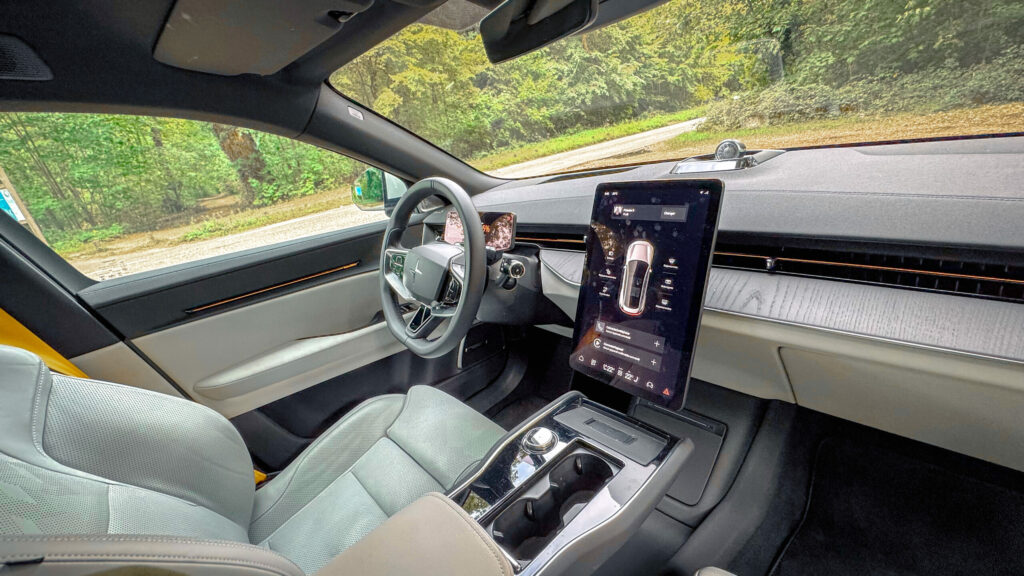
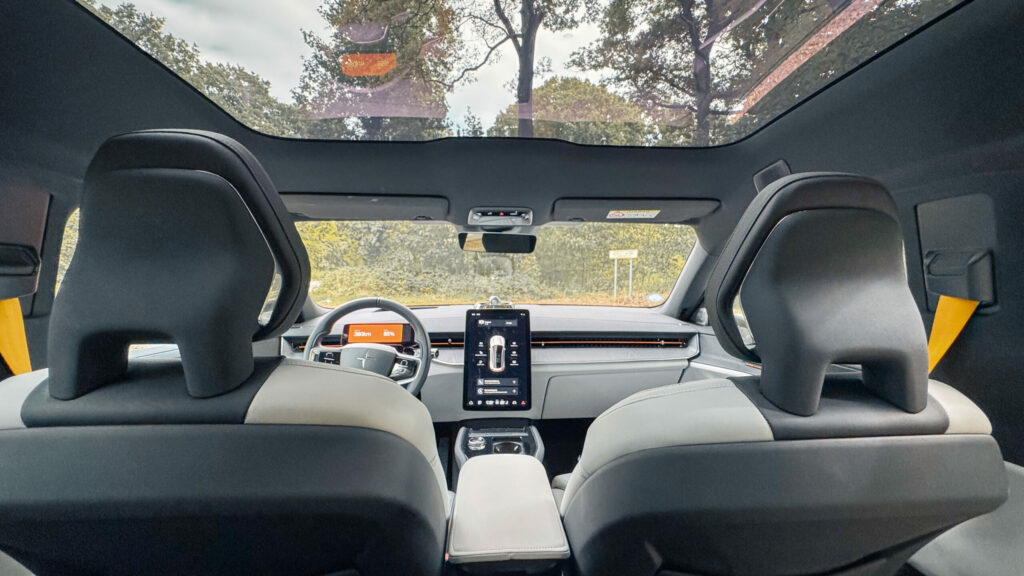
So much for the negative. Now for the positive: everything else. Inside, as on other models from the brand, everything is adjustable and customisable from the central screen. The bonus here is a Bowers & Wilkins audio system – of the highest order – and dozens of options for personalising your experience. By choosing studio mode, it was as if Johnny Cash was in the car with us. Amazing. And if he was really in the back seat, he would certainly have pointed out that he had plenty of legroom! In terms of comfort, it’s 10/10, particularly the quality of the seats, the ergonomics, and the lower, less imposing centre column, which opens up the cabin a little.
It feels much lighter than its 2.6 tonnes, and its large dimensions – almost 5 metres long and more than 2 metres wide, including the rear-view mirrors – are not noticeable when you’re driving, apart from the advantages of the interior space.
In brief:
It’s the most expensive, but it’s not the most powerful, nor the most compact, nor the one with the longest range. So why is it our favourite? For its versatility, for one thing, its comfort, its driving pleasure – without exaggerating, I felt more rested after driving it – and a more than adequate power output of 517 bhp and 910 Nm of torque. In short, it does everything (very) well. Special mention must go to the Bowers & Wilkins audio system, which is a real favourite. The ideal family SUV?
Technical data (model tested) :
Transmission: all-wheel drive
Power: 380 kW / 517 bhp
Torque: 910 Nm
0-100 km/h: 4.7 s
Maximum speed: 210 km/h
Towing capacity: up to 2,200 kg
Battery: 400 V lithium-ion, 111 kWh capacity
WLTP range: 563 km
Fast charge up to 205 kW: 10% – 80% in 30 min
Length: 4,900 mm
Width including mirrors: 2,120 mm
Height: 1,614 mm
Wheelbase: 2,985 mm
Wheels: 22″ Performance
Price: €91,800 inc.
Polestar 4, the powerful sports coupé
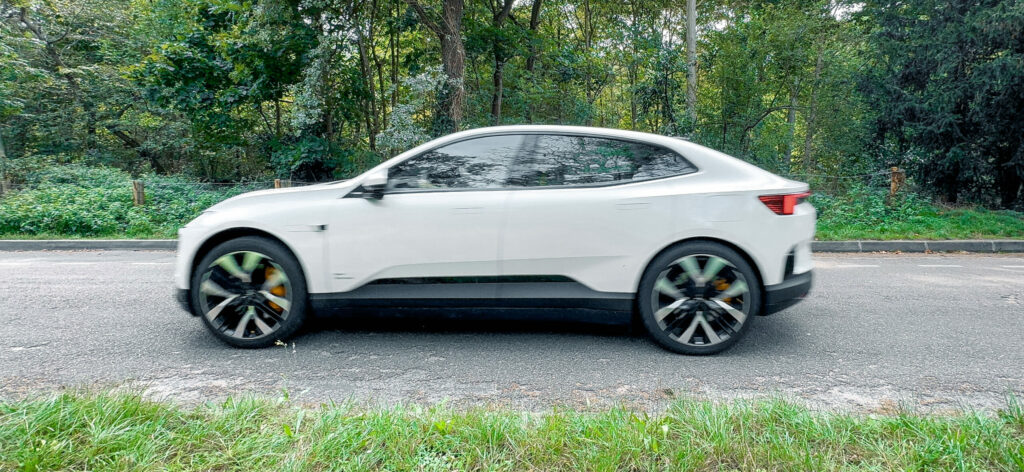
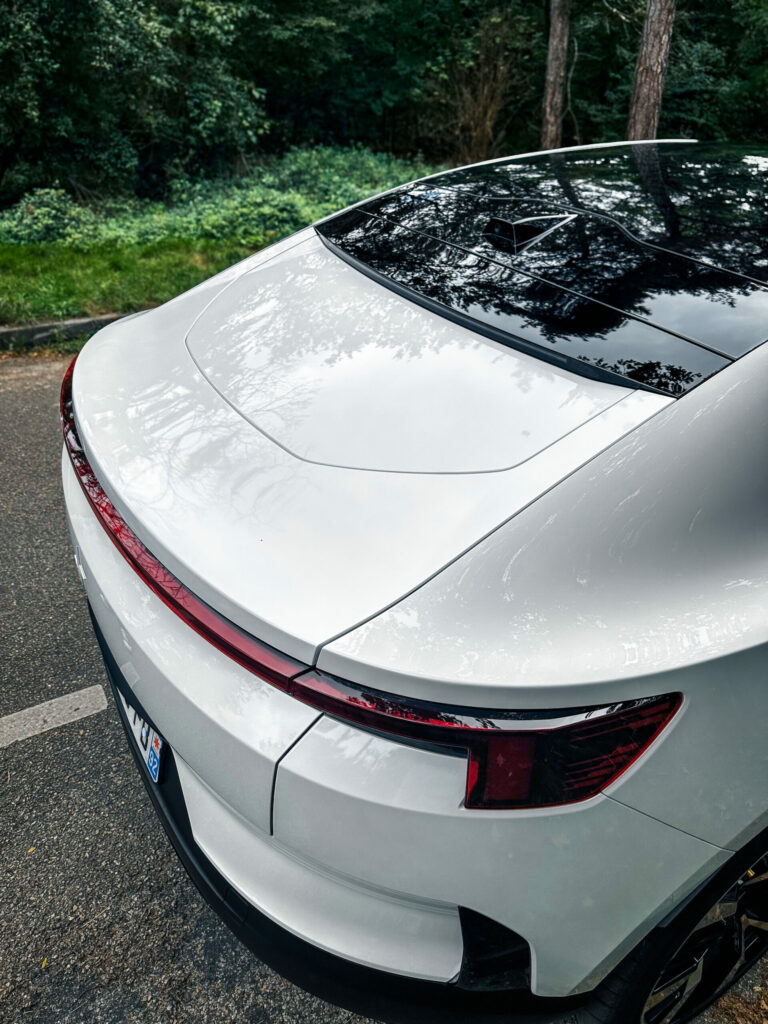
The 4 is the latest addition to the Polestar catalogue, while we wait for the Polestar 5. According to the brand, it’s a large SUV coupé, but visually it looks more like a family saloon. It’s a family car because, at 2.14 m wide and 4.84 m long, it’s a handsome baby with plenty of room in the back, despite a plunging roof that can shave the heads of even the tallest passengers. Above all, it’s the most powerful of the three models at our disposal, putting out 544bhp. And that’s what we liked best about our test drive: standing up from a standing start. In sport mode, you take off, you soar, and a 0-100 kph time of less than four seconds really puts butterflies in your stomach.
The exterior design is classic, very Volvo in spirit: sleek, elegant, simple and effective. That is, until you go round the corner and find yourself ‘up the arse’ of the car. No rear window! Instead, there’s a camera that sends the image back to the screen that serves as the rear-view mirror. It’s a bit confusing at first, but you get used to it, and then you love it.
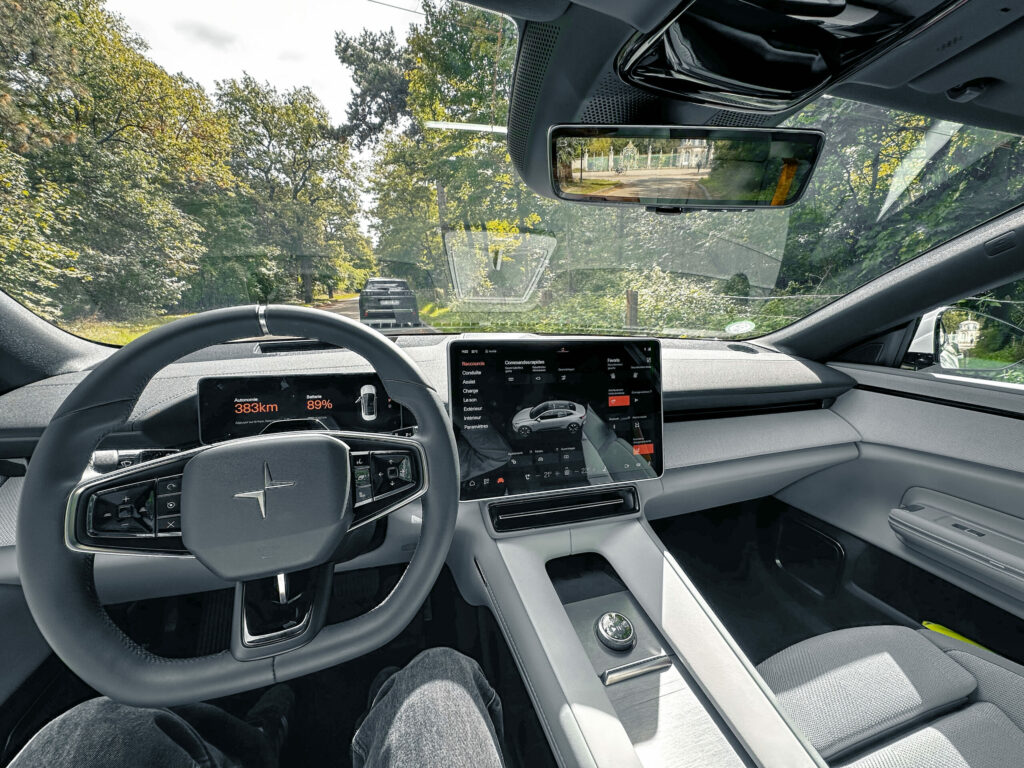
The screens are another strong point of the Polestar 4. The central 15.4-inch screen is horizontal and imposing, but doesn’t interfere with driving or concentration. The screen on the dashboard blends in perfectly with the cockpit, and the head-up display is superbly legible. Comfort is high, as are the premium materials, many of which are recycled – a welcome nod to the environment.
The pleasant surprise is the 11.64 m turning circle. That may sound like a lot, but it’s a lot less than the 12.13 m of the Tesla Model Y 2025, for example, and it means you won’t have the drops on your forehead when entering a car park. Add to that a battery of 360° cameras and driving aids (also present on other models, but particularly practical on this beautiful beast that is the Polestar 4), and you’d almost forget its XXL dimensions.
And we say ‘almost’, because in reality, 2.13 m wide is a lot. And that’s one of our downsides, as it inevitably reduces practicality a little. Another negative point is visibility. Nothing dangerous, but the structure of the car takes up a lot of space, particularly to the left of the driver, forcing him or her to do a bit of gymnastics in certain situations.
In brief:
The Polestar 4 is the missing link between the Polestar 2 city saloon and the Polestar 3 family SUV. With a little of both worlds, this SUV coupé/large saloon will appeal to fans of power, comfort and technology. But it will also appeal to consumers who want to stand out from the crowd by owning a car that is one of a kind and, let’s not forget, without a rear window!
Technical data (model tested) :
Transmission: all-wheel drive
Power: 400 kW / 544 bhp
Torque: 686 Nm
0-100 km/h: 3.8 s
Maximum speed: 200 km/h
Towing capacity: up to 2,000 kg
Battery: 400 V lithium-ion, capacity 100 kWh (110 cells)
The Lyon Motor Show 2025 will take place from 24 to 28 September. Held every two years, alternating with the Paris Motor Show, it has established itself as the second most important motor show in France. After a successful 2023 event, the 2025 edition will feature a host of new products, including electrified vehicles, and a number of test drives.
Lyon’s Eurexpo centre is getting ready to host the 2025 edition of the Lyon Motor Show from 24 to 28 September. In all, 57 manufacturers are expected to be on hand to present their new products over an area of almost 50,000 m2, some of which will be unveiled to the French public for the first time, others for the first time at all, and some of which will even be previewed. It’s an interactive show that puts the public at the heart of its operation: at the last edition, in 2023, nearly 400 cars were available to test drive, and we’re expecting at least the same number this year.
Credit: GL Events
The Lyon 2025 Motor Show is organised around seven ‘universes’: used vehicles, commercial vehicles, motorsport, van life, services and accessories, ecomobility and new vehicles. Of course, it’s these last two that interest us most, but the editorial team will of course take the time to visit all the stands. And yes, ECO MOTORS NEWS will be there, from the press day on September 23! In the meantime, here’s an overview of the new products that have been announced and/or are expected, although we can’t rule out a few surprises… For that, we’ll have to wait until the big day.
French cars out in force at the Lyon Motor Show
As the capital of the Gauls, the Lyon Motor Show is bound to be a showcase for national cars. DS will be showcasing its new spearhead, the N°8 top-of-the-range saloon/SUV electric coupé, on which the brand is betting big. The company will also be previewing the restyled N°4.
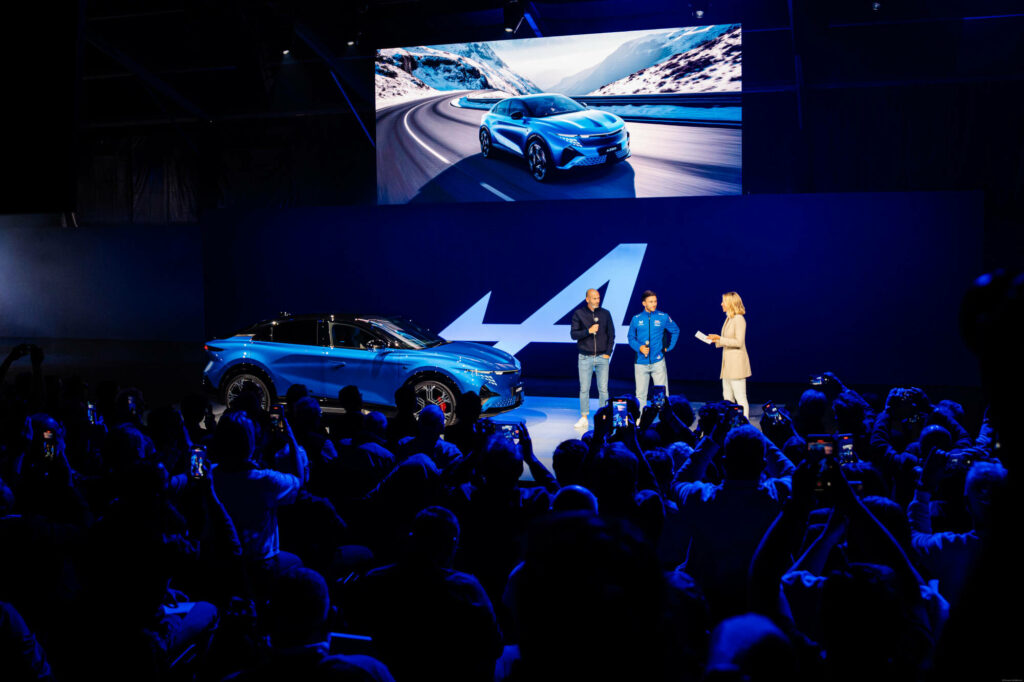
On the Alpine side, the new A390 SUV, unveiled last May at Dieppe, will be making its debut. Following on from the warm welcome given to the A290 city car, which has enjoyed fairly decent sales in this niche segment, this will be an opportunity to confirm the popularity of Alpine electric sauce with a second model positioned in a much tighter market, that of top-of-the-range electric SUVs.
Credit: Alpine Cars
Peugeot’s main attraction will be the presentation of the new e-208 GTI, which is expected to be a showpiece, while Citroën will be highlighting the C3 and C5 Aircross. Finally, Renault will be present with the Clio 6 in the spotlight, already presented in Munich a few days ago.
Manufacturers from all over the world at Lyon
Of course, it’s not just the French manufacturers who will be presenting their new electrified models in Lyon. The giants will be there, including Tesla with the Performance version of its Model Y, and BYD, which is still struggling to sell its 100% electric cars in Europe, and has decided to focus on the Seal 6 hybrid. Still on the subject of giants, Volkswagen, which was already very active in Munich at the beginning of the month, will also be taking up a lot of space in Lyon, notably with the new T-Roc and the still camouflaged version of its ID.Polo.
Credit: Volkswagen
On the other side of the Atlantic, Jeep is planning to present its new Compass to the French public, a compact SUV in which the brand has high hopes, and which will be available in both electric and hybrid versions. Cadillac, the legendary firm from Detroit, is likely to shock the world with two 100% electric monsters: the Lyriq, which we already know, and the Vistiq, even more massive, exceeding 5 m in length and 2 m in width.
What about Japan? Well, the beautiful Lexus ES saloon will be making its first appearance on French soil, as will the upgraded version of the RZ SUV. The Lyon Motor Show will also provide an opportunity to see the new 100% electric Mitsubishi Eclipse Cross in the flesh, as well as the 100% electric version of Isuzu’s legendary D-Max pick-up.
It’s a short step from Munich to the Lyon Motor Show
ECO MOTORS NEWS may have been lucky enough to attend the IAA Mobility show in Munich at the beginning of September, but not everyone else was. But don’t panic, the Lyon Motor Show will be the perfect opportunity to catch up. The Clio 6, as mentioned above, will be making its French debut, and the impressive Skoda Vision O and Audi Concept C will be on show, along with the Xpeng P7+ and some very promising new models from Opel.
Finally, there are a number of models that aren’t exactly new, but which we can’t wait to get close to – and try out? – including the spectacular Lotus Eletre SUV and the already cult Tesla Cybertruck. And, who knows, we might even take a look at the Prestige area and the Hypercars Zone, which, even though they mainly feature combustion-powered cars, will be well worth the diversions with the presence of Aston Martin, Bentley, Ferrari, Lamborghini, Lotus, Maserati, McLaren and Porsche. It’s sure to be a sight to behold!
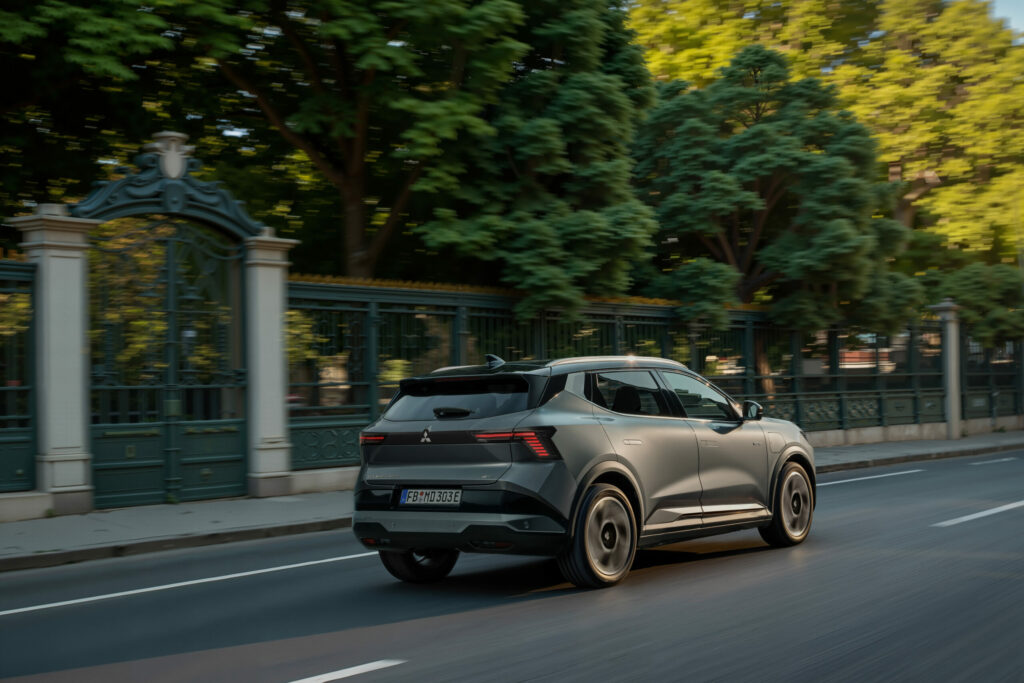
The Mitsubishi Eclipse began life as an iconic Japanese sports car coupé in the 1980s, but is now an MPV/SUV with sleeker lines, now available in a 100% electric version… the French way!
The Mitsubishi Eclipse was launched in the late 1980s. At the time, it was a racy coupé with a power output of up to 200 bhp, much appreciated by car modifiers and other DIY enthusiasts. The 1995 version of the little Japanese car even had the luxury of becoming a film star, driven by Paul Walker in the Fast and Furious saga, sporting a bright green livery and a few vitamins under the bonnet. The coupé also scored a number of victories on the racetrack and in rallies. But in 2017, at Geneva, to everyone’s surprise and at the height of the SUV boom, Mitsubishi unveiled the Eclipse Cross. And in this case, ‘Cross’ doesn’t evoke any racing spirit, but rather ‘crossover’, because it’s… an SUV! And the aim? To win back the hearts of European consumers with a hybrid family car, while retaining a legendary name. In 2025, the diamond manufacturer will be taking a new step forward, as the Eclipse Cross hybrid will disappear in favour of a 100% electric version that bears a striking resemblance to another automotive icon, this time a French one.
Credit: Mitsubishi
A Japanese SUV… made in France
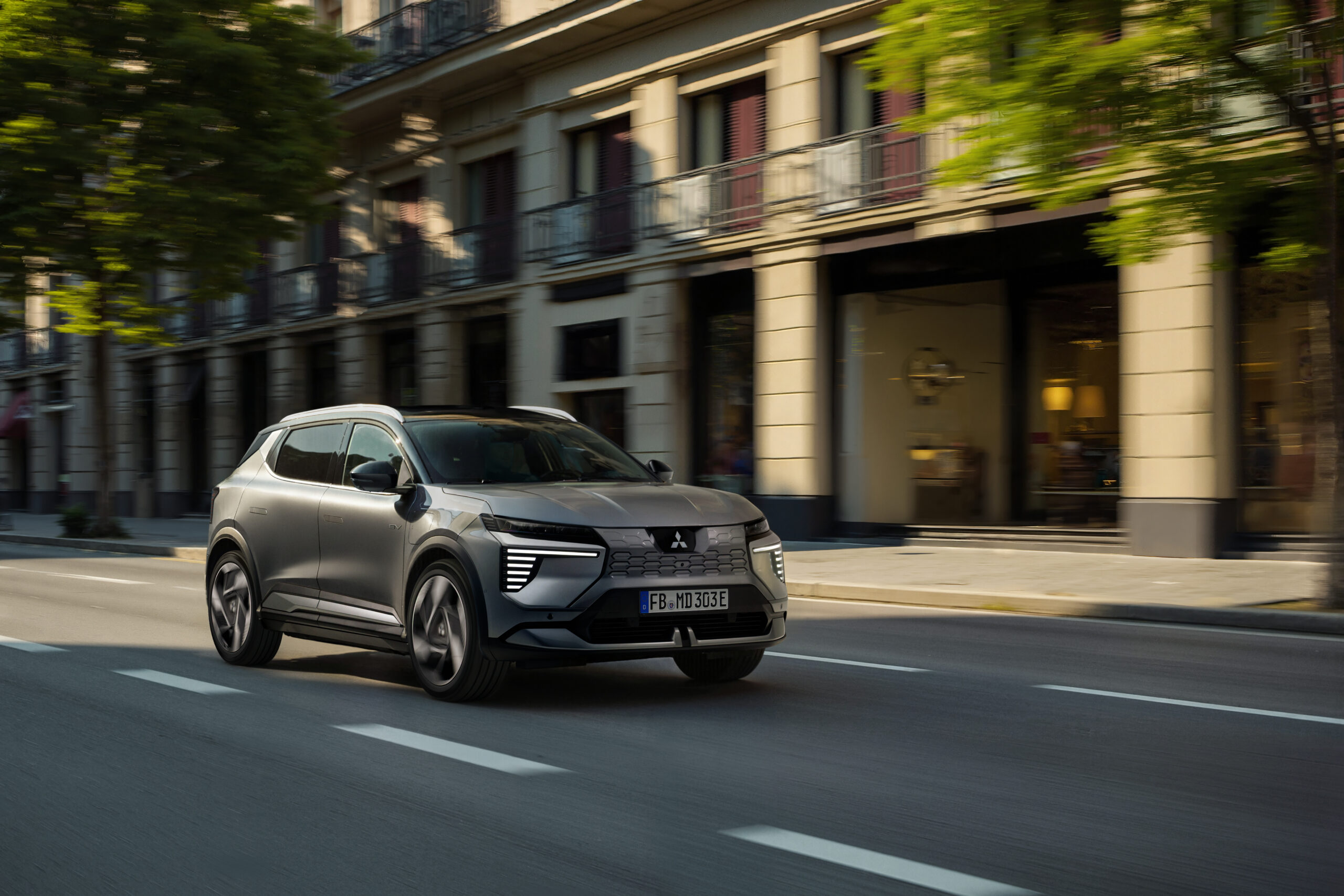
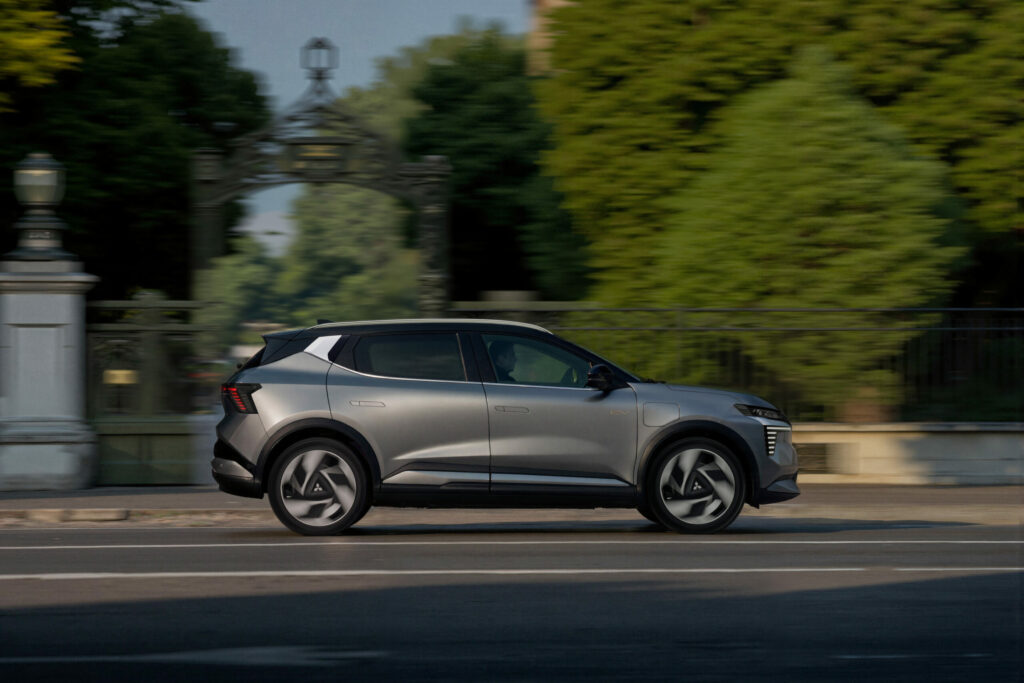
The Eclipse Cross looks (really) a lot like the Scénic. And why is that? Because, it’s no secret, it’s the fruit of a marriage of convenience: the industrial alliance between Renault, Nissan and Mitsubishi. As a result, the Japanese manufacturer’s new electric SUV will be made… in France! In Douai, to be precise, on Renault lines, which explains its resemblance to the famous French MPV/SUV. Even if, in good faith, it does have a few of its own identifying features: a slightly reworked front end and the brand’s signature light signature at the rear.
Credit: Mitsubishi
In addition to its similarity in design, the Eclipse Cross is almost identical in size to the electric Scénic, with a length of just under 4.50 m, placing it in the ‘compact’ SUV category, and a width of just over 1.85 m, making it easy to handle. These similarities are due to the fact that Mitsubishi’s new electric SUV and Renault’s best-seller also share the same CMF-EV platform.
The Mitsubishi Eclipse Cross promises 600 km of range
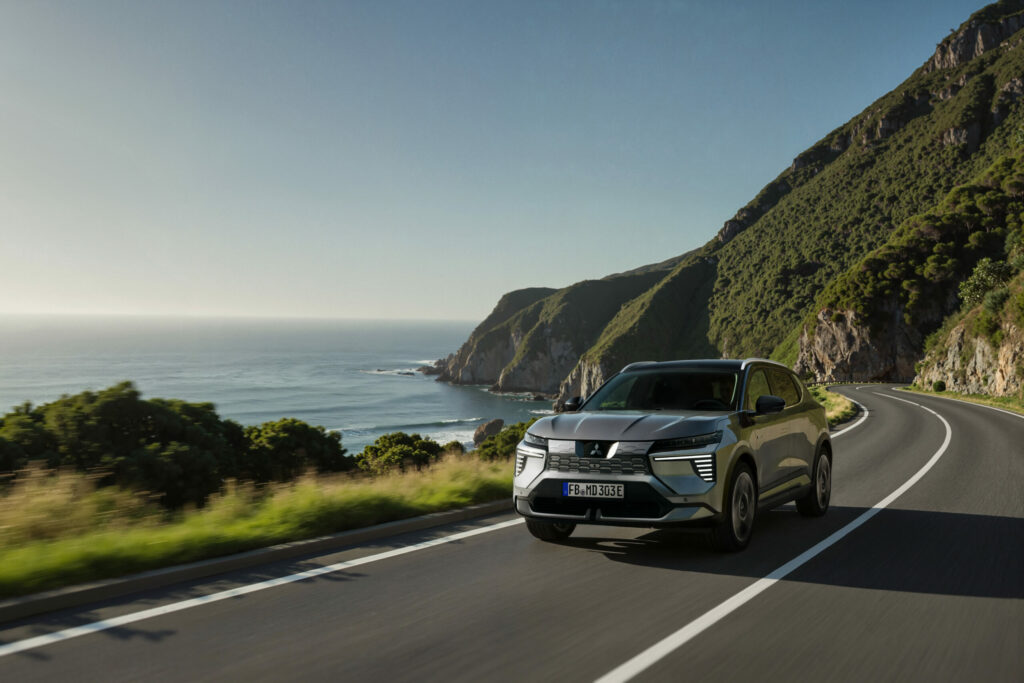
In terms of performance, the Eclipse Cross currently only offers a single 160 kW (220 hp) engine. Another, slightly less powerful, version should be available next year, at what we imagine will be a lower price. Where the promise is most tempting is in the floor, with an 87 kWh battery that boasts a range of 600 kilometres WLTP and the possibility of rapid recharging up to 150 kW.
Credit: Mitsubishi
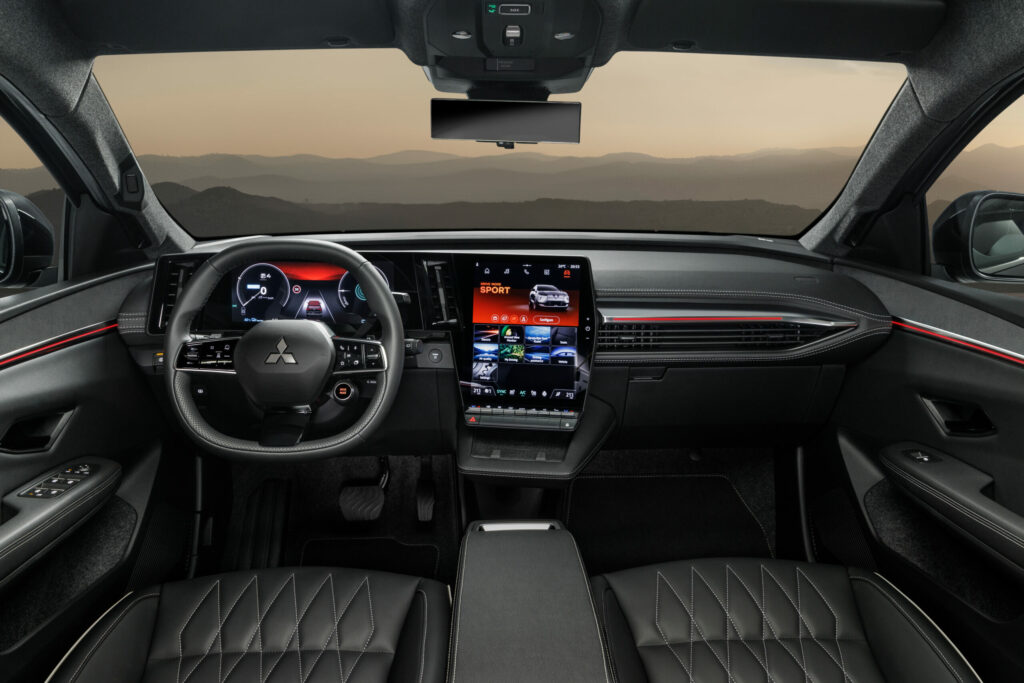
Inside, it’s quality. Visible stitching on the seats, beautiful materials, a connected and ergonomic cockpit, screens that blend in with the décor and an appreciable sobriety. Above all, there’s the Harman Kardon audio system, which will allow the most nostalgic to play the Fast & Furious soundtrack over and over again… Even if, limited to 170 km/h, this electric Eclipse 2025 is unlikely to break any speed records.
Credit: Mitsubishi
The question is, who will benefit from the arrival of the Eclipse Cross on the European market? For Renault, it’s simple: to keep its factory running. For Mitsubishi, it’s a question of positioning itself in a strategic market while limiting industrial costs on the one hand, but also research and development costs, since there are no new platforms to develop. We are now waiting to see how the new Franco-Japanese SUV will differentiate itself from its competitor and first cousin, the Scénic, and only time – and a test drive – will tell.
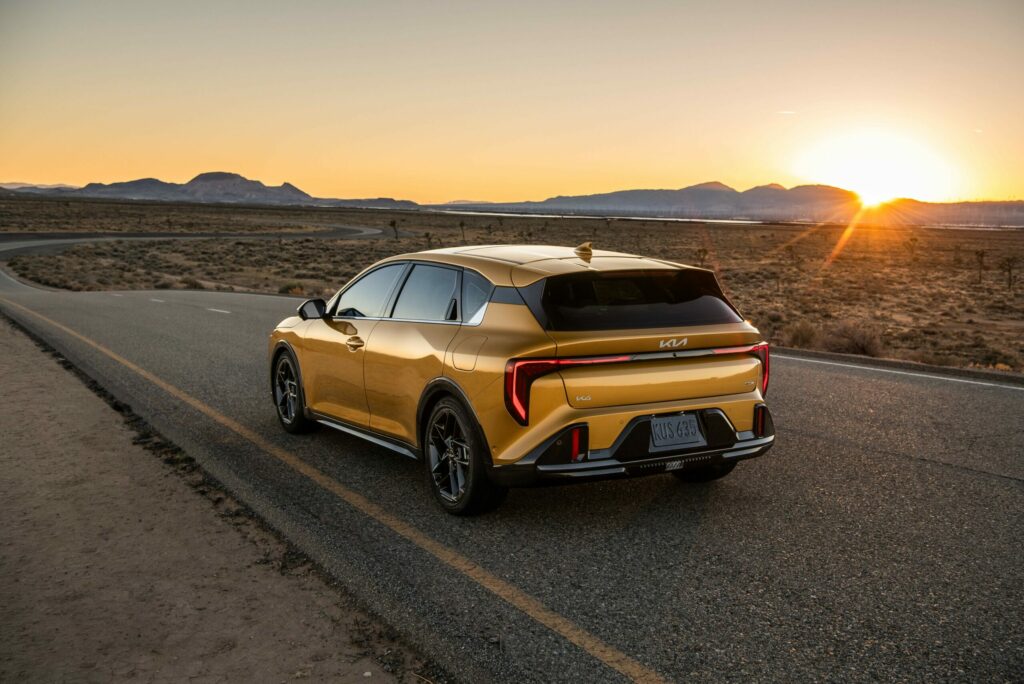
The Korean manufacturer has announced that, from 2026, the new K4 compact hatchback will replace the iconic Ceed in European catalogues. This marks the start of a new electrified era for Kia on the Old Continent, as the Ceed will also be offered as a hybrid.
In 2007, when Kia launched the Ceed, then spelt ‘cee’d’, it was with the aim of taking on the Golf, Focus and Mégane, then the reigning champions of compact budget hatchbacks. Mission accomplished, because although we don’t know the sales figures for the third and latest generation, the first two were produced in excess of 600,000 units each. Above all, it enabled Kia to make a name for itself in Europe. Now, almost two decades later, the Ceed is preparing for a well-deserved retirement.
A new string to Kia’s bow
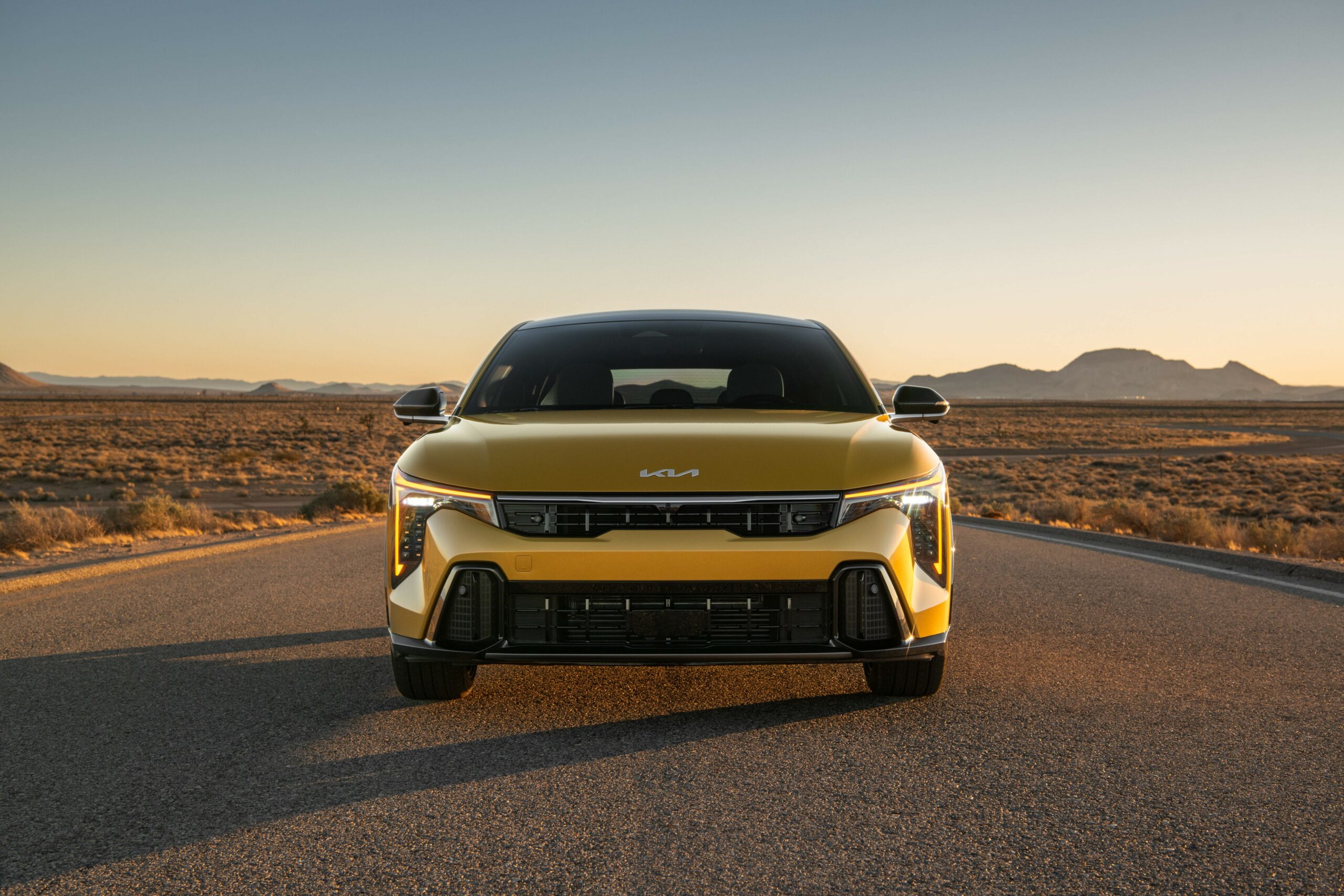
Already ‘rivalled’ by its electric cousin, the EV4, the Ceed now sees the arrival on the Old Continent of the K4, which will replace it definitively in 2026. This is the hatchback version of the classic K4 saloon already sold in other markets.
2026 K4 Hatchback
While this K4 hatchback remains in the C segment (cars between 4.10 m and 4.50 m long) at 4.44 m, it is still almost 20 cm longer than the first Ceed. Above all, it offers a design that we now associate with electric cars. In fact, it looks a lot like the EV4, with its plunging roof, receding grille, knife-edge lines, ultra-modern light signature and large glazed sections. The Ceed seems to have turned the page…
A hybrid version of the Kia K4 coming soon
Kia has chosen to present its K4 hatchback to Europeans with… combustion engines! Petrol engines with outputs ranging from 115 to 180 bhp… Strange, given that a ban on the sale of combustion engines is on the horizon, but it’s understandable, 10 years is a long time, and it will give Kia time to sell a good number of units of its new K4.
Credit: Kia
So why are we talking about it on ECO MOTORS NEWS? Well, because a HEV or full hybrid version – non-rechargeable hybrids for those who haven’t read the electromobility glossary – is planned for 2026. This is the real revolution at Kia: the Korean manufacturer will be able to position itself in two strategic markets, particularly in Europe: the compact saloon market and the non-rechargeable hybrid market. Enough to make the 308, its announced nemesis, tremble?
The world of electromobility, like all new markets, is full of abbreviations and jargon that can sometimes confuse consumers. To help you find your way around, ECO MOTORS NEWS presents the electromobility glossary, which will evolve over time.
The electromobility glossary provides a better understanding of the key terms used in the world of electric and plug-in hybrid cars.
To get a clearer picture, we first need to identify the different categories in this glossary of electromobility. Starting with the types of electric vehicle, through to everything to do with recharging and batteries, not forgetting the terms used to describe the societal changes associated with the energy transition.
The different types of electric vehicles :
BEV: Abbreviation for Battery Electric Vehicle, covering all 100% electric vehicles. Sometimes simplified to EV or VE.
EREV: Abbreviation for Extended Range Electric Vehicle. An electric vehicle with a small petrol-powered generator to extend its driving range. Also called REEV for Range Extended Electric Vehicle.
FCEV: Abbreviation for Fuel Cell Electric Vehicle, generally refers to hydrogen-powered vehicles. More specifically, the vehicle’s electric motor is powered by a fuel cell, which produces electricity through oxidation.
HEV: Abbreviation for Hybrid Electric Vehicle, used to describe non-rechargeable hybrids whose electric motor is powered by a battery that is recharged by the internal combustion engine and sometimes during braking and deceleration.
PHEV: Abbreviation for Plug-in Hybrid Electric Vehicle, this is a hybrid vehicle that can be recharged at a terminal or plug socket.
MHEV: Abbreviation for Mild Hybrid Electric Vehicle, this is a vehicle that benefits from light hybridisation, with electric assistance during the famous “start and stop” or to power some of the electronics.
Designations you need to know
TCO: Total Cost of Ownership. It already existed with internal combustion engines, particularly for professional use, but it has come back to the fore with electric vehicles, as it is often used as an argument in favour of electrified vehicles.
Crit’Air: Rating and classification of vehicles from 0 to 5 according to their emissions, fuel used and age. Only 100% electric or hydrogen-powered cars qualify for the green sticker equivalent to 0.
ZFE: Zone à Faibles Émissions or Low Emission Zones, sources of heated debate and still unstable status, are urban areas where the circulation of Crit’Air 3 vehicles and above is regulated or even banned.
WLTP: The Worldwide harmonized Light vehicles Test Procedures is one of the standards used to determine, after a series of tests, the range advertised by manufacturers to the public. For internal combustion cars, it determines fuel consumption.
NEDC: Long used in Europe, the New European Driving Cycle disappeared in 2018, giving way to the WLTP.
CLTC: The China Light-Duty Vehicle Test Cycle is the Chinese equivalent of the WLTP. Adopted in 2021 as the national standard, it is sometimes considered to be more lenient. For example, 500 km on the CLTC is equivalent to 410 km on the WLTP.
Glossary of batteries and recharging
Lithium-ion: This is the most common type of battery, chosen for its relatively low cost, good energy-to-weight ratio, efficiency and long life. As the name suggests, it consists of an anode and a cathode that exchange lithium ions.
Solid state battery: Unlike the lithium-ion battery, here the electrolyte between the anode and cathode is solid. This inevitably makes them more compact, increasing their capacity for the same volume and, de facto, extending the vehicle’s range. At the moment they are too expensive to manufacture, but their democratisation is eagerly awaited.
AC (Alternating current): Often associated with so-called slow charging stations, such as home charging stations, which use alternating current that must then be converted to direct current to be stored in the battery.
DC (Direct Current): In contrast to AC terminals, DC terminals, known as fast terminals, are often found in service areas. They supply direct current directly to the battery and range in power from 50 to over 500 kW.
CCS connector: Combined Charging System. Type of charging point combining AC and DC charging, used mainly in Europe and a direct competitor to Tesla Superchargers.
V2G : Abbreviation for Vehicle-to-Grid, a technology that allows energy from a vehicle’s battery to be fed back into the grid when it is plugged in. This preserves the life of the battery while taking the strain off the grid.
V2H : Abbreviation for Vehicle-to-Home, this enables a vehicle to power a home.
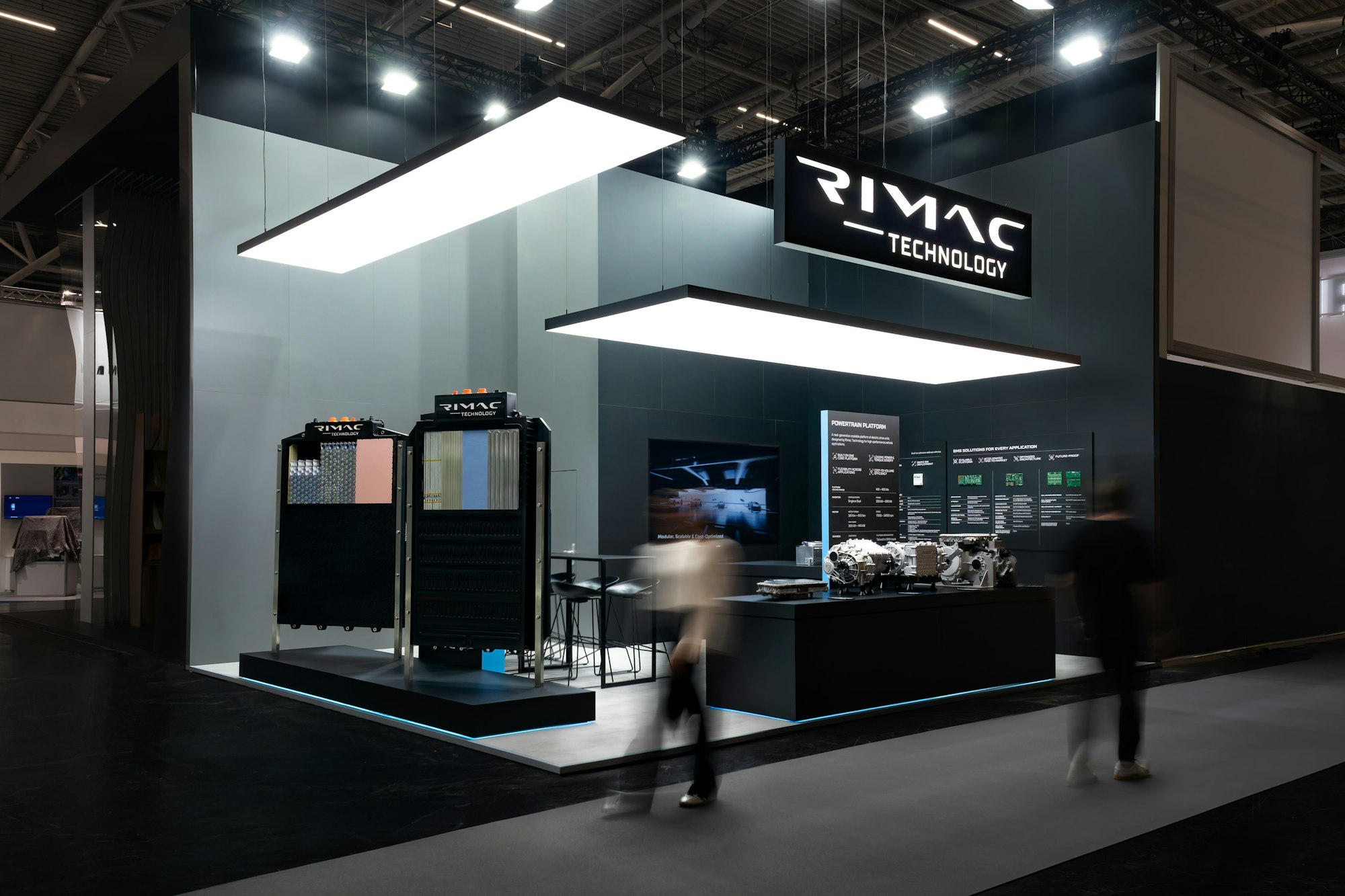
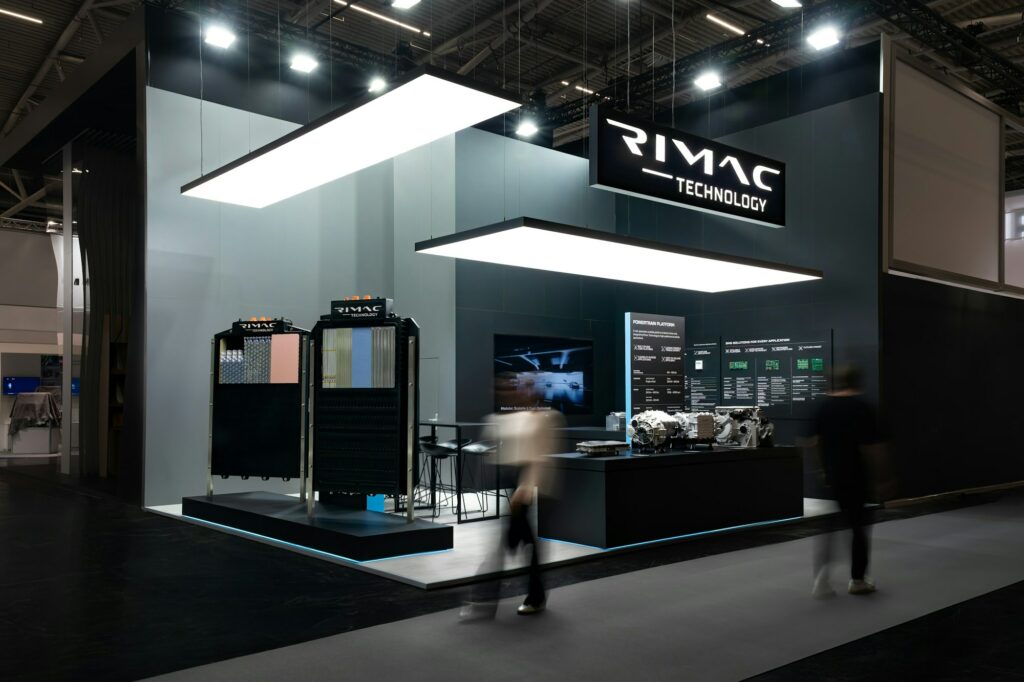
Rimac, known for its electric hypercars, has just unveiled a new solid battery and ultra-powerful electric axles. The idea? To become a major technological player in the electric car industry.
Since its creation in 2009 by the young Croatian engineer Mate Rimac, the brand of the same name has rapidly established itself as a key player in the world of electric sports cars. With the Concept One and its 1,200bhp, followed later by the Nevera, which flirts with 2,000bhp, Rimac has made its mark and proved that electrification doesn’t close the door on thrills. The problem? Making a profit selling hypercars isn’t the easiest thing in the world! So the idea of its founder is to add another string to Rimac’s bow by becoming a technology supplier for other manufacturers, using its cars as a showcase.
Very promising solid state batteries
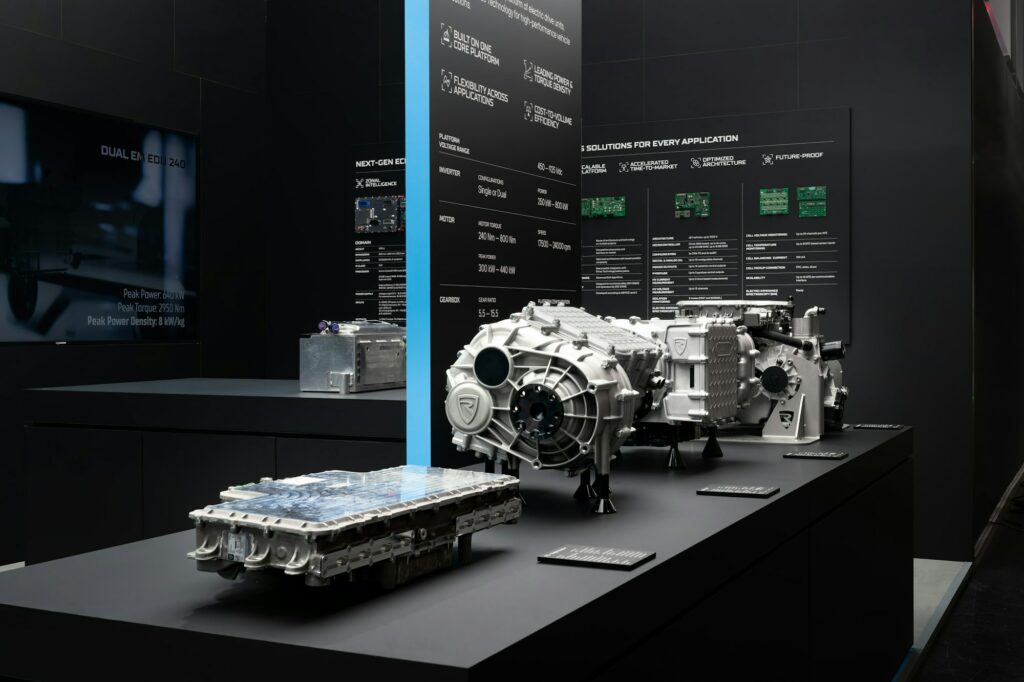
This autumn, the manufacturer has announced a new solid-state battery. Developed in partnership with ProLogium and Mitsubishi Chemical Group, it has a capacity of 100 kWh and an energy density of around 260 Wh/kg. That’s not bad, but it’s even better when you consider Rimac’s promise of a recharge time of 10-80% in less than seven minutes.
Credit: Rimac
And this is not just a concept or a manifesto, but a presentation ahead of the commercial launch in 2027. While solid batteries are still relatively rare on the market, if Rimac meets the deadline, it will be one of the pioneers in this segment. This is a strategic positioning, since solid batteries are more compact and therefore offer greater range for the same weight as lithium-ion batteries. For many observers, solid batteries represent the future of the electric car.
A major commercial power?
In addition to its future solid-state batteries, Rimac also presented its new generation of electric axles called Sinteg 300 and 550. These are engineering monsters that can deliver up to 11,000 Nm of torque to the wheels. It’s totally insane, and once again, it could convince many manufacturers, especially those looking for high performance, to choose the Croatian manufacturer.
Credit: Rimac
Starting out by producing spectacular hypercars and making a name for himself in the sun, Mate Rimac, like a good engineer, has decided to use the fame he has gained from his cars to start designing parts, starting with batteries, axles and engines. It’s certainly more profitable than selling fifty Nevera…
Founded in 2016, SERES has, in just a few years, established itself as a leading player in electromobility. First through its commercial success as a manufacturer under the AITO name, then through a strategic partnership with Huawei. Today, SERES is setting its sights on Europe, presenting its ultra-efficient ‘Super Range-Extender’ system at the IAA Mobility trade fair in Munich.
The story of SERES is a good illustration of the extent to which the Chinese automotive industry has been able to reinvent itself at breakneck speed. Founded in 2016 as an electric mobility brand in the global sense of the term, the company has found a major partner: the giant Huawei. It was with the flagship of Chinese tech that SERES developed AITO, a local manufacturer that enjoyed almost immediate success (750,000 cars sold in its first four years of existence – that’s amazing) thanks to its high-end positioning, which has since been fully acquired by Huawei in 2023. Relations are still very good between all these companies, which are now cohabiting in the same universe, linked by partnerships.
SERES, long-term autonomy and vision
Today, SERES, through its SERES Power branch, focuses mainly on the design and manufacture of electric motors, in particular for the famous extended-range electric vehicles (EREVs) that are a big hit in China. These cars use small combustion engines, powered by petrol, which, instead of driving the wheels, act as generators to recharge the batteries. SERES was at the IAA Mobility trade fair in Munich to present a new development in these systems.
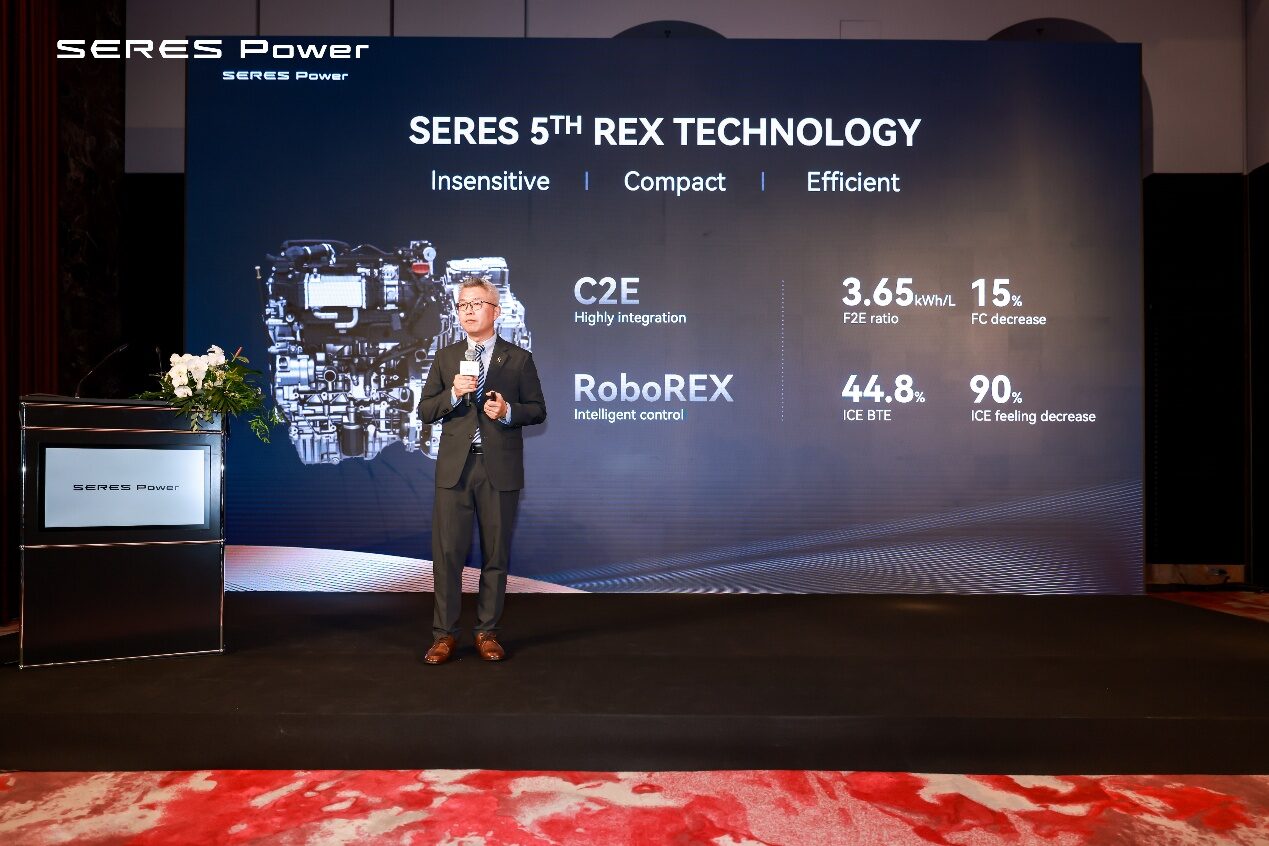
The ‘Super Range-Extender System’, whose name sounds like something out of a Marvel film, uses in-house RoboREX technology. According to SERES, its active energy management enables it to reduce fuel consumption by 15%, cut noise by 90% and deliver a spectacular output of 3.65 kWh per litre of fuel. All this with a maximum energy efficiency of almost 45%, when most current petrol engines struggle to exceed 35%.
Credit: Seres
This presentation in Europe is not insignificant. EREVs are not yet very popular on our side of the world, but this seems to be mainly due to lack of recognition, the rarity of models and the absence of this type of vehicle in the catalogues of European manufacturers. With some 3,900 patents to its name and 132% growth over the last year, SERES is determined to change the situation and add new industrial partners to its already impressive portfolio. It’s a story to keep an eye on, because at a time when the European electromobility market is in the throes of transition, when the vagueness surrounding the ban on 100% internal combustion is persistent, when the installation of recharging stations is still too sporadic and, above all, when range is the most persistent factor in motorists’ hesitation to switch to electric vehicles, range extenders are emerging as a very interesting solution.
Young Turkish manufacturer Togg took advantage of the IAA Mobility 2025 show in Munich to announce its imminent arrival on the European market, starting with Germany. As the spearhead of Turkey’s industrial revival, Togg is aiming to win enough market share to first become profitable and then expand on a large scale.
Turkey is doing its utmost to achieve a balanced trade balance. Still too dependent on imports despite its strong agriculture and status as a major industrial hub, the country has set itself the task of continuing to develop this second point. So, in 2019, the government unveiled the start-up Togg, an acronym for “Türkiye’nin Otomobili Girişim Grubu“, Turkey’s first national manufacturer. A small revolution that will enter its second phase in 2025: internationalisation.
Germany as a gateway for Togg
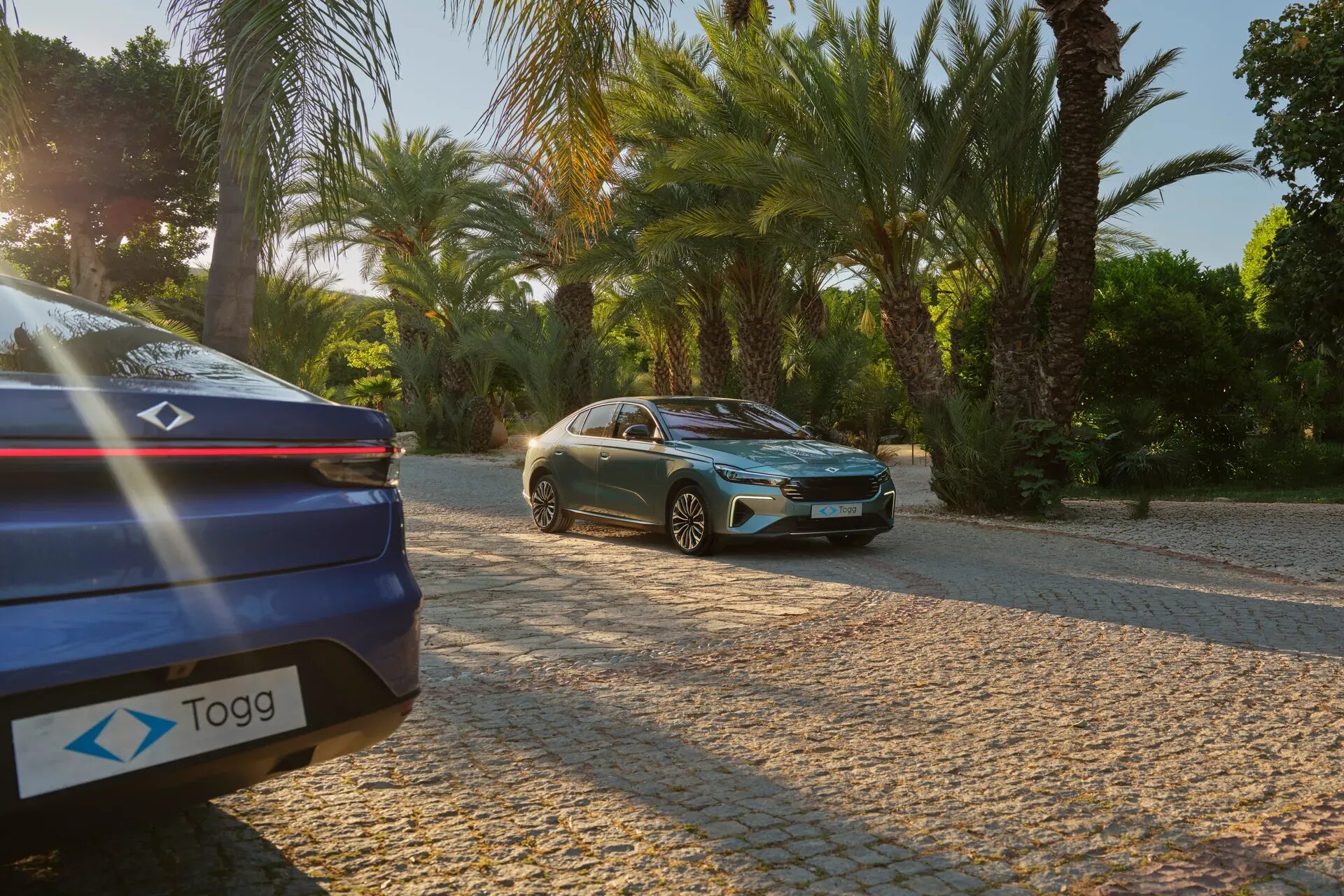
At the IAA Mobility show in Munich, Togg announced the imminent arrival in Germany of its two 100% electric models: the T10X SUV and the T10F saloon, whose design, inspired by BMW’s lines, could appeal to German customers who are already well used to them. And it’s in the locals’ interest to like them, because Togg’s development, and even survival, depend on it. According to Reuters, the manufacturer needs around 200,000 sales a year to reach profitability. Its domestic market, despite respectable results with 30,000 units sold in 2024, will not be enough to ensure Togg’s long-term growth. Germany is therefore de facto the priority market for the young manufacturer, providing both a potential springboard and a gateway to the rest of Europe.
The T10F saloon. Credit: Togg
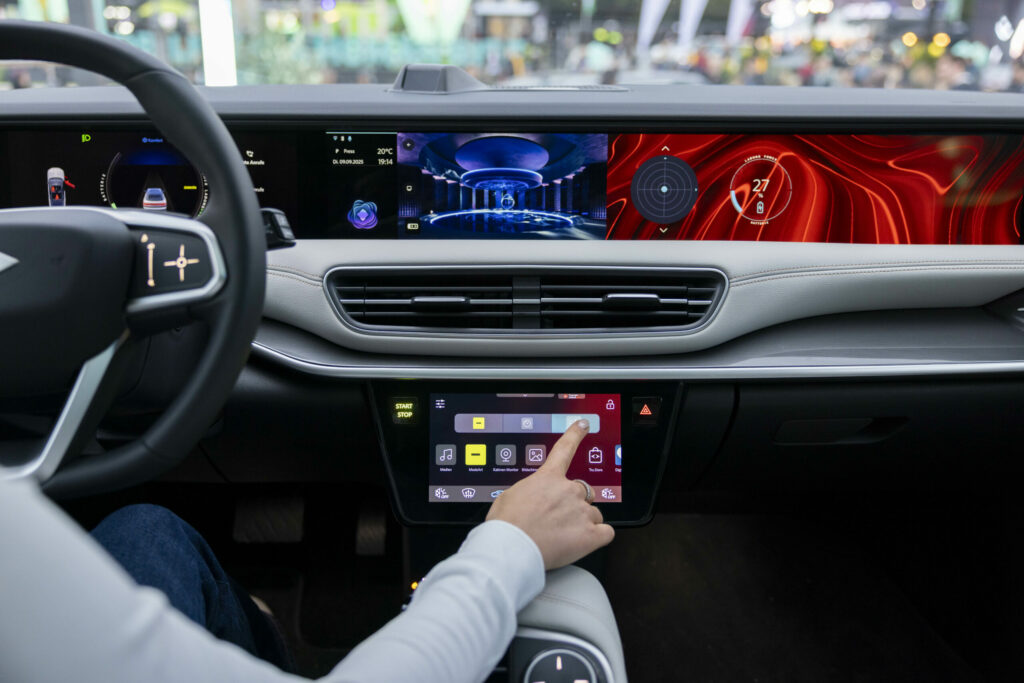
But Togg didn’t just announce its arrival in Germany. The manufacturer has also sprung a surprise by tackling another field that is becoming increasingly essential: artificial intelligence. Can.ai, its in-house AI platform, has been developed in partnership with Microsoft Turkey, from whom it borrows the Azure cloud, and incorporates technologies from OpenAI, from whom ChatGPT is derived. While it responds to voice commands, as is the case in almost all new vehicles, this virtual assistant “makes predictions and acts proactively in the best interests of users“, as Togg puts it. This ‘hands-free’ support is summed up by the name of its interface, ‘ZeroTouchUI’.
The Can.ai platform presented at the 2025 Munich Motor Show. Credit: Togg
It now remains to be seen what practical applications this artificial intelligence will have in driving, but on paper, and on test at the Toog stand in Munich, it looked promising. And that’s at least what it will take to stand out in an already crowded German market. While the Togg vehicles offer a classic design that has proved its worth, a decent range – 500 and 600 km respectively for the T10X and T10F – and this new AI assistant that promises to be revolutionary, they should be priced at between €45,000 and €50,000, putting them up against the Audi Q4 e-Tron and BMW iX2, among others… We’ll have to hang on!