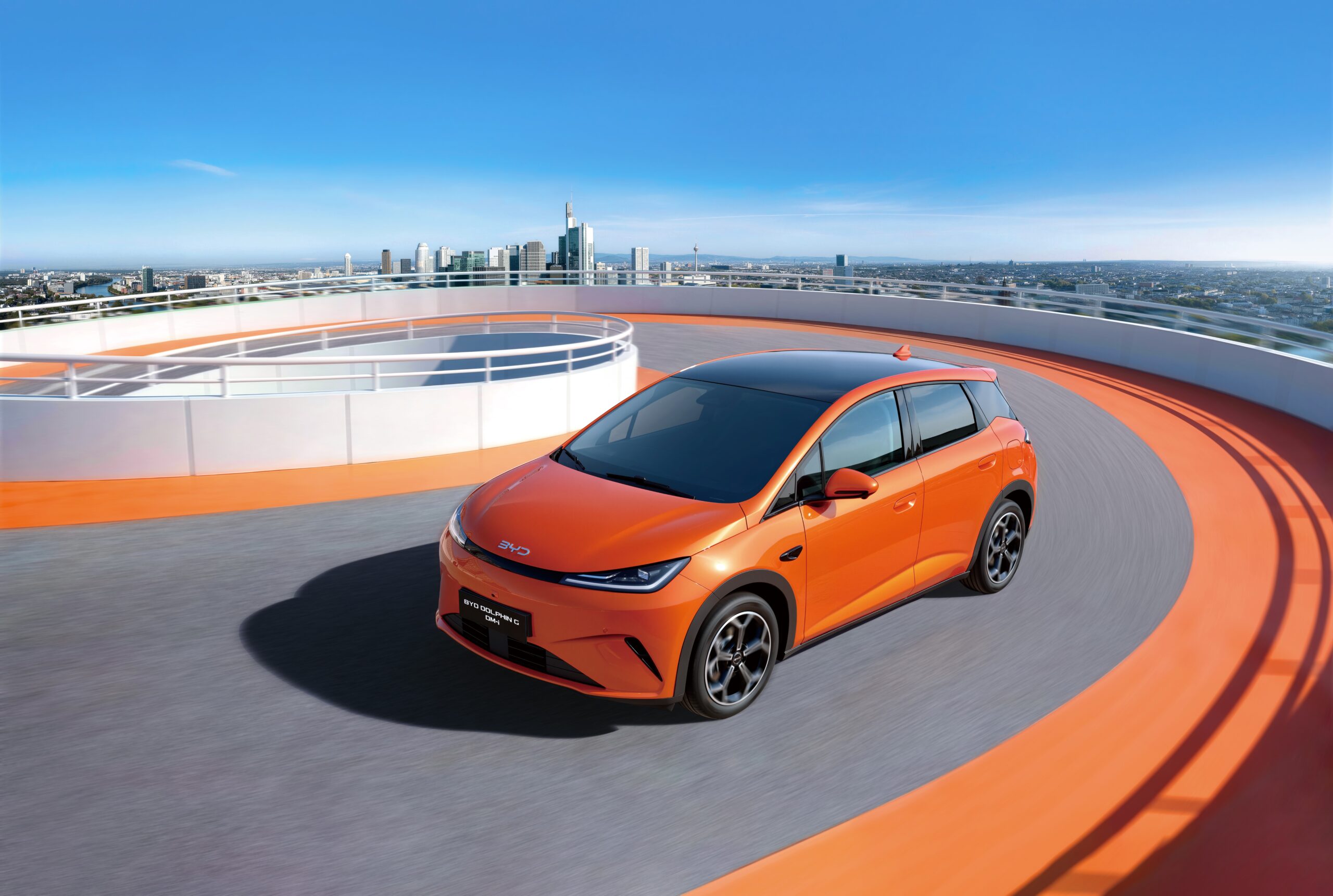
Car manufacturer BYD and its premium brand Denza will be exhibiting at the upcoming Paris Motor Show in October. This announcement confirms that Europe remains at the heart of the Chinese giant’s product offensive. As such, the Dolphin G DM-i could well steal the limelight from the Renault Clio and Toyota Yaris, the queens of our cities. This plug-in hybrid city car promises a range of 1,000 km on a single tank of petrol. This is a first for a model in the B-segment, which is very popular here.
Photo credit: BYD
First model developed for markets outside China
The BYD Dolphin range already includes the compact electric saloon, which competes with the Renault Megane e-Tech and VW ID.3, and the Dolphin Surf, which is also 100% electric, smaller in size, and rivals the Renault R5 and Citroën e-C3. Now slotting in between these two models is the Dolphin G, a versatile 4.16-metre city car. In other words, the perfect size to take on the stars of the B-segment: the Renault Clio, Toyota Yaris and Peugeot 208. BYD is placing a great deal of faith in this car, which has been specially developed for markets outside China, where there is demand for compact, affordable, easy-to-drive and economical cars. But above all, the Dolphin G will boast a significant advantage under the bonnet: DM (dual mode) ‘Super Hybrid’ technology, which enables the zero-emission driving of a 100% electric vehicle whilst retaining the flexibility of a hybrid for long journeys.
Photo credit: BYD
1,000 km range
In short, the Dolphin G is expected to feature the DM-i architecture already familiar from the range, namely a petrol engine that recharges a battery (7.8 kWh or 18 kWh), as in the Atto 2 DM-i SUV. Wheel drive is provided by a front-mounted electric motor (sometimes assisted by the combustion engine for more powerful acceleration). As a result, this plug-in hybrid technology (the car can also be plugged into a charging point) can deliver a range of up to 1,000 km on a single tank of petrol. Given the current sharp rise in fuel prices and the fact that electric city cars are still too expensive, this solution comes at just the right time.
Photo credit: BYD
A unique offer, a winning strategy?
Whilst BYD has not yet released the exact technical specifications for the Dolphin G, the other DM-i models in the range can travel 40 km in all-electric mode with the smaller battery (7.8 kWh) or nearly 90 km with the larger battery (18 kWh). Compared to its rivals such as the Clio, Sandero or Yaris, which are available as standard hybrids, the Dolphin G therefore has a significant advantage in terms of fuel economy and an unbeatable range. BYD is even making a rather revolutionary new offering in this B-segment, which is highly competitive in Europe. Whereas ‘Super Hybrid’ technology was previously reserved for larger SUVs or estate cars, it is now making its debut in a compact, versatile car. This is a market with very high sales volumes – enough to whet BYD’s insatiable appetite.
Photo credit: BYD
Attractive price
In contrast, the Dolphin G’s lines are very conventional and its styling is designed to be universally appealing. However, its price, which has not yet been announced, is likely to attract attention. It could start at around €25,000, which is slightly less than the Atto 2 DM-i SUV. Sales will begin this summer, with the first deliveries scheduled for the third quarter of 2026. The city car is likely to be one of the stars of the Paris Motor Show, starting on 12 October, at the BYD stand. The manufacturer is returning to Paris for the third consecutive year and is bringing its premium brand Denza, whose recent Z9 GT and ultra-fast charging system will be the must-see highlights at the show.
The news was confirmed during the presentation of Stellantis’ “FastLane 2030” plan. In 2028, Citroën will launch a revival of its famous 2CV with an electric motor, as part of the roll-out of an E-car range of small, affordable models across the entire group. This new iteration of France’s most iconic car is already sparking the imagination of enthusiasts, but will it be enough to revive the chevron-badged brand, which has fallen somewhat behind other manufacturers within Stellantis?
Photo credit: Citroën
The return of a folk legend
Almost 80 years after the launch of the legendary Citroën 2CV (in 1948), Citroën has finally confirmed what many had hoped for but never really believed would happen: the return of one of the most iconic cars in history. But this will be neither an opportunistic neo-retro exercise nor a simple marketing reissue, as this future 2CV will be electric, affordable and designed as a modern response to new forms of mobility. It is a bold gamble, but one that reflects the brand’s ingenious character: “Reinventing the 2CV of tomorrow is an immense challenge and responsibility,” says Xavier Chardon, Citroën’s CEO. “The original 2CV was never designed to become an icon. It became one because it offered people greater freedom. The new 2CV will carry on this spirit, not out of nostalgia, but by reinventing its simplicity and accessibility for today’s world. Electric. Essential. Affordable. Human. It marks the return of an optimistic vision of progress.”
Photo credit: Citroën
A philosophy rather than a design
Citroën therefore has no intention of replicating the round, friendly ‘face’ of the car that was originally known by the code name TPV (Toute Petite Voiture), but rather of evoking and reinterpreting ‘the spirit of the Deuche’. From a manufacturing perspective, the cost of producing the bodywork exactly as it was would alone prevent the car from being offered at a low price. At a time when manufacturers are drawing on their heritage to revive successful cars – such as Fiat with the 500 or Renault with the R5 – Citroën will not be able to follow this trend, despite the evocative image released alongside the announcement.
The future model will build on the core strengths that made the 2CV such a success: lightness, versatility, ease of use, affordability and a strong personality. Behind the scenes, Citroën seems to be seeking to answer a question that has become central to the automotive industry: how can we make electric cars desirable without making them unaffordable? Citroën’s CEO sums up this ambition: “True innovation is not about adding more and more, but about improving lives and focusing on what really matters.”
Photo credit: Citroën
An electric anti-SUV?
Unlike other manufacturers at present, Citroën will therefore not be producing a trendy urban SUV that is heavy, more powerful and more expensive. The example of the recent Renault R4, marketed as a small SUV that bears no resemblance to the versatile and practical car of the past, illustrates this point. Its sluggish sales prove that a marketing concept alone is not enough to attract the crowds. On the other hand, the future 2CV is set to launch the ‘E-car’ category, the Stellantis group’s project for compact, lightweight and affordable electric vehicles. The specifications thus echo those of the original TPV from the 1930s: a simple, robust and economical means of transport for the masses. This future Citroën could thus become one of the symbols of electric cars finally becoming popular and accessible to Europeans in particular.
Photo credit: Citroën
Citroën ‘demoted’ within Stellantis
Whilst we wait to see the design of the 2028-generation 2CV, this announcement – however upbeat it may be – should not obscure the fact that Citroën has been sidelined under the ‘FastLane 2030’ plan. Within the Stellantis group, the chevron-badged brand has effectively been ‘demoted’ to the status of a regional brand, like Opel or Alfa Romeo. In other words, Citroën products will not benefit from the latest innovations, nor from the largest investments reserved for the four so-called ‘global’ manufacturers: Peugeot, Fiat, Jeep and RAM. The popularity of Citroëns cannot mask the fact that sales have been slumping for several years: 350,000 units sold last year in Europe, its main market, compared with one million annual sales in the early 2000s. It is also likely that the 2CV will be produced abroad, in one of Stellantis’ Italian or Spanish factories (where the small Fiat Panda or entry-level Opel models are made), in order to reduce costs.
Photo credit: Citroën
A strategy consistent with the ë-C3
Nevertheless, this comeback hasn’t come out of the blue. For several months now, Citroën has been rolling out a series of initiatives focused on affordable electric vehicles, notably with the Citroën ë-C3, which meets motorists’ everyday needs. It is one of the ‘star’ models of the social leasing scheme (EVs for less than €100 a month) launched in France last year. Another model that has found a new audience is the AMI. A small, licence-free electric car with limited top speed, it is very popular with young students in suburban areas. The future 2CV is therefore expected to slot in between these two models. To appeal to buyers, its profile will need to be less status-oriented, more emotional and potentially more disruptive than current electric city cars.
The question remains: what impact will the return of the 2CV have? This is a major challenge for Citroën. Revamping the 2CV amounts to rethinking a cultural icon as much as an automotive one. With over 5 million units produced between 1948 and 1990, the “deuche” remains associated with a very French idea of freedom, simplicity and non-conformity. In other words, the exact opposite of the arrival of small electric city cars, imposed by European regulations.
Copyright William Crozes @ Continental Productions
See you at the 2026 Paris Motor Show
Citroën invites you to the Paris Motor Show in October 2026 to discover the first concrete details of the project. It will no doubt be a concept car that will be scrutinised for its design, its nods to the past and its homage to the original 2CV. Further information on the platform, range and price will be provided. We can expect specifications in line with those of the new electric Renault Twingo in the A-segment. An entry-level price of around €15,000, a small battery offering a range of 250 km (or more), and technical innovations and manufacturing processes sourced from China (through the Leapmotors partnership with Stellantis) to reduce development time to under two years. If Citroën succeeds in its venture, the brand could well revive an idea that the automotive industry seemed to have forgotten: making mobility simple, accessible and appealing once again.
The launch of a new Ferrari is always a major event. The fact that it is electric makes it all the more sensational. But did fans and purists anticipate such a radical departure, both in terms of style and technology, with the Luce (‘Light’ in Italian)? An imposing model that is aesthetically difficult to describe, remarkable in its interior design, technically in line with current electric sports cars, and excessively expensive. Introducing a car that redefines electric luxury and must establish its own standards in the face of new rivals from Asia.
Photo credits: Ferrari
Luce: an Apple spin-off for the automotive industry?
Unveiled in Rome, the Ferrari Luce could be likened to an Apple-inspired automotive product, such is the influence of the design conceived by Marc Newsom and Sir Jony Ive—the designer behind the iPhone and Apple Watch—which is evident in its presentation. Aesthetically, this monolithic, streamlined shape may come as a shock to those accustomed to the taut lines, generous curves and elegant forms of entire generations of Ferraris. These design choices were primarily dictated by the need for aerodynamic efficiency. Like the windscreen wipers positioned vertically on the windscreen, it is inelegant but necessary. Airflow is thus channelled from the nose to the roof and via black lacquered side vents around the wheels. The very clean lines symbolise the technological marvel beneath this bodywork. Measuring 5.02 m in length (5 cm longer than the Purosangue SUV), 2 m wide excluding the wing mirrors and 1.54 m high, the Luce is a sort of crossover that is part saloon, part MPV and part coupé. A few details, such as the round rear lights and the yellow logos on the sides, serve as a reminder that this is indeed a Ferrari.
Photo credits: Ferrari
More innovative and inspiring on board
The Luce is the first five-seater Ferrari in history. A unique feature is that the three rear-seat passengers enter via rear-hinged doors, which makes access much easier. Thanks to its electric powertrain, the long wheelbase (2.96 m) and the absence of a central transmission tunnel provide a level of interior space unprecedented in a Ferrari. The same goes for the XXL boot size: 597 litres, a record for a Prancing Horse model.
But it is at the front that the design is radically new for a Ferrari. The approach is intended to be very high-end neo-retro. The steering wheel has a slim rim, reminiscent of 1960s racing cars. The materials used, such as recycled anodised aluminium, Corning® Gorilla® Glass and premium leather with Alcantara-lined storage compartments, contribute to this concept of transforming the car into an object of desire. The dials are digital but retain a needle; only the backgrounds change on demand.
Photo credits: Ferrari
It’s the little things that matter
In addition to the attention to detail in the finish and the perceived quality of the materials and assembly, a few ergonomic details demonstrate that Ferrari is entering a new dimension. The ignition key, a small rectangular control, slides into the centre of the centre console and turns black when the engine is started, as if to symbolise the connection between the driver and the car. The adjustable centre console (which nevertheless retains physical controls) draws its inspiration from digital interfaces, as does the rear control panel, which displays real-time driving information to passengers.
On the overhead panel, positioned much like in an aircraft cockpit, a “Launch Control” pull-cable lever is used to activate the standing start procedure. Finally, the steering wheel features both the famous “Manettino” with five driving modes (Ice, Dry, ESC off, etc.) and the new “e-manettino” with three settings (Range, Tour, Performance: power, torque curve and drive mode) to select the most appropriate use of energy.
Photo credits: Ferrari
Average electric technology
Designed and manufactured in Maranello, the Italian brand’s home base, the NMC (nickel-manganese-cobalt) battery comprises 210 cells. It has a capacity of 122 kWh and its 800 V high-voltage architecture enables high charging power of up to 350 kW.
The Luce can recharge 70 kWh of energy in 20 minutes, which is about average for its class but is far outpaced by the ‘Fast Charging’ speed of the Chinese Denza Z9GT (9 minutes from 10% to 97%). There are no miracles when it comes to the claimed range, which is around 530 km and will likely be significantly lower in real-world use.
Ferrari has fitted four radial-flow motors (as opposed to the axial-flow motors on the Mercedes-AMG GT 4-door). One motor per wheel delivers 310 kW of power and 355 Nm of torque at the rear, and 105 kW/140 Nm at the front. The total power output is 772 kW, or 1,050 hp.
These electric traction motors are combined with an electronically controlled active suspension (derived from the F80 supercar) and a four-wheel steering system, all of which operate in perfect synchronisation. True to its tradition, Ferrari has developed these technologies and their components in-house: from the motors to the batteries. The project involves 60 technical patents to ensure long-term quality and exclusivity.
Photo credits: Ferrari
Performance on a par with its competitors
The Luce delivers over 1,000 hp, with a maximum torque of 990 Nm. Ferrari claims performance figures that are ultimately quite similar to those of its rivals (notably the Mercedes-AMG GT 4-door). It goes from 0 to 100 km/h in 2.5 seconds and from 0 to 200 km/h in 6.8 seconds, with a top speed of 310 km/h. What about the agility of this Italian electric car? All-wheel drive is a first for Ferrari, but it allows the potential of torque vectoring to be harnessed with precision and consistent responsiveness, whilst the torque transfer system and regenerative braking ensure smooth torque delivery and engine braking worthy of a sports car. Dynamic performance should therefore be impressive despite the high weight associated with the floor-mounted batteries (2,260 kg).
Photo credits: Ferrari
Unpublished acoustic work
In Sport mode, an artificial sound is played through the 21 speakers in the cabin. This sound is a balanced blend of the powertrain’s sound and an unprecedented level of acoustic and vibration comfort derived from metal and captured in real time. A sound that is further amplified in ‘Perfo’ mode. Ferrari has therefore chosen not to reproduce the roar of a V8 or V12 engine, but instead demonstrates its commitment to recreating an atmosphere very close to natural vibrations. Inventing a new emotional language: a Ferrari signature in the electric era.
Photo credits: Ferrari
A high price to pay for exclusivity
Ferrari never produces concept cars, and it is risky for such a prestigious brand to launch a completely new all-electric model without going through this prototype stage. This ‘pilot’ model should enable the brand to validate its choices, take into account the reactions of the fan base (which has given this launch a mixed reception) – a very significant factor at Ferrari – compare it with rival technologies, and affirm the brand’s stance on this new energy source.
Then there is the Luce’s sky-high price tag: from €550,000, excluding tax and optional extras. This is both unreasonable and baffling given that its specifications are no better than those of its competitors and even inferior to certain Chinese models. But the Prancing Horse continues to cultivate its exclusivity and its legendary status.
Photo credits: Ferrari
Can Ferrari win people over?
Neither a true supercar in terms of its looks and proportions, nor a long-distance GT, perhaps the Luce should be seen as a new-generation family saloon. But does it retain Ferrari’s DNA? It looks more like a blank cheque given to designers to create a desirable, fantasy version of electric mobility – the car seen as a status symbol seeking a new clientele more inclined towards technology.
Who is this car aimed at? By ditching the combustion engine, Ferrari is challenging the legend with the Luce, for which sales are expected to be low. Some experts estimate that around 1,000 units will be produced each year, representing less than 10% of annual production volumes.
In any case, it is Ferrari’s first response to the growing global trend towards electric mobility. Unlike other manufacturers who are taking a more wait-and-see approach (such as Lamborghini, Porsche and McLaren), the Maranello-based brand is forging ahead and setting out its vision in response to the standards imposed by China.
Even if it means treating this Luce as a full-scale trial run, the aim being to replace it fairly quickly to make way for new technical solutions, as the electric vehicle sector is evolving very rapidly.
In the face of a global slowdown in sales, the Franco-Italian-American group has unveiled an ambitious plan for technological revitalisation focused on innovation (software and AI). More than a hundred new models (including facelifts) will be launched by 2030. Among the 14 brands, Peugeot, Jeep, Fiat and RAM will be the main focus of investment, whilst the other brands will strengthen their regional presence. All will benefit from a new multi-energy platform that will enable significant cost reductions and greater industrial agility.
An ambitious plan to reposition Stellantis within the global automotive industry
At its ‘Investor Day’ held in Auburn Hills, Michigan, Stellantis unveiled ‘FaSTLAne 2030’, an ambitious five-year strategic plan worth €60 billion designed to accelerate its growth, boost profitability and firmly reposition the group within the global automotive industry.
Led by CEO Antonio Filosa, this plan marks a new phase for the Franco-Italian-American manufacturer, with a renewed focus on the most profitable brands, global technologies and a more region-led organisational structure.
“This plan is the result of several months of hard work. It is designed to drive long-term profitable growth. “We want to bring people closer to the brands and products they love and trust,” explains Antonio Filosa. “We are building on exceptional talent, the strength of our global presence, and unique brands that connect and inspire. Finally, the benefits of our ‘win-win’ partnerships strengthen our ability to realise our ambitions.”
Four iconic brands at the heart of the strategy
As the first step in its “FaSTLAne 2030” strategy, Stellantis is streamlining its product strategy around four priority global brands: Jeep, Ram, Peugeot and Fiat. These long-established manufacturers will account for 70% of the group’s product and technology investments, alongside Pro One, the division dedicated to commercial vehicles.
Stellantis also plans to launch more than 60 new models and 50 facelifts by 2030, as part of a wide-ranging multi-energy strategy:
– 29 fully electric (BEV) models
– 15 plug-in hybrids (PHEVs) or extended-range electric vehicles (EREVs)
– 24 conventional hybrids (HEV)
– 39 petrol or mild-hybrid models
The so-called ‘regional’ brands — Citroën, Opel, Alfa Romeo, Chrysler and Dodge — will continue to benefit from the group’s new platforms and technologies, whilst further emphasising their local distinctiveness.
Originally launched as premium brands, DS Automobiles and Lancia will be repositioned as niche brands, managed by Citroën and Fiat respectively. Finally, Stellantis plans to revitalise Maserati with the launch of two new E-segment models. A detailed roadmap will be presented in December 2026 in Modena.
STLA One: the new global ‘multi-energy’ platform
From an industrial and technological perspective, “FaSTLAne 2030” is based on a strategy of standardisation and large-scale sharing of resources. The group will invest more than €24 billion in global platforms, powertrains and technologies. By 2030, half of Stellantis’s production volume will be based on three platforms, including the new STLA One architecture.
This platform is set to merge five existing platforms into a single modular architecture capable of supporting B-segment city cars, C-segment compacts and D-segment family cars. This shared technical platform therefore enables the manufacture of very different vehicles, whilst reusing up to 70% of components. Put simply, a future compact Peugeot, a Jeep SUV or an Opel saloon could share the same basic structure, electronic components and certain mechanical parts.
Objective: to reduce costs and speed up development. Stellantis is therefore aiming to produce 2 million vehicles a year by 2035 and achieve a 20% profit margin thanks to this new manufacturing facility. Above all, however, Stellantis is reaffirming its multi-energy strategy, rejecting the forced shift towards an all-electric future. The group will therefore continue to develop the following in parallel:
As regards electric vehicles, the STLA One is designed for ‘cell-to-body’ integration, meaning that the battery is incorporated directly into the vehicle’s structure. This results in greater rigidity, reduced weight, more interior space and cost savings. Furthermore, this platform will be compatible with an 800 V electrical architecture, enabling ultra-fast charging for the group’s future electric cars.
Artificial intelligence at the heart of Stellantis’ future vehicle
Lagging behind Chinese manufacturers in particular, the group also intends to step up its efforts significantly in the areas of software and artificial intelligence, which account for a significant proportion of the added value of EVs in particular. Three major technological pillars will be established:
– STLA Brain: a new centralised electronic architecture
– STLA SmartCockpit: a new human-machine interface
– STLA AutoDrive: a scalable autonomous driving system
From 2027, these technologies will begin to be rolled out on a large scale. Stellantis aims to have 35% of its global vehicle output equipped with at least one of these solutions by 2030, rising to over 70% by 2035. To accelerate this transformation, the manufacturer is forging a growing number of strategic partnerships with technology firms such as NVIDIA, Qualcomm, Mistral AI and CATL.
Leapmotor, Dongfeng, Tata: Stellantis’s new partners
The other key focus of the plan is industrial partnerships, which are set to develop more rapidly. Through the Chinese brand Leapmotor (in which Stellantis holds a 51% stake in the international joint venture), the group aims to strengthen its competitiveness in the affordable electric vehicle market and pool procurement and manufacturing capacity, particularly at its Spanish plants in Madrid and Zaragoza.
In China, Stellantis is reviving its partnership with Dongfeng to produce new Peugeot and Jeep models for the Chinese market as well as for export. The group is even planning a future European joint venture with Dongfeng, which could get underway soon at the Rennes plant. The site in Brittany, which currently assembles the sole Citroën C5 Aircross, has excess production capacity and would welcome the arrival of a new model – even a foreign one – to ensure the long-term future of the plant and its jobs.
Finally, there is talk of partnerships with Tata and Jaguar Land Rover to boost industrial competitiveness in various regions around the world, such as India and Latin America.
A major industrial restructuring in Europe
To successfully implement this ambitious plan, an industrial reorganisation is required. In Europe, Stellantis plans to reduce capacity by more than 800,000 units through site conversions and industrial partnerships, whilst pledging to safeguard jobs. Peugeot’s historic site in Poissy is one of the factories set to undergo changes. The objective is clear: to increase the capacity utilisation rate of European factories from 60% today to 80% by 2030. In the United States, Stellantis is also aiming for 80% capacity utilisation through increased production volumes.
Drastically reduced development times
Like other major manufacturers, the carmaker aims to reduce the development time for a new vehicle: from the current 40 months to just 24 months. In the medium term, the plan envisages annual savings of €6 billion by 2028, a massive improvement in quality and the increased use of artificial intelligence in industrial operations (more than 120 applications already deployed).
“FaSTLAne 2030” is set to revitalise the international group, which comprises 14 brands, and restore a more proactive momentum following several months of internal tensions and a slowdown in sales in certain markets. Stellantis is now focusing on a more agile organisation, a refocused product range and a technological ramp-up to defend its position among the world’s leading automotive manufacturers.
At the 2026 New York International Motor Show, Hyundai unveiled the Boulder Concept. A body-on-frame 4×4 with a bold design, it offers a glimpse of a mid-size pick-up expected around 2030. But behind the product itself, the Korean manufacturer is primarily posing a strategic question: how does a major player in electric mobility establish itself in a segment that has historically been dominated by internal combustion engines, is highly codified, and has been dominated for decades by the Americans and the Japanese?
source: Hyundai
New York, the right place for this message
Hyundai could have unveiled this concept at a motor show with a stronger focus on technology or electric vehicles. But it chose New York – the market where 4x4s are most successful, given American tastes. Indeed, it is in the US that the Jeep Wrangler, Ford Bronco and Toyota 4Runner are sold, three models that the Boulder is directly targeting, even if it doesn’t name them.
source: Hyundai
The concept builds on the Hyundai Crater, unveiled in 2025, but with an approach that this time seems more structured and closer to actual production. This high-profile unveiling feels more like a statement of intent than a formal exploration.
source: Hyundai
First, the architecture: a separate chassis – a choice with serious implications
The most important aspect of the Boulder isn’t its design. It’s its technical underpinnings. The project is based on a future body-on-frame platform. This term means that the chassis is separate, as is typical of large American 4x4s and pick-up trucks. The manufacturer has promised that this chassis is intended to form the basis of a pick-up truck around 2030.
This choice says something fundamental about Hyundai’s ambitions. Because without a separate chassis, there is no serious towing capability, no real off-road capability, and therefore no real credibility in this segment, where the car is very often a genuine workhorse.
source: Hyundai
As for the Boulder’s powertrain, Hyundai has not yet confirmed any specific engine options. The door remains open to hybrid or electrified solutions, but nothing has been finalised at this stage. What is clear, however, is that the manufacturer is keeping all options open, and that its overall electrification strategy provides a framework for this project.
A design that doesn’t try to please everyone
The Boulder adopts the brand’s “Art of Steel” design language, but takes it in a direction that is radically different from that of the Ioniq or the Tucson (the brand’s best-seller). It’s plain to see: this is clearly not a model with flowing lines, nor one that optimises aerodynamics, nor one with taut surfaces. Instead, much like what Range Rover has achieved with the Defender, we’re dealing with massive volumes, sharp angles, broad and compact proportions, and clearly visible protective elements.
source: Land Rover
For the manufacturer, this is typically a vehicle designed to be practical, and that is precisely what makes it a credible contender in this segment. The interior follows the same philosophy: reinforced materials in high-contact areas, plenty of physical controls, modular surfaces, and a layout designed with outdoor and professional use in mind. Hyundai has also incorporated a digital assistance system designed for off-road driving, an area where the brand can set itself apart from its long-standing competitors thanks to its lead in on-board electronics.
source: Hyundai
What the Boulder tells us about Hyundai’s strategy in North America
It would be simplistic to view the Boulder solely as an SUV concept. It must be seen within the broader context of the Hyundai Group’s roadmap, which aims for 5.55 million global sales by 2030, 60% of which will be electrified vehicles—including hybrid, plug-in hybrid and fully electric models. More than 18 hybrid models are announced for the period up to 2030.
North America plays a central role in this strategy. Hyundai is ramping up local production with the Metaplant in Georgia, which is set to add an additional 500,000 units, bringing the global total to an extra 1.2 million units by 2030.
In this context, the launch of the Boulder signals Hyundai’s desire to move away from its image as a manufacturer specialising in well-finished on-road SUVs, and instead establish itself in segments with a stronger cultural presence in the United States: pick-up trucks and 4x4s.
source: Hyundai
The real question raised by this concept
What the Boulder Concept reveals is the next stage in Hyundai’s American ambition: no longer content to remain in the segments where it is already a familiar presence, but instead taking on a traditional internal combustion engine market head-on with an approach that could, in time, incorporate an electric dimension.
It is an industrial and cultural gamble. The US market for 4x4s and pick-up trucks has not yet made the switch to electric, with adoption levels still limited and very specific expectations regarding towing capacity and real-world range. But Hyundai is betting that by 2030, when the production model based on the Boulder is ready, conditions will have changed. The answer will lie in the product – see you in 2030.
Lagging behind China and the United States, where autonomous (and therefore electric) cars are already a commercial reality, Europe must develop its shared mobility offering without relying on foreign players who are already at the cutting edge of the technology. The aim is to increase the average occupancy rate of cars on the road, roll out a structured system for everyone, and maximise the social benefits that autonomous vehicles can bring. In short, prioritising mobility that benefits the community rather than individual robot-taxi services.
Europe is lagging behind; France sounds the alarm
The High Commission for Planning and Strategy is sounding the alarm over Europe’s lag in the development of autonomous vehicles. A reading of the report drafted by Thomas Matagne, CEO of the start-up Ecov, leaves no room for doubt. European Union countries have only a few dozen autonomous vehicles on the road, in certain selected cities and often as short-lived trials. In contrast, in China and the United States, the technology is already a well-established commercial reality: autonomous vehicle services are freely accessible to the public, and the companies operating them are expanding and becoming increasingly profitable (some autonomous car journeys are already cheaper than a taxi ride in China). Without an action plan, within a few years, there is a risk of becoming a ‘digital colony’. Europeans would be forced to rely solely on these foreign operators to travel safely and to have their mobility data exploited. In other words, a loss of sovereignty in the transport sector.
Autonomous driving for everyone
However, “autonomous driving is for everyone,” explains Thomas Matagne. Private cars account for 81% of the road mileage covered by the French each year. The average occupancy rate of a car, which has five seats, is just 1.6 people per car for all journeys combined and barely 1.07 for commuting. The low utilisation rate is also a weakness: on average, a car is only used 5% of the time.”
The advent of autonomous vehicles therefore presents an opportunity to rethink how we use cars as a means of transport. Indeed, the primary benefit of autonomous vehicles is that they can be shared (Shared Autonomous Vehicles, SAV). Europe could use them as an extension of public transport.
Coordination at European level is on the horizon
On 8 June, transport ministers from the 27 EU member states are set to sign a reciprocal agreement aimed at working together to facilitate the introduction and deployment of autonomous vehicles. This is a first step towards establishing a Europe-wide framework and harmonising regulations and infrastructure. There are many reasons for doing so:
– Road safety: autonomous vehicles should help reduce the number of road accidents
– From an economic perspective, this solution is becoming increasingly attractive. For example, Waymo carries out 500,000 journeys a week in the United States
– Operating costs are expected to fall further as a result of machine training
– The technology is mature and ready for widespread adoption. Waymo plans to launch a commercial service in London in 2026, Pony.ai is set to test Level 4 autonomous vans in Luxembourg, and WeRide is already operating in Belgium, Spain and Switzerland.
From robot taxis to shared public transport services
However, rather than simply opening up the market to individual robot-taxi services—booked and used as an alternative to taxis or private hire vehicles—the European approach could differ from the Chinese or American models. Thomas Matagne therefore suggests implementing a strategy to develop an optimised public transport system, which would offer potential benefits.
Taking the example of a 30-km road used for commuting around the Nantes metropolitan area. Switching to a system of autonomous vehicles designed as public transport would reduce the number of vehicles on the road each day by a factor of four and save €4 billion a year. “In our simulation, which prioritises public transport over private transport, it is possible to increase the occupancy rate of autonomous vehicles and thus maximise their social benefits. Vehicle flows are no longer managed on a journey-by-journey basis for each passenger request, as in the ‘robotaxi’ model, but organised into public transport services (buses, trains, etc.),” summarises the report’s author.
Four key areas of development
In line with this thinking, a number of recommendations will form the basis for discussions among EU Member States:
– Prepare for the practical introduction of autonomous vehicles by developing transport services in poorly served suburban and rural areas. For example, build hubs to link up coach routes, car-sharing schemes and express networks, and create dedicated lanes or priority parking spaces for recharging
– To foster the emergence of two or three European leaders in autonomous driving, in order to secure both the technology and technological sovereignty. These companies will need substantial funding, in the form of both capital investment and public procurement contracts, to be able to compete with their American and Chinese counterparts.
– Invest in and take the lead on road operating system technology, including autonomous vehicles. It is, in fact, only through collective action that road mobility infrastructure can be established and managed.
– In France, identify five to ten pilot areas – encompassing urban, suburban and rural communities – where the large-scale deployment of autonomous vehicles would be authorised, financially supported by the State and fully integrated into the local transport system, from 2026 onwards. The aim would be to focus efforts on ambitious, system-wide projects.
Take the initiative again
Given the speed at which start-ups in Silicon Valley and Chinese firms are rolling out their technologies, Europe’s lag in the development of autonomous vehicles is very real, but not insurmountable. The role of local players is now to take the initiative, change habits, win people over, drive progress and develop a European model for autonomous transport. The challenge is ambitious but not unrealistic, given that this technology is still in its infancy.
The Chinese manufacturer has just rolled the first mass-produced model of its Robotaxi off the production line in Guangzhou. For XPeng, this is more than just a new vehicle; it represents a step towards the commercial roll-out of its autonomous driving services.
source: XPeng
A major milestone for XPeng
On 18 May 2026, XPeng officially announced the roll-off of its first mass-produced robotaxi from the production line at its Guangzhou plant. The announcement marks a new milestone for the Chinese manufacturer, which is already established in the electric vehicle market but is now looking to accelerate its expansion into the autonomous mobility sector.
The company explains that this marks the first time in China that a car manufacturer has succeeded in mass-producing a robotaxi developed entirely in-house. XPeng is not just referring to the assembly of the vehicle, but to the entire technological chain, from microchips to autonomous driving software.
The model is based on the new GX platform and has been designed to meet Level 4 (L4) autonomous driving standards. In practical terms, this means that the vehicle can navigate defined areas on its own without human intervention.
source: XPeng
This project has been in the pipeline since January 2026, when XPeng was granted a road testing permit in Guangzhou. In March, the company established its Robotaxi business unit to oversee product development, R&D testing and operations, thereby accelerating the commercialisation roadmap.
A technical strategy that differs from that of several competitors
One of the major new developments that might (on paper) give sceptics of autonomous driving cause for concern is that, from a technical standpoint, XPeng is taking a different approach to most other players in the sector.
Indeed, whilst many robotaxis rely on LiDAR sensors and highly detailed high-definition maps, XPeng has opted for an approach known as “Vision-Language-Action”. The vehicle relies primarily on cameras and its VLA 2.0 artificial intelligence model to interpret its surroundings and make decisions.
source: XPeng
The manufacturer claims that this architecture reduces the system’s response time to less than 80 milliseconds. The Robotaxi also features four in-house Turing AI chips, which deliver a claimed computing power of 3,000 TOPS.
XPeng’s stated aim is also to simplify the roll-out of the vehicle in different cities. By reducing its reliance on highly detailed city maps, the manufacturer believes it can speed up any future expansion into other markets.
This approach is nevertheless being closely monitored. Some industry players still regard LiDAR sensors as an additional safety measure in certain more complex situations, such as dense fog, heavy rain or poor lighting conditions. In response to this, the company emphasises a dual-redundancy hardware architecture to ensure proper operation in the event of a failure in one of the systems.
source: XPeng
An interior designed for driverless journeys
With no driver on board, the brand with the X logo has taken the liberty of altering the vehicle’s interior layout as well.
XPeng explains that it has focused more on the passenger experience, incorporating a range of special features such as variable-tint windows, ‘zero-gravity’ seats and screens for rear-seat passengers.
The vehicle also features a voice assistant that allows you to control various functions, such as vehicle settings and certain multimedia features, whilst on the move. The aim is quite simple: to transform the cabin into a space that is more focused on transport and less on the traditional driving experience.
China is stepping up its efforts in the robotaxi market, in the absence of Europe
This announcement is part of a broader trend in which China has been seeking for several years to establish a dominant position in autonomous driving, having already significantly consolidated its lead in electric vehicles.
XPeng is thus joining an already well-established ecosystem, alongside players such as Baidu with its Apollo Go service, as well as Pony.ai and WeRide. All are now moving towards the same goal: moving beyond the testing phase and into the gradual roll-out of robotaxi fleets.
source: XPeng
This acceleration stands in contrast to the situation in Europe. Whilst the continent had already fallen behind in the electric vehicle value chain – particularly in batteries, key components and certain in-car software – it now also appears to be lagging behind in Level 4 autonomous driving. Trials are taking place, but they remain limited.
Conversely, China and the United States are already establishing large-scale services, with rising order volumes and strategies for territorial expansion. Against this backdrop, Europe’s long-term technological dependence is likely to continue.
Trials this year, with a target set for 2027
XPeng plans to launch pilot schemes in the second half of 2026 to assess several aspects: technical reliability, user feedback and the economic viability of the service.
The manufacturer is then aiming for fully autonomous operation without a safety operator on board from 2027.
Mercedes and its AMG sports division are making the leap into electric motoring with the unveiling of an impressive grand tourer: the AMG GT 4-door. The German tuning firm has developed an innovative architecture, a high-performance battery based on Formula 1 technology, and a triple-motor setup to enable this pure-bred sports car to deliver up to 1,169 hp (860 kW) of maximum power. The performance of this new benchmark in the segment promises to reach new heights, such as accelerating from 0 to 100 km/h in just 2.1 seconds!
A masterpiece of engineering
Mercedes was expected to unveil the electrified versions of its ultra-sporty models developed by its tuning division, AMG. The four-door GT coupé, which has just been unveiled in Los Angeles, is truly impressive. Building on the CONCEPT AMG GT XX technology demonstrator presented last year, the production model looks set to become the benchmark in the high-performance electric segment. There are numerous innovations, starting with the AMG.EA architecture, specially developed in Affalterbach, which features an all-wheel-drive concept with three ‘axial-flow’ motors (two on the rear axle, one at the front) combined with a high-performance battery. This 800-volt battery incorporates some of the components found in the battery pack used in F1, with directly cooled cylindrical cells (thanks to a liquid that circulates continuously between the cells). This unique battery allows for better energy absorption, and the power density delivered is higher than normal. Advantages: it can deliver rapid, sustained and reproducible instantaneous power. Mercedes thus promises sprint performance over marathon distances, often the weak point of electric power compared to combustion engines.
Performance on a par with the finest supercars
The combination of the three more compact engines thus delivers up to 860 kW of power – the equivalent of 1,169 hp – and a massive 2,000 Nm of torque. In its sportiest configuration, the AMG GT 4-door is capable of accelerating from 0 to 100 km/h in 2.1 seconds and from 0 to 200 km/h in 6.4 seconds. The top speed is 300 km/h, provided the ‘AMG Driver’s Package’ is selected. The ‘boost’ provided by the electric power lasts for over a minute continuously. Alongside these figures, worthy of the finest supercars, come encouraging results in terms of range, AMG’s other key focus in electric vehicles. The development of the AMG XX Concept prototype recently proved this. At the Nardo test track in Italy, the vehicle completed a “round-the-world” journey at very high speed, covering more than 40,000 kilometres (without stopping, except to recharge), in 7 days and 13 hours. This achievement validated the technological choices made and broke 25 electric long-distance records along the way. As a result, “with the AMG GT 4-door Coupé, we are taking performance and endurance to a whole new level and pushing the boundaries of electric mobility,” says Jörg Burzer, Chief Technology Officer at Mercedes-AMG.
Charging speed and driving experience
Mercedes-AMG has also focused on reducing the time spent at the charging station. Thanks to a 600 kW capacity (optional AMG Performance Charger), the charging speed allows for 460 km of range to be restored in 10 minutes. The standard charging cycle from 10% to 80% takes just 11 minutes. Spending as little time as possible at the charging point is, in fact, the other key challenge for an electric GT. It is worth noting that the battery capacity is 106 kWh net.
In terms of the driving experience, Mercedes has developed the AMG Race Engineer. This is a suite of connected software designed for drivers who wish to make the most of the car’s dynamics in line with their driving style. Whether it’s throttle response, traction or cornering behaviour, three dials on the centre console allow the desired level of response to be adjusted across nine settings. Combined with these settings, the AMG Active Ride Control suspension offers optimal weight distribution, semi-active roll stabilisation and maintains a balanced road holding that strikes a balance between the rigidity expected of a sports car and the comfort of a grand tourer. Together, these electronic systems enhance the agility of a very heavy (2,460 kg kerb weight) and long (5.09 m, with a wheelbase of over 3 m) car and should make it easier to handle dynamically, particularly on the track.
Athletic and aerodynamic design
In terms of styling, the AMG-GT 4-door coupé boasts an athletic and sporty design: with taut lines and the active Aerokinetic system to maximise downforce, the drag coefficient is 0.22, a level of aerodynamic efficiency that helps keep fuel consumption low (around 21 kWh/100 km).
Inside the cabin, the atmosphere is high-tech and sporty (backlit air vents, carbon fibre trim). The ergonomics are designed around the driver, who sits very low and faces a flat-bottomed multifunction steering wheel with touch controls and rotary knobs for selecting the driving mode without taking their eyes off the road. Three screens span the full width of the dashboard, serving both driver and passenger, highlighting the blend of cutting-edge technology that bridges the gap between extreme sport and ultimate luxury.
Two versions of the electric AMG GT
On a more light-hearted note, an artificial V8 engine sound is played through the speakers. This immersive sound, which includes a brief interruption in power delivery with every simulated gear change, promises to be authentic enough to satisfy fans of powerful V8s. Whether that’s the case is down to individual taste.
Mercedes is launching two versions of this four-door AMG GT. The sportier AMG 63 delivers a constant 721 hp and a range of just under 600 km. The GT 55 version, meanwhile, offers a constant 510 hp and a longer range (up to 700 km). Both are powered by the fully variable 4Matic+ all-wheel-drive system.
Towards a new era
Whilst the price of this AMG-GT four-door coupé is not yet known, it is expected to go on sale in a few days’ time. This new model, which is already being billed as ‘iconic’, is therefore Mercedes’ response – a rather convincing one on paper – to Porsche, Tesla, Xiaomi and YangWang (BYD). These manufacturers all present a different vision of high-performance electric vehicles. But what they have in common is proving that electric power can deliver unprecedented and radical driving experiences thanks to innovative technology and revolutionary designs, with the aim of ushering in a new era – provided customers are on board…
Stellantis has announced the launch of Project E-Car, a programme aimed at developing a new generation of small electric cars manufactured in Europe. Expected from 2028 onwards, these future models are set to enable the group to re-enter a segment that has gradually been neglected in recent years: that of affordable city cars.
source: Simon Wohlfahrt / AFP
A project rather than a one-size-fits-all approach
Over the past few years, European car manufacturers have gradually moved away from the most affordable models in favour of larger, more profitable vehicles. As a result, the range of affordable small cars available in Europe has shrunk significantly.
With its E-Car project, Stellantis has announced its intention to return to this historic market. But contrary to what the name might suggest, this is not a single model. Instead, the group describes E-Car as a new family of compact and affordable electric vehicles, set to be produced by several brands in its portfolio.
In its press release, the manufacturer describes these future vehicles as “electric, compact, innovative and affordable” models, developed with a view to “mobility for all”.
source: Stellantis
In particular, the group aims to address a market reality: affordable small cars have gradually become scarce in Europe, leaving a gap between city cars and more versatile—but also more expensive—models.
A return to Stellantis’s historical roots
The announcement also marks a return to basics for several of the group’s brands. For decades, Fiat, Citroën and Opel have built part of their identity on simple, compact vehicles designed for the masses. Notable examples include the Fiat Panda and Fiat 500 at Fiat, the Citroën 2CV and Citroën AX at Citroën, and the Opel Corsa at Opel. These cars have long been based on a fairly similar formula: compact dimensions and controlled costs. But in recent years, manufacturers have gradually shifted their focus towards larger, more profitable models.
source: Stellantis
Antonio Filosa, CEO of Stellantis, highlights this very point in the press release: “Customers want to see a return to stylish small cars, proudly manufactured in Europe, that are both affordable and environmentally friendly.”
The E-Car project therefore appears to be seeking to revive this philosophy, albeit adapted to the current constraints of electric vehicles.
source: Citroenvie
Several brands could be affected
Stellantis confirms in its press release that several brands will be involved in the project, without specifying which ones. There is already much speculation about which brands are most likely to use this future architecture.
At Fiat, some are speculating about a future successor to the Fiat Panda or the current Pandina. At Citroën, these future models could potentially fill the gap between the Citroën Ami and the Citroën ë-C3. Opel could also be involved.
source: Stellantis
Production is scheduled to begin in Italy from 2028
Whilst we do not yet know much about these future “low-cost” vehicles, what we do know for certain is that the first vehicles to emerge from the E-Car project will be produced from 2028 onwards at the Pomigliano d’Arco plant in Italy.
This seems like a sensible choice given the factory’s track record. Indeed, it has a long history of manufacturing popular, high-volume models. It was here, in particular, that certain generations of the Fiat Panda were produced.
Stellantis says it intends to capitalise on this industrial expertise in order to handle potentially large volumes.
source: Stellantis
A response to the new dynamics of the European market
The launch of the E-Car project comes at a time when several manufacturers are gradually returning to the small electric car segment.
Indeed, at Renault, it is the Renault Twingo E-Tech that occupies this segment, whilst at neighbouring German manufacturer Volkswagen, it has been announced that a more affordable electric city car is set to be launched.
At the same time, Chinese manufacturers are continuing to make headway with electric vehicles offered at competitive prices. Notable examples include the BYD Dolphin and the BYD Seagull from BYD, the MG4 Electric from MG, and the Leapmotor T03, which is distributed in Europe via Stellantis.
For Stellantis, these future electric cars could therefore also serve as an industrial and commercial response to this new competition.
source: Stellantis
The price is still unknown, but the direction seems clear
At present, Stellantis has not released any information regarding range, battery capacity or performance. The manufacturer simply promises “cutting-edge electric technologies” developed in collaboration with various partners in order to speed up the time to market.
No official price has been announced either. However, several analyses suggest a price point that could approach the €15,000 mark, a threshold that has become particularly strategic in the European market for small electric cars.
For now, the announcement mainly marks the launch of an industrial project. As for the future models, they are yet to be revealed.
Four years after acquiring ALPINA, BMW has finally unveiled its concrete vision for the brand’s future. Unveiled at the 2026 Concorso d’Eleganza Villa d’Este, the BMW ALPINA Vision is more than just a concept car: it outlines the new identity of a brand set to position itself between BMW and Rolls-Royce, with a distinctive blend of performance, comfort and understated luxury at its core.
source: BMW
The BMW ALPINA Vision seems to be taking a different approach.
BMW has probably just answered a question that many enthusiasts have been asking themselves for several years: what will the ALPINA of the future actually look like?
Since the announcement of BMW’s takeover of the German manufacturer in 2022, followed by its official integration into the group in 2026, the brand’s future has been the subject of much speculation. Some feared a gradual dilution of its identity, whilst others were already imagining it as nothing more than a luxury version of existing BMW models.
We’ve known more since 18 May 2026, at the Villa d’Este Concours d’Élégance. A concept car was unveiled, taking the form of an imposing coupé measuring 5.20 metres in length. Its silhouette is reminiscent in some respects of the 8 Series, which is set to be discontinued with no real replacement announced as yet.
source: BMW
More than just a top-of-the-range BMW: a new collaboration between BMW and Rolls-Royce
The ambition is now much clearer than before: BMW wants to position ALPINA as a brand that bridges the gap between its traditional premium models and Rolls-Royce.
Oliver Viellechner, Head of BMW ALPINA, said: “BMW ALPINA occupies a unique position within our portfolio, between BMW and Rolls-Royce, at a time when we are seeing growing potential in the high-end luxury segment.”
source: LinkedIn
The positioning is particularly interesting. On the one hand, BMW already has top-of-the-range models such as the 7 Series and X7. On the other, Rolls-Royce remains positioned in an ultra-luxury segment where the passenger experience far outweighs the driving experience.
ALPINA will now have to occupy this middle ground: more exclusive than a standard BMW, yet more focused on driving pleasure than a Rolls-Royce. This also indirectly brings the German group’s strategy closer to that of Mercedes with Maybach.
A design that revives several of the brand’s historic design elements
Visually, BMW has not sought to create a complete break with the past; on the contrary, the BMW ALPINA Vision is full of historical references.
The long bonnet, the elongated roofline, the low-slung proportions and the famous shark nose are immediately reminiscent of certain BMWs from the 1970s, particularly the early E24 6 Series models.
source: carjager
The famous ALPINA 20-spoke alloy wheels are also making a comeback, as are the side trim strips that have featured on the brand’s models since the 1970s.
But bear in mind, this is 2026, so the approach is much more modern. Decorative lines are now integrated directly beneath the paintwork, the exterior surfaces feature carefully crafted contrasts between dark metallic finishes and lighter shades – likely inspired by details from historic models such as the BMW 507 – and the light signatures have become extremely slim.
source: BMW
Maximilian Missoni, Head of Design at BMW ALPINA, explains this philosophy: “Every detail reflects a genuine quest for substance, whether in terms of engineering, materials or the story the vehicle tells.” The idea, therefore, is not to pile on ostentatious features, but rather to offer a more understated form of luxury.
source: BMW
An interior designed more for grand touring than as a showcase for technology
This philosophy is also evident inside the car, where the cabin is designed with a clear focus on comfort and long-distance driving. The interior architecture is based on clearly defined spaces, with a distinct separation between the different zones, rather than a fully digitalised or uniform design. It features the new BMW Panoramic iDrive interface from the Neue Klasse range, which combines a head-up display at the base of the windscreen with a central screen that spans the full width of the dashboard, creating a sense of visual continuity.
source: BMW
The coupé’s generous 5.20-metre wheelbase allows for a genuine four-seater layout, with particular attention paid to the rear seats, which are designed for long journeys rather than occasional use. The front seats, which are more enveloping, follow the same low, stretched design philosophy, in keeping with the vehicle’s overall silhouette. The materials follow the same approach, featuring full-grain leather sourced from suppliers in the Alpine region and metal elements finished in a style inspired by watchmaking, combining satin and polished surfaces.
source: BMW
Certain features complement this ensemble in a more specific way, such as the integration at the rear of the centre console of a glass water bottle accompanied by BMW ALPINA crystal glasses, which are automatically deployed. This feature is consistent with the concept’s design philosophy, in which functional elements are treated with a particular level of finish. The press release links these features to a long-standing brand philosophy, inherited from Burkard Bovensiepen, according to which in-car comfort is directly linked to the driver’s ability to concentrate and perform.
source: BMW
A V8 under the bonnet, but the door is open to electrification
Beneath its massive bonnet, the BMW ALPINA Vision currently suggests a V8 engine, which is being touted as the benchmark internal combustion engine for this concept. BMW is, however, deliberately keeping a low profile: no official figures on power or performance have been released.
And this is precisely where this concept really comes into its own, as it is, above all, a design study that marks the start of a new chapter for ALPINA within the BMW Group.
source: BMW
In this context, it is hard to imagine a future model in this segment without some form of hybridisation, or even a shift towards all-electric vehicles. BMW already has solid experience with these architectures, with hybrid models such as the M760e and the M5 plug-in hybrid, as well as high-end all-electric models such as the i7 and iX, which demonstrate the brand’s ability to combine performance, comfort and electrification.
All these factors suggest that a production version could well be part of this evolution, whilst retaining ALPINA’s distinctive grand touring DNA.
source: BMW
A concept car that gives us a glimpse of what’s to come
As is often the case with BMW, a Vision concept is generally more than just a design exercise. These concepts often serve as a very close preview of future production models. The manufacturer has already confirmed that the first BMW ALPINA model to emerge from this new strategy will arrive as early as 2027, based on the future 7 Series.