Category: News

  • Stellantis puts the brakes on autonomous driving

    Stellantis puts the brakes on autonomous driving

    Stellantis has just suspended its AutoDrive programme, which was supposed to embody the future of level 3 autonomous driving. Presented at the beginning of 2025 as a major breakthrough, this technology was intended to free drivers from certain tasks on motorways. However, according to several internal sources, the project has been put on hold for lack of a clear market and immediate profitability.

    Stellantis logo illustrating the suspension of the AutoDrive level 3 autonomous driving programme
    Stellantis is putting its AutoDrive Level 3 autonomous driving programme on hold.

    A market that’s not taking off

    Officially, Stellantis asserts that the technology is ready for deployment. However, the manufacturer admits that demand remains too low. Unofficially, high costs and technical complexity are the main reasons for this sudden halt. Doubts about customer appetite reinforce this strategic caution.

    Ambitions scaled back

    The Franco-Italian-American group wanted to compete with Tesla or Mercedes through in-house software development. In the end, this costly strategy was abandoned. Stellantis now prefers to rely on aiMotive, a start-up acquired in 2022, to adjust its roadmap. Its new CEO, Antonio Filosa, is due to present refocused technological priorities in early 2026.

    Consequences for motorists

    In practice, no Peugeot, Citroën or DS will be offering Level 3 autonomous driving in the short term. French drivers will therefore remain dependent on foreign systems such as Android Auto or CarPlay for their software. The dream of full autonomy “made in France” is getting even further away.

    Shared disillusionment

    Stellantis is not alone in this impasse. Mercedes, BMW and Honda are encountering the same obstacles. High costs, legal uncertainties and a lack of real interest on the part of drivers are holding back the adoption of level 3. Meanwhile, some Chinese manufacturers, such as BYD, are already moving towards level 4 in real-life conditions. Stellantis is therefore coming up against a reality: total autonomy remains more of a promise than a market.


  • Huawei inaugurates the largest recharging station for electric trucks

    Huawei inaugurates the largest recharging station for electric trucks

    Chinese giant Huawei has just opened the world’s largest recharging station for electric trucks in Sichuan. This extraordinary facility illustrates China’s ambitions in the energy transition and zero-emission transport.

    Huawei charging station for electric trucks in China
    The Huawei station in Mianyang can recharge 700 electric trucks a day. (Credit: Huawei)

    Record power for heavy haulage

    Located in Mianyang, the Sichuan Yuanqi Xingguang Megawatt Supercharging Station covers an area of 4.6 hectares and houses 198 charging points. Of these, 18 deliver 1.44 MW, 72 offer 720 kW and 108 supply 600 kW. In total, the site will be able to deliver a nominal power of 100 MW. At present, only half of this is operational, but it is already providing power for up to 700 lorries a day.

    Decisive time-saving for drivers

    Huawei’s superchargers can recover 100 km of range in just 5 minutes. For a 400 kWh battery, it takes just 15 minutes to recover 80% of its charge. This level of performance considerably reduces vehicle downtime, which is crucial for transport companies that need to optimise every journey.

    A resort focused on green energy

    The station doesn’t just pump electricity into the grid. It also produces green electricity thanks to a megawatt of solar panels installed on shaded roofs. These generate around 5,000 kWh a day, stored in liquid-cooled 215 kWh units. Over the year, the infrastructure could avoid the emission of 45,000 tonnes of CO₂.

    A strategic investment

    Developed by Yuanqi Xingguang Digital Energy Technology at a cost of 150 million yuan (around €18 million), the installation represents an economic asset. According to Huawei, hauliers will recoup the purchase of their electric trucks in three years thanks to the savings they make on operating costs.

  • BYD shatters the world record with its Yangwang U9 Track Edition

    BYD shatters the world record with its Yangwang U9 Track Edition

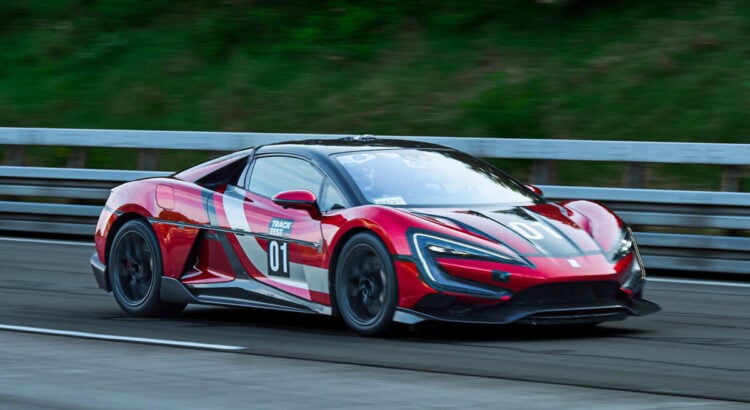
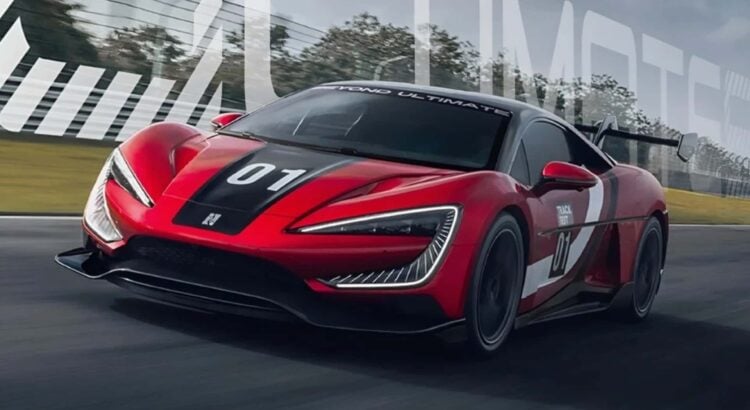
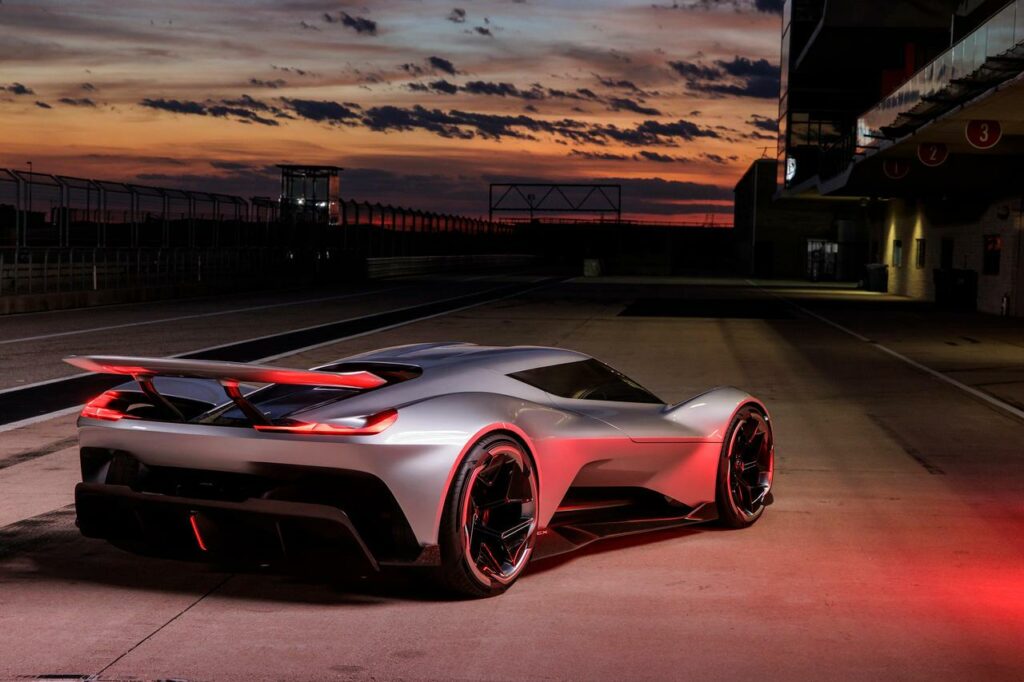
    With its Yangwang U9 Track Edition, BYD has achieved a resounding success. This Chinese electric hypercar has broken the 472.41 km/h barrier. Thanks to its 3,016 bhp, it dethroned the Rimac Nevera and redefined performance standards in the world of electric supercars.

    BYD Yangwang U9 Track Edition on track for electric speed record at 472 km/h
    The BYD Yangwang U9 Track Edition reaches 472 km/h and breaks the world record for electric cars. (Credit: BYD)

    An all-time record on German soil

    The Yangwang U9 Track Edition set a new record on the ATP test track in Papenburg, Germany. In doing so, it far surpassed the Rimac Nevera, which had previously held the title with a speed of 431.45 km/h. This feat puts BYD right up there with automotive legends such as Bugatti and Lotus.

    Outstanding mechanics

    The Track Edition features one engine per wheel, each delivering 754bhp. Together, they produce 3,016bhp, a level of power never before seen in the sector. Its carbon bodywork and refined aerodynamics guarantee stability and control, even at extreme speeds. By comparison, the classic U9, with its 1,300bhp, had a top speed of 309kph.

    A concentrate of surprising technology

    BYD hasn’t just added power. The U9 Track Edition retains a number of new features, such as the active suspension, which is capable of making the vehicle ‘dance’. This system, inspired by Mercedes models, also limits body movements, improving roadholding on the track.

    Close-up of the carbon bodywork and aerodynamics of the Yangwang U9 Track Edition
    The carbon bodywork and optimised aerodynamics enable the U9 Track Edition to exceed 470 km/h. (Credit: BYD)

    A new era for electric hypercars

    This record goes far beyond the figures. It symbolises a profound change: electric hypercars are emerging from the niche to become a strategic battleground. However, the market remains uncertain. Rimac has not sold out its entire production run, and several competing projects have been put on hold due to lack of demand.

    An unbeatable price/power equation

    In China, the standard version of the U9 costs around €200,000. Even more expensive, the Track Edition would still be much cheaper than its rivals, such as the Rimac Nevera, which sells for over two million euros. A difference that could convince a small but passionate clientele.

  • European carmakers say climate targets unachievable

    European carmakers say climate targets unachievable

    European carmakers are calling for environmental rules to be relaxed. In their view, the CO2 emission reduction targets set by the European Union are now out of reach. Commission President Ursula von der Leyen is due to meet the sector in September to discuss the future of the industry.

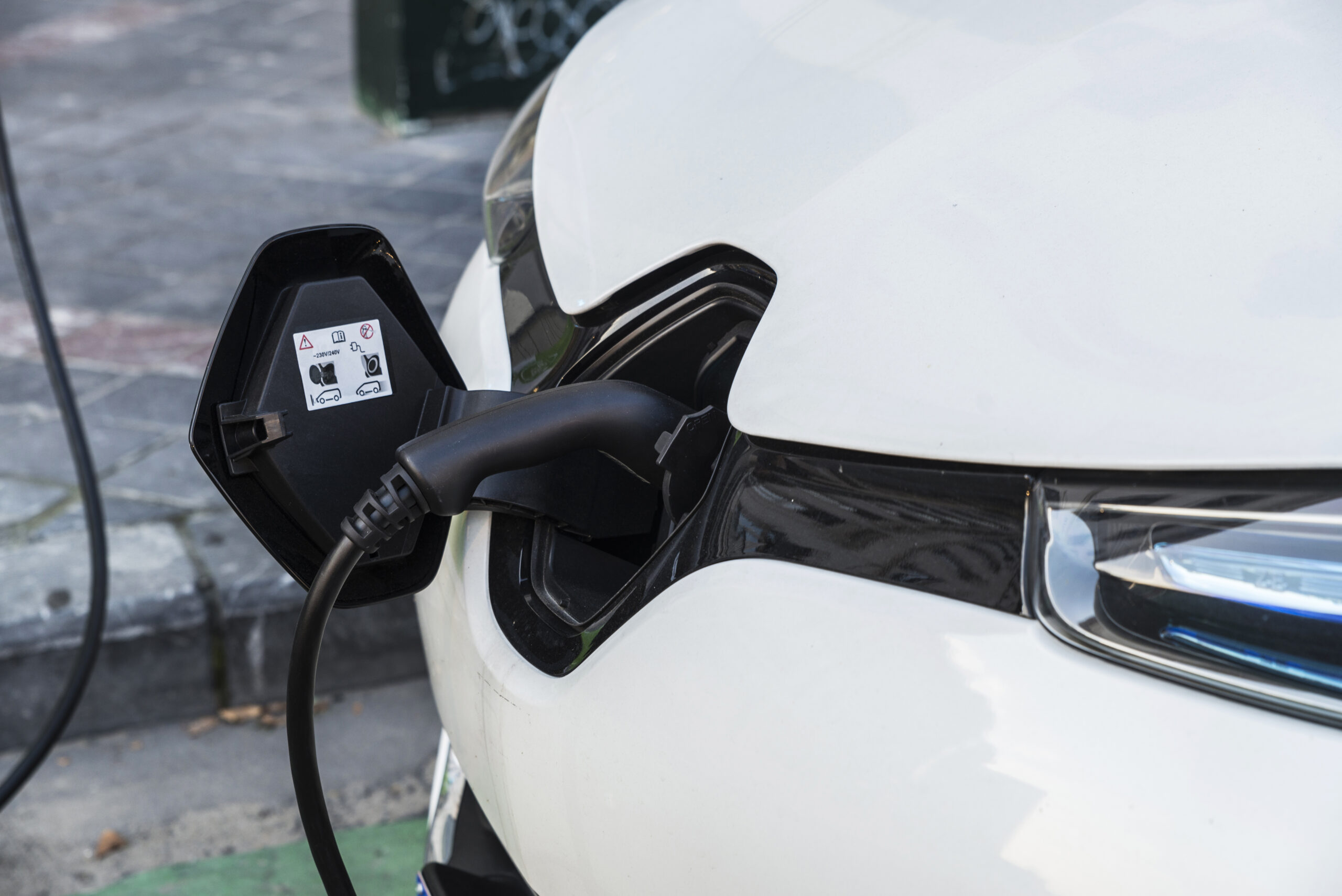
    Electric cars being recharged in front of a European car plant, illustrating the European Union's CO2 targets.
    Electric cars being charged in front of a factory, symbolising the challenges faced by European carmakers in meeting the EU’s climate targets.

    Growing pressure on Brussels

    Leaders of the automotive associations, such as Ola Kaellenius and Matthias Zink, have written to Ursula von der Leyen to express their concerns. They point out that dependence on Asian batteries, high costs and uneven charging infrastructure make the 2030 and 2035 targets unrealistic. In their view, achieving a 55% reduction in emissions for cars and a 50% reduction for vans by 2030 seems compromised.

    An industry weakened by global competition

    In addition to European constraints, the sector is facing two major threats. Firstly, the rise of Chinese manufacturers in the electric sector. Secondly, the introduction of US tariffs, which are increasing costs. These factors, combined with Brussels’ strict rules, are threatening the competitiveness of European brands.

    Towards a more diversified transition

    The signatories reiterate that they remain committed to achieving carbon neutrality by 2050. However, they believe that electric vehicles cannot be the only way forward. They call for rechargeable hybrids, efficient internal combustion engines, hydrogen and low-carbon fuels to be fully integrated into the transition. Regulations must evolve to ensure that innovation is not held back.

    A decisive meeting in September

    Ursula von der Leyen will be meeting industry representatives on 12 September. This meeting will be crucial for striking a balance between climate ambitions and industrial realities. Several European political parties are already calling for a review of the ban on internal combustion engines scheduled for 2035. The debate on Europe’s green road has therefore only just begun.

  • Peugeot 308 (2025): the restyled compact gets a makeover

    Peugeot 308 (2025): the restyled compact gets a makeover

    The third-generation Peugeot 308 has been updated to remain competitive with European compact cars, despite the rise of the SUV. Its design is evolving subtly, while the electric powertrains are gaining in range and practicality. Orders are due to open in early September 2025, before arriving in dealerships in the autumn.

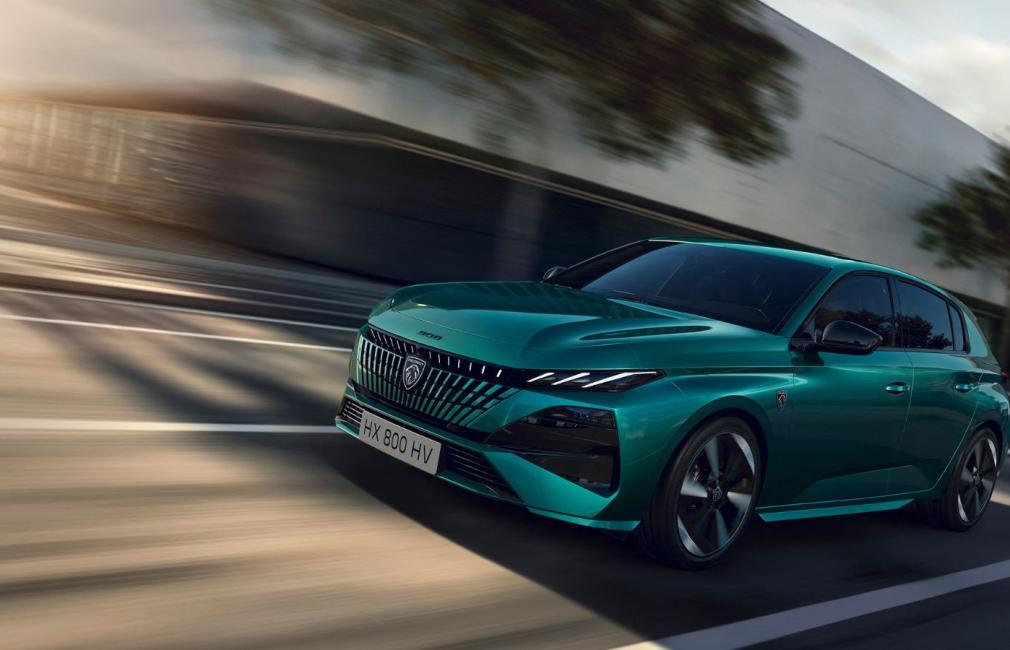
    Exterior view of the restyled Peugeot 308 2025, modernised design and compact silhouette
    The Peugeot 308 2025 adopts a revised style with a reduced radiator grille and refined headlamps. (Credit: Peugeot)

    A modernised style, but faithful to the original

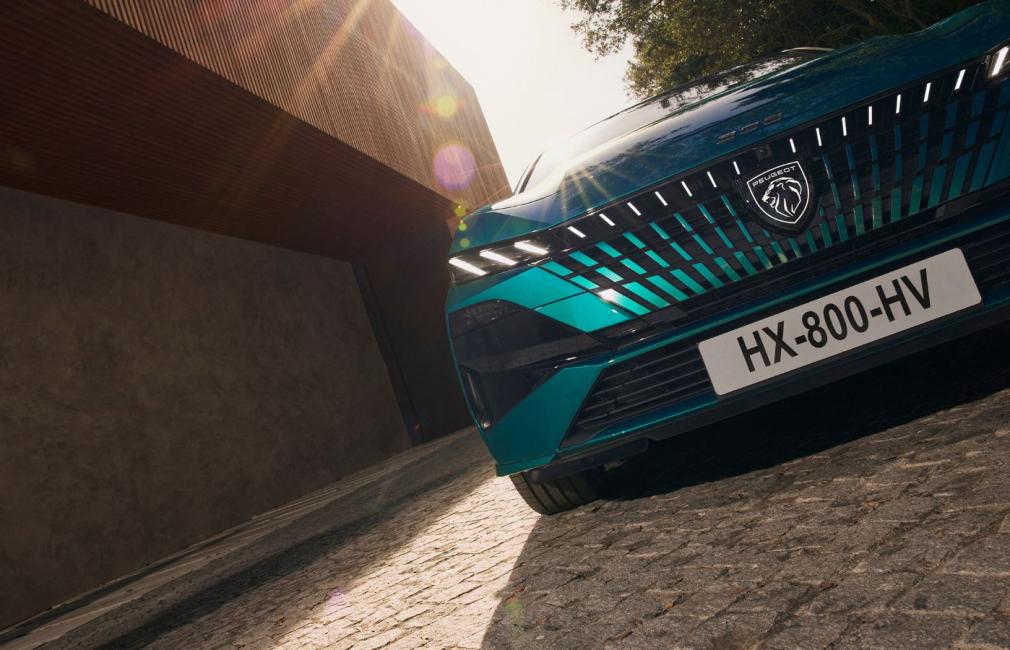
    The restyling maintains the dimensions of the 308, with 4.37 m for the saloon and 4.64 m for the SW estate. On the front, the grille is smaller and the bumper slightly wider, to give the car a better visual presence. The slim headlamps adopt the triptych of daytime running lights and the headlamps are integrated lower down. In addition, the Peugeot logo is illuminated for the first time and the diamond-cut wheels add a dynamic and contemporary touch. Finally, new Ingaro Blue and Lagoa Blue colours complete an already rich colour range.

    An unchanged but functional cabin

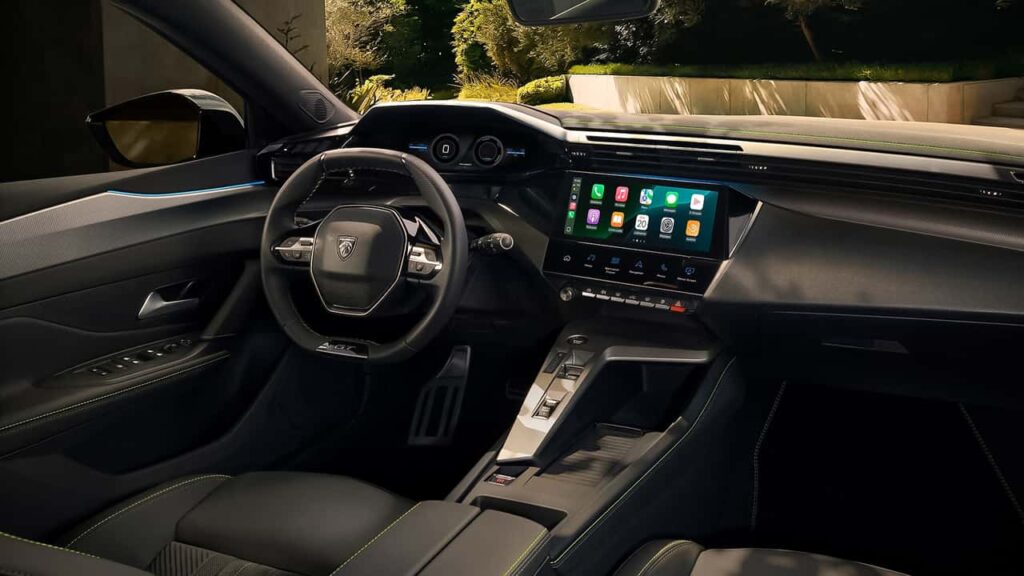
    Inside, Peugeot is keeping the compact steering wheel, the i-Cockpit and the central 10-inch touchscreen compatible with Android Auto and Apple CarPlay. The i-Toggles can still be customised, providing quick access to essential functions such as navigation, climate control and multimedia. The upholstery is new only on the Allure and GT trim levels, with more modern TEP materials. On-board space remains decent for the category, although the rear bench is not the most generous. The abundance of storage space and intuitive ergonomics go some way to compensating for this.

    Interior of the Peugeot 308 2025 with i-Cockpit, 10-inch touch screen and new upholstery
    The cabin retains the i-Cockpit and gains in comfort thanks to new materials on the higher trim levels. (Credit: Peugeot)

    A wide range of engines and an improved electric version

    The 308 retains its petrol, diesel and hybrid engines, as well as the rechargeable 195 bhp version offering 85 km of electric range. The 100% electric e-308 has been upgraded with a 55.4 kWh battery, giving it a combined range of 450 km. It also benefits from the V2L function for powering small appliances and a fast 32-minute charge from a DC terminal. As a result, the compact car remains versatile and attractive to all types of driver, whether they’re looking for performance, economy or zero emissions.

    A top-of-the-range finish to seduce

    The new GT Exclusive completes the range with Matrix LED headlamps, 18-inch diamond-cut wheels and Alcantara upholstery. It also features heated massaging seats and a 3D display on the instrument cluster. The voice assistant incorporates ChatGPT artificial intelligence, enhancing the user experience and on-board connectivity. This trim level is aimed at customers looking for uncompromising comfort, technology and aesthetics, and makes the 308 even more attractive than its European rivals.

    Zoom in on the front of the Peugeot 308 2025 with illuminated logo and modernised LED lights
    The backlit logo and new light signature reinforce the modern character of the compact car with the lion.

    Prices and availability

    Prices will be announced in early September 2025, with the restyled 308 expected to be slightly more expensive than the current model. Manufacturing will continue to be carried out in Mulhouse, and an extended warranty of up to 8 years or 160,000 km will be offered, providing security and peace of mind for future owners.

  • Cadillac Elevated Velocity: the concept that combines luxury and innovation

    Cadillac Elevated Velocity: the concept that combines luxury and innovation

    At Monterey Car Week, Cadillac presented a spectacular concept: the Elevated Velocity. Indeed, this 100% electric SUV-coupe, conceived as a technological and stylistic showcase, embodies the ambitions of the American brand. Moreover, with its futuristic design, surprising innovations and remarkable versatility, it could thus well herald Cadillac’s future direction.

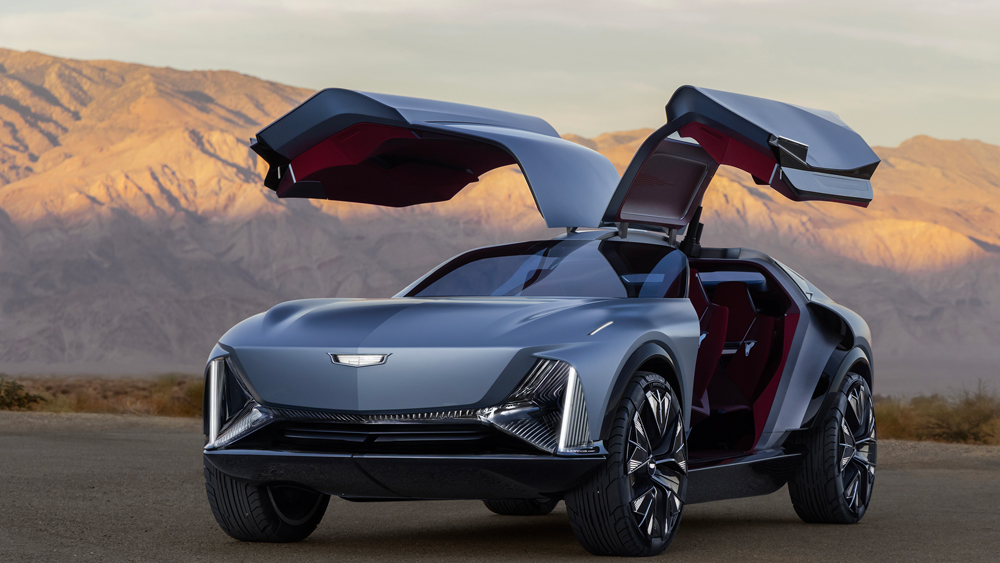
    Cadillac Elevated Velocity concept, an electric SUV coupe with a spectacular, futuristic design
    The Cadillac Elevated Velocity boasts bold styling with streamlined lines and gullwing doors (Credit: Cadillac).

    A spectacular and assertive design

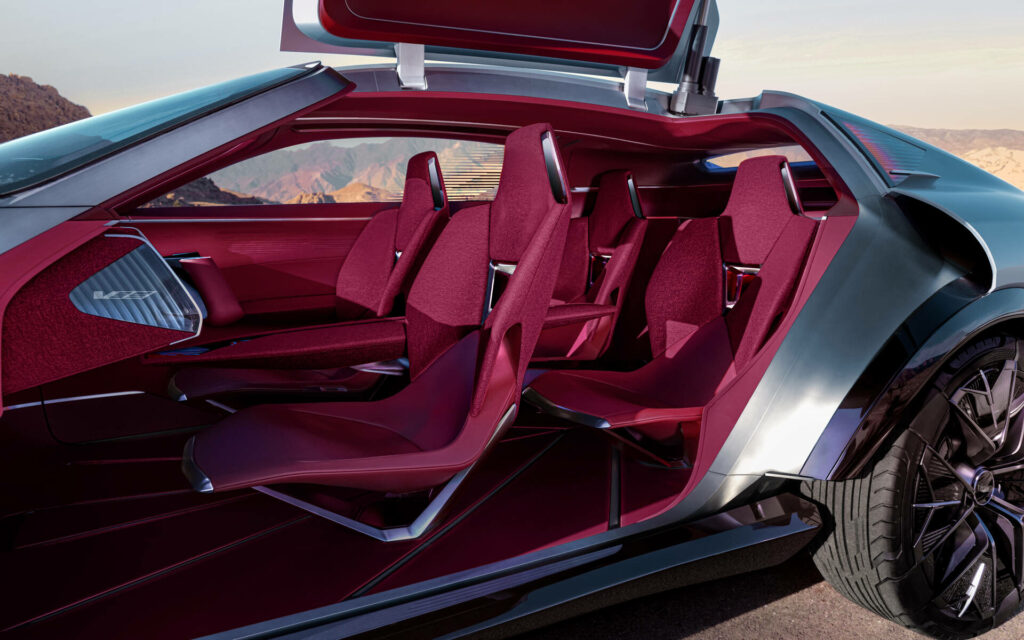
    At first glance, the Elevated Velocity immediately impresses with its monumental gullwing doors, 24-inch wheels and raised silhouette. Moreover, the design incorporates some of the styling cues already seen on the Lyriq and Celestiq electric models, but it takes them in a bolder and sportier direction. From the side, its fastback look accentuates its dynamism, while the rear features plunging lights on a concave tailgate, thereby asserting a unique identity. In addition, the blue hue combined with shades of grey and a deep red interior creates a strong visual contrast. Inside, Cadillac also pays particular attention to materials, since Nappa leather, textured fabrics and immersive lighting effects vary according to the modes selected.

    A modular, technological experience

    As well as its style, this concept stands out for its modularity. Cadillac offers several modes of use: ‘Welcome Mode’ uses a light show to welcome passengers, ‘Elevate Mode’ transforms the cabin into a space for relaxation with the steering wheel and pedals retracted, while ‘Velocity Mode’ focuses on performance and driving sensations. In addition, various settings enable the car to be adapted to the road, sand, snow or trails. Cadillac is also innovating with a surprising technology: a vibration system capable of automatically cleaning the bodywork, removing dust and debris. A feature that underlines the desire to combine comfort, practicality and exclusivity.

    Interior of the Cadillac Elevated Velocity with red Nappa leather, immersive lighting and technological cockpit
    The interior of the Cadillac Elevated Velocity focuses on comfort, refined materials and personalised lighting. (Credit: Cadillac)

    A showcase for Cadillac’s future

    Presented at The Quail Concours d’Elegance in California, the Elevated Velocity is not intended for immediate production. However, it clearly heralds the arrival of future electric sports versions, derived from the Optiq and Lyriq. Indeed, this concept also shows how Cadillac intends to combine bold design, advanced technologies and top-of-the-range electrification. Moreover, Elevated Velocity is more than just a styling study: it actually embodies the vision of a brand ready to push back the boundaries of automotive luxury.

  • Mercedes-AMG GT XX: an electric round-the-world trip in a week

    Mercedes-AMG GT XX: an electric round-the-world trip in a week

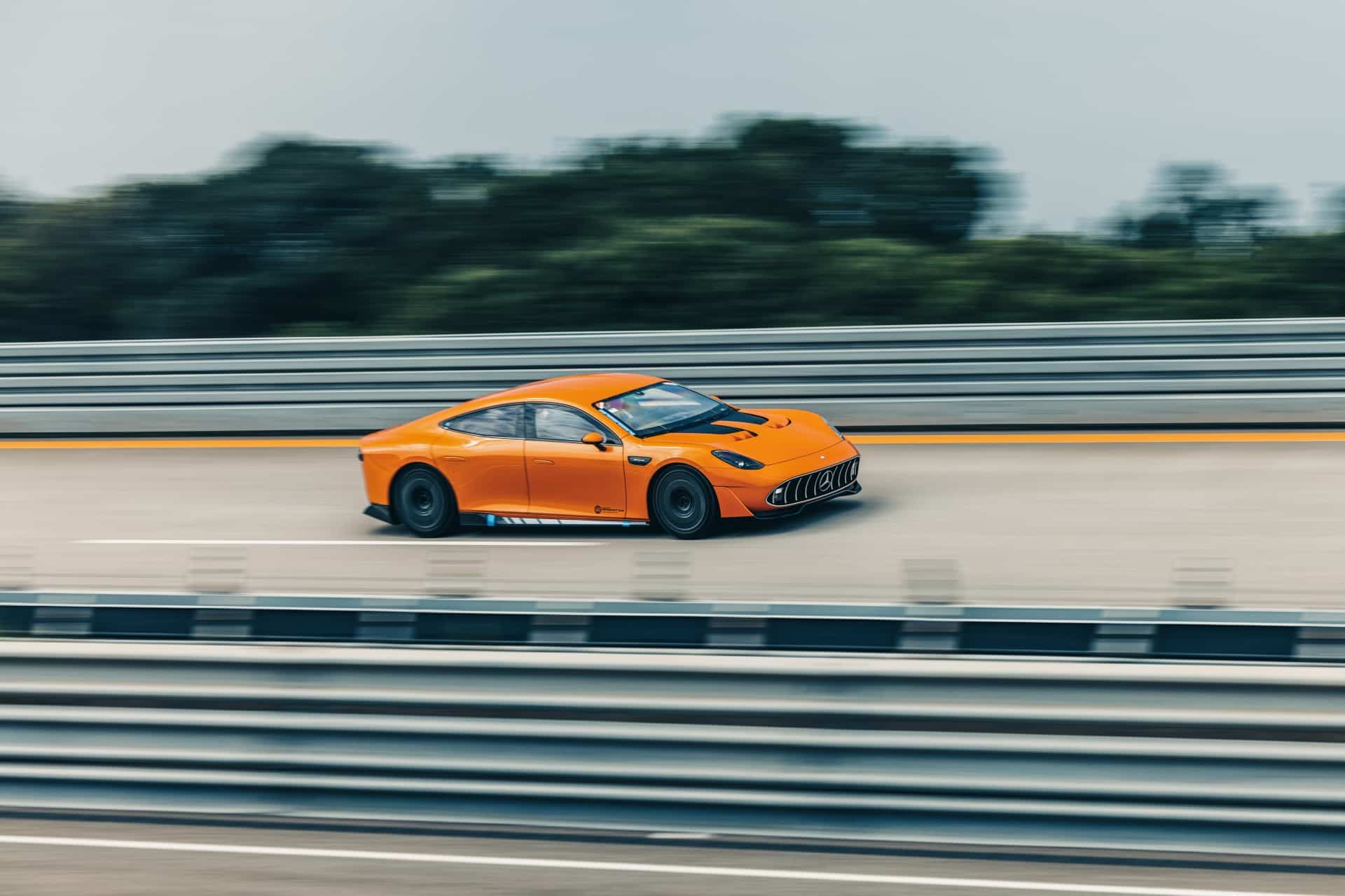
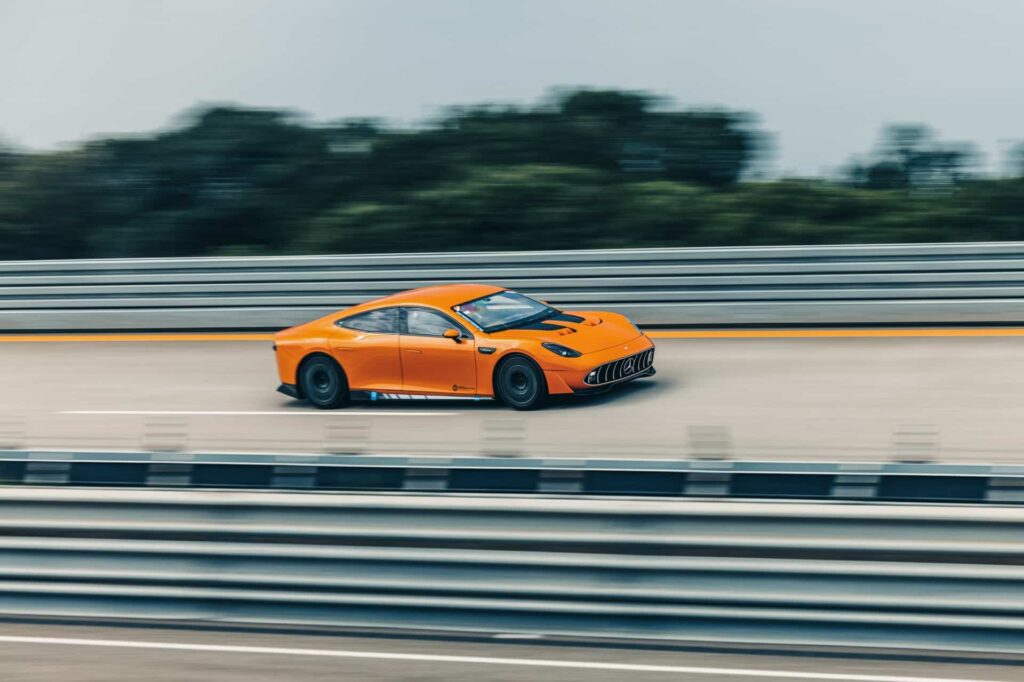
    Mercedes-AMG has hit the ground running in seven days. With its GT XX prototype, the German brand covered the equivalent of the earth’s circumference, i.e. 40,075 km, on the Nardò ring in Italy. In the process, the car set 25 world records, including the longest distance in 24 hours. A spectacular demonstration that illustrates the technological endurance of the future electric AMG.

    Mercedes-AMG GT XX electric on the Nardò oval, distance record
    The Mercedes-AMG GT XX prototype races around the Nardò oval, setting 25 electric endurance world records (Credit: Mercedes-AMG)

    An electric hypercar ahead of its time

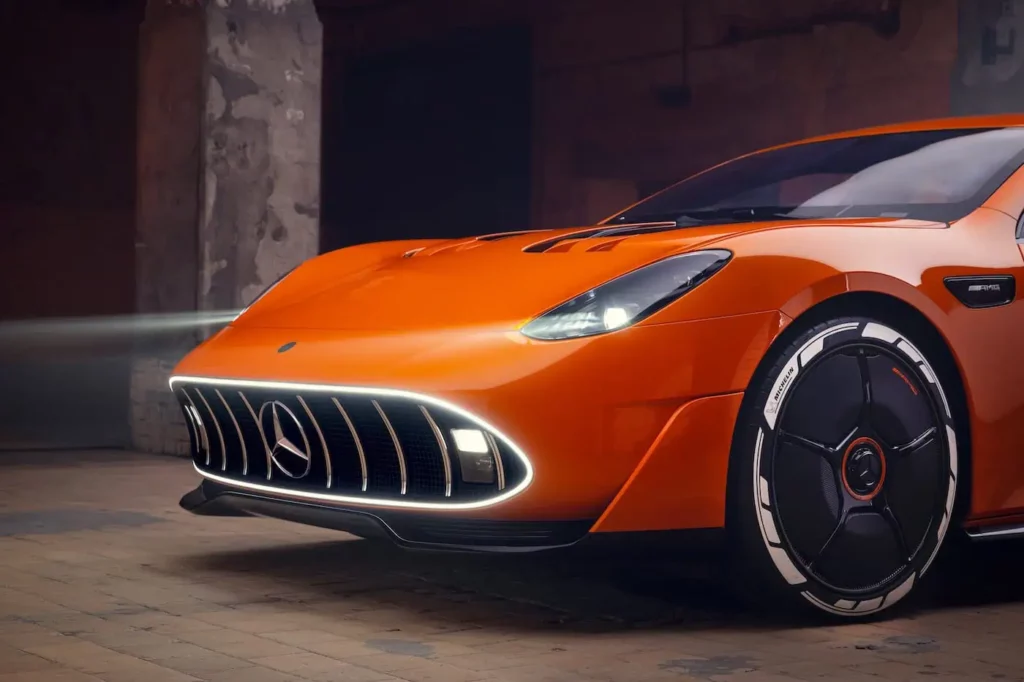
    Officially, the GT XX is still a concept. Yet its characteristics already place it among the ranks of hypercars. Three axial-flow engines deliver 1,360 bhp, an unprecedented level of power for an electric road car. Its high-performance battery can take a charge of 850 kW. It features direct cooling inspired by Formula E. In concrete terms, it takes just five minutes to recover 400 km of range, a figure that ridicules the current competition. On the track, the engineers chose to maintain a stabilised speed of 300 km/h, a crazy speed which is not the vehicle’s maximum (360 km/h), but which represented the ideal compromise between performance and energy efficiency.

    Breathtaking records

    For eight days, two prototypes took it in turns to keep up the pace. Meanwhile, seventeen drivers from F1, GT and rally racing, including George Russell and France’s Doriane Pin, completed a series of two-hour stints in extreme conditions, sometimes at temperatures in excess of 35°C. The result: a new record for distance covered in 24 hours, with 5,479 km, almost 1,500 km more than Xpeng’s previous feat. On average, each day saw more than 5,300 km covered without any major incident, which clearly underlines the reliability of a machine that is still at the experimental stage.

    Details of the engine and battery of the electric Mercedes-AMG GT XX
    Zoom in on the high-performance engine and battery of the Mercedes-AMG GT XX prototype, capable of ultra-fast charging at 850 kW. (Credit: Mercedes-AMG)

    A message to the competition

    Over and above the sporting performance, Mercedes has a clear objective. Specifically, it aims to regain the upper hand against Chinese manufacturers. The latter, such as Xiaomi, BYD and Nio, are stepping up their electric power. With this in mind, Mercedes-AMG has reaffirmed its position as a global benchmark and its commitment to endurance and performance. Furthermore, the GT XX is not just a technological showcase. Indeed, it foreshadows a new generation of AMG electric cars, expected at the Munich Motor Show in September. Later, in 2026, an SUV based on the same AMG.EA platform will also arrive.

    A feat… subject to conditions

    One important point remains. Indeed, this feat was only possible in a totally controlled environment. A private ring, a team of engineers mobilised day and night, and customised charging points delivered a level of power inaccessible to the general public. As a result, the average motorist will not see 850 kW chargers in Europe for a long time. Therefore, this performance is above all a marketing tool and a message of power sent to the competition. Nevertheless, Mercedes has demonstrated impressive technological know-how. Moreover, this expertise could soon be reflected in production models. Ultimately, the real revolution will come when this prowess hits the streets and finally becomes accessible to AMG customers.

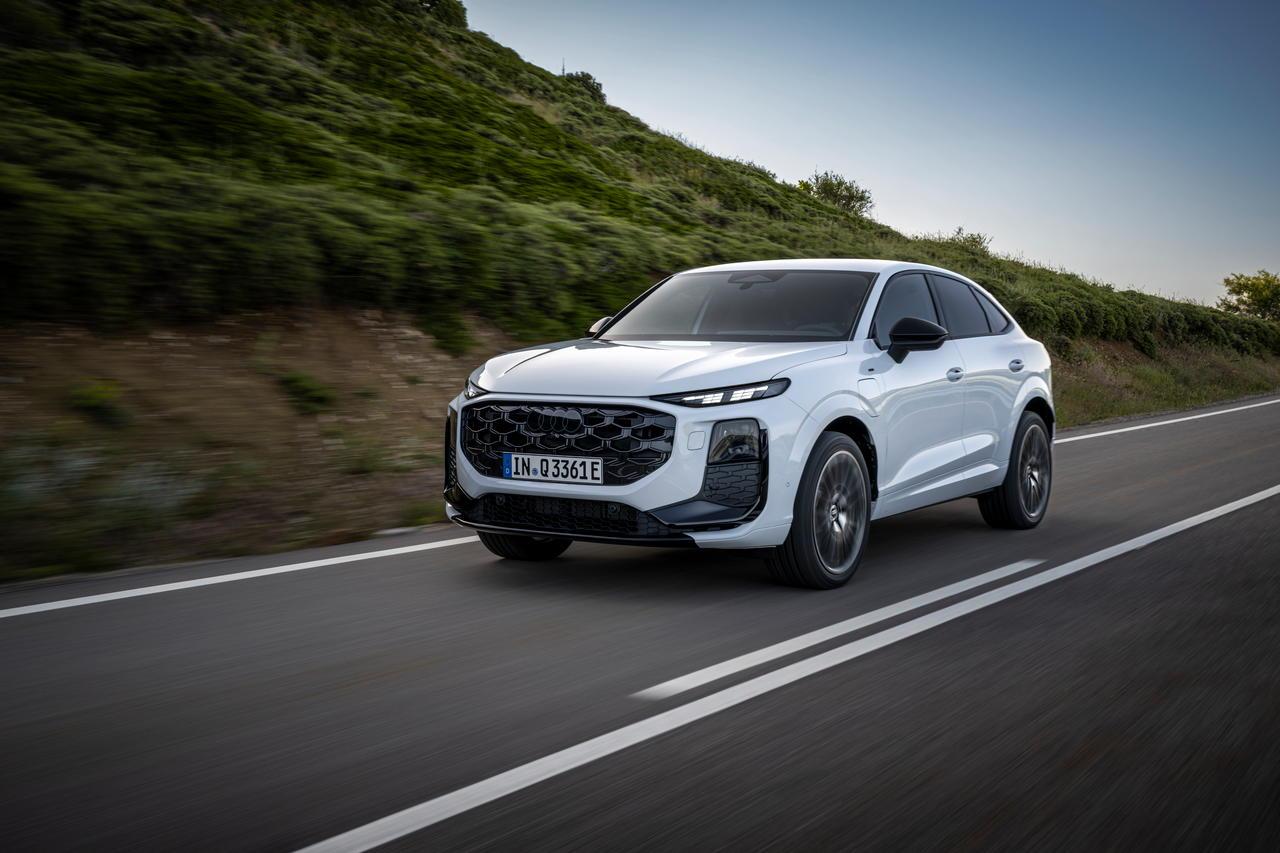
  • Audi Q3 Sportback e-hybrid: the SUV coupé bets on 120 km of electric range

    Audi Q3 Sportback e-hybrid: the SUV coupé bets on 120 km of electric range

    Audi is presenting its new Q3 Sportback plug-in hybrid at the IAA Munich 2025. This premium compact SUV combines sporty styling with electric efficiency.

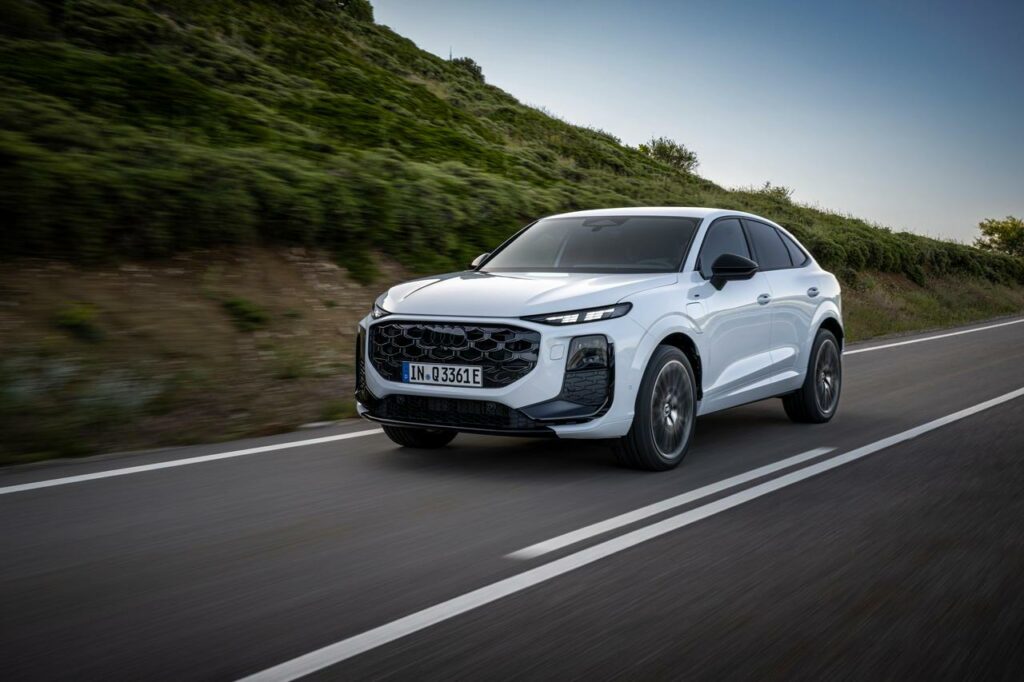
    Audi Q3 Sportback e-hybrid 2025, plug-in hybrid SUV coupé with 120 km electric range
    The new Audi Q3 Sportback e-hybrid 2025 boasts a sporty silhouette and record electric range (Credit: Audi)

    A sporty design that appeals

    With its roofline lowered by 29 mm and coupé silhouette, the Q3 Sportback makes a strong statement. The wide single-frame grille and digital Matrix LED headlights give it a modern look. At 4.53 metres long, it retains well-balanced proportions that are ideally suited to family use.

    A connected, optimised interior

    The dashboard features an 11.9-inch digital instrument cluster and a 12.8-inch central touchscreen. Audi has introduced new steering wheel levers, freeing up space in the centre console. Passenger space remains decent, even if the boot capacity drops to 375 litres on the plug-in hybrid version.

    A powerful, efficient engine

    The e-hybrid version combines a 177 bhp 1.5 petrol engine with a 115 bhp electric motor. Together, they produce 272 bhp and 400 Nm of torque. The SUV accelerates from 0 to 100 km/h in 6.8 seconds, while offering a smooth, quiet ride.

    Record electric range

    Thanks to a 19.7 kWh battery, the Q3 Sportback e-hybrid claims up to 120 km in electric mode. What’s more, the battery can be rapidly recharged with 50 kW of direct current, taking it from 10% to 80% in just 26 minutes.

    Prices and availability

    In France, the Q3 Sportback e-hybrid starts at €57,500 in Design trim. However, it is subject to a weight penalty of €1,010. It is due to go on sale in November 2025.

  • Monterey Car Week 2025: innovation and exclusivity on the agenda

    Monterey Car Week 2025: innovation and exclusivity on the agenda

    Every summer, Monterey Car Week transforms California into a temple to the automobile. In 2025, manufacturers and tuners vied with each other in their creativity to seduce a demanding public. From electric concepts to hybrid hypercars, the diversity was total. Daring restomods, unprecedented supercars and extraordinary performances were the hallmarks of the event. Here’s a look back at the models that thrilled enthusiasts and collectors alike.

    Corvette CX electric hypercar presented at Monterey Car Week 2025
    The electric Corvette CX, unveiled by General Motors at Monterey, embodies the future of zero-emission hypercars with its radical design.

    General Motors, electric and spectacular

    General Motors hit back with two striking concepts. The electric Corvette CX impressed with its radical design and performance ambitions. Alongside it, the CX.R Vision Gran Turismo, developed with the creator of the famous video game, ignited discussions. Cadillac also unveiled its Elevated Velocity concept, a sculptural manifesto of future luxury. The public reacted enthusiastically, with some wanting to buy models not yet on the market.

    Lamborghini Fenomeno: the hypercar of extremes

    The Italian marque has unveiled the Fenomeno, produced in just 29 examples. With 1,080 bhp, this hybrid hypercar accelerates from 0 to 100 km/h in less than 2.5 seconds. With a price tag of 3.5 million dollars, it is aimed at a very select clientele. Its sharp design and oversized engine make it one of the jewels of the 2025 edition.

    Restomods and unique creations

    The tuners showed off their expertise with some daring interpretations. Gunther Werks presented Project F-26, a Porsche 993 transformed into a 1,000-horsepower monster. Ringbrothers reinvented a 1971 Aston Martin DBS, now the Octavia, powered by an 816bhp Ford V8. Meyers Manx and Tuthill surprised us with the LFG buggy, powered by a Porsche flat-six capable of 11,000 rpm.

    Gordon Murray, a tribute to the legends

    The British engineer celebrated the 30th anniversary of the McLaren F1 victory at Le Mans. Under his GMSV brand, he presented two exclusive supercars, including the Le Mans GTR. A demonstration of his expertise that confirms his status as a key figure in the world of sports cars.

    The 2025 edition of Monterey Car Week will go down as one of the most exciting and surprising ever. With electrified innovations, tributes to icons and outrageous performances, the event once again proved that it’s much more than a show: it’s an open-air spectacle where the automobile is constantly reinventing itself.

  • Bajaj Auto relaunches its electrical production using rare earths

    Bajaj Auto relaunches its electrical production using rare earths

    Indian manufacturer Bajaj Auto is back on the rare earth supply track. After several weeks of stoppage, production of electric scooters is back on track. This comes just before the festival season, a key period for vehicle sales. Managing Director Rajiv Bajaj confirms a significant improvement in shipments of rare earth magnets.

    Bajaj Auto logo displayed on a mobile phone
    Bajaj Auto relaunches production of Chetak electric scooters thanks to improved supplies of rare earths.

    Global dependence on rare earths

    China supplies almost 90% of the rare earths used in the world. However, in April, China banned exports of rare earths, causing disruption to many car manufacturers. This decision forced Bajaj Auto and its competitors to look for alternatives to maintain production. Moreover, rare earth magnets are essential for electric motors, making their availability crucial for the manufacture of electric scooters and motorbikes.

    A gradual recovery in production

    Rajiv Bajaj said that deliveries of rare earth magnets resumed three to four weeks ago. As a result, Bajaj Auto expects to produce 15,000 Chetak scooters in August, before increasing this figure to 40,000 units in September. This increase reflects the resumption of the flow of raw materials and marks a turning point after a “zero production” month of August for certain electric models.

    A strategic opportunity for the festival season

    The period from August to October in India is a good time for major purchases, including vehicles. Consumers take advantage of the festivities to invest in electric mobility. By improving its supply, Bajaj Auto hopes to meet the growing demand and consolidate its position in the market. In this way, the manufacturer is preparing to take full advantage of a period that can account for a significant proportion of annual sales.

    Towards a more stable future for electricity generation

    This resumption of supplies marks an important step for Bajaj Auto. It demonstrates the manufacturer’s ability to adapt to global constraints and secure the resources needed to support the growth of electric vehicles in India.