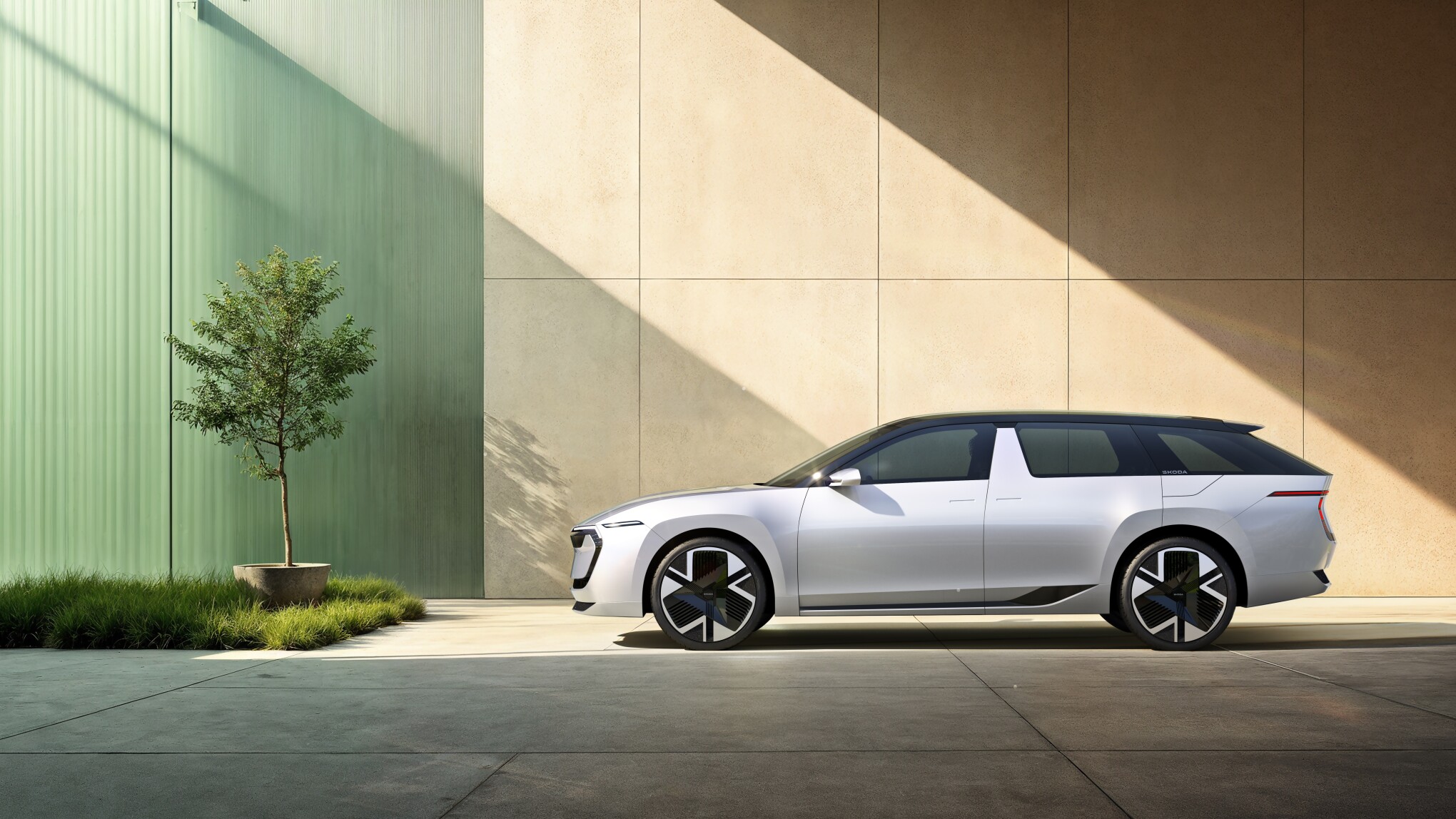
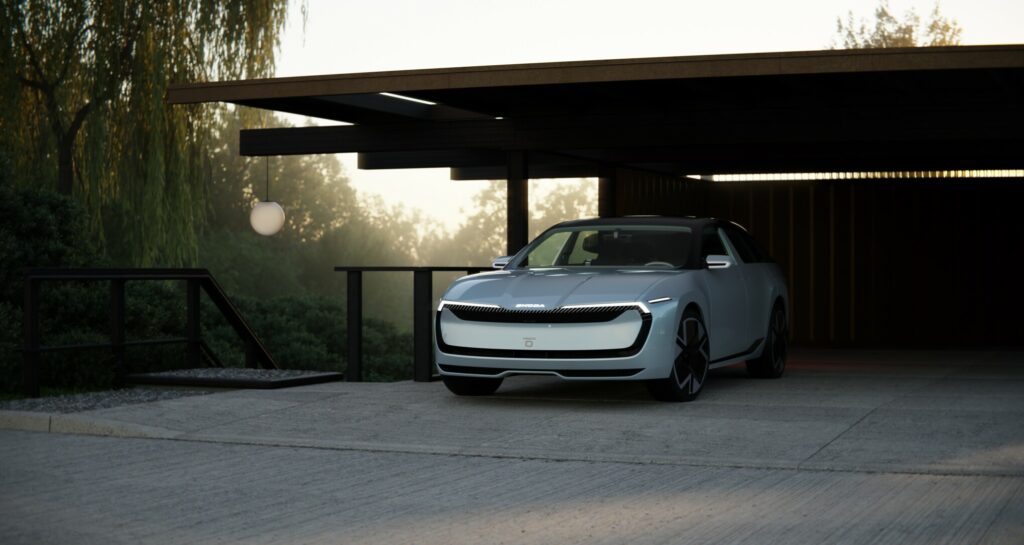
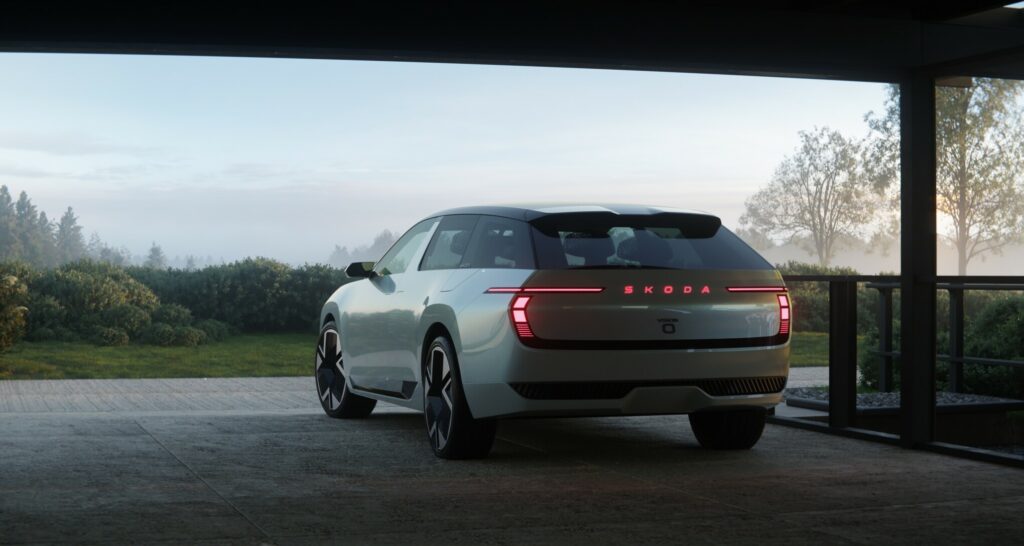
The IAA in Munich is an opportunity for Skoda to present its Vision O concept. A large electric estate car that will serve as the basis for future models from the Czech brand in the Volkswagen Group.
The Volkswagen Group has decided to use this 2025 edition of the IAA Mobility show in Munich as a showcase for its future. After Audi’s Concept C, a veritable white paper on the design of future vehicles in the rings, it’s Skoda’s turn to present its manifesto, in the form of the Vision O concept. And, as with Audi, it’s not just another SUV! It’s an estate car (100% electric, of course), a category in which the Czech manufacturer has enjoyed a string of commercial successes, led by the Superb Combi and Octavia Combi.
Credit: Skoda
Practical, spacious and… elegant
Skoda has revisited its design language, known as ‘Modern Solid ‘, which emphasises simplicity and a futuristic brutalism. The new front end features a full radiator grille, with headlamps and sensors forming the future visual signature of the brand’s models. The whole thing is 4.60 metres long and has a very slender silhouette for an estate car. It’s elegant.
But this sharp styling doesn’t seem to prevent the Vision O estate from fulfilling its initial mission: making life easier for the driver, offering comfort for passengers and offering a voluminous boot. This is the case here, with Skoda announcing a capacity of 650 litres! That’s almost as much as the Skoda Superb Combi, the benchmark in the brand’s catalogue, which is almost 30 centimetres longer. And it’s 50 litres more than the current Octavia Combi for the same size. All-electric helps!
Credit: Skoda
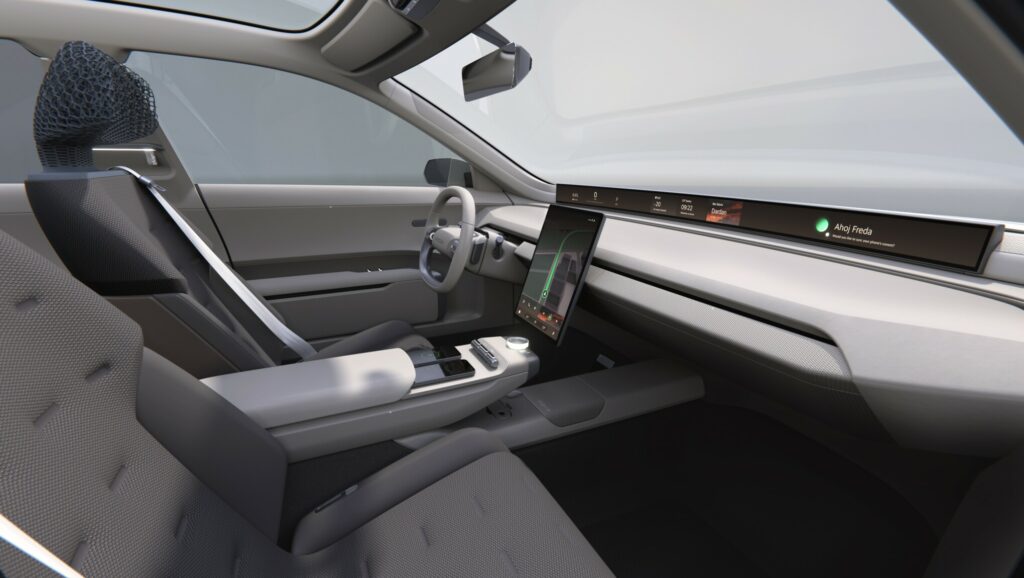
Still inside, but this time in the passenger compartment, everything is simpler than in current models. Tech and minimalism are not necessarily the house style, but it works. The ‘Horizon Display’ extends across the entire dashboard, the lighting adapts to different times of day and a voice assistant called Laura, infused with artificial intelligence, keeps the car’s occupants company. There are two killer details: an integrated fridge and a portable loudspeaker. If that’s not a family car, we don’t know what is.
Credit: Skoda
See you in 5 years?
A highly accomplished concept car, we could almost expect to see the Vision O or its production versions on our roads as early as next year. But that won’t be the case! Instead, it is part of the Skoda Strategy 2030 and, according to several observers, the manufacturer is waiting for the Volkswagen Group to finish developing its new platforms for electric cars before announcing the first vehicle adapted from the Vision O. And if we had to put a coin in, we’d bet on the first electric Octavia. What’s in it for us? Its dimensions and the ‘O’ in ‘Vision O’ give us a hint.
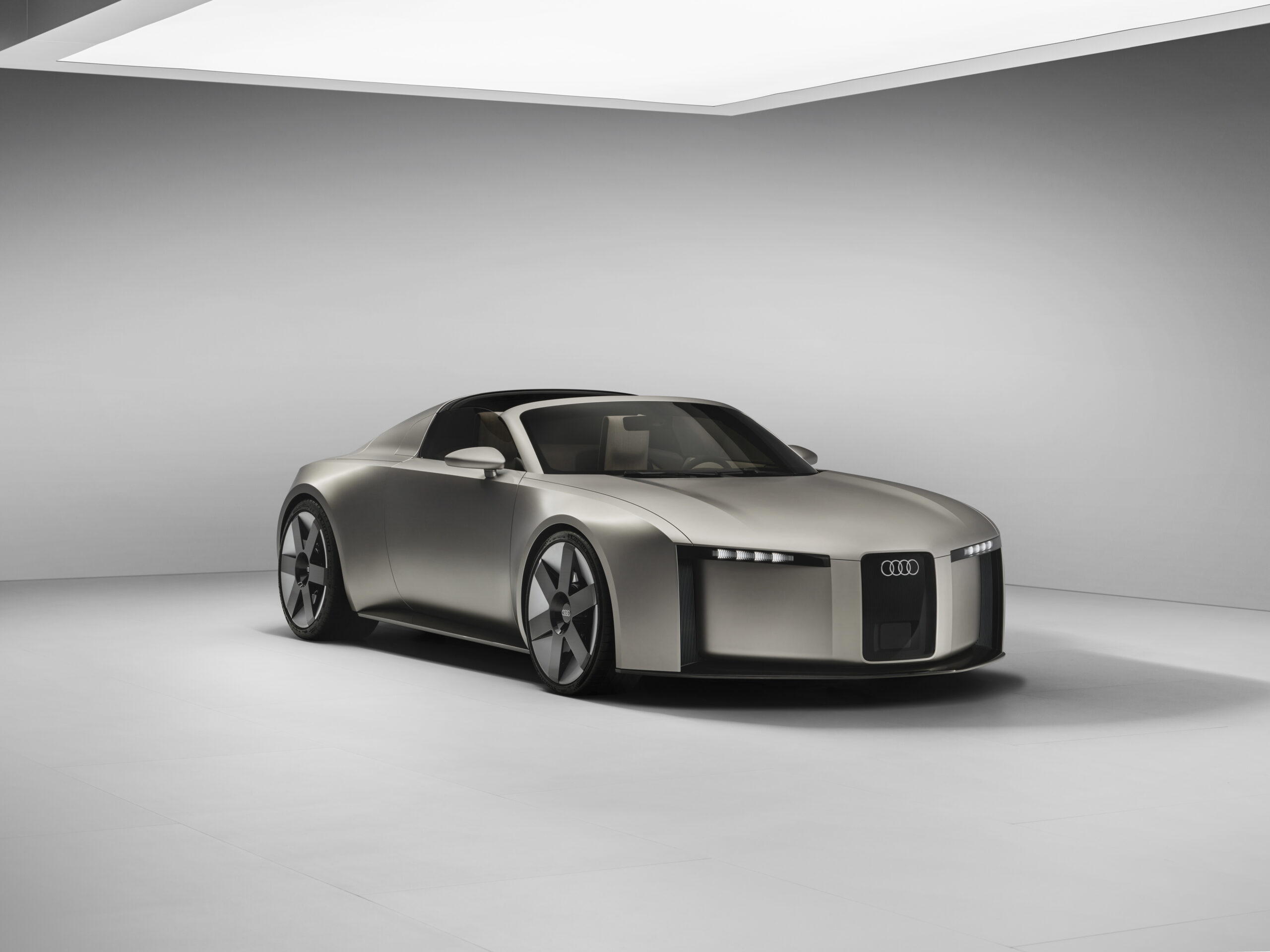
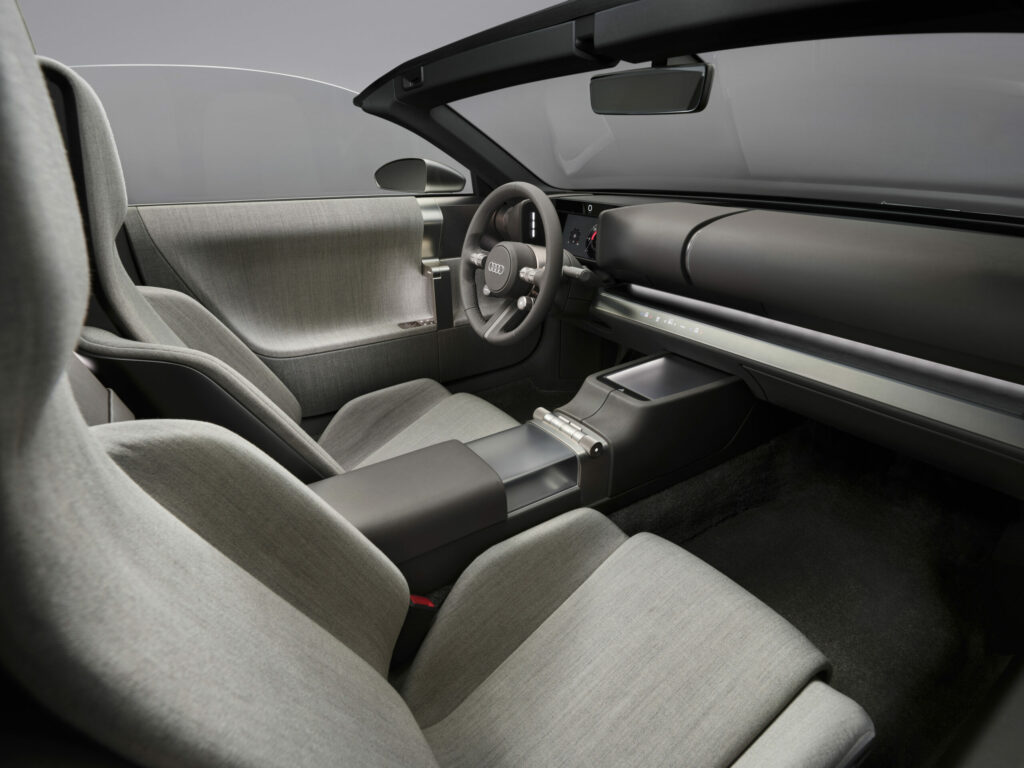
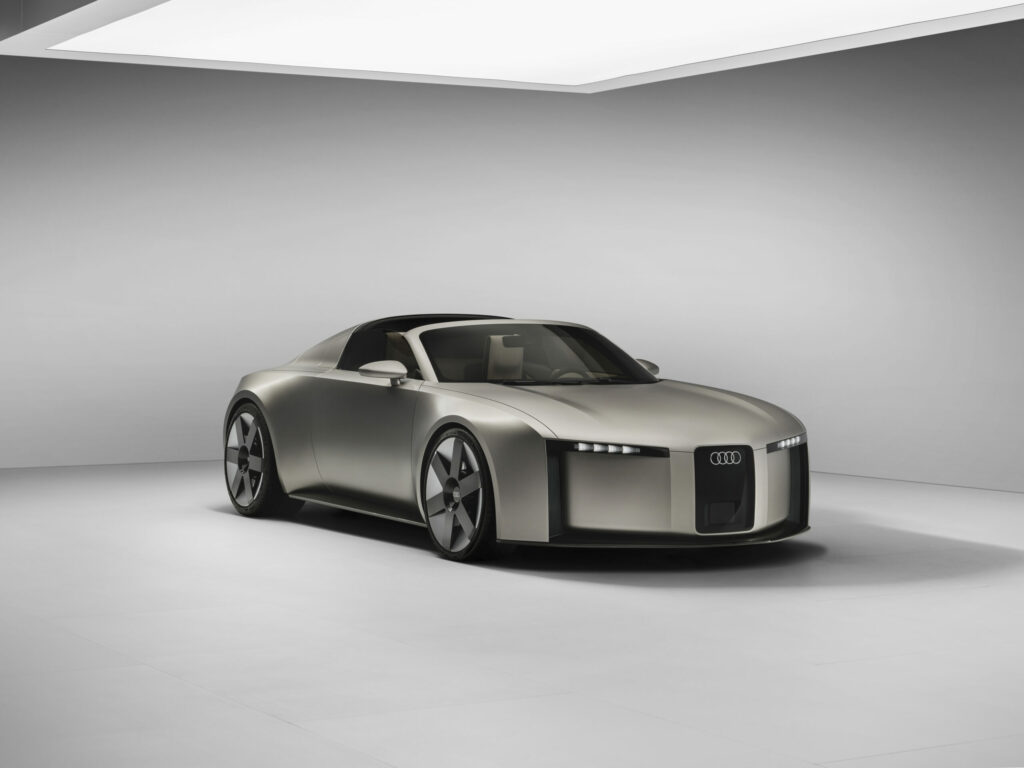
Presented by Audi as a white paper on its future aesthetic identity, the Concept C electric two-seater roadster makes our mouths water.
I owe my first car shock to Audi. When my friend Curtis’ father left school, he came to pick him up with his new car: an Audi TT. At the time, I wasn’t really into design, let alone car design. But this coupé was like nothing I’d ever seen. It was designed outside all convention, conveying a new aesthetic language capable of speaking to the hearts even of those who had never really paid attention to cars before. That was some twenty years ago (we’re not getting any younger!) and even then, the brand with the four rings was opening the door to a new way of thinking about the silhouette of cars. And history could well repeat itself. With the 100% electric Concept C, just unveiled at the IAA Mobility show in Munich, Audi is entering what it describes as a “new era in automotive design“, guided by a quest for purity of line and simplicity that breaks with the current era of convoluted silhouettes and slashed surfaces.
Credit: Audi
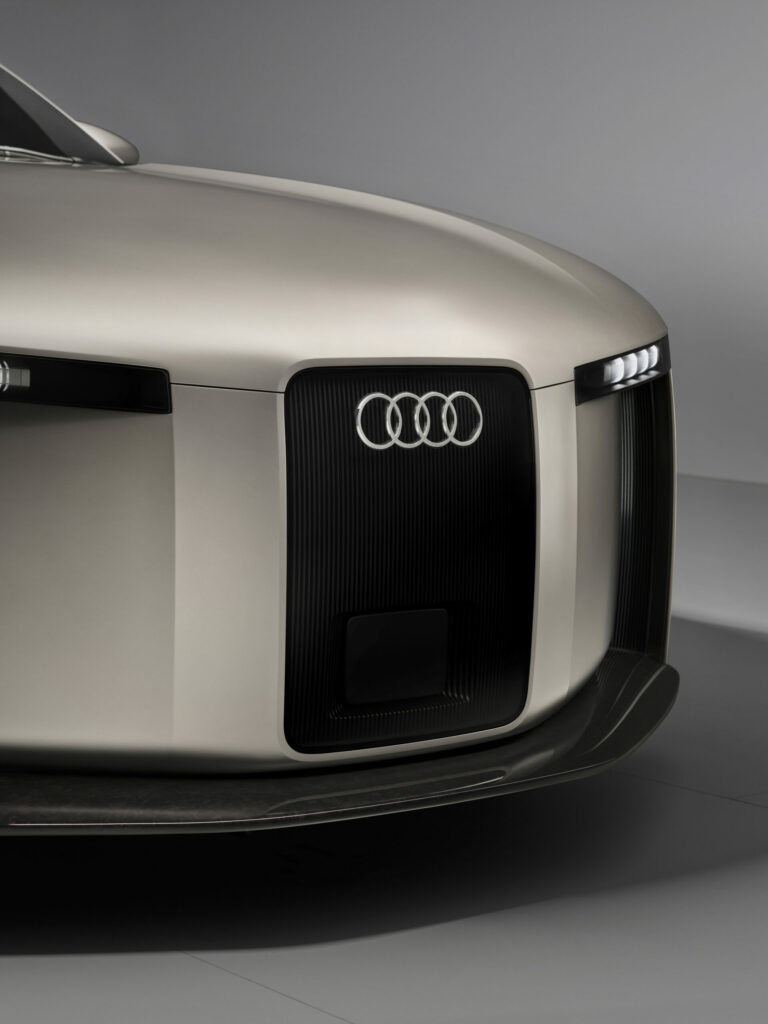
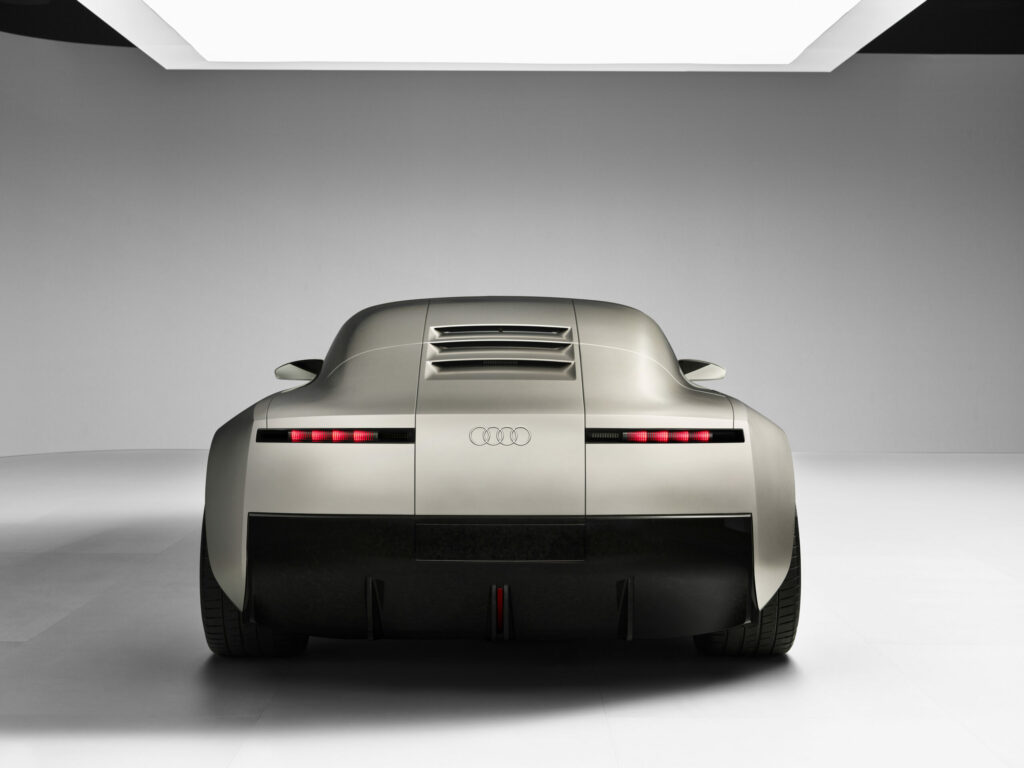
The Concept C reshuffles the deck with its ultra-legible design, harmonious proportions and an almost Bauhaus minimalism that is anything but sad. The most striking element is undoubtedly the abandonment of the traditional grille in favour of a contrasting but less intrusive vertical ‘face’. According to Audi, the overall design was inspired by the Auto Union Type C single-seaters of the 1930s and the third-generation Audi A6 of 2004. Curiously, the company never mentions the Audi TT or the R8, with which the similarity is obvious… But that’s certainly due to a lack of objectivity. Still on the subject of design, the Concept C appears to be the debut of the brand’s new light signature, made up of four horizontal segments, again very discreet.
Credit: Audi
Audi Concept C… more than just a concept car
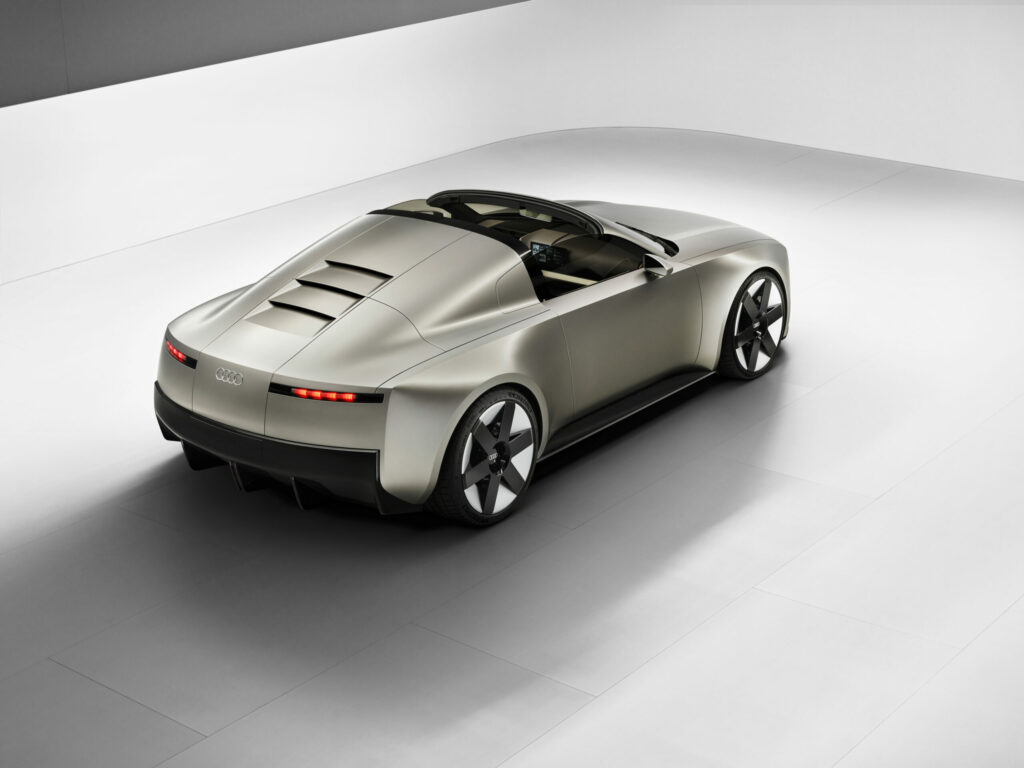
In addition to this aesthetic approach, the Concept C also reveals more about the architecture of the Audi of the future. The roadster is built around its battery pack, giving it a rather svelte silhouette, efficient aerodynamics and a very low centre of gravity, without compromising passenger comfort. And for the first time at Audi, the retractable roof is… rigid! It’s certainly not going to please canvas purists, but a coupé/cabriolet is so cool…
Credit: Audi
Inside, it’s nothing to write home about. It’s (very) simple and (very) effective. There’s nothing revolutionary about it. On the contrary, it’s more in line with what’s being done a lot of these days: a screen, few or no buttons and materials that alternate between cold (aluminium) and warm (wool).
Credit: Audi
For those who still doubt the influence of the Concept C on the future of the brand, Audi could not be clearer: “this concept car prefigures a future production model and will influence future creations“. And I’ll take their word for it, because the production TT is a near carbon copy of a concept car presented a year earlier. Rebelotte?
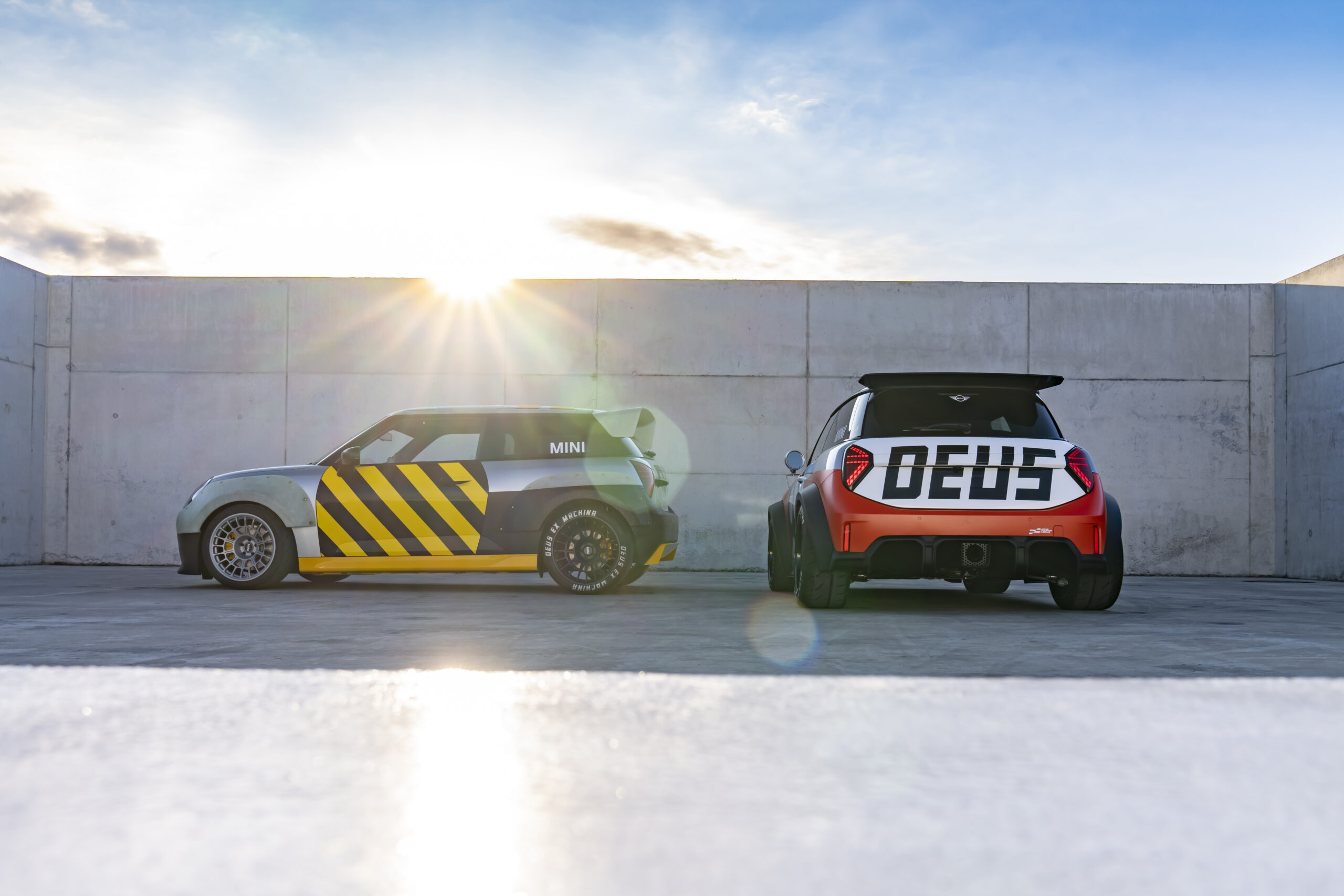
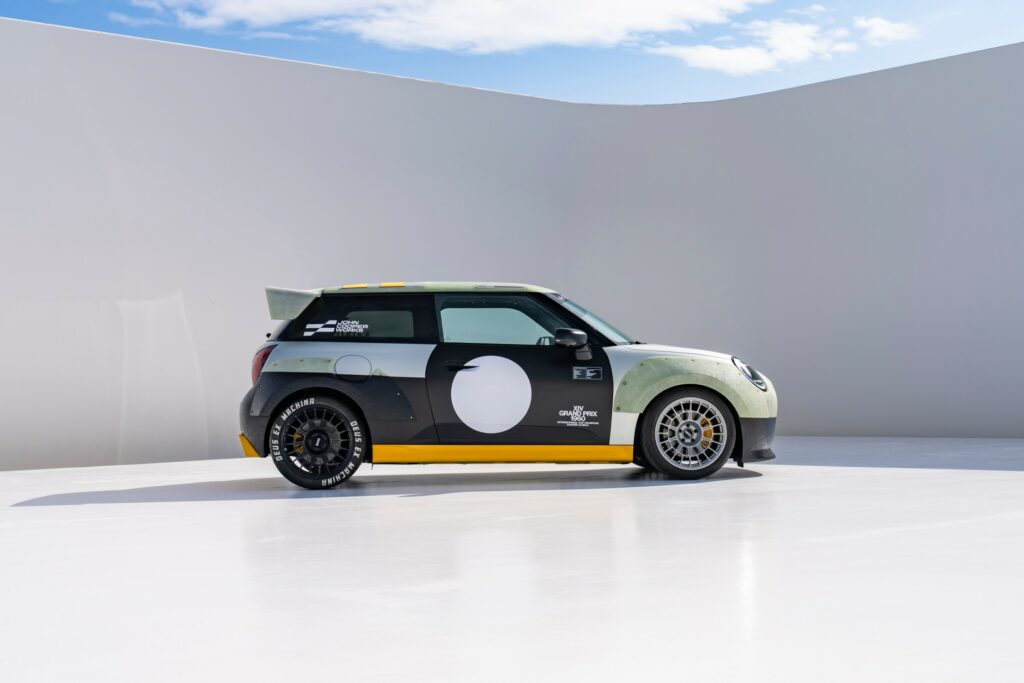
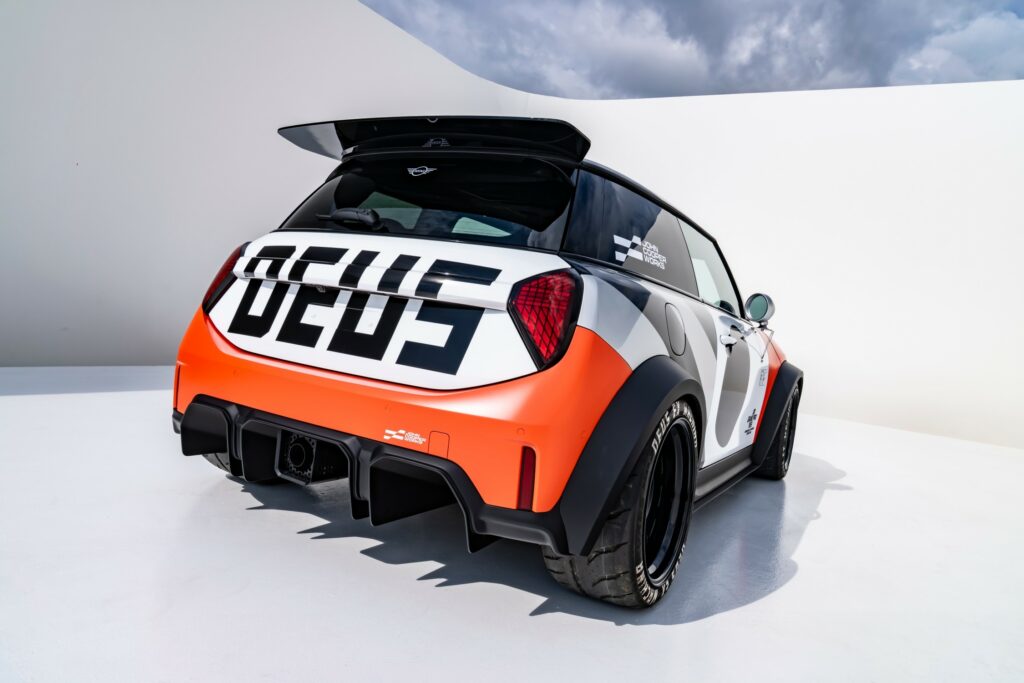
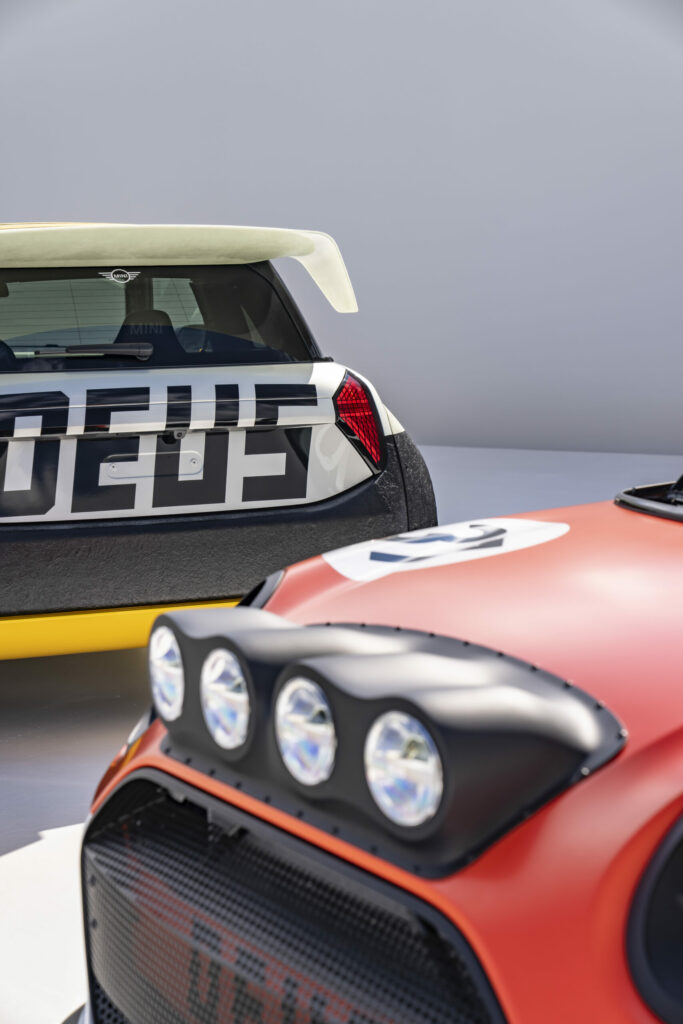
Mini, in collaboration with Australian fashion label Deus Ex Machina, and via its sports car subsidiary John Cooper Works, unveiled two crazy concepts at the IAA Mobility show in Munich, called The Skeg and The Machina. The Skeg and The Machina are electric bombshells and thermal powerhouses that bridge the gap between two worlds that sometimes struggle to understand each other.
At first glance, nothing seems to compare The Skeg and The Machina. The first is a revisit of the beastly electric Mini JCW and its 258 bhp. Its surfboard-like fin and yellow straps on the roof are all calls for adventure, a characteristic trait of the Deus universe that The Skeg transcribes to perfection.
Credit: BMW Group
Its companion, The Machina, as its name might suggest in Italian, prefers petrol to watts. It’s powered by a 231bhp turbocharged four-cylinder petrol engine, and it’s not hard to imagine the symphony that is the hallmark of John Cooper Works cars. Its livery is also a tribute to sportiness. It wears the colours of Monaco and bears the number 37, which Paddy Hopkirk wore when he won the Monte Carlo Rally in 1964. Mini and Deus have also paid homage to the sporty interior, with bucket seats, a racing steering wheel, extra headlights and, the detail that really gets us going, a hydraulic handbrake.
Credit: BMW Group
Not the same engine, but the same passion
In other words, you get both the smell of petrol and the ugly back of electric power. Unfortunately, this will remain at the concept stage… Indeed, Mini and Deus Ex Machina have no plans to offer the two cars for sale, even in limited editions. So what’s the point? These show cars will certainly play a role in the communication of the two companies, but they also demonstrate the versatility of this iconic little city car. Above all, and this is what interests us here: The Skeg and The Machina show that a car can still be a subject of creativity and sportiness, whether it’s electric or combustion-powered.
Credit: BMW Group
This ‘reconciliation’, even if symbolic, is worth highlighting at a time when the car industry is undergoing a transition that can sometimes be divisive (we know something about this, we read all the comments on our social networks…). In 2025, a decisive year for the future of mobility, Mini has chosen to tell two seemingly parallel stories that ultimately come together around the same conclusion: when you love the car, you love the pistons and the oil as much as all the memories you create behind the wheel.
And while the cars aren’t for sale, you can still get a little piece of the partnership… To mark the occasion (and do a bit of business), a capsule collection of clothes inspired by the collab is available on the Deus Ex Machina website.
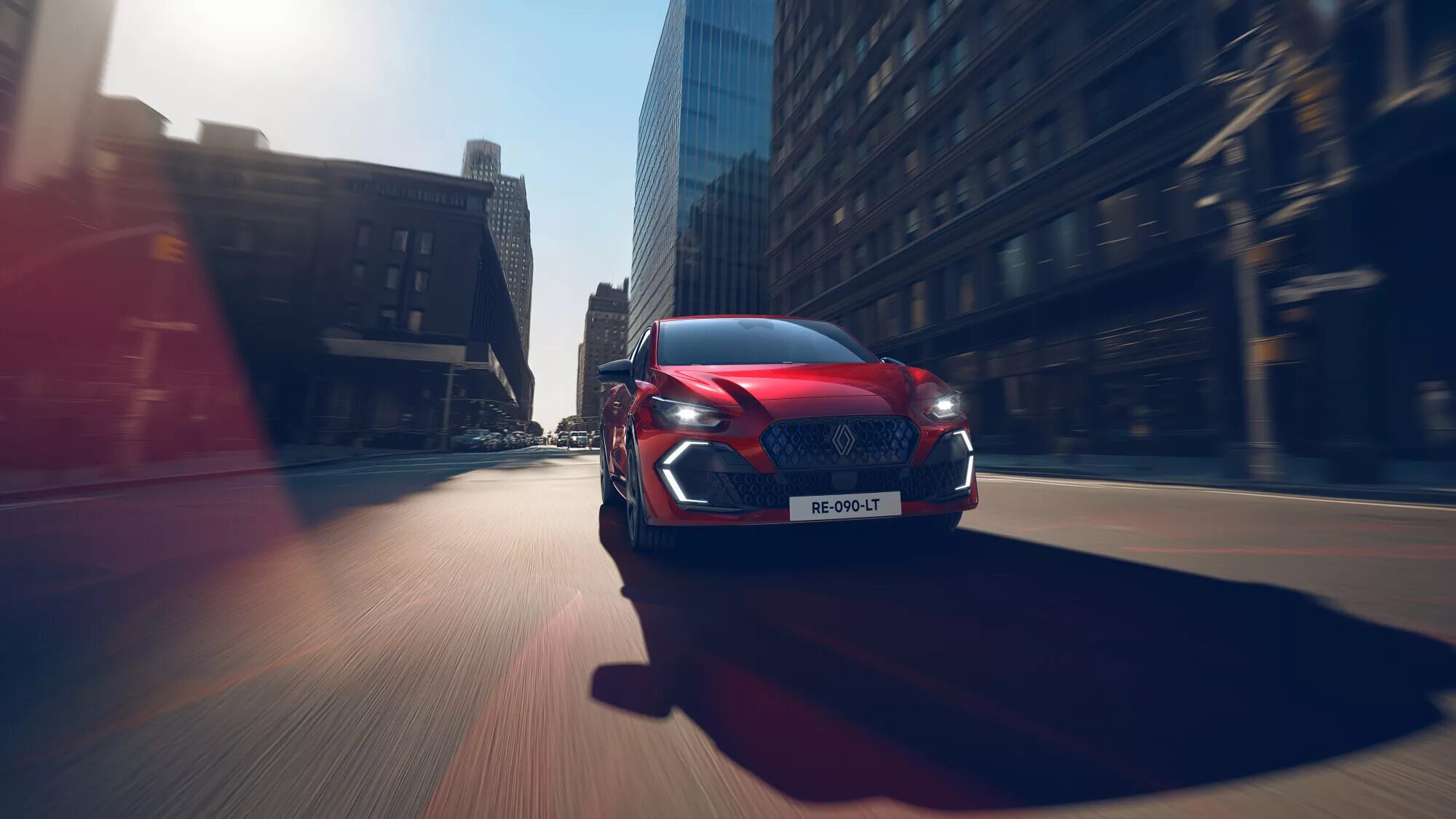
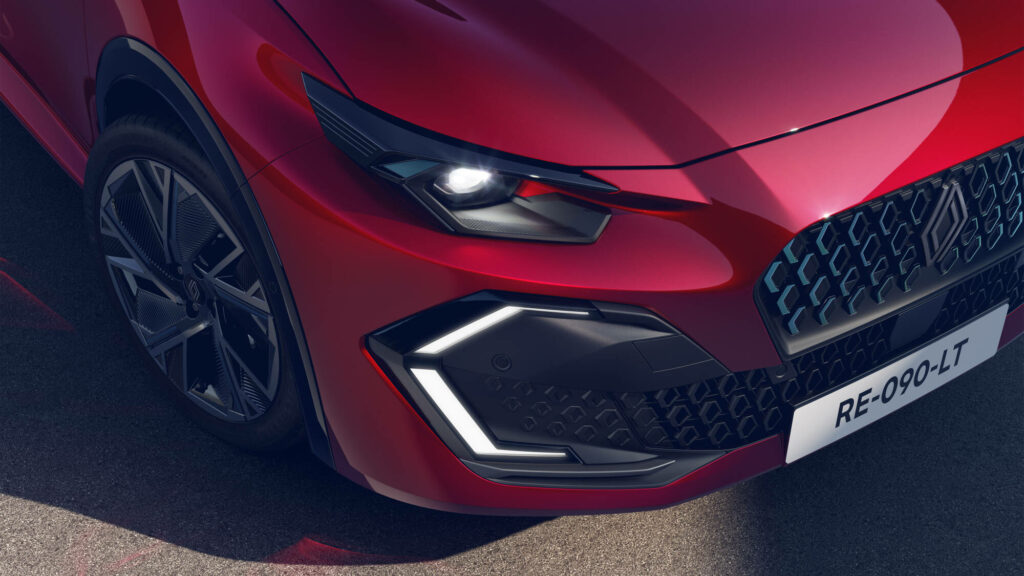
Renault took advantage of the IAA Mobility show in Munich to present the Clio 6. It’s a clear break with the past and a risky gamble: bigger, more connected, more expensive and now available exclusively in petrol and hybrid, the iconic city car – and incidentally its best seller – will have to (con)quer or perish.
This autumn, at the IAA Mobility show in Munich, where ECO MOTORS NEWS made the trip, Renault lifted the veil on the Clio 6. The launch is no mean feat, given that 17 million Clios have been sold since the car first hit the road in 1990. It is not only a Renault icon, but also an emblem of European motoring. The proof is in the Clio 5’s second place in the ranking of the best-selling cars in Europe in the first half of 2025, behind the Dacia Sandero. It would therefore be an understatement to say that this Clio 6, the first models of which are due to leave the Bursa plant in Tunisia in early 2026, will not only be eagerly awaited, but will also play a major role in Renault’s future.
Credit: Renault
Futuristic design, modernised interior and new on-board technologies
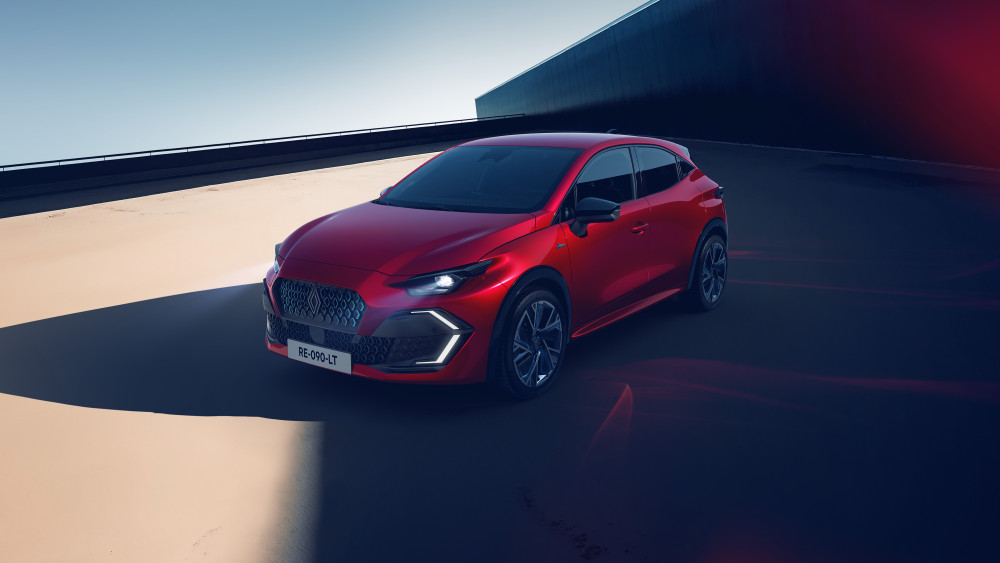
If you put the Clio 6 next to a Clio 5, you’d think they were from two different manufacturers! Quite simply, we haven’t seen such a restyling since the transition from the 2nd to the 3rd generation. And, as was the case then, the new design is divisive. Here at ECO MOTORS NEWS, we love it! With a hint of the Emblem concept car and its sleek, tapered, futuristic lines, and with its aggressive grille and sharp, handsome headlights, the Clio 6 is definitely in tune with the times. But there’s one intriguing detail above all: this city car is becoming ‘decitadinised’. A rather barbaric neologism, but with an extra 7 centimetres in length, for a total of 4.12 m, we’re moving even further away from the original spirit of Renault’s best-seller and its 3.70 m length. And that’s precisely where Renault is taking a risk, since it’s the compactness of the Clio that has made it such a success… Especially as this change in size also implies a change of segment and, de facto, a change in pricing. Although Renault has yet to reveal the price of the Clio 6, it is estimated that it could start at around €20,000, considerably more than the current version. Once again, this is a gamble, since the ‘affordable’ nature of Renault’s city car is another argument in its favour.
Credit: Renault
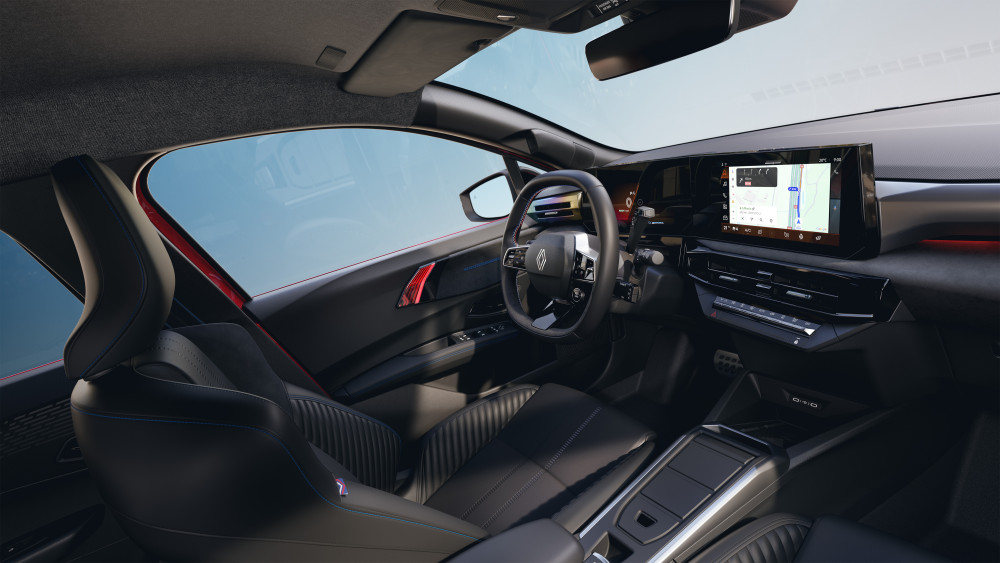
But the change in price can also be explained by the changes inside. In addition to a completely redesigned, high-quality interior, the Clio 6 features the same digital interface as the R5 and R4 E-Tech, with a dual 10-inch screen, native integration of Google Maps and the AI assistant, and almost thirty driving assistance devices. A far cry from the crank to wind up the windows…
Credit: Renault
Clio 6 closes the diesel chapter
It was to be expected, and that’s the way the story goes, but it’s still something: there will be no Clio 6 diesel. The same goes for the smaller internal combustion engines, which explains the higher entry price. The range now starts with a 115bhp three-cylinder petrol engine. A petrol/LPG bi-fuel is also on the programme. But what really interests us is the hybrid model, which will undoubtedly be the biggest seller. This benefits from some significant improvements, notably to the petrol engine, which has been reworked to boost its power by around 15bhp to 160bhp. All this is backed up by the two electric motors that have made the other hybrid models in the E-Tech range so successful. We would have loved Renault to spring a surprise with a 100% electric Clio 6, but that still doesn’t seem to be on the agenda… Let’s just say that a lot of things would have had to be rethought before launching such a novelty, and the gamble is risky enough as it is!
Credit: Renault
Renault is therefore taking a calculated risk. The Clio is still a safe bet, but the competition is intensifying, particularly in the face of Chinese brands with their formidable value for money, and the growing popularity of compact SUVs. With this longer, more powerful sixth generation, Renault hopes to consolidate the Clio’s place on the European best-seller podium by expanding into other market segments. It remains to be seen whether this strategy will pay off or whether, on the contrary, the Clio 6 strays too far from the Clio spirit for customers who are very attached to the legendary city car.
The IAA Mobility 2025 show opens in Munich in a climate of change and uncertainty for the automotive industry. But with technological innovations, new European models and an offensive by Asian manufacturers, the event gives us grounds for optimism.
The IAA Mobility 2025, which takes place in Munich from 9 to 14 September 2025, confirms its status as the global platform for mobility. ECO MOTORS NEWS is already on site, having opened its doors to the press on September 8. At today’s press conference, the organisers and some of the 740 exhibitors from 95 countries highlighted innovations in electric and electrified mobility. Taking place both in the heart of the exhibition centre and in the city, this 2025 edition is set to be the most ‘general public’ yet also the most international. More than half of the exhibitors are non-German.
Volkswagen, BMW and Mercedes reign supreme, Opel creates a surprise at the Munich Motor Show
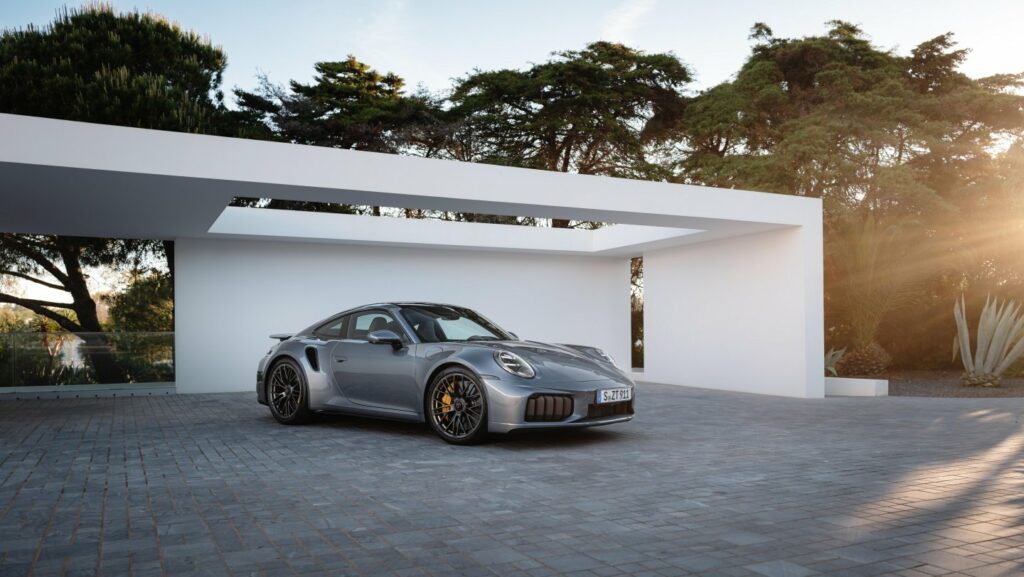
The IAA Mobility 2025 in Munich has opened its doors to manufacturers from all over the world, but it’s still the German brands that are taking the lion’s share. Leading the way was Volkswagen, which unveiled no fewer than four new electric models in its ‘Open Space’ area, accessible to the public in the city centre. Also from Volkswagen, but this time within the group, Skoda unveiled the Epiq, a small electric SUV expected to cost under €25,000. It further strengthens the VW group’s position in the highly sought-after entry-level electric segment. A little less ‘affordable’, Porsche chose Munich to present the 911 Turbo S equipped with a new hybridisation system (we’re not talking about a Prius, admittedly, but still!) as well as an electric version of the Cayenne, equipped with an innovative wireless recharging system. These two new products show that Porsche has not given up: the brand intends to preserve its DNA while making the transition to a more energy-efficient car.
Credit: Porsche
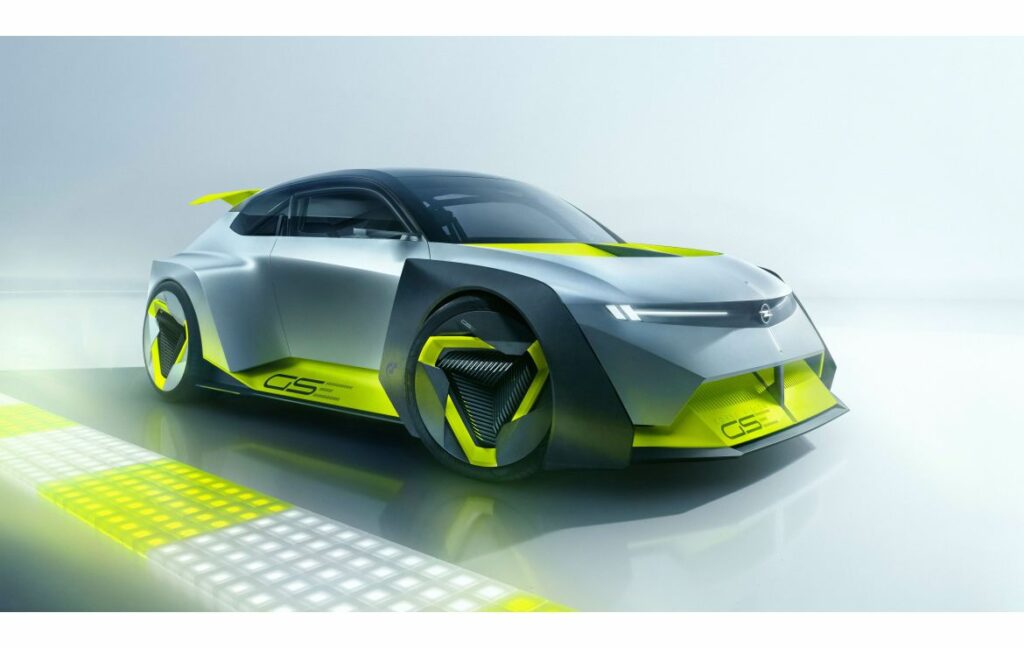
While the Volkswagen Group, the world leader, was inevitably eagerly awaited on its home turf, it was a German manufacturer, but from the Stellantis Group, Opel, which created the biggest surprise. Opel caused a sensation at the IAA Mobility 2025 with two eye-catching new products: the new Mokka GSE, a sporty electric version of its compact SUV, and above all the Corsa GSE Vision Gran Turismo concept car. Futuristic, pop-coloured and sharp, it seems to point to future design changes at Opel.
Credit: Stellantis
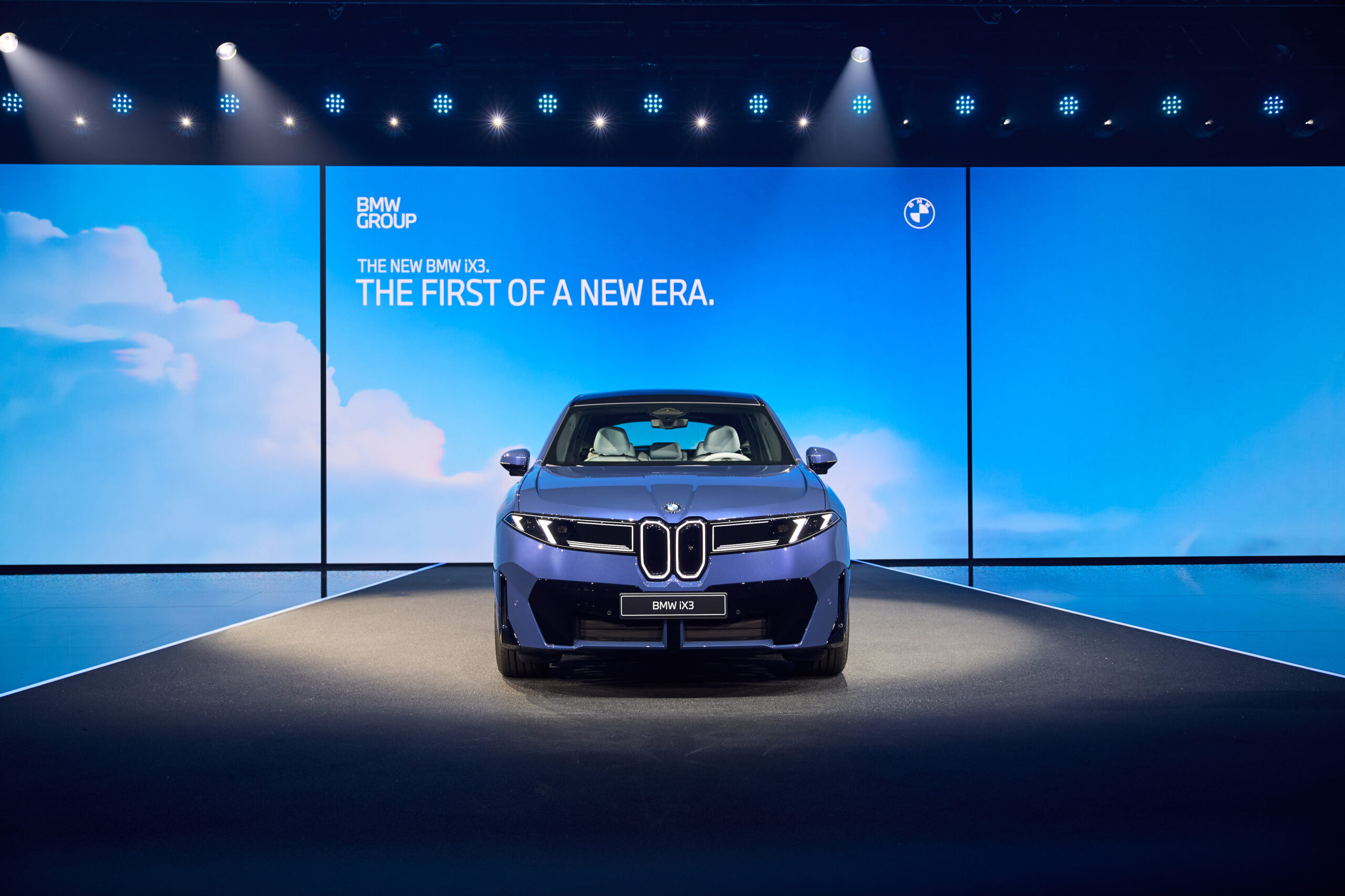
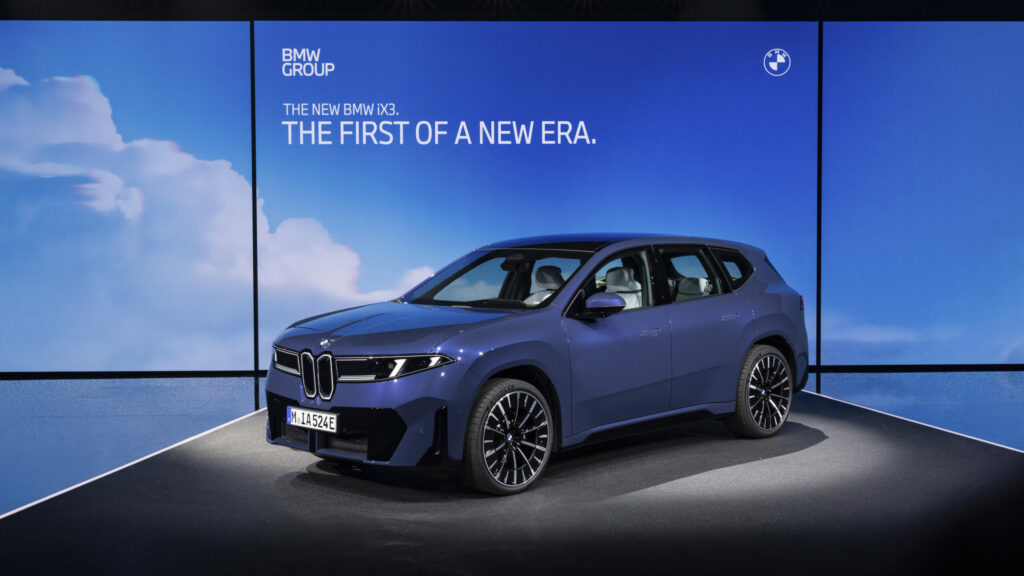
Mercedes, for its part, presented the new 100% electric GLC, equipped with EQ technology and embodying the new phase of its “Sensual Purity” design philosophy. Last but not least, BMW caused a sensation with the launch of the iX3, the first model on the new ‘Neue Klasse’ electric platform, which promises a range in excess of 800 km and the possibility of recovering up to 370 km of range in just ten minutes. Available on the Old Continent from spring 2026, it is expected to cost around €69,000. Enough to stop the Chinese competition?
Credit: BMW
Chinese and Turks attack the European market
Chinese manufacturers are making a big impression at Munich. Whether it’s Leapmotor with its B05, which is due to go into production in Spain by the end of 2026, ready to take on the Megane E-Tech and the Volkswagen ID.3, or Xpeng with its P7+, with a price/performance ratio that could well shake Tesla and maybe even… Mercedes!
Credit: Xpeng
On the borders of Europe, there’s a young brand that’s determined to make its mark in the sun, starting with Germany. Togg, Turkey’s first national manufacturer and only 7 years old, has announced the arrival in Germany of its two models, the T10X SUV and the T10F saloon, whose BMW-inspired design could catch the eye of German drivers. And Togg’s survival depends on it. According to Reuters, the Turkish manufacturer would need 200,000 sales a year to be profitable, and its domestic market, although showing very decent results (30,000 units sold in 2024), is not enough. Germany is therefore, first and foremost, a strategic market to conquer, but also the ideal gateway for conquering other European markets.
Autonomous driving, from fantasy to reality
It’s not just hardware that’s on show in Munich. The IAA Mobility also welcomes exhibitors specialising in software, particularly for autonomous driving. Or rather, ‘driving aids’. More than 200 vehicles will be on display for visitors to get a real feel for the latest developments in these technologies, which are as fascinating as they are frightening! QCraft, for its part, is not afraid of anything. Quite the contrary, in fact. The Beijing-based company, which specialises in autonomous navigation solutions, has announced the opening of its European headquarters in Germany – which explains its presence in Munich – as well as a strategic partnership with American giant Qualcomm. Sounds promising!
Optimism at IAA Mobility Munich 2025
While the skies over Munich are not all rosy when it comes to electric mobility and even the automotive sector in general – Volkswagen’s Oliver Blume claims that US customs duties have cost the group billions and forced it to review its international policy, and Jean-Philippe Imparato of Stellantis is backtracking on all-electricity by 2030 – the 2025 edition of the IAA Mobility is nonetheless full of fine promises. With more affordable vehicles, new recharging technologies, autonomous driving, Chinese companies planning to produce in Europe and even the sporty Porsche 911, there’s plenty to be optimistic about.
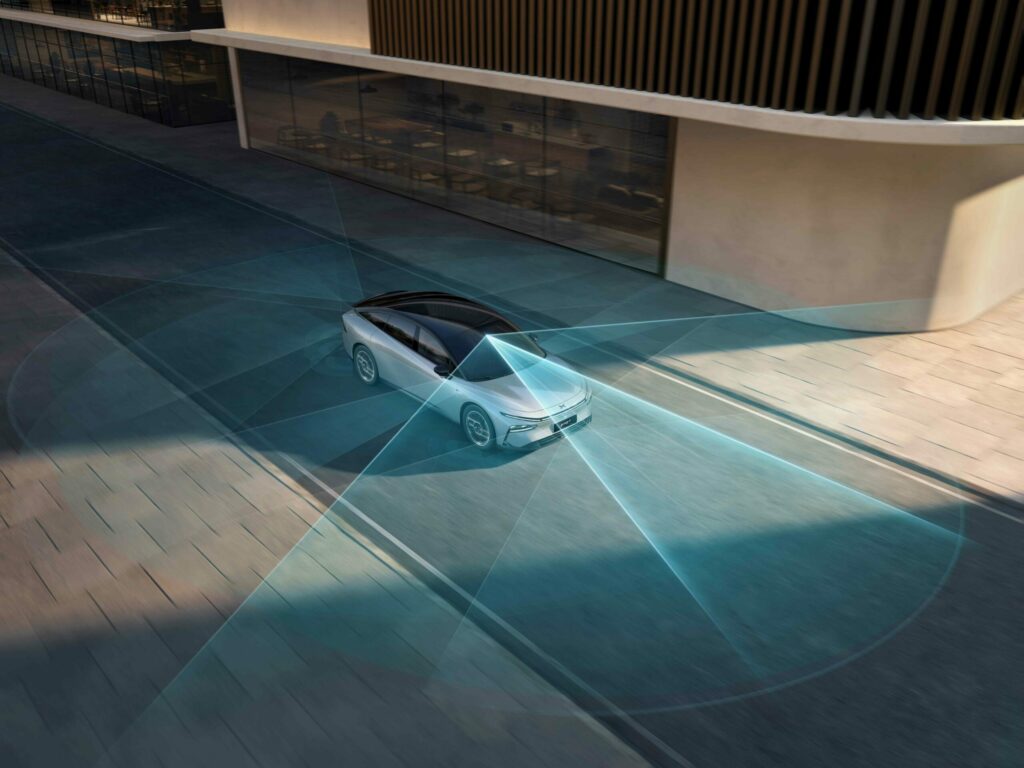
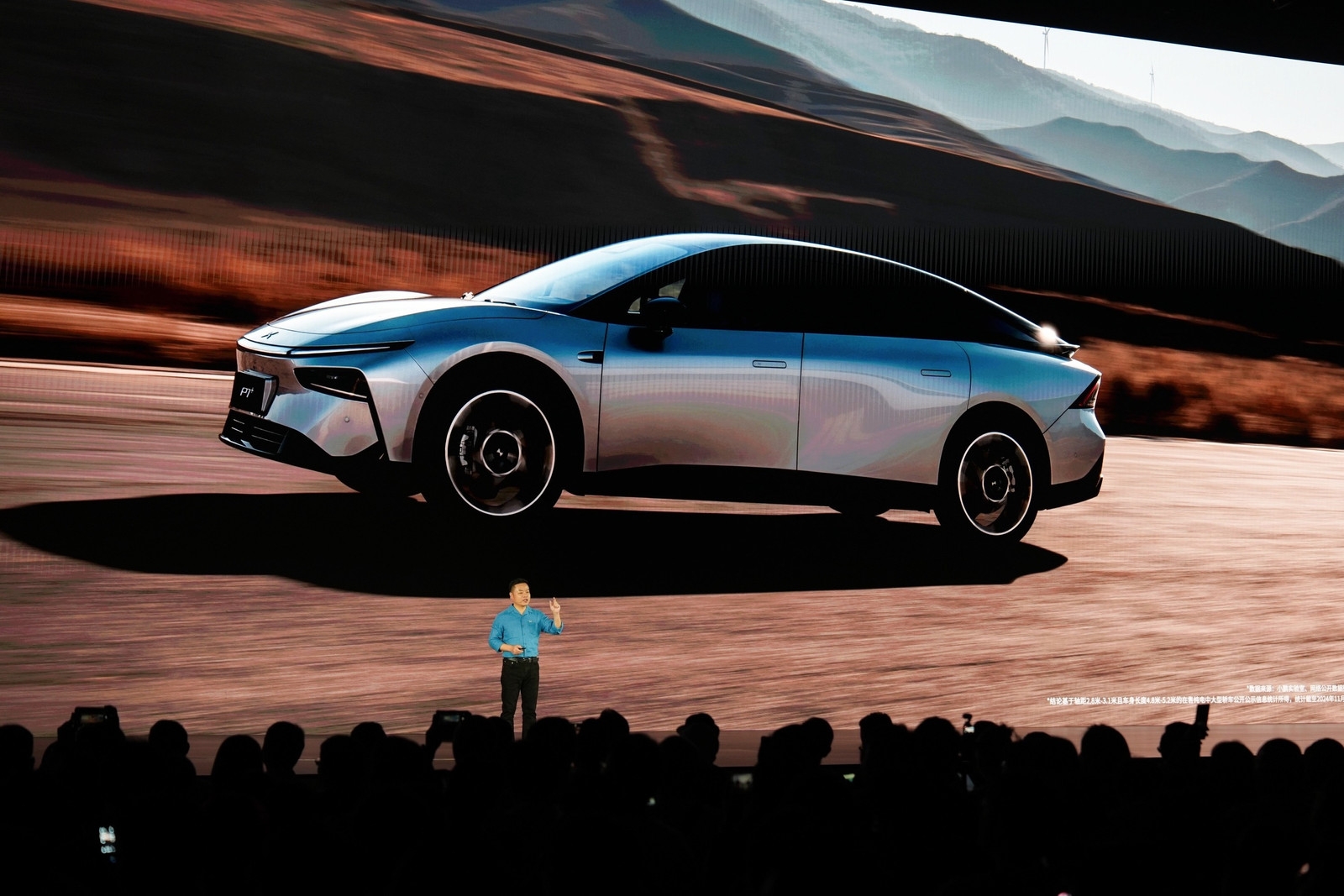
At the IAA Mobility 2025 trade fair in Munich, Xpeng announced that its P7+ saloon would soon be available in France.
September is back-to-school month, but not the only one! For the editors of ECO MOTORS NEWS – and the rest of the ecomobility world – it’s also time to head to Germany for the IAA Mobility show in Munich, to take the pulse of this booming industry.
Chinese carmaker Xpeng decided to unveil its new large saloon – the Xpeng P7+ – for the first time on the Old Continent, in Franz Beckenbauer’s hometown. The premium brand is thus confirming its imminent arrival on the French market, as we predicted in our article on the 5 Chinese electric car models you need to know about.
Credit: Xpeng
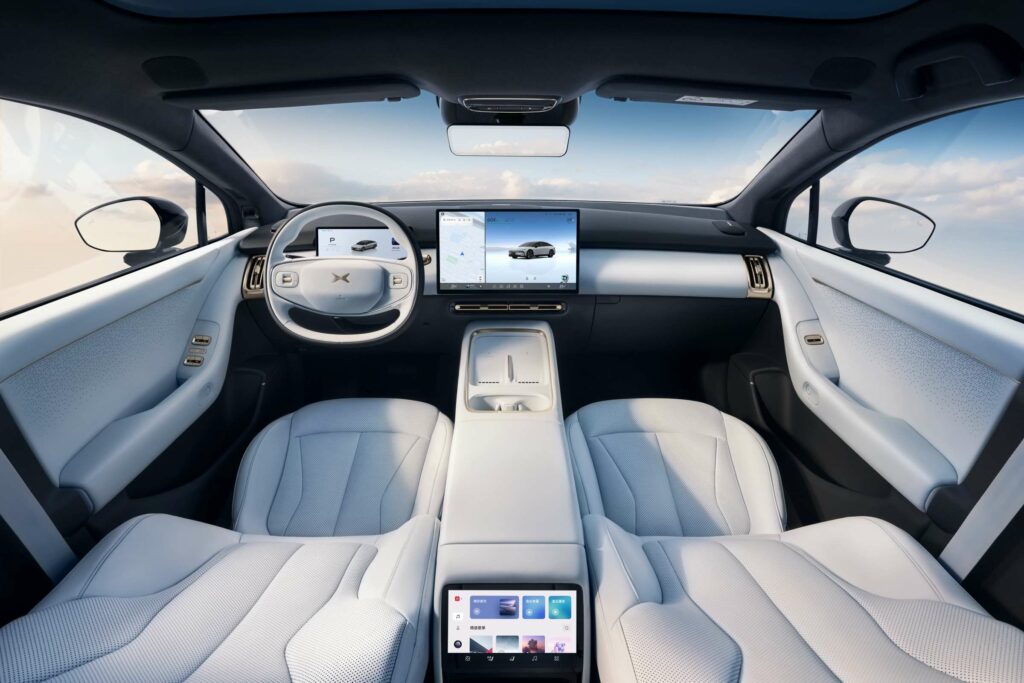
This XXL saloon (over 5 metres long) is based on the company’s signature SEPA 2.0 platform, which is modular and practical, and whose architecture enables it to accommodate 800-volt batteries. It therefore promises ultra-fast recharging, with a refill from 10% to 80% in around twelve minutes on the highest-performance version. In the age of SUVs and, more generally, 4-wheel drive, the P7+ will only be available with rear-wheel drive. Two versions will be offered, all equipped with lithium-iron-phosphate (LFP) batteries, with a choice of 60.7 kWh or 76.3 kWh, promising power outputs of 245 and 320 bhp.
In terms of performance, the claimed range (to be taken with a grain of salt) is 715 km CLTC – the Chinese equivalent of the WLTP, which is closer to 585 km. In terms of design, every detail of the car’s aerodynamics has been thought through in order to limit fuel consumption, with a fastback that is particularly striking. The boot capacity, which varies between 725 litres and 2,221 litres with the seats folded, is more than adequate. When it arrives in France, expected before spring 2026, it should be priced between €45,000 and €50,000. Indeed, Xpeng has announced that its price will be similar to that of its G6 SUV, which sells for €47,000 in France. If the P7+ lives up to its promise, it could put the Tesla Model 3 under pressure in the same price segment.
Credit: Xpeng
In short, the Xpeng P7+ is an ambitious large electric saloon, combining ultra-fast charging, generous interior space, advanced technology and very attractive value for money in the European segment. Could this finally be the comeback of the saloon? In the meantime, stay tuned for further announcements and news straight from the IAA Mobility Munich show, coming soon to our website.
As the electric car market is still relatively new and growing rapidly, it is of interest to consultancies and pollsters, who are constantly publishing studies on the subject which, when aggregated, produce a profile of the typical electric car owner in France.
A discreet portrait of an electric car owner in France, behind the wheel of his vehicle. (Credit: Michael Kahn)
We know that they are men (nearly 70% of owners), private individuals, aged between 46 and 48 according to the studies (much younger than those with combustion engines, whose buyers of new cars are approaching sixty), mostly city dwellers, who invest in new cars. Technophiles, they generally have a charging point at home – a figure that rises to 90% for house owners – and, despite comfortable incomes, they tend to go for the most affordable models, which they acquire by leasing. Finally, in the first few months of 2025, French electric vehicle owners were more inclined to buy… French! In fact, the top 10 electric cars sold in France in recent months include six models from French manufacturers.
The main motivations
For this typical buyer and all the others, the decision to go electric is the result of a number of factors. The first is, of course, consumers’ growing ecological awareness. Reducing their carbon footprint (in use) and making their own contribution to curbing climate change are the main reasons for considering the purchase of an electric car, particularly among younger people, which explains why the average age of electric vehicle owners is lower than that of internal combustion customers. But this is not the only argument in favour of ‘watted’ cars. While the average purchase price of an electric car is always higher than that of a combustion engine, the running costs are lower, maintenance is less frequent and more expensive, and it is possible to benefit from state aid to reduce the bill. Add to this the numerous financing options, from long-term leasing (LLD) to leasing with an option to purchase (LOA), and the wallet can manage without too much damage. The new generation, for whom the car seems to be primarily a utility object rather than a collector’s item, seems more inclined to lease their vehicle and to change it more often than their elders.
In the same vein, shifting gears after rattling the rev counter, listening to the hum of a V8 and changing the oil, filters and spark plugs in the garage on Sundays is a little less thrilling for these new buyers, who prefer a vehicle that is quiet, easy to drive and packed with technology.
A mass of electric vehicles in a car park in France, reflecting the widespread adoption of electric cars.
Persistent obstacles
But let’s not kid ourselves. If the electric car market is growing rapidly, it’s mainly because it started from scratch and has been boosted by various political measures, both in France and in the European Union. Consumers are still faced with a number of obstacles to the purchase of an electric car, the most important of which is range. This is the number one concern for more than 80% of French people, even though on average they only drive around fifty kilometres a day. In addition to this – slightly exaggerated – fear of a breakdown, there’s the worry of not being able to find charging points. With 160,000 charging points spread across the country, France is not lagging behind, and is even aiming for 400,000 by 2030. By way of comparison, there are only 10,000 service stations in the whole country! But the argument is still valid, particularly for people living in rural areas who often have no choice but to install a charging point at home, given the long distances between charging stations.
Finally, although we mentioned above that electric cars can be interesting from a financial point of view, money is still a barrier for most households. This can be explained by the fact that the second-hand market for electric cars is still very small. Logical, given that a French owner keeps his or her electric vehicle for an average of 5 years before selling it on, and that a large number of these vehicles in the French fleet have been on the road for less than 5 years… There are grounds for optimism.
Towards democratisation?
All the lights are green for the democratisation of electric cars (and electric mobility in general) in France and Europe. Carmakers have switched, are switching or are planning to switch to 100% electric cars, from the most mass-market to the most luxurious, driven by the desire to change things, to attract new, younger consumers who are concerned about the environment, but above all by the local policies imposed on them. In 2035, quite simply, it will be forbidden to sell new combustion-powered vehicles. And 10 years is the minimum time needed to ensure that the transition is complete by then.
The ambitions for infrastructure dedicated to recharging electric vehicles are very high, but so far in France, one target after another has been met, giving us confidence for the future. The same goes for innovations to extend the range of electric vehicles, battery recycling and battery manufacture – all areas of uncertainty and concern for French consumers that should become clearer over the next few years. The main question is whether, by 2035, the sketch we drew up in the introduction will be any different from that of 2025? Not for sure, but if there is a real democratisation of electric mobility, it will be much more complex to establish!
China, the undisputed leader in battery manufacturing, has produced more than two-thirds of the lithium-ion batteries currently in circulation. This dominance can be attributed to an immensely powerful industrial network that allows for full internalization of the supply chain. It is also due to competitive manufacturing costs and easy access to raw materials thanks to China’s strong economic ties with key supplier countries.
The ACC gigafactory in Billy-Berclau, France, is a leading European battery manufacturing facility focused on advancing EV battery production. (Credit: ACC)
However, with the recent and spectacular rise of electric vehicles (EVs), Europe and the United States, among others, are investing heavily in developing their own production capacities to secure energy independence.
At the same time, promising technological innovations are emerging, aiming to revolutionize battery performance and sustainability—particularly in terms of size (and therefore weight).
They also focus on the use of minerals whose extraction often sparks controversy.
“Made in Europe” Batteries: Between Strategic Independence and Chinese Investments
It’s clear—based on both government announcements and the inauguration of new factories in recent years—that Europe is aiming to become a major player in electric vehicle battery production. By 2033, it’s estimated that nearly 250 factories will be established across the continent.
This surge is driven by key projects in France, Germany, Italy, Spain, and Norway, among others. If some of them are failing, because of a still fragile market, companies such as Verkor and ACC (initially founded by Stellantis and Total, now with Mercedes-Benz among its shareholders) in France, and Italvolt in Italy are taking the lead.
This vibrant European ecosystem has quickly attracted the attention of… the Chinese! Envision, based in Shanghai, has built gigafactories in Douai, France, and Sunderland, UK, in partnership with Renault and Nissan, respectively.
Similarly, CATL, the undisputed global leader in EV battery manufacturing, has teamed up with Stellantis—the two companies that plan to invest over €4 billion—to build a factory in Zaragoza, Spain. This will be CATL’s third factory in Europe after Germany and Hungary, with a fourth already in the pipeline. Its location has yet to be announced.
Finally, BYD, the new global leader in EV sales, has already opened two factories in Europe and is considering a third. These partnerships and installations highlight the complex challenge facing European governments: developing a domestic industry to achieve energy independence, while also relying on the very players they hope to free themselves from. This allows them to benefit from their funding and technical expertise.
The American Industrial Boom
This lithium-ion battery is manufactured in the USA for Ford electric vehicles, highlighting America’s growing battery manufacturing industry. (Credit: Ford)
In the United States, the 2022 Inflation Reduction Act (IRA) has sparked a true boom in the construction of EV battery factories. An unprecedented surge has brought dozens of gigafactories, most still under construction, within the “Battery Belt” spanning ten states from Georgia to Michigan.
In addition to Tesla, which is already well-established, Ford, General Motors, Hyundai, Toyota, and others are investing heavily, supported by federal tax credits provided by the IRA. From just two such factories in 2019, the U.S. now has around thirty that are either operational or nearing completion. There are over 200 battery-related projects.
There’s also a wave of startups creating battery recycling solutions that ensure batteries remain within the country for their entire lifecycle. The question remains: what will the Trump administration do about this electrification movement? The 47th President of the United States is a strong supporter of the oil industry.
Yet he also launched a trade war with China and promised to massively reduce unemployment. Domestic battery manufacturing helps reduce reliance on Chinese imports and, according to several estimates, could create over 100,000 jobs.
So, between protectionism—fueled by industrialization and electrification—and conservatism—rooted in continued oil reliance—two core features of Trump’s platform, the administration will have to make a choice. But which one?
New Batteries: Lighter and More Durable
A cutting-edge research lab dedicated to developing innovative and sustainable battery technologies for the electric vehicle market. (Credit: ThisisEngineering)
Far from these geopolitical concerns, technological innovation is steadily progressing and lies at the heart of the battery sector’s transformation.
Recently, U.S.-based Paraclete Energy developed SILO Silicon, a silicon anode material that reduces battery weight by 50% while doubling range. An 80 kWh pack could drop from 565 kg to just 150 kg. It could also offer a range of over 930 km. A promising outlook!
Stellantis is also exploring promising alternatives. In partnership with Zeta Energy, the group is developing lithium-sulfur batteries, which are lighter, cheaper, and contain no cobalt or nickel. This dramatically reduces the need for controversial raw materials. These batteries could hit the market by 2030 and be compatible with existing infrastructure.
Finally, semi-solid battery technology is advancing. Stellantis plans to test Dodge Chargers equipped with these batteries starting in 2026. They offer higher energy density and compatibility with current production lines.
Whether powered by sand, seawater, air, or carbon—whether they charge as quickly as a gas tank fills, or even offer virtually unlimited lifespans—the batteries of the future are already on their way!
The year 2024 marked a major milestone in electric vehicles (EVs) expansion worldwide. 17.1 million EVs were sold globally, representing an impressive +27% increase compared to 2023. Development is mainly driven by three key markets: The United States, Europe, and China, which together represent over 90% of all EV sales globally. This rapid growth is backed by a thriving business ecosystem, with nearly 14,000 start-ups exclusively focused on electric vehicles and electric mobility worldwide. In Europe alone, the EV market is expected to generate $224.9 billion in revenue by the end of 2025.
Europe: The North is spearheading
Several European countries are showing particularly high EV adoption rates. Norway, of course, continues to lead the continent (and the world), with 88.9% of new car sales in 2024 being electrified. Denmark follows with 51% and Sweden with 35%.
Forte adoption des véhicules électriques dans les centres urbains en 2024-2025 (Credit: redcharlie)
Infrastructure is also expanding rapidly. As of spring 2025, the Netherlands leads with 183,000 public charging stations, followed by France (160,000) and Germany (153,000). On a per-capita basis, the Netherlands stays at the top with 10.04 chargers per 1,000 inhabitants, followed by Belgium (6.54) and Iceland (6.48).
The electric mobility startup scene is vibrant, particularly in the United Kingdom, home to 1,100 startups in the sector. Germany follows with 700, and France with 400.
Public incentives also play a crucial role in the EVs market growth. Norway, for instance, offers VAT exemptions for EVs priced below €44,000. In France, buyers can receive up to €4,000 for an EV priced under €47,000. The Netherlands, on the other hand, provides multiple tax breaks for both buyers and companies, including deductions for businesses that install charging stations.
Rest of the world: China and its underdogs
The EV shift is also accelerating in other parts of the world. In China, 25% of vehicles sold in 2024 were 100% electric (almost 50% electrified), making it the world’s largest EV market in terms of volume. Canada followed with 11,4% and the USA with 8%.
In terms of charging infrastructure, China still dominates with 3.2 million public charging stations, well ahead of South Korea (405,000) and the United States (200,000). South Korea has the best EV-to-charger ratio in the world, with just 1.7 vehicles per public charger, followed by China (2.5) and Mexico (20).
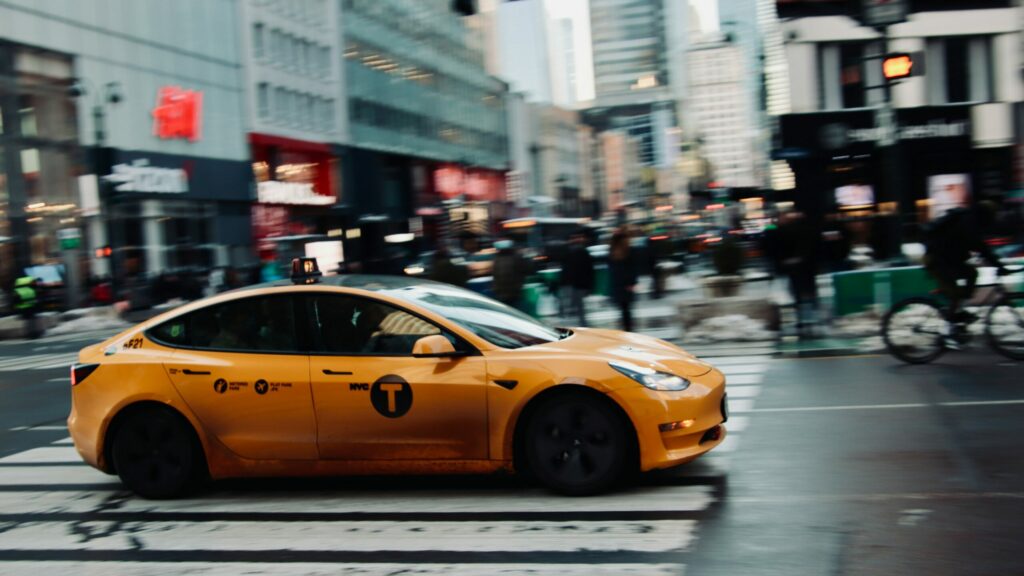
Taxi électrique circulant dans les rues de New York en 2025, symbole de la transition vers la mobilité durable. (Credit: Paul Cuad)
When it comes to innovation, the United States leads with 2,500 startups dedicated to electric mobility, followed closely by India (1,800) and China (1,700).
Last year saw some interesting growth in emerging markets, with Vietnam posting a +197% increase in EV sales between 2023 and 2024, Indonesia +104%, and Brazil +90%.
Some countries are also setting bold ambitions for the future. India aims for 80% of two-wheelers to be electric by 2030. Ethiopia has banned the import of combustion vehicles and is now importing 100,000 electric vehicles every month. Meanwhile, Singapore has set its sights on a 100% electric vehicle fleet by 2040.
Pascal Hureau, President of the Fédération Française des Associations d’Utilisateurs de Véhicules Electriques (FFAUVE) – an association formed in 2019 from the merger of several electric car owners’ associations – is a tireless campaigner for an accessible, pragmatic and user-centred energy transition. At a time when the electric car market is at a turning point, he talks to ECO MOTORS NEWS about his commitment, the current obstacles to the electrification of the car fleet and his vision of an electrified France by 2035.
Pascal Hureau, Chairman of the Fédération Française des Associations d’Utilisateurs de Véhicules Électriques (FFAUVE). (Credit: DR)
What is the FFAUVE? Pascal Hureau: First of all, it’s not a car club! It’s the only association in France that represents electric vehicle users. We defend their interests, a bit like the UFC Que Choisir for electromobility. We have the advantage of being a federation of regional associations, which means we can keep in touch with the realities on the ground.
What made you decide to go electric? Pascal Hureau: In a word: pleasure. The pleasure of driving, the silence, the comfort. As we often say at FFAUVE, if you try an electric car, you’ll love it! Of course, I also wanted to reduce my environmental impact: I was fed up with burning fossil fuels. Then, finally, with an electric vehicle, you gain real autonomy, you can recharge at home or elsewhere, without having to rely on a service station.
But there’s still a big step to be taken between adopting electric cars and committing oneself as you’re doing… Pascal Hureau: I’ve developed a passion for the subject. The range of vehicles on offer has grown, but demand has yet to mature, so I’ve been looking for a way to participate in the rise of the electric car: supporting this transition, informing, defending and proposing. And that’s what we’re doing at FFAUVE.
You are also active politically as deputy mayor of Montrouge, in the Paris region. PH: Yes, I am deputy mayor for digital transition, e-administration and European relations, but for a long time I was responsible for roads and urban development. I initiated the installation of the town’s first charging points, and today Montrouge is one of the best-equipped towns in the inner suburbs of Paris.
On a national scale, what is your assessment of the coverage of charging points? PH: We’ve almost reached 160,000 charging points accessible in public spaces. There’s been a real boom in shops, supermarket car parks, cinemas and so on. Motorway service areas are 100% covered. In reality, it’s mainly condominiums that are lagging behind: just 10-15% are equipped. That’s another of our missions, to help these co-ownerships install charging points in their car parks.
“It’s vital to combat misinformation”.
In your opinion, what are the current obstacles to more widespread adoption of electric cars by the French? PH: The price of vehicles is still too high for some people, especially those living in blocks of flats. This goes some way to explaining why there are so few recharging points in large housing estates… But the fear of autonomy is receding. Coverage is good and new technologies mean that recharging can be done very quickly. And we have to get away from the fantasy that we sometimes wait longer at the pump than at a fast-charging point. At least, that’s what we saw over the long Easter weekend. One thing is certain, we have to stop thinking that electric cars will be a niche market: they are the future of the motor industry.
There are also misunderstandings about the charging ecosystem… PH: Yes, it’s a big issue. There have been too many cards, too many systems. We need to move towards “plug and charge“, as Tesla is doing. Alliances like the SPARK Alliance are working in this direction. Simplicity is the key: bankcard or automatic authentication.
“We must not give up on the end of fossil-fired power in 2035”.
What are the FFAUVE’s plans for 2025? PH: First of all, we are going to publish a new version of our white paper – which can be downloaded directly from our website – and launch a specific guide for local authorities with a view to the 2026 municipal elections. We will also be stepping up our fight against misinformation, sometimes spread by influential media. We recently won a complaint to the Autorité de régulation de la communication audiovisuelle et numérique (ARCOM). Finally, the FFAUVE will continue to work with dealers to ensure that they are better trained to sell electric cars.
Finally, what do you think France will look like in 2035, in terms of electric cars? PH: Electric vehicles at the same price as combustion engines. Electric charging points everywhere. A rich second-hand market, thanks in particular to corporate fleets. More versatile and affordable models. And a stable, non-punitive, clear industrial policy that we stick to. The deadline is clear: 2035, the end of new combustion engines. And that’s something we must not give up!