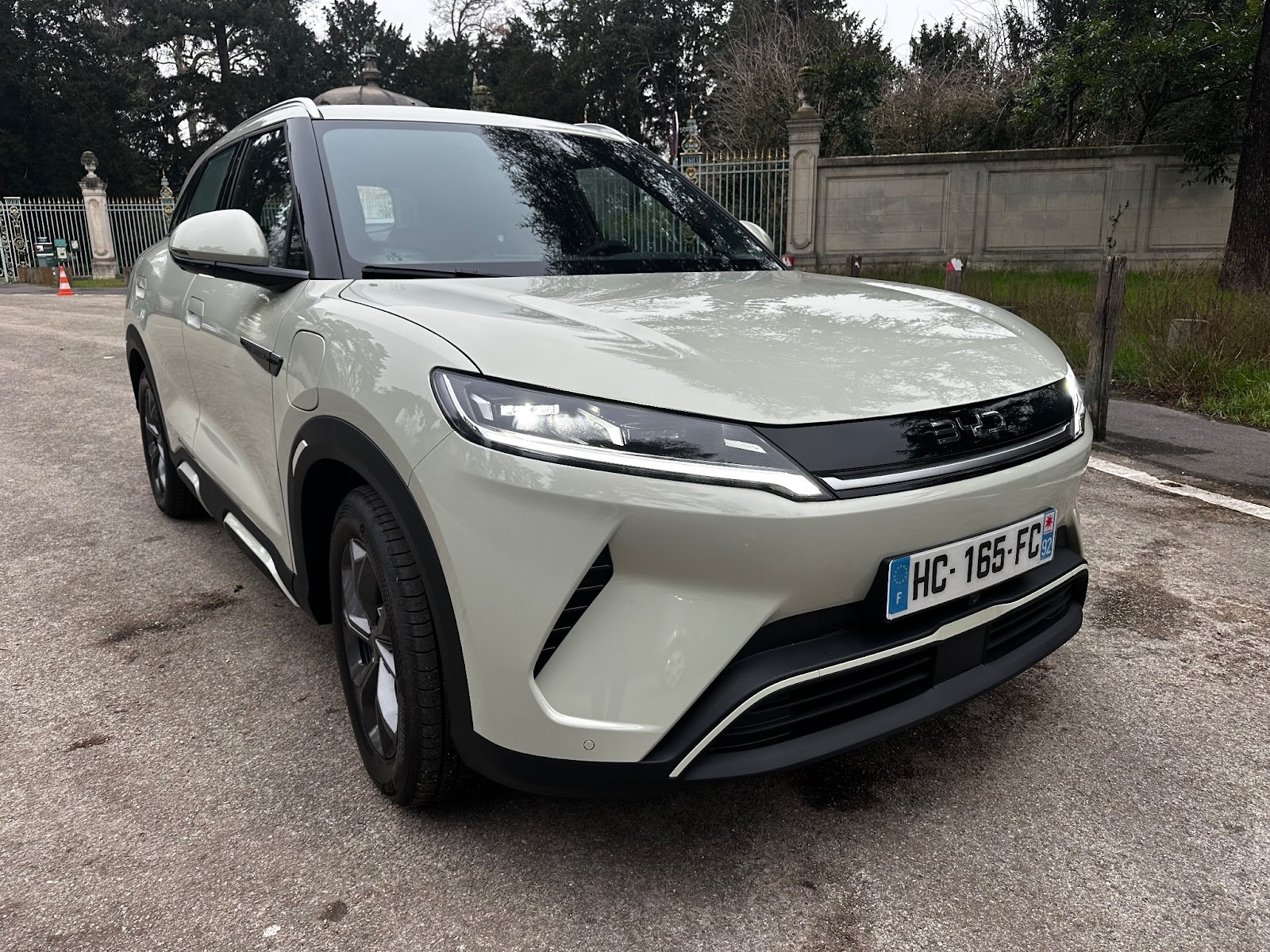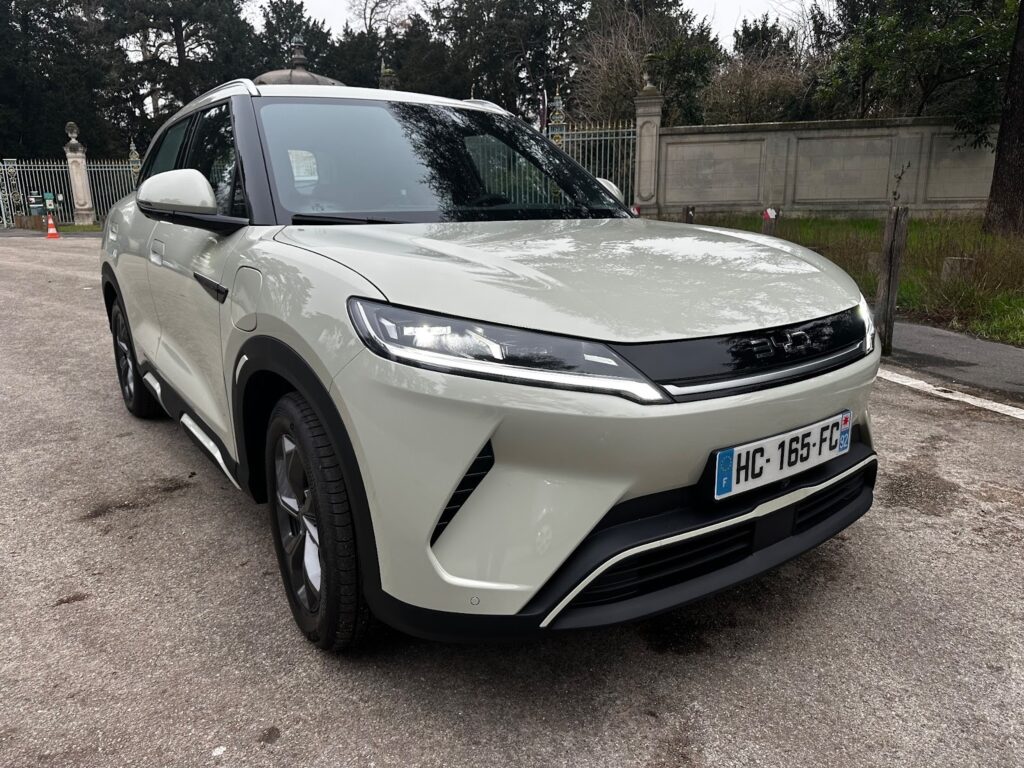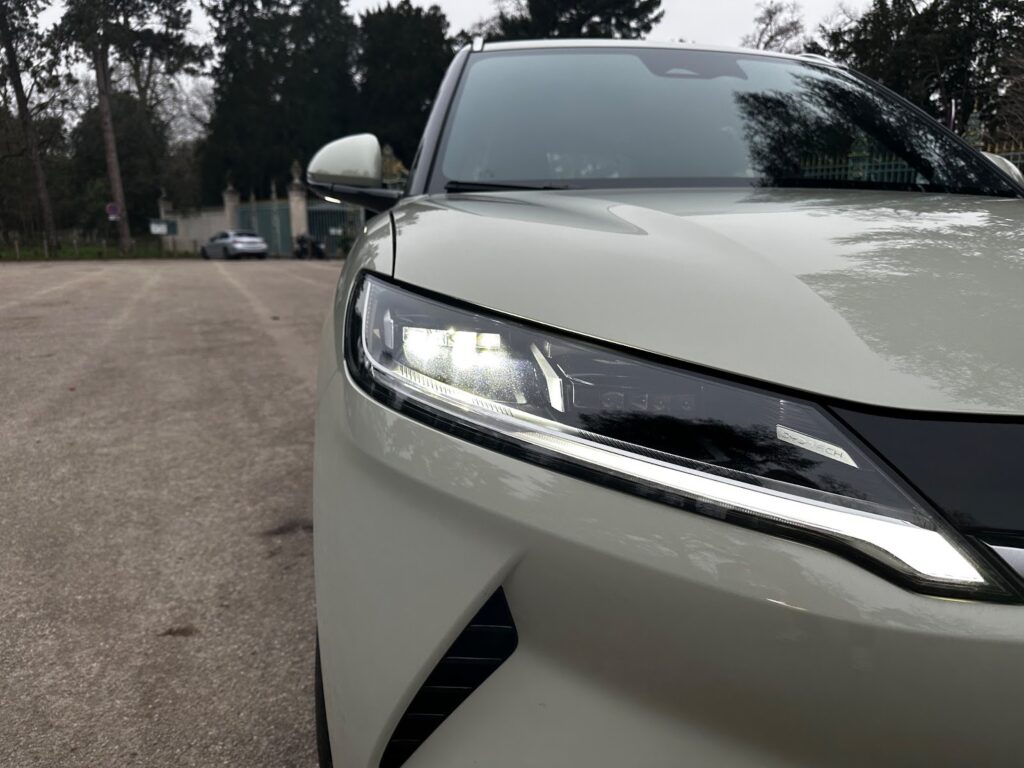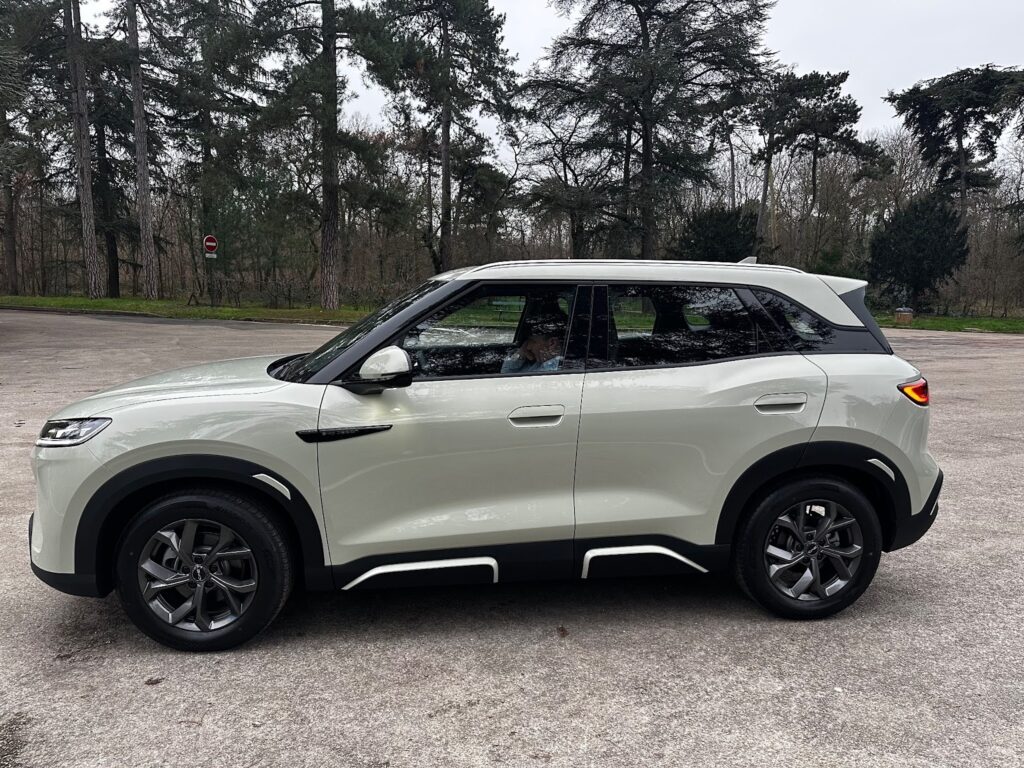
Category: Tests

  • Test drive: Linktour Alumi, the Chinese micro-city car that fancies itself a proper little electric car

    Test drive: Linktour Alumi, the Chinese micro-city car that fancies itself a proper little electric car

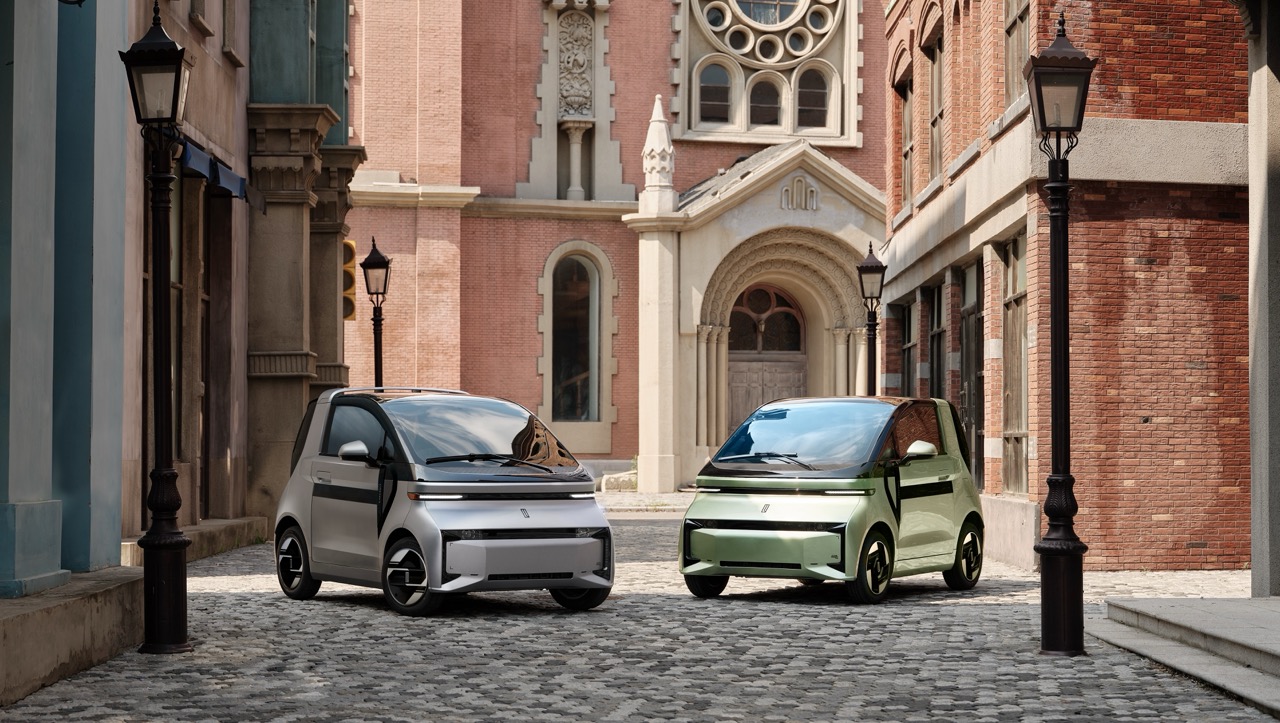
    A new brand from China is launching in France this summer: Linktour. Its electric quadricycle is designed to be more comfortable, more spacious and more technologically advanced. Put simply, the Alumi aims to replicate the driving experience of a conventional car. It’s an ambitious challenge, but the public could well be won over by this licence-free microcar as it goes head-to-head with Stellantis’s star models, the Citroën AMI and the Fiat Topolino.

    Micro-city cars: a booming category

    The micro-city car segment has seen a spectacular surge in popularity in recent years, driven by the Stellantis duo: the Citroën AMI and the Fiat Topolino. For these light quadricycles (L6e category, ‘licence-free cars’), the European market has grown from 27,000 registrations in 2019 to nearly 64,000 in 2024 (+137% over five years). The same trend is evident in France, where the market has more than doubled over the same period (29,000 units sold in 2024).

    It is electrification, in particular, that has fuelled this boom: three-quarters of the models sold are electric. These small, licence-free cars are a hit with young people, who can get behind the wheel from the age of 14. But there is considerable potential for growth: car-sharing, a second car for urban households, and vehicles for older people or in areas poorly served by public transport.

    Moving upmarket

    Having started out as a niche segment, micro-city cars are therefore set to become a mobility solution that meets people’s expectations and lifestyles, provided they remain affordable. Faced with the dominance of models from Citroën, Fiat and Microlino, a new brand from China is attempting to establish itself in France this summer: the Alumi from Linktour. This microcity car, classified as L6e (no licence required) or L7e (B1 licence required), aims to offer a step up in terms of design, comfort and technology. Eco Motors News put the L6e Alumi Pro version, with its mid-range specification, through its paces.

    Innovative design

    The highly geometric design of this micro-city car boasts an original style with a touch of avant-garde flair in its lighting signature (LED daytime running lights and rear lights) and 13- or 14-inch alloy wheels. Its cubic shape catches the eye and intrigues passers-by. The body colours range from Moon White to Boreal Green, Starry Black and Rock Grey. These colours are more understated than its futuristic look.

    A warm welcome

    The first impression comes from opening the door, which feels surprisingly heavy and solid. You’re getting into a proper car, unlike those micro-city cars whose plastic bodywork feels a bit too flimsy. The Alumi’s bodywork is made entirely of aluminium, and the panoramic roof (fitted as standard) creates a lovely, airy feel. The driving position is comfortable and the dashboard layout is simple yet ergonomic. The touchscreen (which is a little slow) allows you to control the air conditioning, the radio and Apple CarPlay or Android Auto apps (which can be connected wirelessly). 

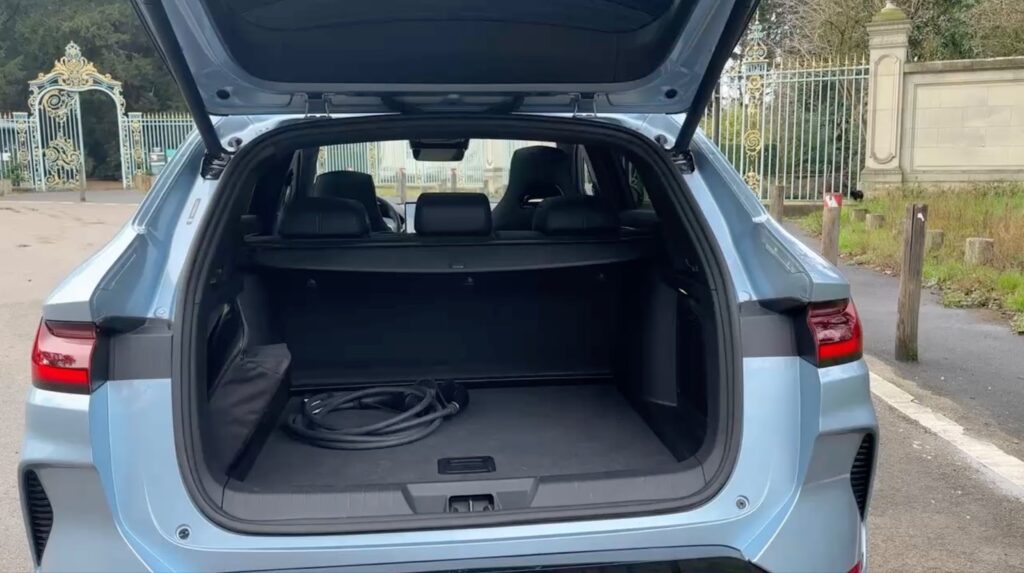
    Behind the steering wheel, an instrument cluster displays essential driving information (speed, remaining range, etc.). Whilst the quality of the materials on board remains rather basic, with a predominance of hard plastics, the overall design is cohesive, well-designed and well-equipped (USB-C socket, storage compartment beneath the windscreen, fabric seat upholstery), which sets it apart from the very stripped-back rival models. It is worth noting the boot capacity (320 L), which is large enough to accommodate two cabin-sized suitcases and the charging cable (2 kW via a domestic socket or public charging point).

    A reassuring chassis

    A quick spin around Paris confirms that initial visual impression. The Alumi handles like a proper small car, with a rigid and reassuring chassis that minimises body roll. This chassis incorporates the 7.2 kWh LFP battery directly (giving a range of 120 km). Naturally very light (95 kg), this aluminium cell-to-body architecture enhances the structure’s impact resistance and boosts acceleration by 12 per cent. Weight distribution is well balanced at 50-50 between the front and rear.

    Easy to manoeuvre 

    With its top speed limited to 45 km/h, the Alumi accelerates quietly and without much responsiveness (65 Nm of torque, 6 kW of rated power), and brakes adequately. The suspension does little to dampen vibrations from Parisian cobblestones, and bumps in the tarmac are felt through the seat, which is rather unpleasant in everyday use. However, the micro-city car makes up for this with its manoeuvrability and ease at weaving through traffic, even without power steering. On the other hand, three-quarter rear visibility is its weak point: a small rear quarter window in place of the body panel would be welcome. When it comes to U-turns and parallel parking, the Alumi (2.68m long) is in its element, aided by a reversing camera.

    A relaxed driving experience

    Unlike the Citroën AMI or Fiat Topolino, the Linktour Alumi offers a more relaxed driving experience, a greater sense of safety on board and a higher standard of equipment. It is also more expensive than its Stellantis counterparts. Expect to pay from €10,690 for the basic Alumi (with a 3-year warranty on the vehicle and a 5-year warranty on the motor and battery), whilst a Citroën AMI starts at €8,400. Modelabs, the company distributing the Linktour for the French market, is aiming for nearly 3,000 annual sales from 2027 onwards, and is currently developing its dealer network across France.

    It is worth noting that an Elite version of the Alumi is available in the L7e category, meaning it is open to holders of a B1 licence aged 16 and over. It has a top speed of 90 km/h, a longer range (180 km) and a rated power output of 10 kW. Its price ranges from €14,990 to €17,389 depending on the options chosen. But at these prices, wouldn’t it make more sense to opt for genuine electric city cars that are just as affordable, such as the Dacia Spring, Citroën ë-C3 or Fiat Panda?

    Technical Specifications: 


    Linktour Alumi
    Category: L6e (motorised quadricycle, no licence required, from 14 years of age)
    Range: 120 km (WMTC standard)
    Battery: 7.2 kWh
    LFP Motor power: 6 kW Maximum power: 12 kW
    Torque: 65 Nm
    Maximum speed: 45 km/h
    Charging mode: AC (alternating current) Charging power: 2 kW (via domestic socket or charging point)
    Charging time: 4 hours
    Length: 2.68 m
    Width: 1.50 m
    Height: 1.55 m
    Wheelbase: 1.80 m
  • LOTUS ELETRE 900 SC TEST DRIVE

    LOTUS ELETRE 900 SC TEST DRIVE

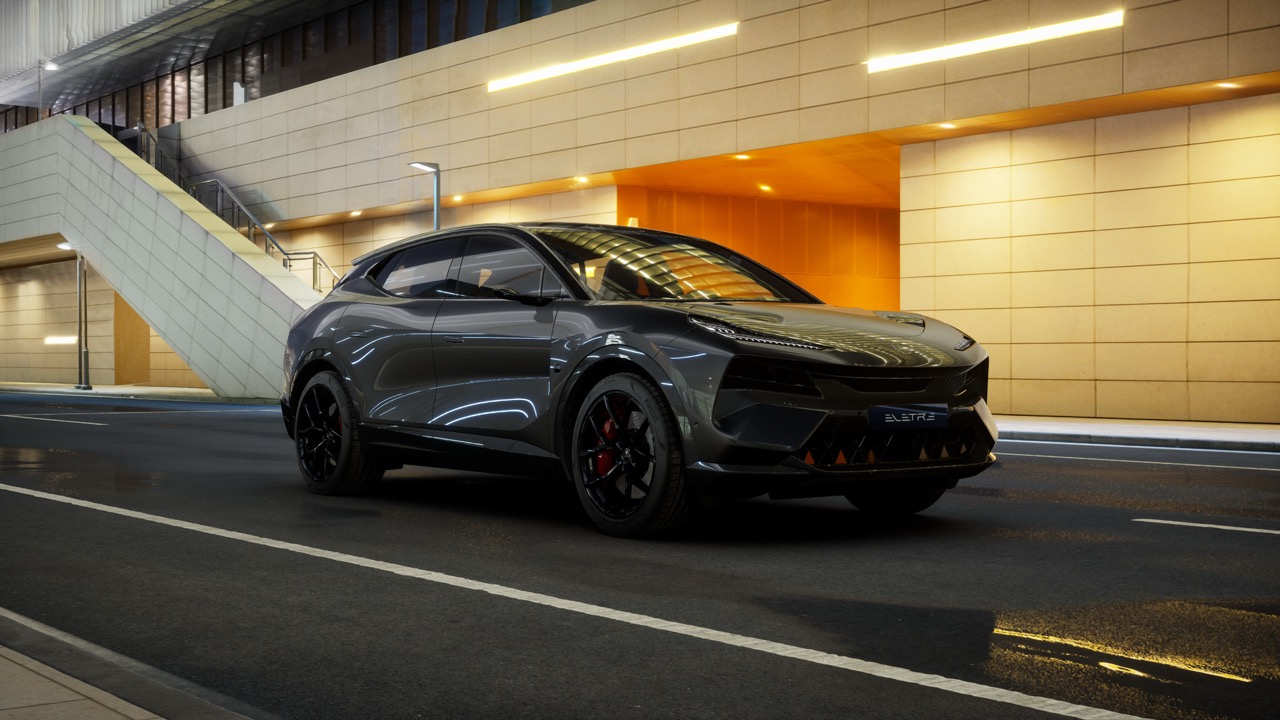
    Lotus, the legendary British brand founded by engineer Colin Chapman, has been going through a rough patch for several years. On the brink of bankruptcy, the manufacturer was taken over by the Chinese giant Geely. This takeover gave rise to a new strategy focused on high-performance electric vehicles, with the imposing Eletre SUV serving as its flagship model since 2023. Eco Motors News got behind the wheel of its most radical variant: the Eletre 900 SC (for Sport Carbon), with 918 ch and a 0-100 time of under 3 s!

    A pioneer amongst electric super-SUVs

    For motoring enthusiasts, combining the terms ‘electric’ and ‘SUV’ seems like a far-fetched and incompatible concept. And if this is happening at Lotus, the brand founded by engineer Colin Chapman (and his famous motto: ‘Light is right’ – meaning, ‘The less weight, the better the performance’) – then the Eletre 900 SC seems like an anachronism. Can an electric SUV be a super sports car? That’s the challenge Lotus, now under Chinese ownership, has set itself. When it was launched in 2023, the Eletre faced competition from the Tesla Model X and the BMW iX M60 in this niche market for electric super-SUVs. It has now been joined by the more luxurious electric Porsche Cayenne.

    The most powerful production Lotus, excluding hypercars

    The technical specifications for the Eletre 900 SC leave no room for doubt: a kerb weight of 2,700 kg, 918 ch of power delivered to the permanent four-wheel drive system, a wheelbase of over 3 m and a ground clearance of over 18 cm with the battery pack housed in the floor, which results in a fairly high centre of gravity for a supercar.

    In short, the Eletre 900 SC is the largest and most powerful Lotus in the manufacturer’s history, with the exception of the Evija hypercar. Nevertheless, does the Eletre deliver a driving experience worthy of its prestigious predecessors and of Lotus’s reputation?

    Shaped by air currents

    Visually, it certainly doesn’t go unnoticed. It is 5.10 m long, 2.23 m wide (including the camera-based wing mirrors) but quite stocky, with a height of just 1.63 m at the roofline. The styling is imposing, but the lines are sculpted by meticulous aerodynamic engineering (a drag coefficient of 0.26), revealing air intakes that run from the bonnet to the raked windscreen and around the wheel arches. These recesses, which channel up to seven airflows, not only give the car a supercar-inspired look but also enable more effective cooling of both the batteries and the brakes. These aerodynamic details are also found at the rear, which features a split rear spoiler and a dynamic wing that deploys from 110 km/h, in a high-stability position, and stands vertically to act as an air brake. 
    The Eletre features a refined look with LED headlights, whilst at the rear, a full-width light strip enhances its dynamic appearance. Whilst it certainly has plenty of character, it is difficult to recognise it as a Lotus at first glance.

    Among the design highlights are the numerous carbon fibre inserts, which emphasise the Eletre’s sporty character, as does the active grille, which opens to cool the components and reduce drag: it is shaped… like a lotus flower.

    The welcome on board meets the standards of luxury

    Paradoxically, the Eletre is imposing yet manoeuvres easily through the streets of Paris, aided by its multiple cameras which provide a 360° panoramic view. The radar, sensors and lidar fitted to the car display the surrounding traffic conditions on the central screen. You can clearly see other road users in real time, whether they are cars or two-wheelers. It’s useful and reassuring. 

    Lotus has opted to replace the traditional wing mirrors with discreet, more streamlined cameras; however, the display screens are positioned too low for the driver’s line of sight and may obstruct visibility. 

    Designed as a highly immersive, driver-focused cockpit, the driver’s seat is ideal and easy to get to grips with. The interface is ergonomic, clear and fairly intuitive. The AI-enhanced infotainment system requires no learning curve. On the huge 15.1-inch central OLED screen, apps glide beneath your finger – it’s quick and as simple as using your smartphone.

    The interior design is in keeping with the standards of luxury cars: leather, Alcantara, carbon fibre trim and a high-quality feel. With few physical controls, Lotus has opted for refinement. The steering wheel and its large paddles (for engaging regenerative braking or selecting the driving mode) exude a sense of competition and technology. Without a doubt, the Eletre ranks amongst the very best high-end sports SUVs, alongside the Bentley Bentayga and the Lamborghini Urus.

    The Lotus SUV can comfortably seat five people. The boot is also very spacious (688 L capacity), and there is also a small 46 L ‘frunk’ under the bonnet at the front.

    Adaptive suspension and a smooth ride

    Behind the wheel, you’ll appreciate the precision and responsiveness of its chassis. The adaptive suspension and active anti-roll control work in tandem with torque vectoring during braking. The whole system is seamlessly integrated, ensuring a comfortable ride and excellent handling on the road. For the driver, the rear-wheel steering is a real treat, offering improved manoeuvrability in this imposing car. These technologies enhance the driving experience, which is designed to be responsive but can also be quite relaxed in ‘Tour’ mode – the most comfortable road setting.

    Lotus’s sporting DNA remains intact

    Lotus Cars has been owned by the Chinese group Geely since 2017, which also owns Volvo and Polestar. Indeed, the Eletre is the technical cousin of the Polestar 3 SUV, but it retains more sporting characteristics, in keeping with Lotus’s heritage. The Eletre 900 SC (Sport Carbon) is thus equipped with two high-performance electric motors (one per axle) delivering 675 kW of power, or a combined 918 ch. The all-wheel-drive system has two gears, the change between which is imperceptible in use. Acceleration torque stands at 985 Nm. That’s enough to push you back into your seat every time you press the right-hand pedal. In ‘Track’ mode – the most extreme setting – an unprepared passenger could almost be thrown forward like a whiplash injury. Yes, for all its size as a large SUV, the Eletre is a lively and hyper-responsive electric vehicle. This vitality makes up for its bulk and puts a smile on the driver’s face.

    It goes from 0 to 100 km/h in 2.95 seconds, which is quite a feat for such a heavyweight. Better still, it accelerates strongly on the motorway, going from 80 to 120 km/h in under 2 seconds. You’d hardly notice its total weight (which can exceed 3 tonnes with passengers and luggage). Its electronically limited top speed is 296 km/h.

    Range of 450 km

    Unfortunately, this performance is likely to be short-lived, judging by the energy gauge, which is dropping rapidly as a result of these bursts of power. With a claimed range of 450 km, it will be difficult to cover more than 300 km when driving dynamically. The batteries are lithium-ion, with a capacity of 112 kWh, and thanks to its 800 V architecture, the Eletre can support charging powers of up to 350 kW DC. This means it can go from 10% to 80% charge in 20 minutes. In this respect, Lotus does not outperform its rivals, the Tesla Model X or the electric Porsche Cayenne.

    From €101,590

    In its most powerful and exclusive 900 SC version, the Eletre therefore offers genuine pleasure in terms of comfort and driving enjoyment, and takes you to high speeds with ease. Even when the road becomes more winding, the electronic steering and dynamic chassis make up for any over-enthusiastic manoeuvres.

    Whilst the handling of the electric power may live up to the expectations of regular Lotus buyers, customers are not yet flocking to dealerships. Is this because of its exorbitant price? Priced from €163,090 for the 900 SC version, our test model costs over €171,910 including VAT. This is very expensive compared to the V8-powered super-SUVs currently on the market. Overall, the uptake of electric vehicles by potential buyers in the ultra-luxury segment is not keeping pace with the investments made by the brands.

    Eletre Hybrid X, the 952 ch plug-in hybrid

    Due to a lack of orders, Lotus is adjusting its plans. It has therefore just added a new model to its range: a plug-in hybrid version of the Eletre (with a range of 350 km in electric mode and 1,200 km in combined mode). Dubbed the Hybrid X, it features a 2.0-litre four-cylinder petrol engine and a 70kWh battery, making it the most powerful Eletre model with a combined output of 952 ch and a 0 to 100 km/h time of 3.3 s. Whilst this partial return to internal combustion may appeal to some Lotus enthusiasts, it remains to be seen whether it will be enough to secure the Eletre’s place amongst the most memorable super-SUVs of its era.

    Notes:

    Battery life: 3.5/5

    Driving experience: 4/5 

    Versatility: 3/5

    Comfort: 4/5

    Technology: 4/5

    Technical specifications

    Lotus Eletre 900 SC (112 kWh) 

    Power: 918 ch

    Torque: 985 Nm

    Range: 450 km 

    Charging time from 10% to 80%: 20 mins (350 kW DC)

    0–100 km/h: 2.9 s

    Top speed: 296 km/h

    Boot capacity: 688 L + 49 L (front)

    Price of the model tested: €171,910

    Prices for the Eletre SUV range: from €101,590

  • Maserati Grecale Folgore: the luxury electric SUV with a strong identity

    Maserati Grecale Folgore: the luxury electric SUV with a strong identity

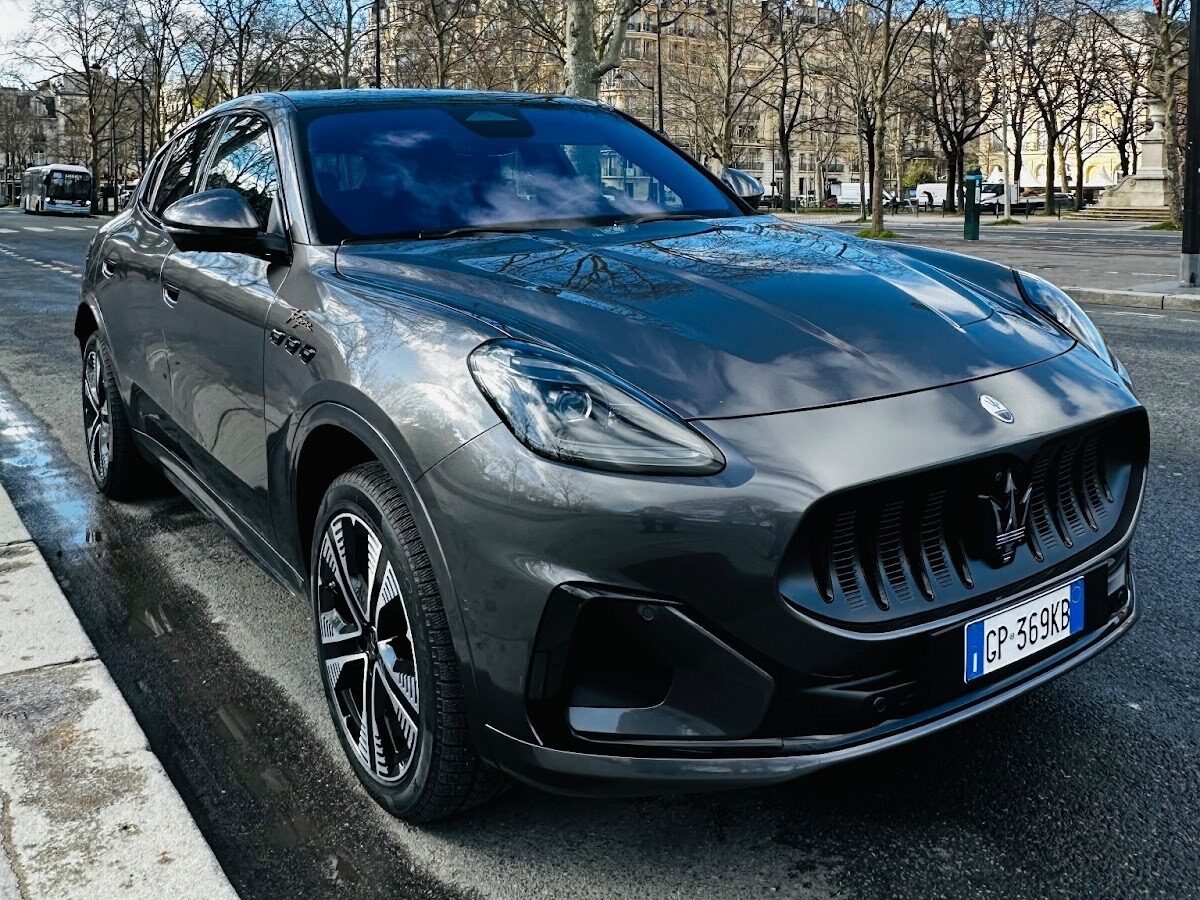
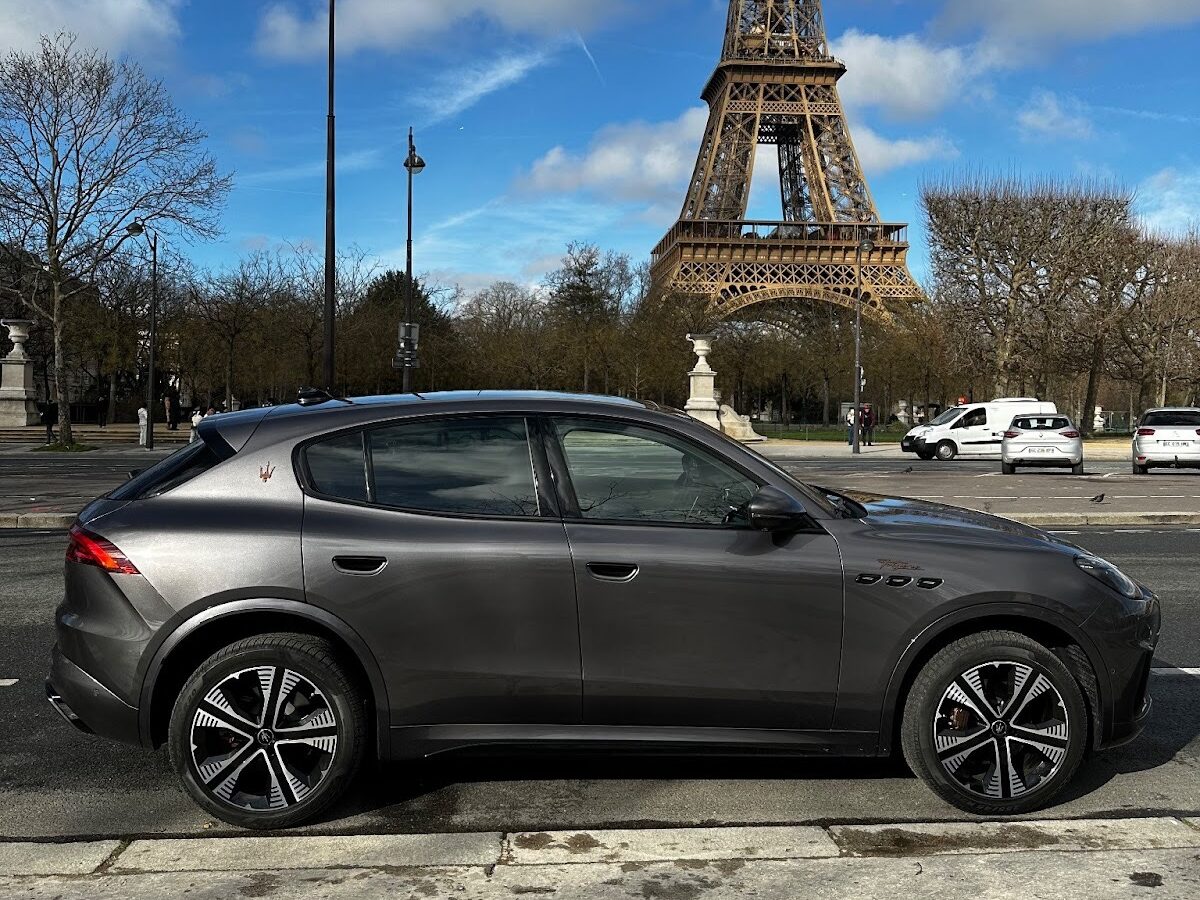
    ECO MOTORS NEWS got behind the wheel of the 100% electric Maserati Grecale Folgore, in a top-of-the-range Nerissima configuration and the eye-catching Rame Folgore paintwork. For three days, we put it through its paces on a variety of terrains: inner Paris, the Paris ring road, motorways, small towns and country roads in the Île-de-France region, to find out what this premium 100% electric SUV has to offer.

    First impressions: the modern Maserati look

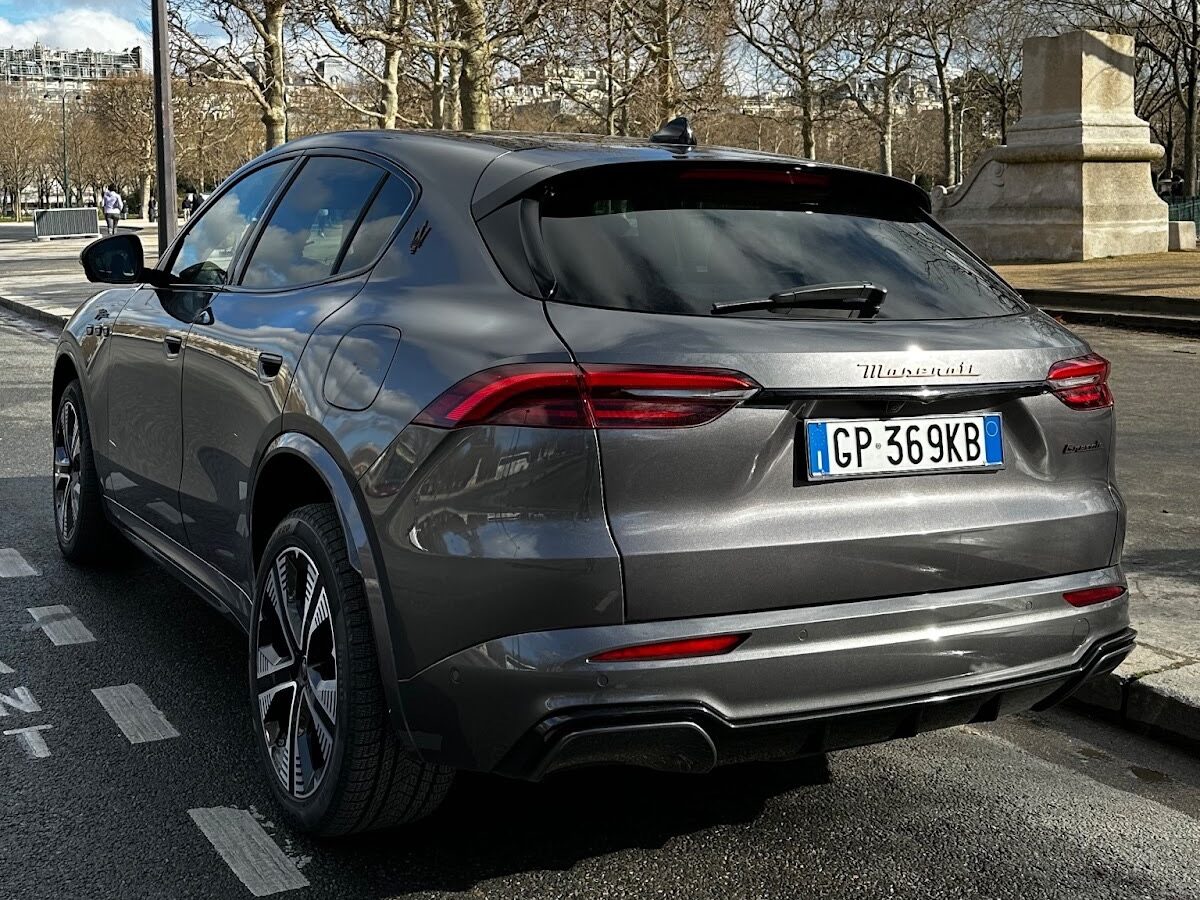
    At first glance, the Grecale Folgore is instantly striking. It obviously doesn’t resemble what one traditionally imagines of a combustion-powered Maserati, but it perfectly embodies what the Italian brand wants to become in the electric sector: elegant, dynamic and instantly recognisable. The exclusive Rame Folgore colour used on the vehicle in our care reinforces this impression, emphasising the SUV’s generous proportions without ever becoming extravagant, and making the most of the vehicle’s curves in the sunlight.

    In terms of proportions, this compact SUV, measuring around 4.87 m long and almost 2 m wide with mirrors, has an imposing presence without being overly heavy visually. As for its silhouette, it is not that of a coupé, but of a classic five-door SUV, with a coherent, dynamic and elegant front/rear identity.

    Exterior design: a sporty take on a classic SUV

    The front end isn’t ‘full’ like some EVs, and it’s very well done. It features a redesigned grille that evokes a compromise between thermal design and electrical requirements, with a trimmed grille that allows it to retain its assertive character and a truly pleasing aesthetic.

    In profile, the roofline is fairly straight, in line with what you’d expect from a top-of-the-range compact SUV. Roadholding is smooth, serene and powerful, without violence.

    At the rear, the light signature is neat but restrained: no extravagance, just a well-integrated aesthetic that fits in well with the vehicle’s overall exterior design.

    On board: luxury, brightness… and a few contradictions

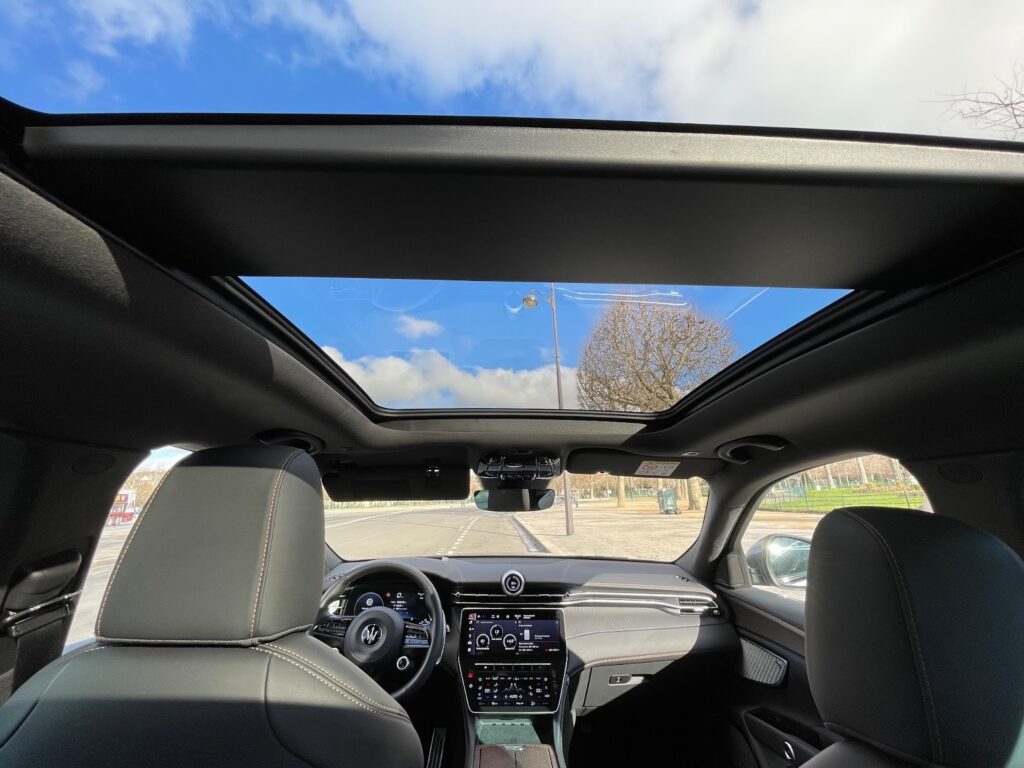
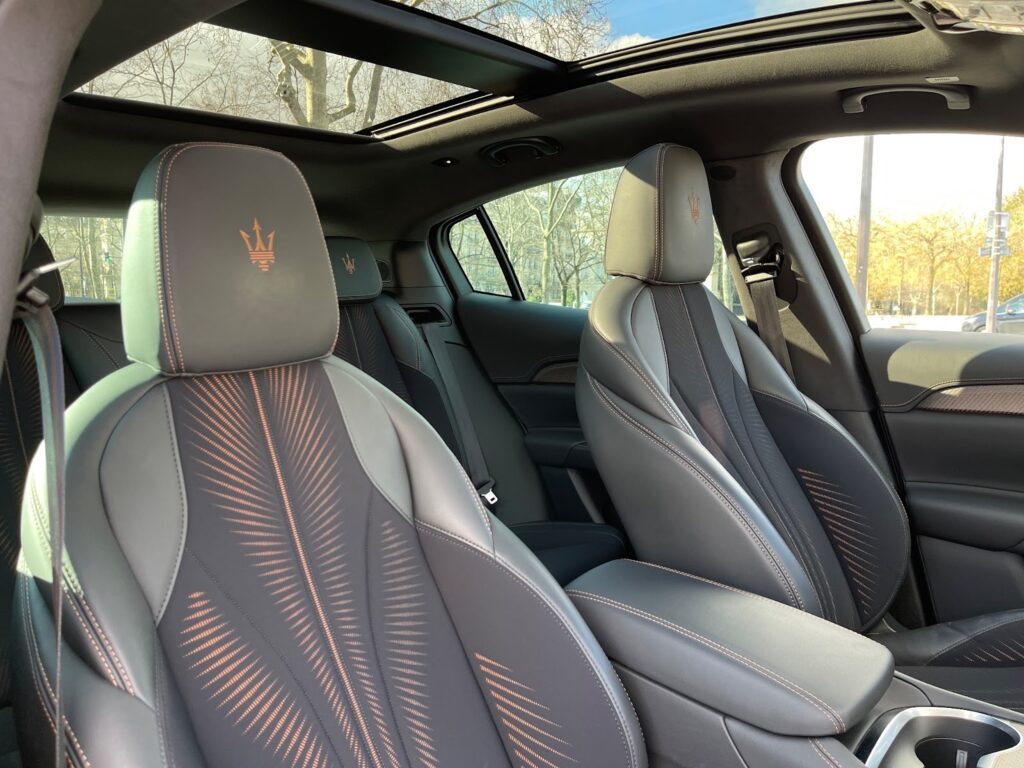
    The interior of the Grecale Folgore shows what you’d expect from a premium electric SUV: brightness, carefully chosen materials and excellent finishes. Pieno Fiore leather, Alcantara, carbon and brushed aluminium inserts and the 14-speaker Sonus Faber audio system create a sophisticated ambience that’s warm rather than futuristic.

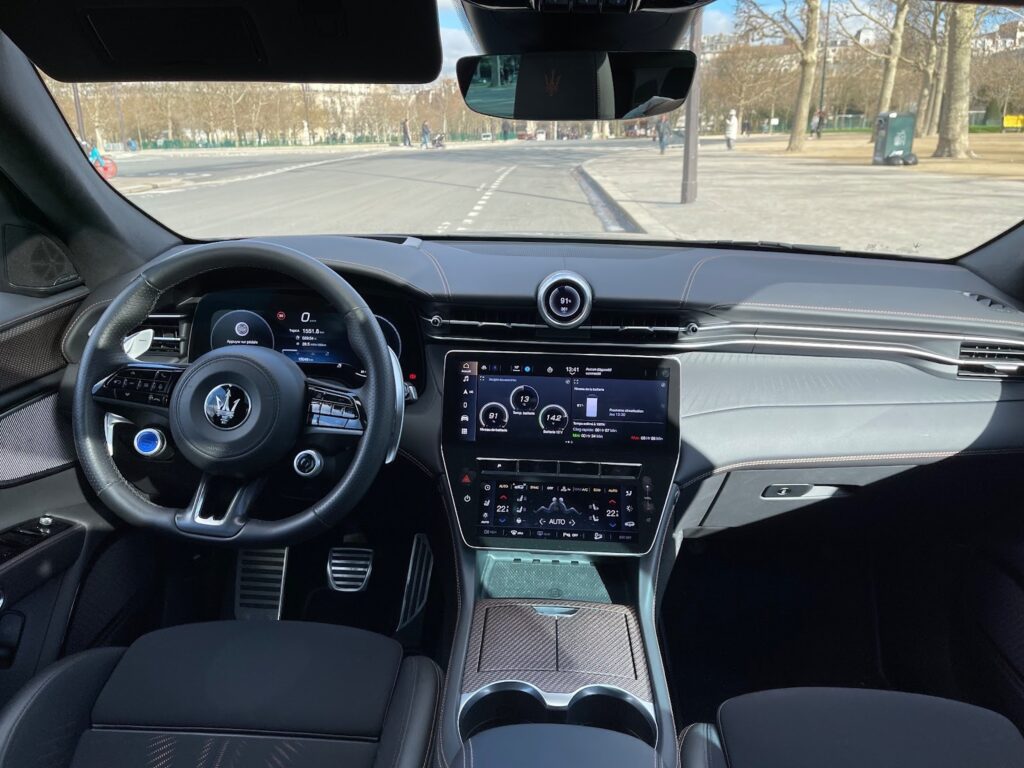
    One of the strong points of the version tested is that natural light floods into the cabin thanks to the large panoramic sunroof. However, this impression of sobriety is somewhat marred by an abundance of physical buttons, particularly around the centre console and steering wheel. Although they are understandable, their number sometimes gives the impression of a less modern interface than one might expect from a top-of-the-range electric SUV.

    The seats are another strong point: comfortable, enveloping and perfectly suited to long journeys. They are heated, but do not offer a massage function, which is perhaps lacking at this level of the range. It’s worth noting that each headrest is decorated with the brand’s logo, which immediately confers a feeling of belonging.

    The overall ergonomics are intuitive, although there is sometimes a slight functional overload between physical controls, screens and menus.

    On-board technology: intuitive but classic

    The multimedia system is based on a 12.3-inch main screen, which is accompanied by an 8.8-inch lower screen dedicated to other functions such as cabin and seat climate control. Although this interface is fluid and relatively intuitive, the second lower screen is a bit of an eyesore, adding to the feeling of overcrowding in the cabin.

    That said, one small detail that really appealed to me was the little circular dial above the screen, which can display the battery level or the time in a variety of designs. It’s the kind of small, customisable detail that’s a pleasure to see, and adds a subtle touch to the cabin. The head-up display is also available as an option, and can be activated and deactivated with a button on the steering wheel.

    Rear seats & boot

    In the rear, space is comfortable for two adults, even on long journeys. The quality of the rear seats is similar to that of the front, but unfortunately the middle seat is not as good. In terms of equipment, there are USB sockets at the rear and the middle seat can be converted into an elbow rest and has integrated drink holders.

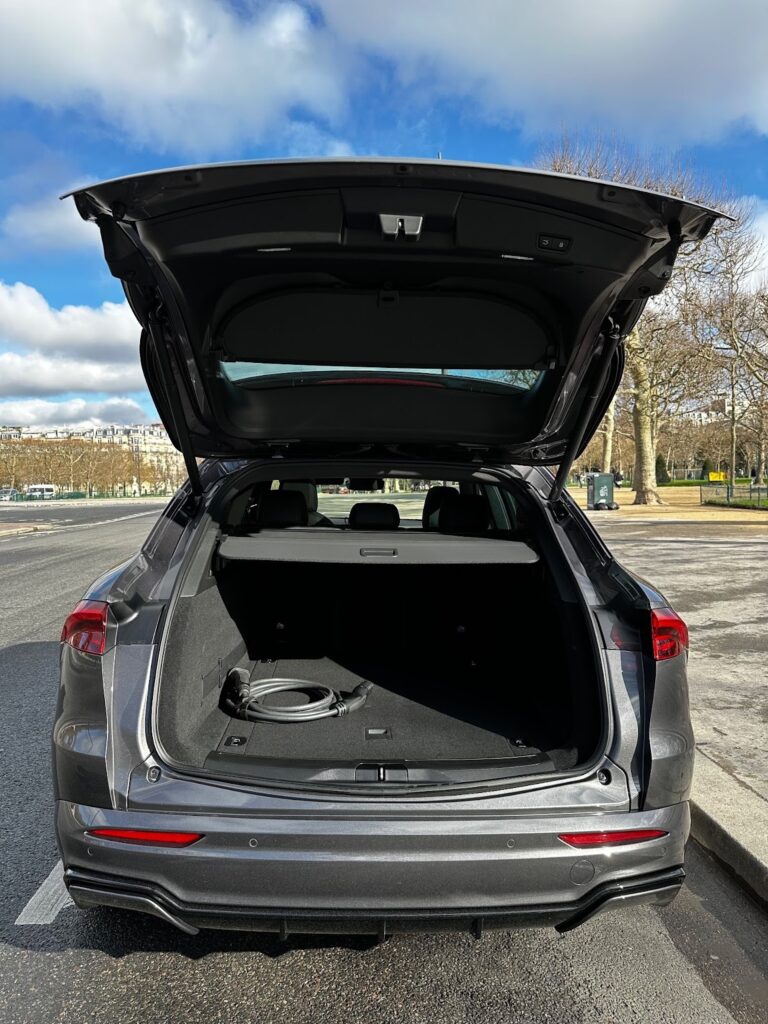
    As for the boot, for an SUV you’d expect plenty of storage space. And the Grecale Folgore does well in this respect, with a boot capacity of 535 litres, extendable to around 1,400 litres with the seats folded down. For this type of vehicle, of course, the boot is equipped with an electric opening/closing system, and there is an underfloor compartment for storing charging cables.

    Driving: luxury, power and electric smoothness

    From the very first kilometre, the Grecale Folgore confirms that it’s there to combine comfort, power and peace of mind. The electric motor delivers its instant torque of 820 Nm with a smooth, pleasant progressiveness, making every start smooth and very quiet.

    The generous width of the vehicle (~1.98 m) is obviously sometimes felt in town or on narrow roads, but the standard 360° cameras make manoeuvring easier, even if their effectiveness could be better compared with the rest of the equipment. And as for comfort, thanks to the Skyhook air suspension, the car adapts very well to the irregularities that some roads can offer.

    On fast lanes and motorways, the soundproofing and chassis balance make the long stages very pleasant. Acceleration is really brisk, which means that this handsome baby of almost 2.5 tonnes can overtake with ease. It has 3 modes, including the super-efficient Sport mode, which increases the feeling of power thanks to a more direct response from the pedal. Surprisingly, and to the delight of purists, Maserati has incorporated a customisable synthetic sound system that gives the illusion of driving a combustion engine.

    Still behind the wheel, but this time in fast corners, despite weighing in at around 2,480 kg, the Grecale remains firmly planted on the ground and handles the bends well, with a contained roll worthy of a well-designed SUV. Of course, it’s not the same as what a racing car might produce, but you naturally feel some mass effects at high speeds.

    Autonomy & recharging: serious figures tailored to use

    Technically, the Grecale Folgore is powered by a 105 kWh battery, offering a WLTP range of between 426 and 501 km depending on the cycle and conditions. On the road, this translates into a realistic range of between 350 and 400 km in mixed use, with around 340 km at motorway speeds and more than 450 km in town or suburban areas, which is still very convincing for an electric SUV of this size.

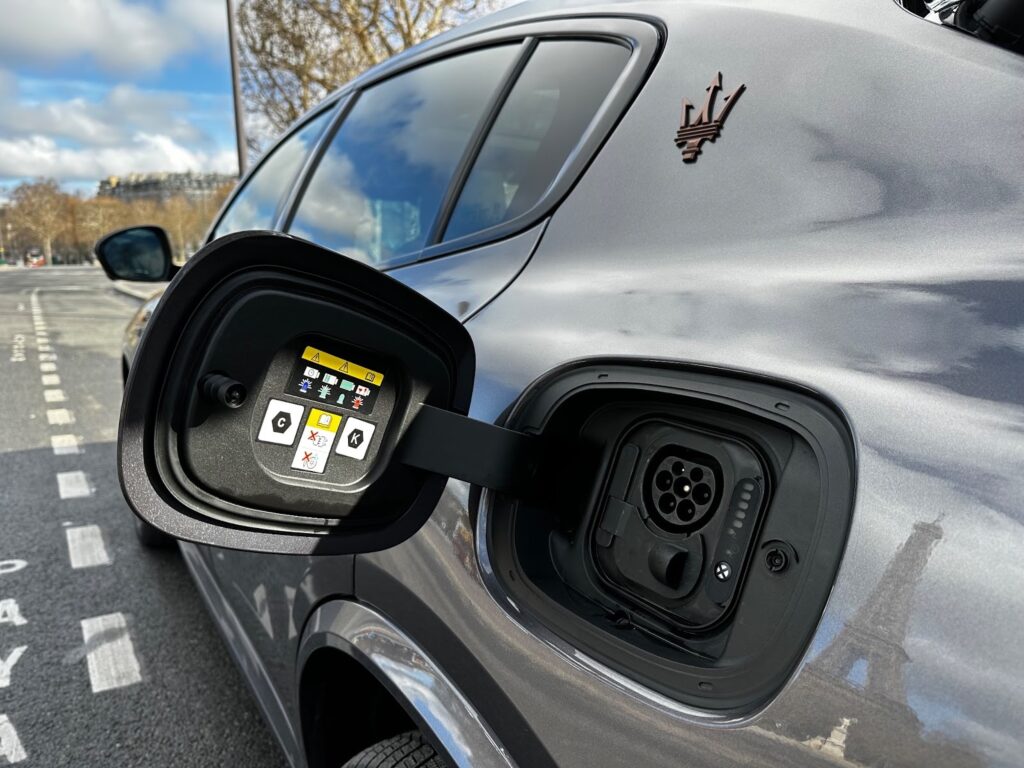
    Recharging is just as consistent: up to 150 kW in DC, enabling the battery to go from 20% to 80% in around 29 minutes, while AC charging goes up to 22 kW, a practical advantage for home charging or fast urban driving.

    Driving aids: well calibrated… but sometimes surprising

    The Grecale Folgore boasts a comprehensive level 2 assistance package, including adaptive cruise control, lane keeping and blind spot detection. These aids prove to be useful and well calibrated, especially on the motorway where they relieve the driver’s attention. Nevertheless, during our test drive, at an unexpected moment in the city centre, the assistance system activated sudden braking for no apparent reason. A reminder that even well-tuned systems can surprise in real-life conditions.

    These aids can be deactivated intuitively via the steering wheel controls or the main menu, without the need for complex navigation. The cameras and sensors, though not perfected, contribute to overall confidence on board.

    Verdict: a coherent, generous premium electric SUV… with a few compromises

    The Maserati Grecale Folgore offers a convincing and credible proposition in the top-of-the-range electric SUV segment. It manages to combine power, comfort, versatility and real range, while retaining a strong and elegant stylistic identity, which is appreciated in an EV landscape that is often uniform and blander.

    Some ergonomic choices (too many buttons, cameras) and some unexpected assistance reactions remind us that even an SUV of this level is never perfect. However, the overall package is still very pleasant to live with on a daily basis, with a driving experience worthy of a prestige car. It’s the kind of car that makes electric power desirable and coherent.

  • BYD ATTO 2 Boost: the urban electric SUV with a focus on simplicity

    BYD ATTO 2 Boost: the urban electric SUV with a focus on simplicity

    ECO MOTORS NEWS got behind the wheel of the BYD ATTO 2 Boost, the Chinese manufacturer’s compact 100% electric SUV, designed for unrestricted urban and suburban use. For three days, we put it through its paces on all kinds of roads: Inner Paris, the ring road, motorways, towns and country roads. The aim was to check whether this small, accessible electric SUV lived up to its promises in terms of comfort, driveability and everyday versatility.

    A small SUV that embraces its size

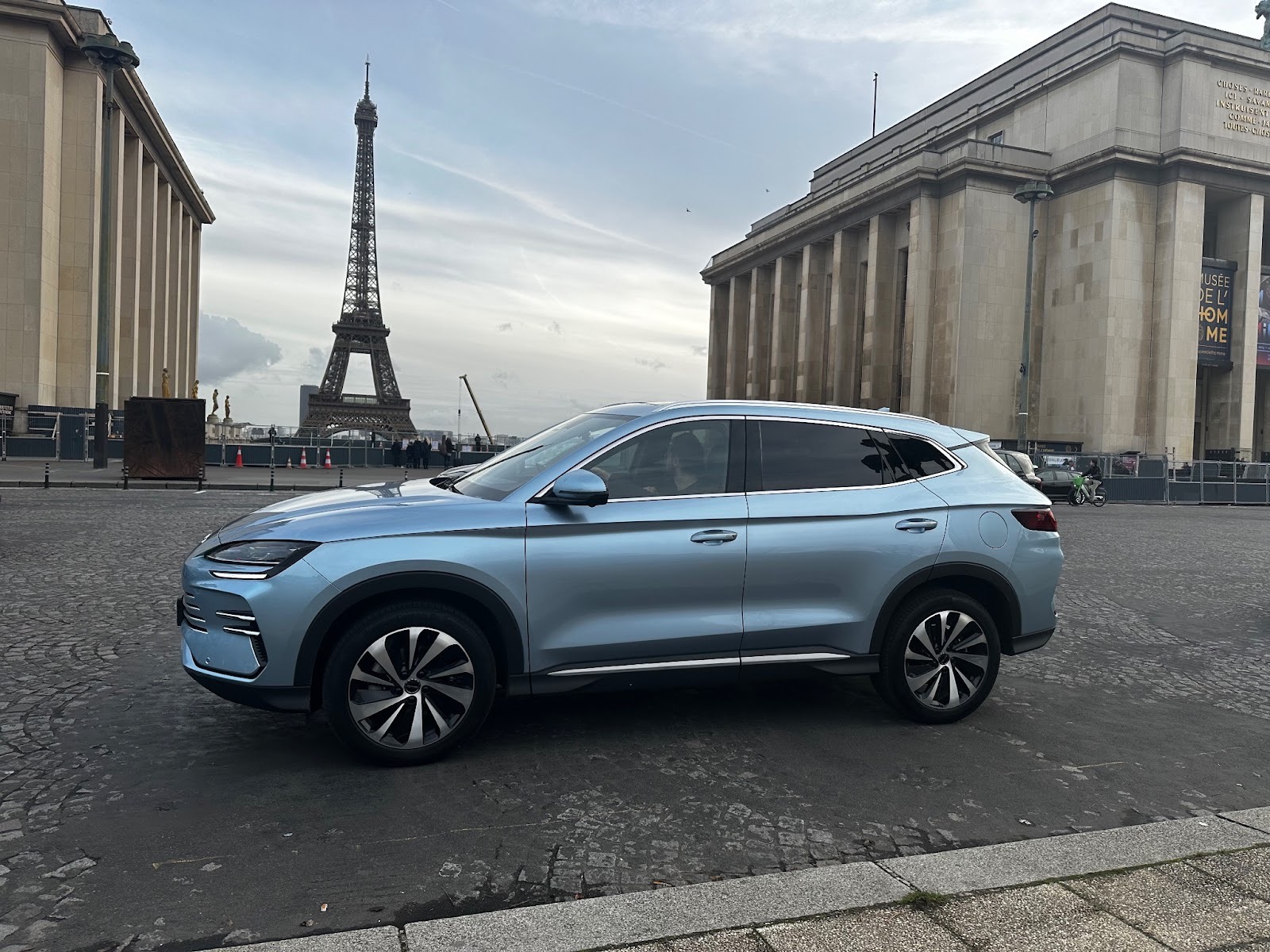
    At first glance, the BYD ATTO 2 presents the driver with a slight dilemma. The vehicle isn’t exactly bulky, but it doesn’t try to pass itself off as a simple city car either. At 4.31 m long, 1.83 m wide, 1.67 m high and with a wheelbase of 2.62 m, the ATTO 2 is positioned right between the two worlds: compact enough for the city, but with a real urban SUV stance.

    This impression is reinforced by the design of the front end. BYD has applied its ‘Dragon Face’ styling language here, with slim, tapering LED headlights that give the vehicle an aggressive facial expression. The overall effect is dynamic, modern and rather successful. It really stands out from what a Chinese electric vehicle represents in the collective imagination.

    In profile, the ATTO 2 confirms its identity as a boosted city car. The proportions are well-balanced, and certain details add a real personality, notably the small white contrasting element in the lower part of the doors, which breaks the general sobriety and avoids any visual monotony.

    At the rear, BYD has also taken the decision to create a unique vehicle. There is a real lighting signature, with an LED strip running the full width of the tailgate, which visually structures the whole. The upper section of the rear is more elaborate and stylised than on many of its rivals, avoiding the overly classic ‘trunk-plate’ effect. It’s modern, identifiable and consistent with the rest of the vehicle.

    Our test version came in Hiking Green. An original colour on paper, but one that we found a little bland and lacking in pizzazz. It has the merit of being discreet, without really enhancing the lines. A choice that will appeal to some, less so to others.

    On board: BYD quality, controlled ergonomics

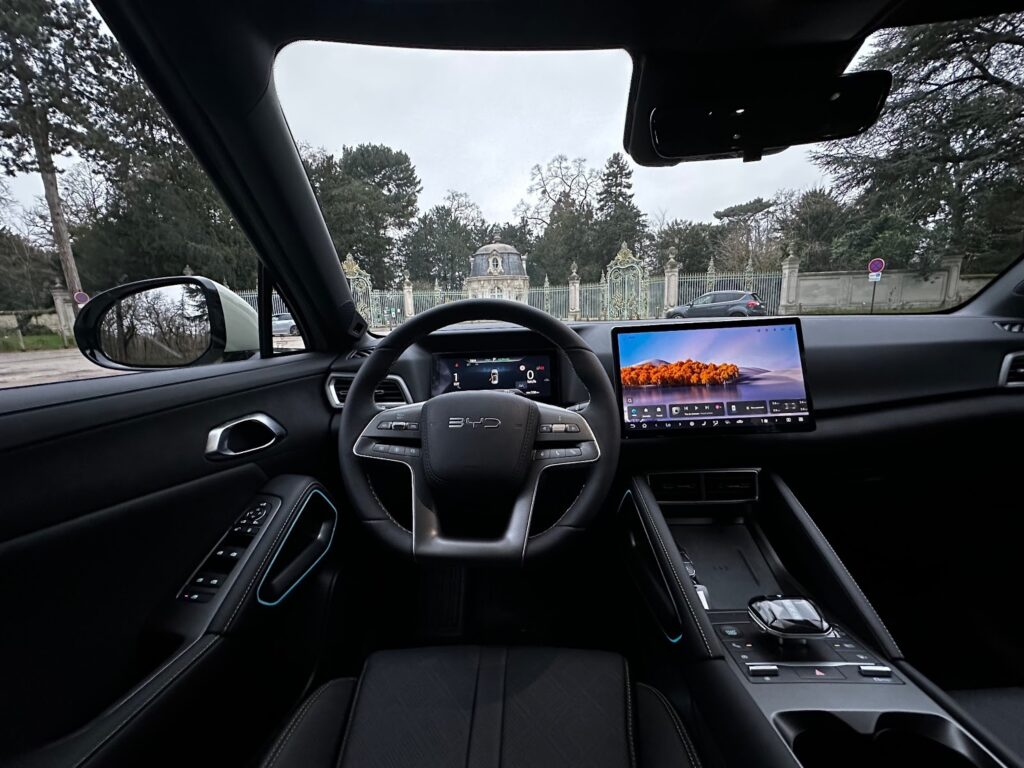
    Now that the exterior has been analysed, let’s take a closer look at the interior. Once you’ve settled in, you’ll immediately see what BYD is good at. The cabin is clean, uncluttered and reassuring, with very good perceived quality for the price. The detail that always makes the difference is that the vehicle is equipped with a panoramic roof that floods the cabin with light and is accompanied by an electrically adjustable sun visor. All in all, the materials are well put together, the controls fall naturally to hand, and the whole package inspires confidence.

    Special mention must go to the Drive Selector, which is both pleasant to use and, above all, beautifully designed. Visually, the knob looks a bit like a large diamond, a detail we liked.

    The central screen is clearly one of the ATTO 2’s strong points, featuring a 12.8-inch touchscreen (which can be rotated), well positioned in the field of vision and offering excellent legibility. It’s also very responsive, with fast response times and smooth menu navigation. While some vehicles equipped with this type of screen sometimes require you to scroll around the interface to find the various settings, BYD has incorporated a permanent shortcut strip at the bottom of the screen. This gives one-click access to essential functions such as air conditioning, vehicle settings and driving aids, making for a real improvement in everyday ergonomics. Of course, Apple CarPlay and Android Auto are also compatible, making daily use even more enjoyable.

    One of the most important details when it comes to choosing a vehicle is the seating: here too, it’s not bad at all. The seats are covered in vegan leather (eco-friendly imitation leather), an elegant, supple and environmentally-friendly material that BYD uses throughout the cabin. They are heated and electrically adjustable, which is an appreciable feature in this segment.

    Rear: decent, but clearly child-oriented

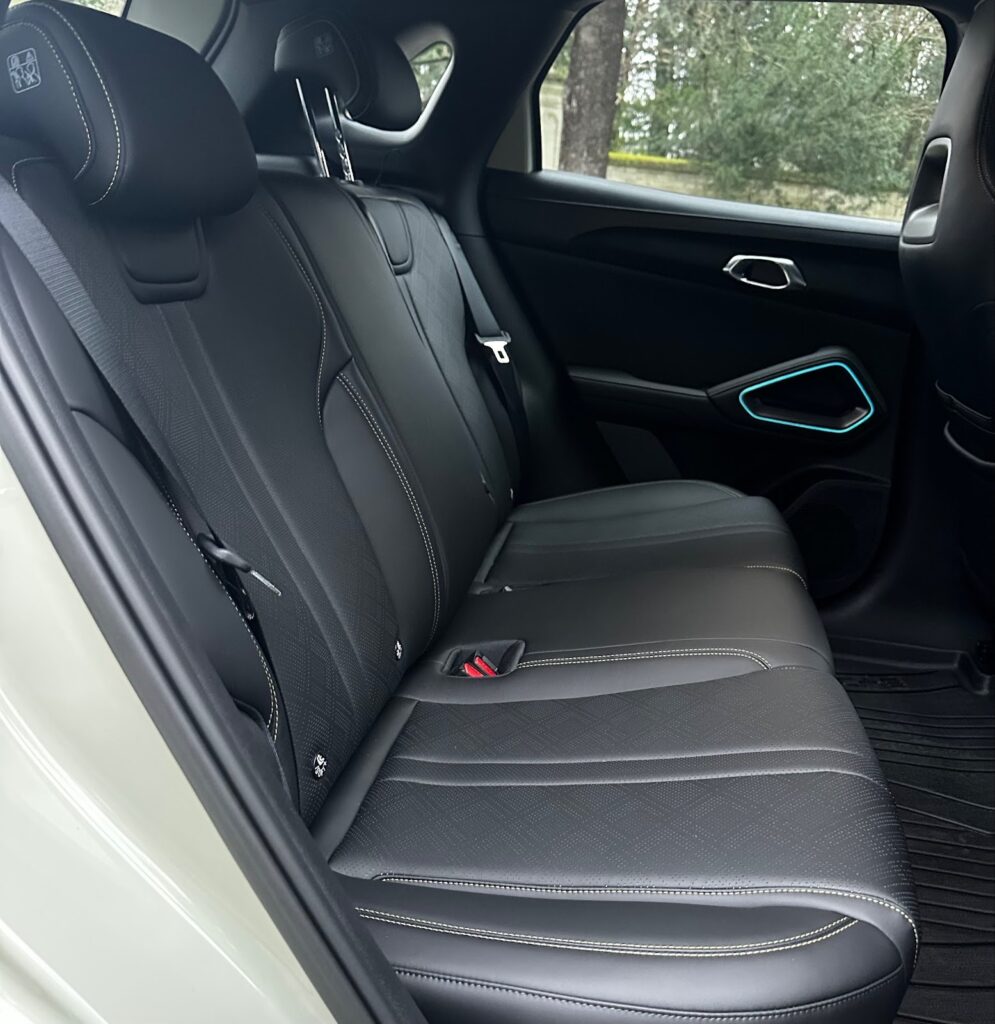
    Unsurprisingly, the rear is not the ATTO 2’s strong point. The space is adequate but not immense, especially for adults on long journeys. The seats are still comfortable, including the middle one, which doesn’t have a real seat but is surprisingly soft.

    There are, however, two USB sockets (USB-C and conventional USB), as well as the blue outline reminders on the doors, which add a little pizzazz. The front seat backs, with their bucket-type design and headrest opening, are visually pleasing and well finished. Overall, the rear is designed more for children than adults, which is in keeping with the vehicle’s light family vocation.

    Trunk: functional, no surprises

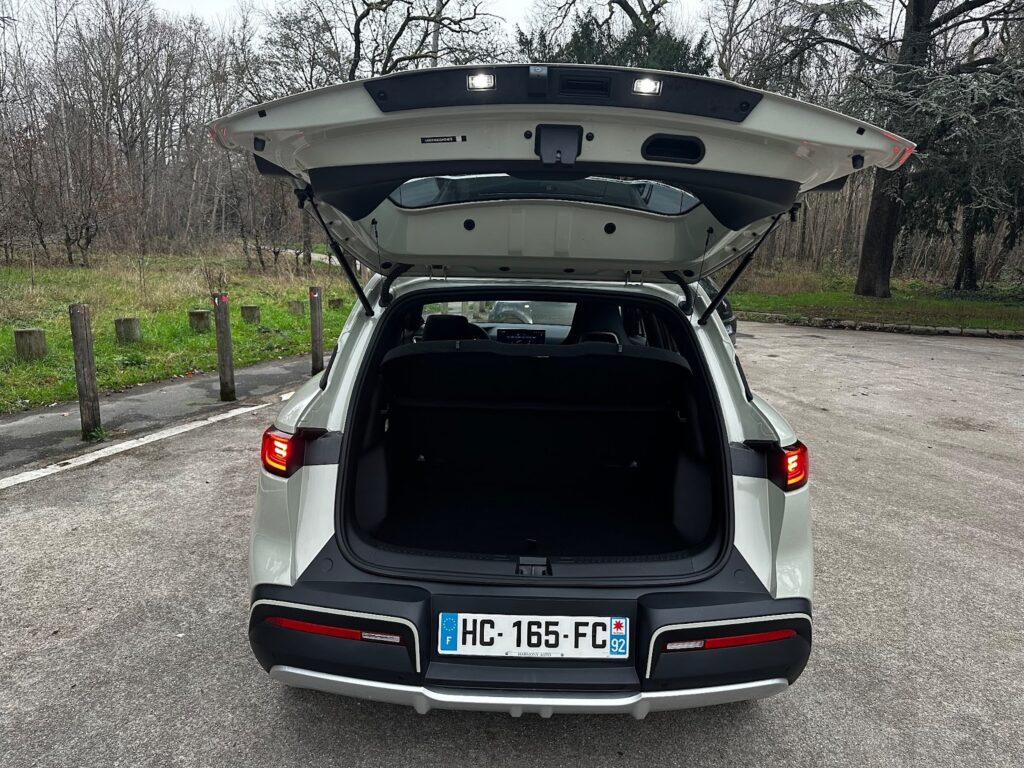
    The boot offers around 400 litres in standard configuration, and up to 1,340 litres with the rear seats folded down. These figures are consistent with its size, but confirm that the ATTO 2 is not a champion of volume; in any case, that’s not what the manufacturer is selling!

    There is one surprising detail, however: for a vehicle due to go on sale in France in 2025, the boot can be opened and closed entirely manually. That’s not a problem, but it is a little surprising for such a modern, technologically-equipped model.

    On the road: fluidity first and foremost

    Once behind the wheel of this compact SUV, you’ll feel it from the very first kilometres: it’s a very fluid car that’s a pleasure to drive. The ATTO 2’s compact size is a clear advantage. In Paris, where traffic and lack of space can quickly turn a journey into an ordeal, BYD’s electric SUV copes very well.

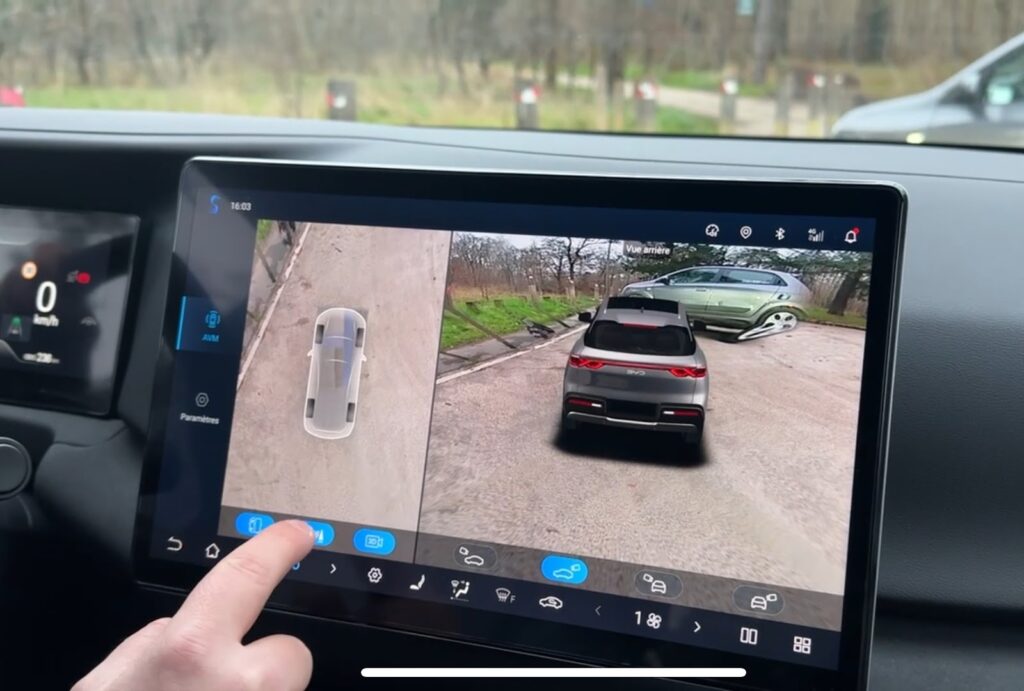
    So, of course, and we at ECO MOTORS NEWS know all about it, the electrics obviously play their part in this smoothness. What’s more, the turning circle of around 10.7 m, combined with the numerous cameras and sensors, makes manoeuvring and parking much easier.

    On fast roads and country lanes, the ATTO 2 remains firmly planted on the road, with reassuring handling and effective responsiveness. It’s obviously not a ‘pleasure’ car that will give you thrills at the wheel, but it’s a healthy compact SUV that’s comfortable and enjoyable, even on longer journeys.

    It’s not all fun and games, but this little car’s got the pedal to the metal, and that’s decided by the different driving modes (Snow, Eco, Normal, Sport). Acceleration is highly dependent on the mode selected: in Eco mode, for example, power is clearly smoothed out to preserve range. In Sport mode, on the other hand, acceleration becomes crisp and responsive, making it easier to overtake, insert or even have a bit of fun, but without ever becoming too brutal.

    The regenerative braking, which can be adjusted in two stages via the centre console, lacks a little bite, even in the most pronounced mode. That’s a shame when you’re used to hardly touching the brake pedal at all.

    Power, range and recharging

    Under the floor, the BYD ATTO 2 Boost features a 130 kW electric motor, giving it 177 bhp. The SUV accelerates from 0 to 100 km/h in around 7.9 seconds and has an electronically limited top speed of 160 km/h.

    As for the battery, the engine is paired with a 45.1 kWh Blade LFP battery. The claimed WLTP range is around 312 km, not an extremely high figure, but consistent with its urban and suburban positioning. Recharging is possible at up to 11 kW AC, and up to 65 kW DC, enabling the battery to recover between 10% and 80% of its charge in around forty minutes under the right conditions.

    Driving aids: well balanced, except for one detail

    BYD is starting to get us used to an extensive range of driving aids. For this model and this version, it’s the same thing: adaptive cruise control, lane keeping, blind spot detection, sign recognition, emergency braking, attention and fatigue detection, pedestrian monitoring, etc.

    The whole system is effective and not very intrusive, which deserves to be emphasised. But during our test drive, only one detail really disrupted the experience: the noise of the indicator, which was very robotic and overly present. A detail, to be sure, but significant enough to be worth noting.

    Verdict: accessible, coherent and reassuring

    Priced at just over €30,000 in France, the BYD ATTO 2 Boost ticks a lot of boxes. It’s not trying to impress with exaggerated figures, but to put people at ease, simplify electric power and offer a credible alternative for everyday use. Once again, this shows that BYD now knows how to talk to European motorists without compromising on the essentials.

  • Ford Capri 100% electric: the fluid, well-balanced SUV coupé

    Ford Capri 100% electric: the fluid, well-balanced SUV coupé

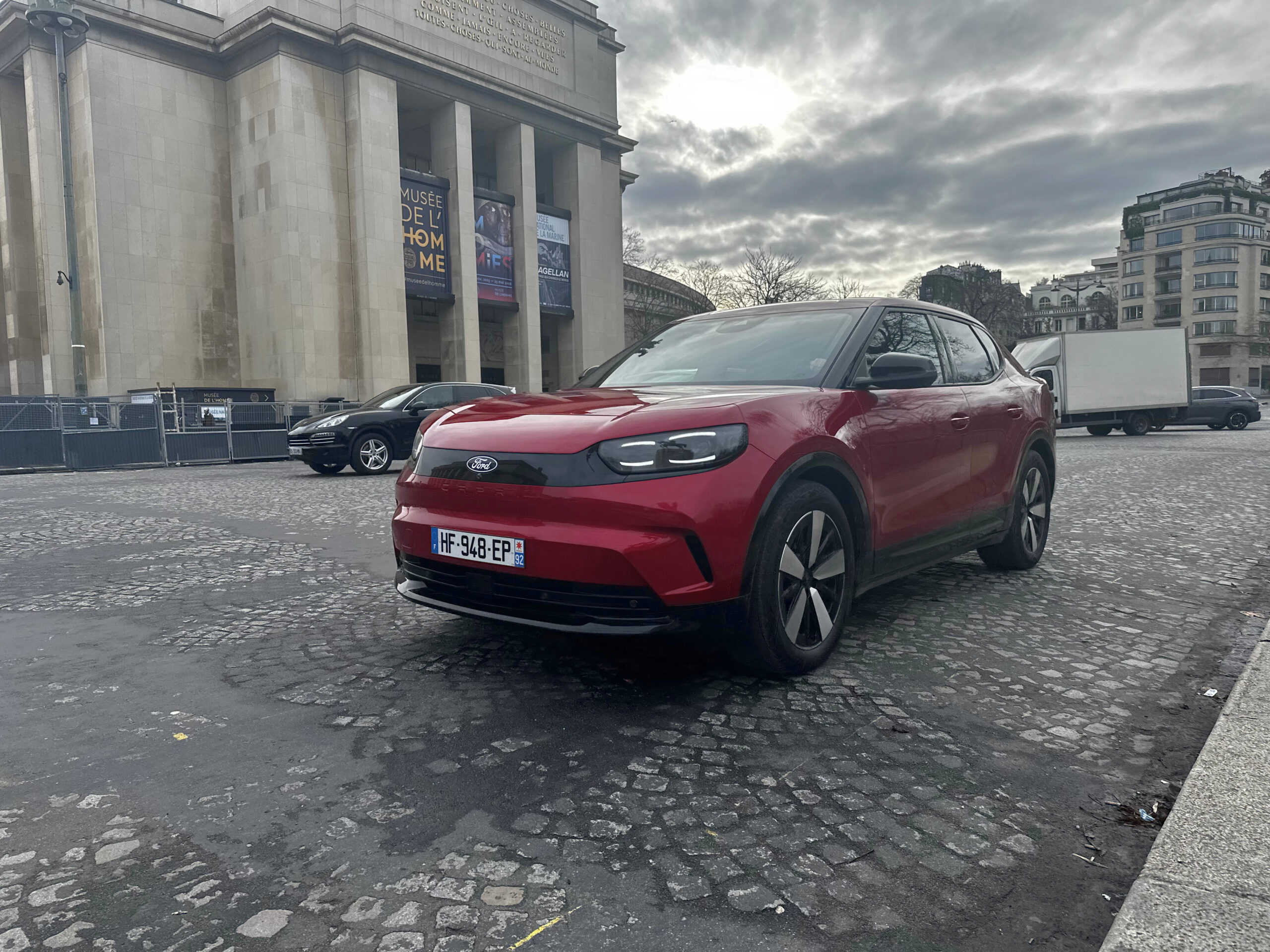
    ECO MOTORS NEWS got behind the wheel of the Ford Capri 100% electric Extended Range Premium, in an eye-catching Lucid Red colour. For three days, we put it through its paces in real-life conditions: Paris, the ring road, motorways, small roads in the Paris region and country lanes. The aim was to assess the car’s handling, interior space and real-world usability… and, above all, to check whether this electric SUV coupé lives up to its promises in everyday life.

    An assertive design… but with a contrasting physique

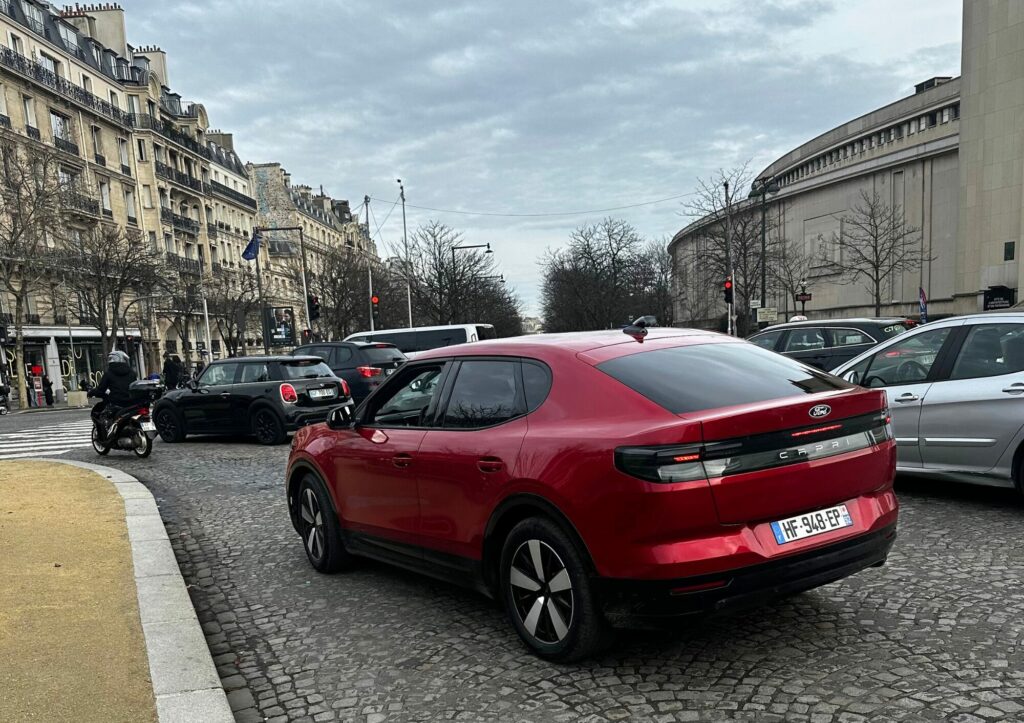
    At first glance, it’s clear that the electric Capri has the proportions of a true compact SUV. Indeed, with a length of around 4.63 m, a width of 1.95 m and a height of around 1.63 m, it’s quite imposing. The Lucid Red colour we tried out highlights its volumes and curves particularly well.

    The front end, typical of an electric vehicle, is full and closed, without a large thermal grille, giving it a modern look, but also a little massive and, for our taste, perhaps too visually heavy for what it claims to be: a sports coupé. The slim LED headlamps, linked by a horizontal light signature, add an appreciable technological touch.

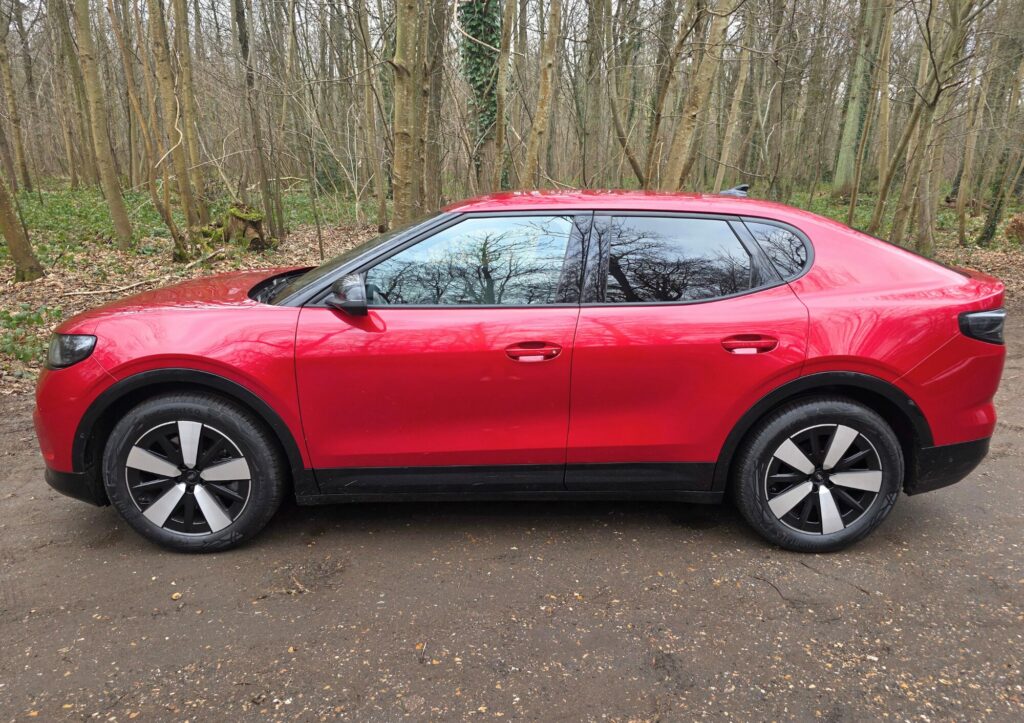
    From the side, it’s really the fastback that catches the eye: a roofline that gradually slopes down towards a steeply raked tailgate, reinforcing the impression of a raised coupé rather than a simple family SUV.

    At the rear, there is also a strong identity in terms of lighting, with a wide strip of light that brings real coherence to the whole.

    Aesthetically, it’s a success on the whole, even if the front end lacks a little of the lightness that’s so convincing in the sporty spirit it claims.

    On board: clean lines and well-thought-out comfort, but average quality

    The Capri’s cabin has a very minimalist, digital philosophy. Once you’ve settled in, the overall atmosphere is bright and uncluttered, reinforced by deliberately simple ergonomics. The quality of the materials is average, with a lot of hard plastic rubbing shoulders with parts of the cabin fitted with leather upholstery.

    The seats, meanwhile, are very comfortable. On our version, the front seats were heated, as was the steering wheel, a real plus that makes all the difference.
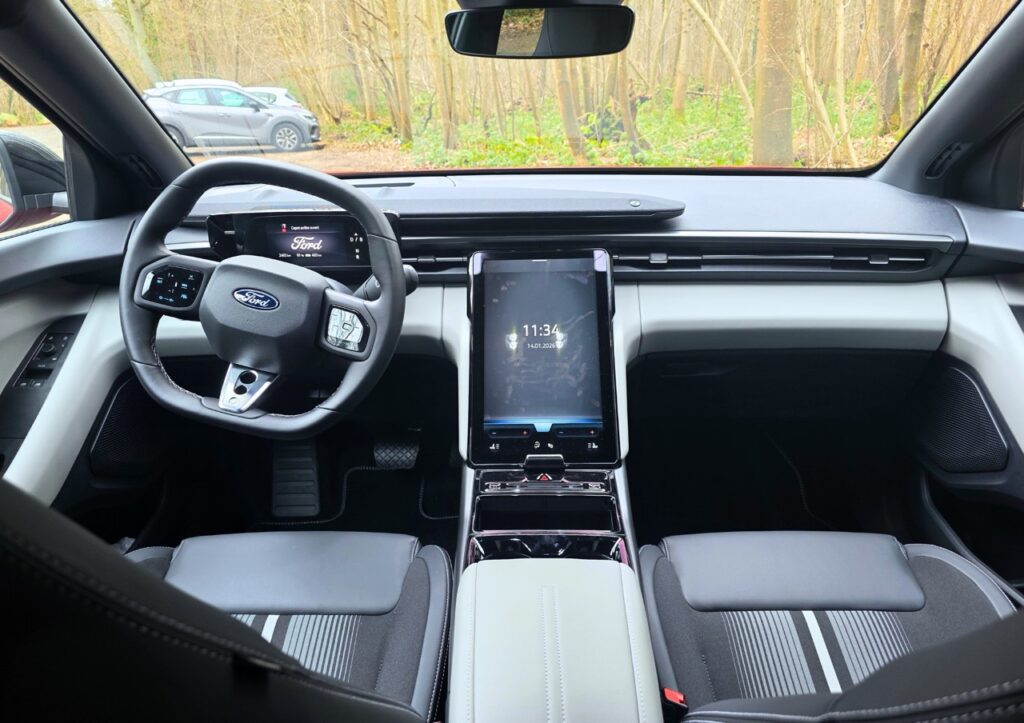
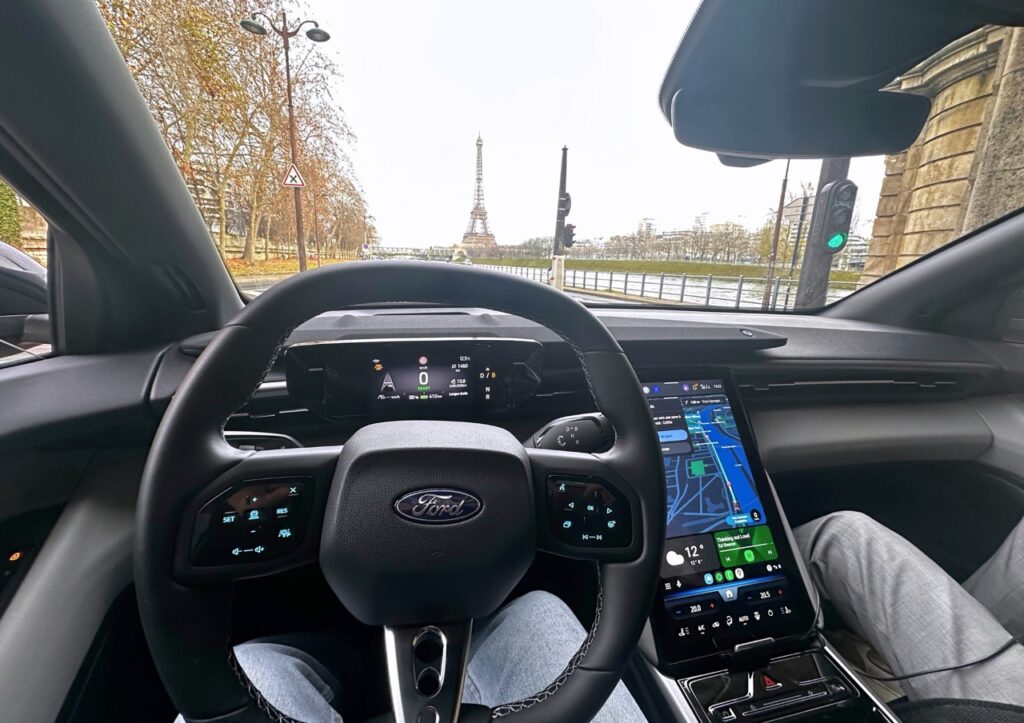
    There are hardly any traditional physical buttons: everything is controlled via the large 14.6-inch vertical central screen, which houses all the essential functions. This screen, which is the central part of the vehicle, is removable and can be adjusted to suit your driving position.

    This streamlined approach to the interior is appreciated by those who like a sober technology: the pivoting central screen is a clever idea that avoids visual overload. The fact that it’s removable and frees up a storage space where you can plug in a phone is a practical little find that I personally appreciated.

    However, not everything is perfect. I was disappointed by the software interface and the ergonomics of the operating system, which lacks intuitiveness, and the connection to Apple CarPlay was laborious, which is a shame for such a technology-oriented vehicle.

    Behind the steering wheel, the digital display that serves as the instrumentation is clear and easy to read, but does not revolutionise the way in which information is consulted. The ‘digital’ buttons integrated into the steering wheel are attractive and original, but their sensitivity is sometimes too high – I’ve had cases of controls being activated inadvertently during manoeuvres, which can become irritating.

    Another surprising ergonomic choice is the management of the rear windows. Only two buttons on the front control all the windows, and you have to activate a ‘rear’ mode to switch between front and rear. It’s a logic that takes some getting used to, but I really liked its originality. Rest assured, of course, that the passengers behind have their own controls.

    Overall, the interior is well thought out and above all original. There’s plenty of storage space in the central part of the front of the vehicle, as well as two induction charging points – in short, everything you need to travel efficiently.

    In the rear: generous, practical space

    Thanks to a generous wheelbase of 2.77 m, rear-seat space is not to be outdone. Whether for children or full-size adults, the rear seats offer more than adequate comfort for medium-distance journeys.

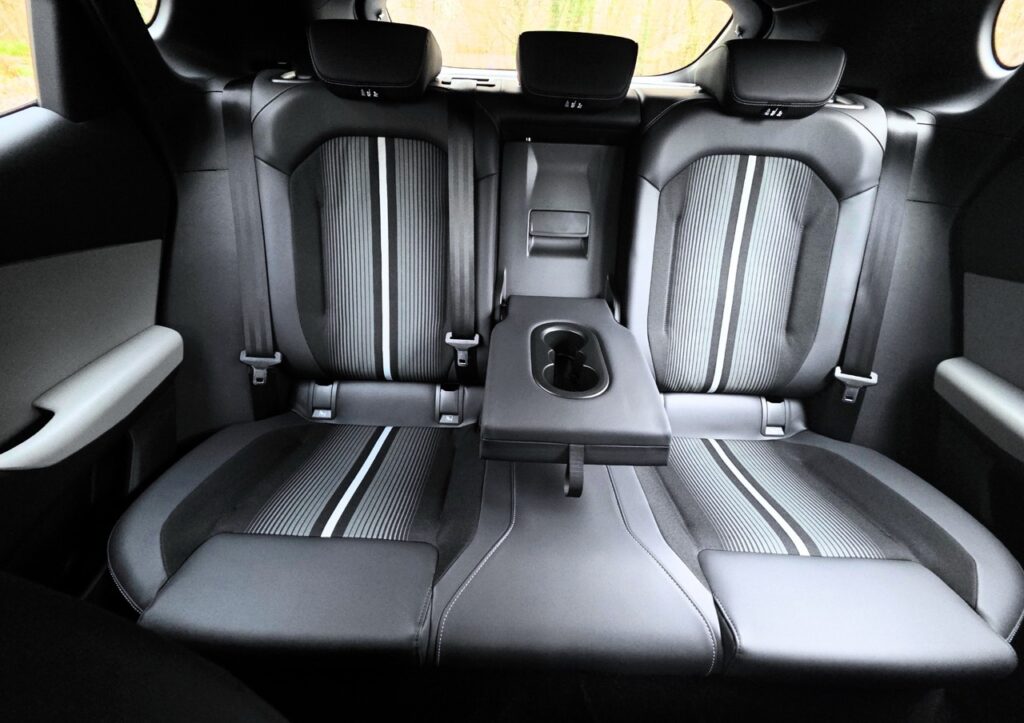
    The Capri even adds a ski hatch integrated into the middle seat, which converts into a glass rest – a clever detail that’s particularly useful on long journeys or for transporting skis without losing any useful space.

    The boot is one of the Capri’s practical strengths. With over 570 litres in standard configuration and over 1,500 litres with the seats folded, it offers generous capacity for a compact SUV coupé.

    On a personal note, I find the boot opening aesthetically pleasing. Of course, it’s also pleasant and wide enough to handle luggage, bags and equipment with ease.

    Smooth, fluid ride with a personality all of its own

    From the very first kilometres, the Capri impresses with its fluidity. In town, it’s silent, the steering is precise and the sensation is very pleasant. On the other hand, forward visibility is sometimes hampered by a bulky central rear-view mirror that invades the field of vision. At some traffic lights, you had to bend over slightly to see the traffic lights properly, a small detail that sometimes bothered us.

    On fast lanes and motorways, the handling is pleasant. The comfortable seats, combined with a chassis that absorbs imperfections well, allow you to cover mile after mile without excessive fatigue. In Sport mode, the Capri is even more lively, making overtaking and merging into traffic stress-free and truly serene.

    In tight bends or at sustained speeds, you feel the weight of the vehicle, which nevertheless remains firmly planted on the ground. There’s a slight perceptible roll, but nothing that’s prohibitive once you get used to its size.

    Technique & autonomy: a serious proposition

    Under the bonnet, the Capri Extended Range boasts an electric motor producing around 210 kW (286 bhp) combined with 545 Nm of torque, enabling it to accelerate from 0 to 100 km/h in around 6.4 seconds and reach a top speed of 180 km/h.

    Its battery has a useful capacity of around 77 kWh, and the WLTP range can reach up to 627 km in mixed use when the battery is fully charged. In use, this generous range translates into real peace of mind on long journeys, although it logically varies according to driving style and road type.

    Charging is well thought-out: up to 11 kW AC for home charging, and up to 135 kW DC fast, which means you can go from 10% to 80% in around 28 minutes at a suitable charging point.

    Driving aids: useful but need to be tamed

    As we’ve said, this is a car that’s very well equipped technologically, and in this respect, it doesn’t neglect its assistance systems. Adaptive cruise control, lane keeping, blind spot detection and multi-angle cameras are all present and function in a way that is useful on a daily basis. The rear camera is oriented according to the direction of the steering wheel, which really makes manoeuvring easier and made us forget how wide it is. The head-up display is well thought out and provides real visual comfort, whether you’re in town or on the motorway.

    Some of the aids may seem a little intrusive at first, but they are easy to deactivate if you prefer a more traditional driving style.

    A generous, fluid electric Capri… with a few compromises

    The Ford Capri 100% electric Extended Range is a solid proposition in the compact electric SUV segment. It impresses with its smooth ride, convincing interior space, generous boot space and reassuring range. The Sport mode is lively, and the well thought-out driving aids make everyday life easier.

    However, some compromises have been made. Forward visibility is not optimal, the screen interface is not very intuitive, and the digital buttons on the steering wheel are too sensitive.

    The Capri is a coherent, enjoyable car that combines comfort, style and versatility. It doesn’t try to impress with extreme performance or ostentatious luxury, but succeeds in offering a practical, dynamic electric SUV coupé that is a pleasure to drive every day, true to its identity.

  • BYD Seal U DM-i: everyday fluidity, comfort and autonomy

    BYD Seal U DM-i: everyday fluidity, comfort and autonomy

    ECO MOTORS NEWS tested the BYD Seal U Boost DM-i, the Chinese manufacturer’s plug-in hybrid SUV which aims to offer a balance between comfort, technology and range. For three days, we travelled around Paris, its ring roads, motorways and country roads to assess its handling, habitability and real-life everyday use.

    An SUV inspired by the sea, but firmly rooted on the road

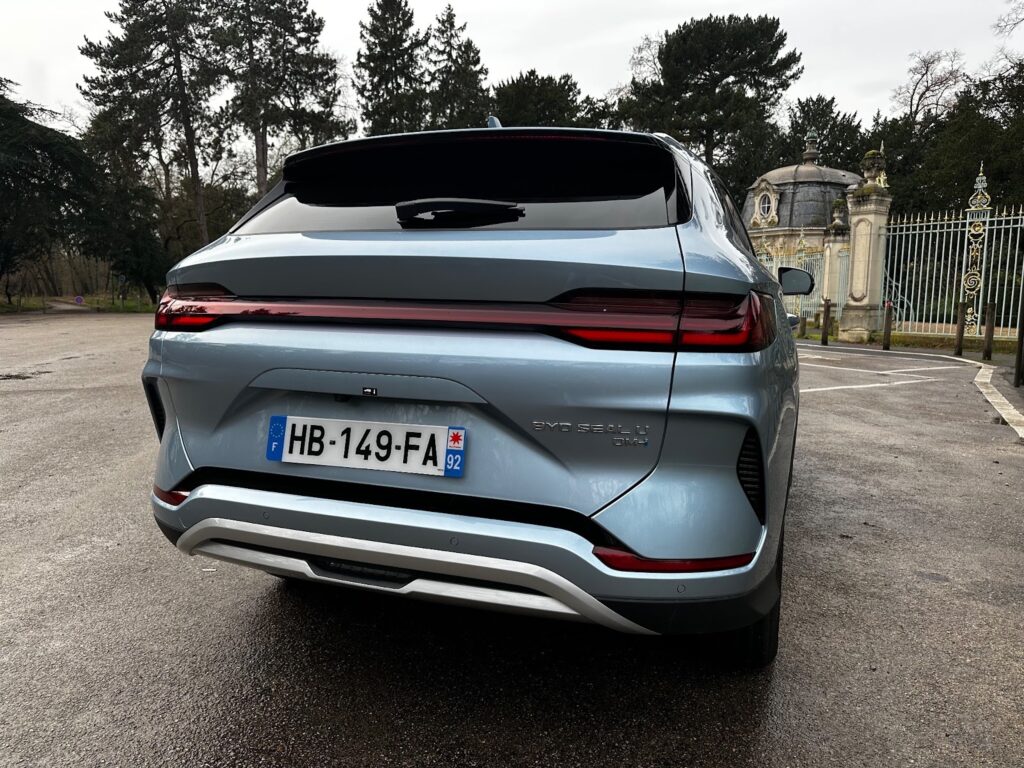
    From the outside, the Seal U stands out with its generous proportions: 4,785 mm long, 1,890 mm wide and 1,668 mm high, with a wheelbase of 2,765 mm, which instantly explains the impression of space on board. The look is massive but not crude; the fluid lines are inspired by the elements of the sea, an aesthetic that BYD claims for the entire Seal family.

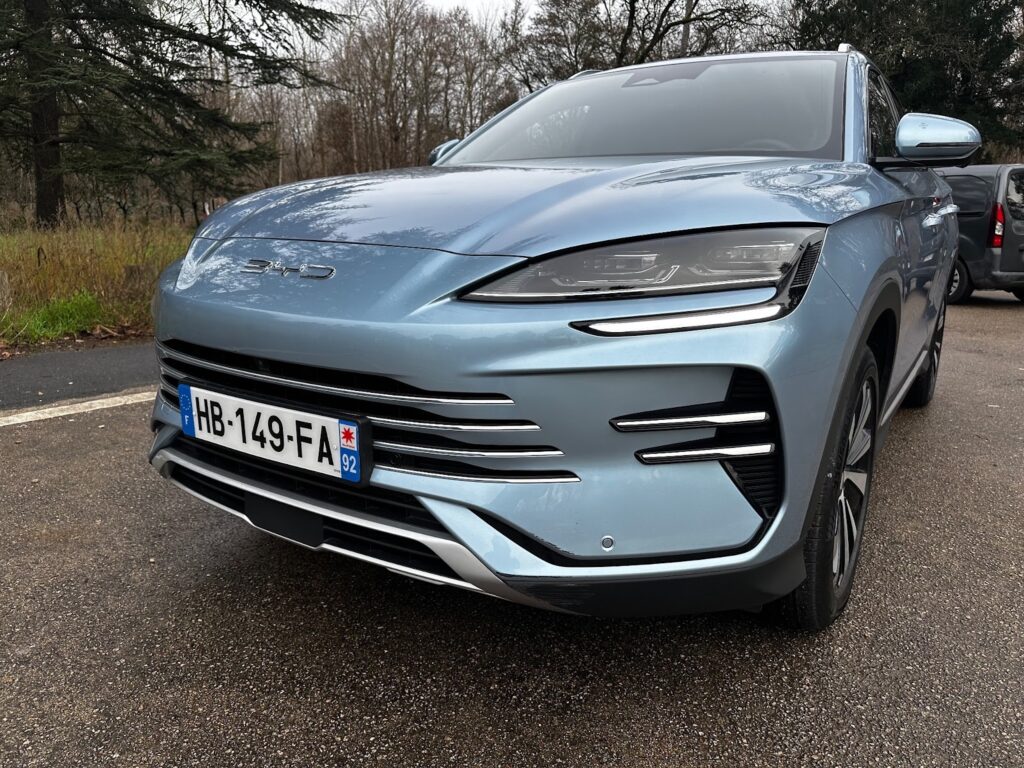
    This desire to draw inspiration from the sea helps to ensure that this SUV is not a square, angular SUV, but rather a vehicle that lifts its stature, giving the profile a distinct visual identity. The rear end is particularly well executed, with clean, dynamic curves without going overboard. In terms of trim, and therefore colour, I had the opportunity to travel in the Seal U decorated with its Tianqing tint. It fits in perfectly with this visual philosophy: it’s discreet without being banal, it’s eye-catching without becoming flashy.

    But obviously, a vehicle of this size can’t be perfect in every respect. On the road, it feels like a real SUV: the size is there, the width is noticeable (especially in town), but the silhouette doesn’t give that heavy impression you’d expect from a 2-tonne vehicle.

    On board: light, quality and intelligent restraint

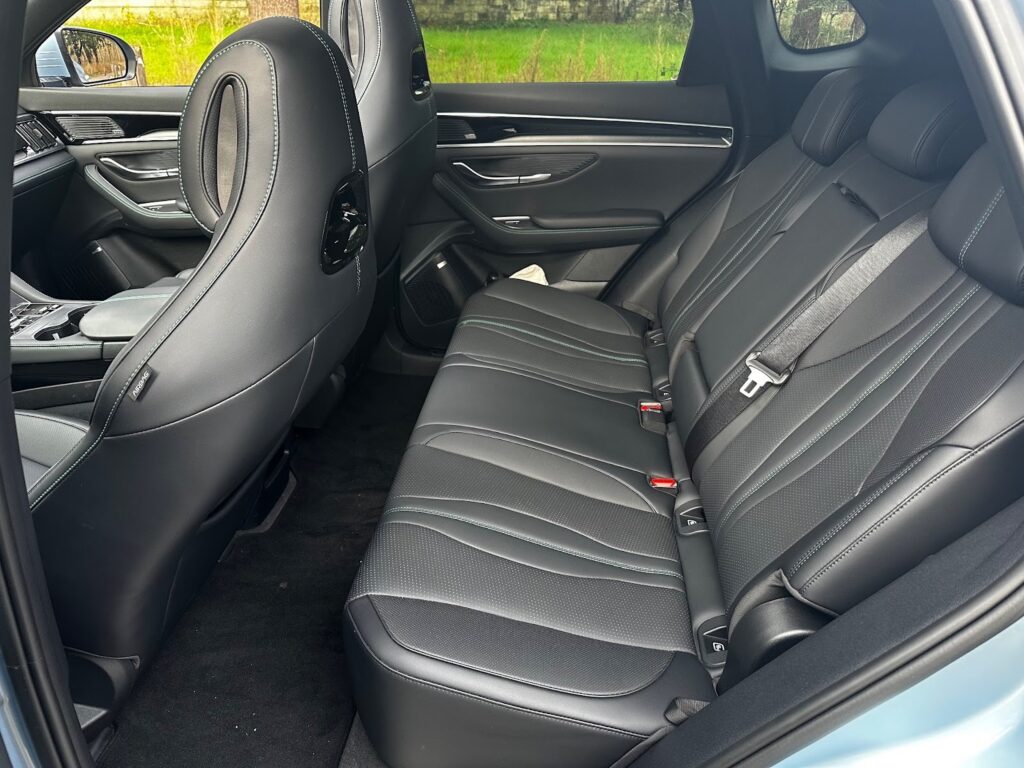
    The interior benefits directly from the vehicle’s generous dimensions. Space is comfortable both front and rear, and the Seal U does not betray its family ambitions. The materials are of good quality for its class and price point, with welcome details such as the blue stitching on the door panels and dashboard.

    At the rear, the generous wheelbase means there’s plenty of legroom, even if the middle seat is logically a notch down in terms of comfort. Light is a real highlight thanks to the generous sunroof, which floods the cabin with light, reinforcing the impression of space.

    What I really appreciated was the ergonomic design, without overloading: the steering wheel and centre console are not covered in unnecessary buttons, and only the most useful shortcuts are present.

    An unconvincing boot

    In terms of boot space, the BYD Seal U DM-i is a little disappointing given its size. With 425 litres in five-seat configuration, the volume is not very generous for an SUV of almost 4.80 m, especially when compared with some direct competitors that are much more generous.

    For everyday use, this is still sufficient, but it is far from a benchmark boot for the segment. However, once the rear seats are folded down, capacity increases significantly to around 1,440 litres, providing real versatility for busy journeys or weekend getaways.

    Screen, technology and driving aids

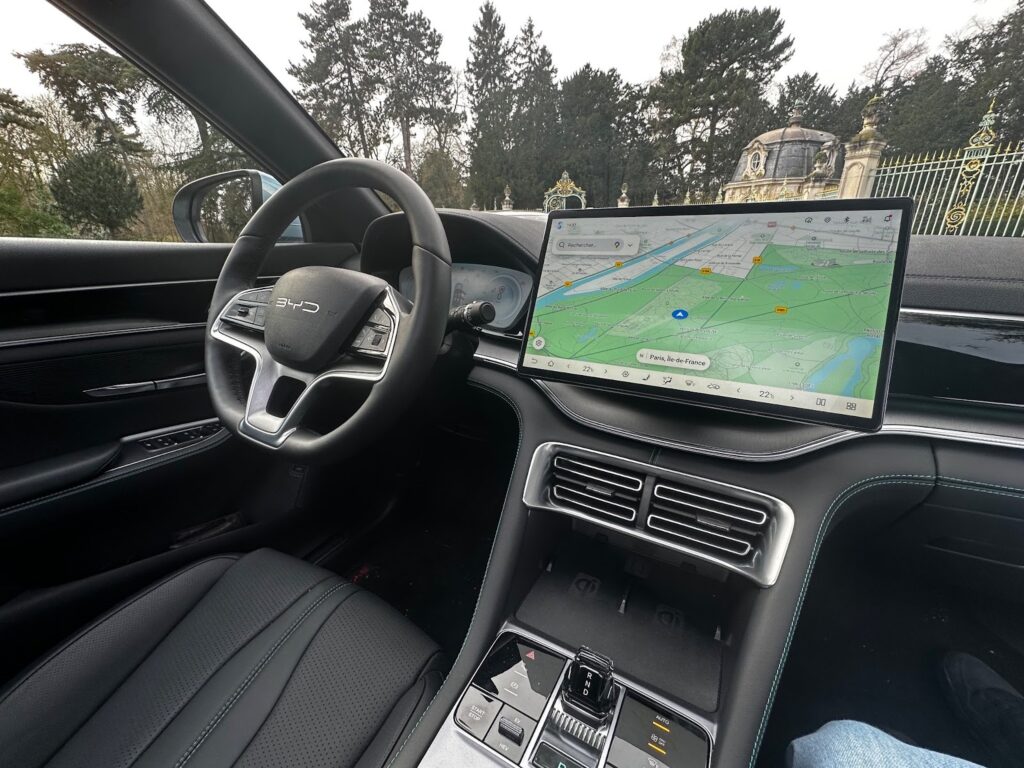
    One of the things that impressed me most was the technological interface. The Seal U is equipped with a 15.6-inch touchscreen, which can be oriented horizontally or vertically via a simple control on the steering wheel. It’s a detail that changes the user experience, because in my experience and taste, the vertical position is perfect for navigation and maps, while the horizontal is better suited to applications and media.

    Connectivity is comprehensive: Apple CarPlay, Android Auto, voice assistant and easy-to-read digital instrumentation. The whole package gives an impression of coherence, where some SUVs in this segment are sometimes content to pile on options with no real concern for ergonomics.

    In terms of driving aids, the Seal U is well equipped, with adaptive cruise control, blind spot detection, sign recognition, pedestrian presence monitoring, lane departure warning and other conventional aids.

    While, on the whole, these aids are effective, some systems are less so. Pedestrian detection, although practical on paper, can be a little too cautious, resulting in sudden braking that can be surprising.

    Driving and real-life use: DM-i logic comes into its own

    On the road, the BYD Seal U DM-i strikes an interesting balance. It’s by no means a sports car, but it also avoids the pitfalls of a heavy, clumsy SUV. DM-i (Dual Mode – Intelligence) technology combines a 1.5-litre combustion engine with an electric motor to produce a combined power output of 218 bhp and around 300 Nm of torque, transmitted to the front wheels – a configuration perfectly in keeping with the vehicle’s size and purpose.

    In town, the drive is smooth, fluid and silent, with electric mode naturally taking the upper hand during acceleration and low-speed phases. On fast roads and motorways, the power reserve is sufficient and, above all, well utilised. The transition between electric and internal combustion engine power is almost imperceptible, which is one of the real strengths of the DM-i system: electric power remains the preferred mode for day-to-day driving, while the petrol engine is discreet when the pace quickens, without ever breaking the coherence of the driving experience.

    Mode management is simple and intuitive. A button on the central island allows you to switch quickly between EV and HEV mode, without unnecessary complexity. The Seal U is clearly not designed to attack, but it proves to be stable, comfortable and reassuring, with healthy behaviour whatever the conditions.

    The only downside in urban environments is that its width of 1.89 m (excluding mirrors) makes itself felt on narrow streets or in heavy traffic. A little vigilance is required, particularly in Paris, but the whole thing is manageable with a minimum of practice.

    In terms of range, the DM-i promise is fully borne out in use. In 100% electric mode, the Seal U can cover a distance of around 70 to 80 km, enough to cover most daily journeys without using a drop of petrol. In hybrid configuration, total range can reach up to 1080 km according to the WLTP cycle, which radically changes the approach to long journeys.

    The system also recharges via regenerative braking, further improving efficiency in urban use. The logic behind this SUV is clear: you can drive electric every day without compromise, and go on holiday without having to plan compulsory charging stops.

    Verdict: versatile, pragmatic and convincing

    The BYD Seal U Boost DM-i is not here to revolutionise the SUV segment. It doesn’t have the agility of a sporty SUV or the technological purity of a 100% electric model. What it does achieve, however, is a real balance between comfort, intuitive technology, everyday range and unrestricted practicality.

    In short, the Seal U DM-i may not be the one that impresses with spectacular figures, but it’s the one that convinces in real life, and often without hesitation.

  • Mercedes-Benz EQV 300: the XXL electric van for uncompromising comfort

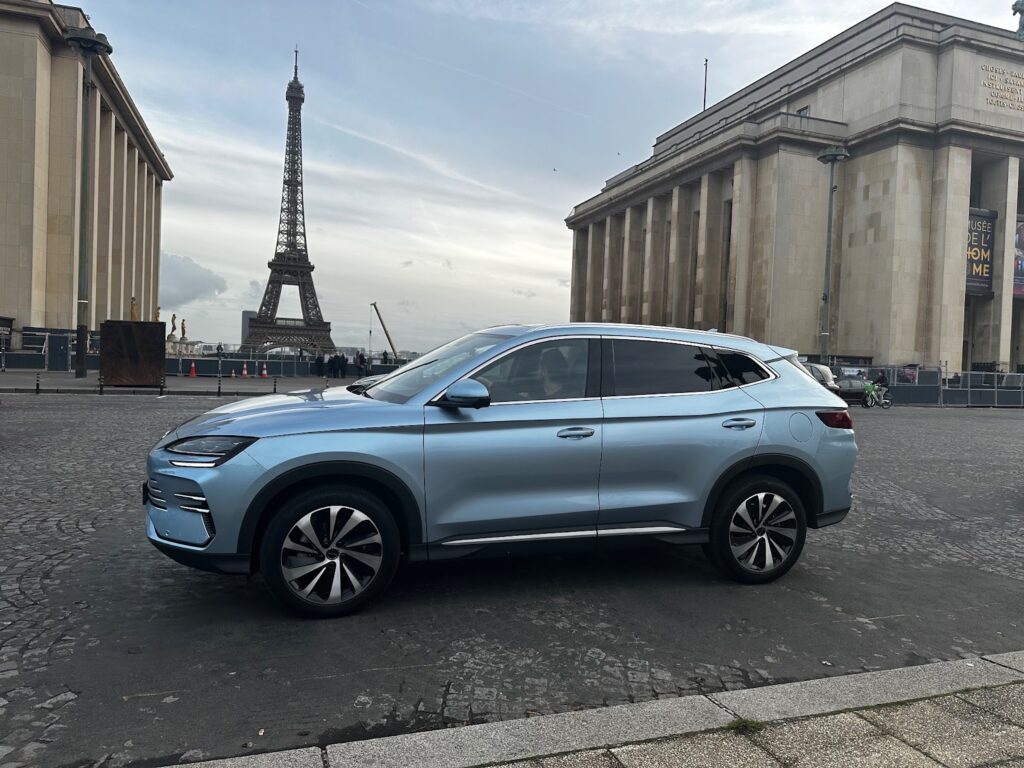
    Mercedes-Benz EQV 300: the XXL electric van for uncompromising comfort

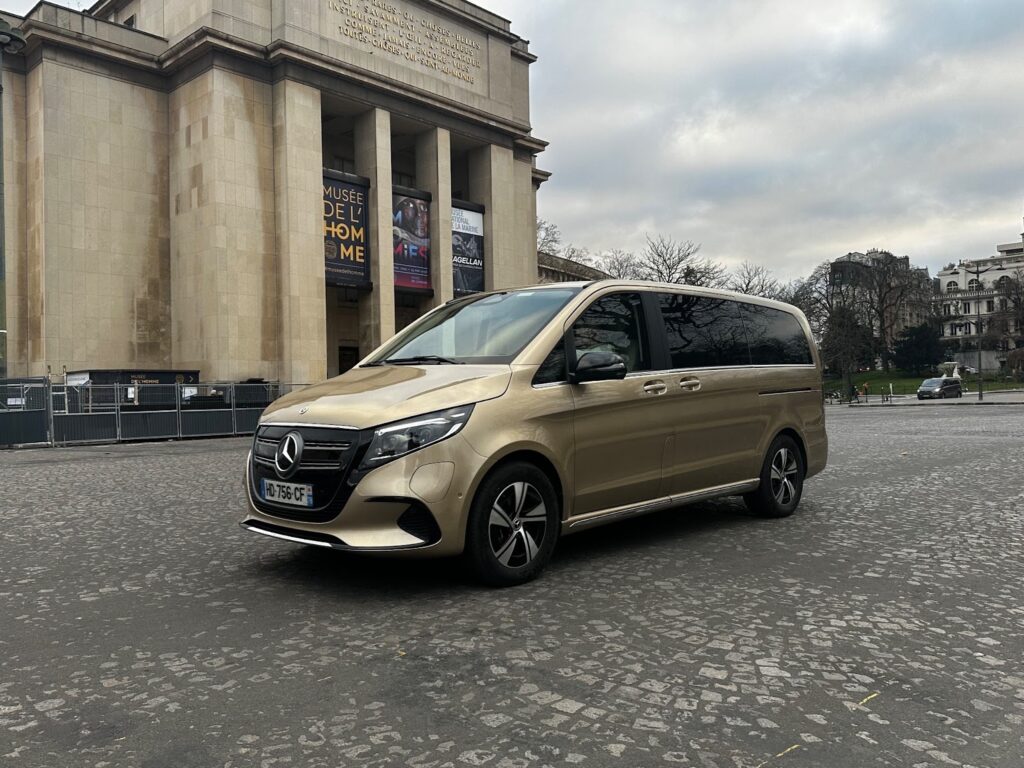
    For three days, the Mercedes EQV 300 shared our daily lives: city, ring road, motorway and secondary roads. A test in real conditions, made in ECOMOTORSNEWS, to measure the value today of a premium electric van designed for families and practical uses.

    A van with presence

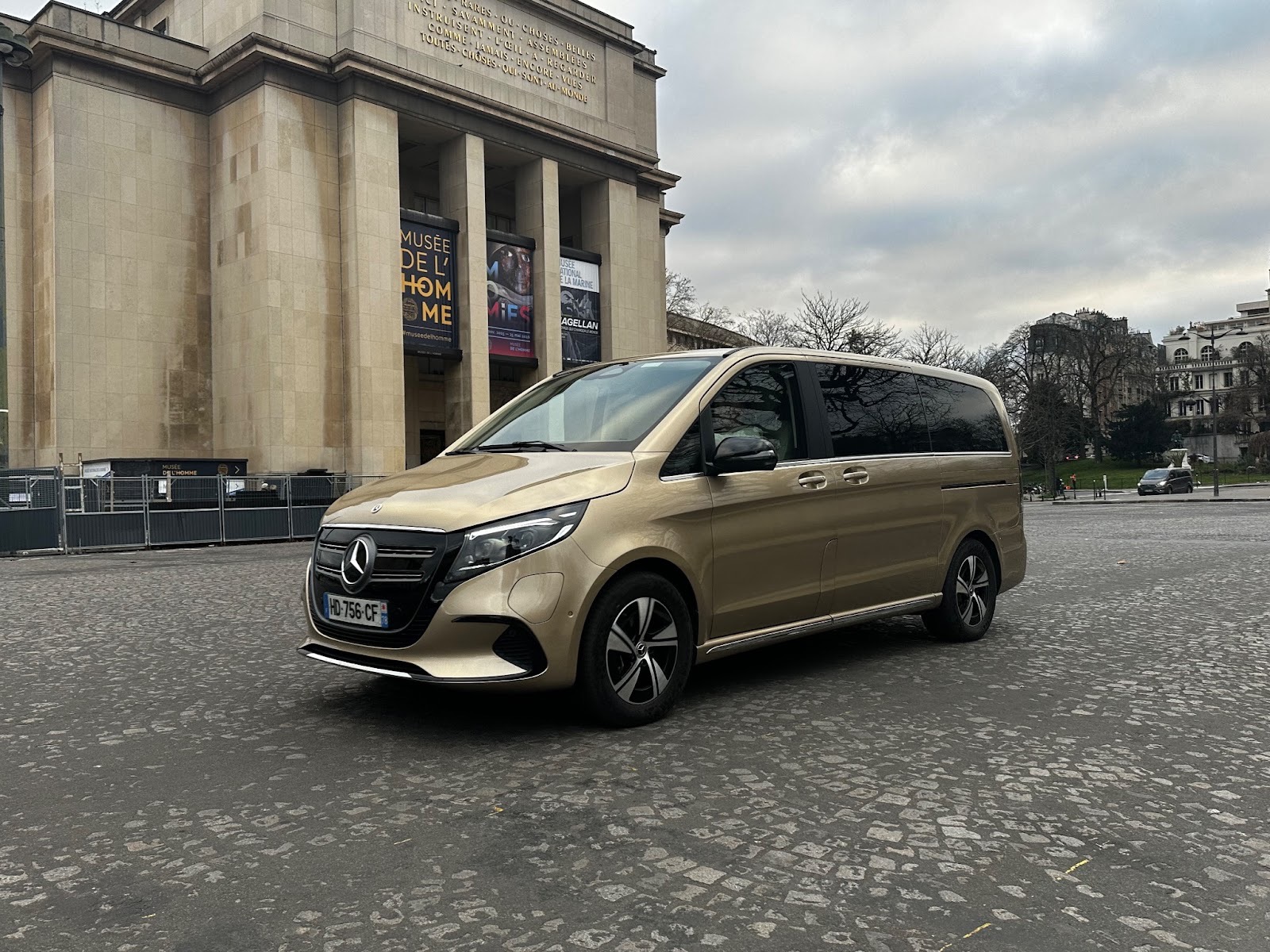
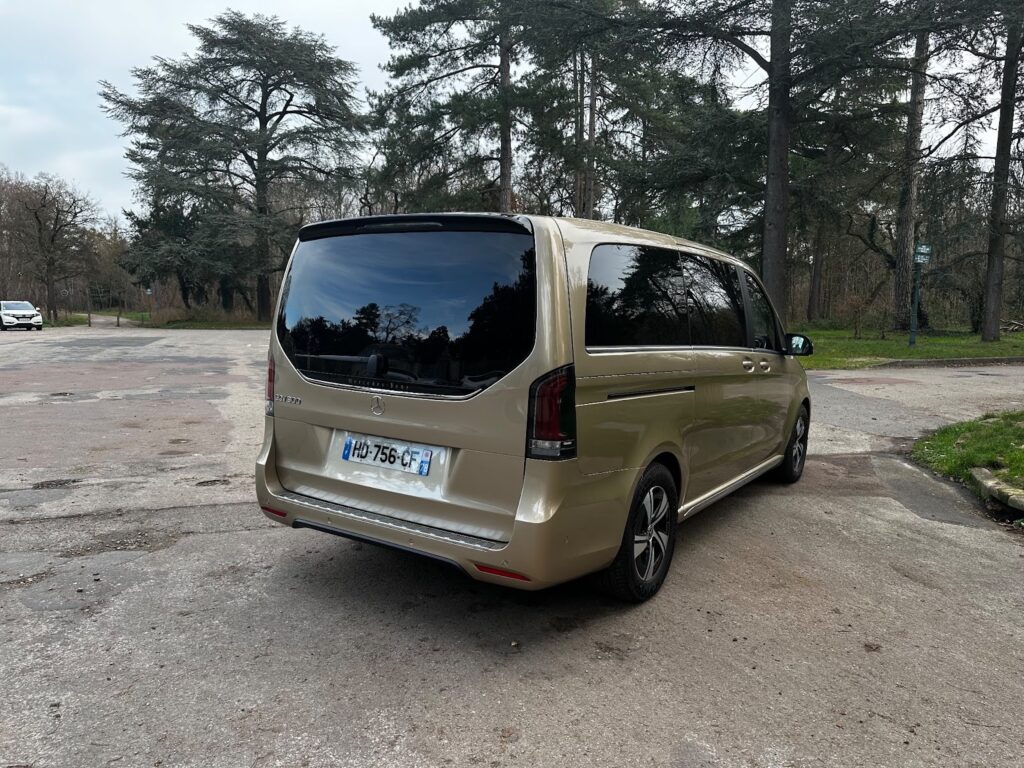
    At first glance, it’s hard not to be surprised by its distinctive colour and balanced aesthetic. On the one hand, the Kalahari Gold metallic gives it a premium, distinctive and attractive look, without going over the top. On the other, the front of the vehicle has nothing to envy from a Mercedes saloon, thanks to the large grille and the big logo that command respect.

    At 5.14 metres long, almost 1.93 metres wide and around 1.90 metres high, the Mercedes EQV has an imposing, assertive stature that clearly sets the tone: this is a real van, designed for space and use.

    However, I was less won over by the rear end, which is too upright for my taste and lacks the dynamism to counterbalance its size. But that remains a matter of taste: for many, this format will remain the symbol of what a van should be: presence, space and efficiency.

    Inside: a promise of comfort that really delivers

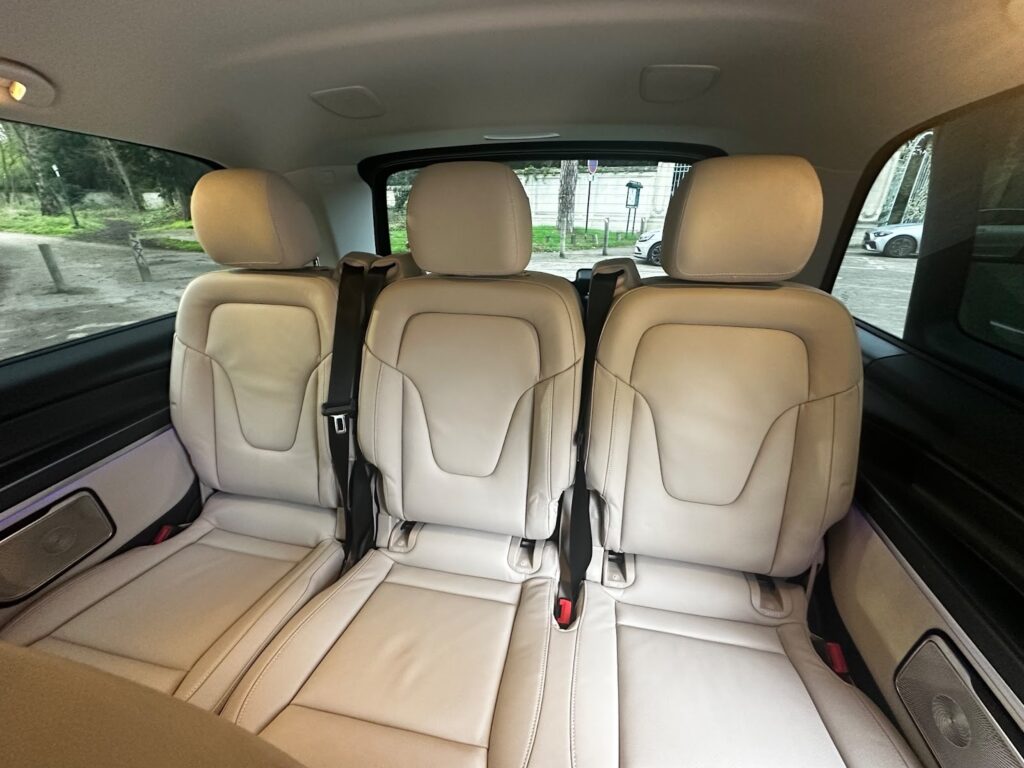
    Opening the doors of the EQV is like discovering a well-designed room. The interior space is bright, generous and perfectly adaptable. Our 8-seater version with individual seats gives an immediate impression of versatility. Everyone benefits from a real seat and convincing legroom, even on long journeys. Unlike traditional 6-, 7- or 8-seater vehicles, the German brand’s intention with its van is clear: no ‘extra’ seats. The seats offer comfort and support worthy of a well-designed lounge chair, which is rare in this segment.

    And access is pleasant too. With its large sliding doors for access to the rear seats of the vehicle, the installation is practical. In this type of vehicle with lots of seats, getting into the back seats is often an obstacle course. Here, with the EQV, everything is easy: the seats fold out and in with ease.

    The Avantgarde finish we tested continues this logic. The beige leather seats, the effective digital display panel, which adds that ever-pleasing ‘high-tech’ touch, and the simple, yet not excessive, ergonomics (quite a few buttons, but well placed and without any real overload) give the cabin a premium feel, almost cocooning without being flashy.

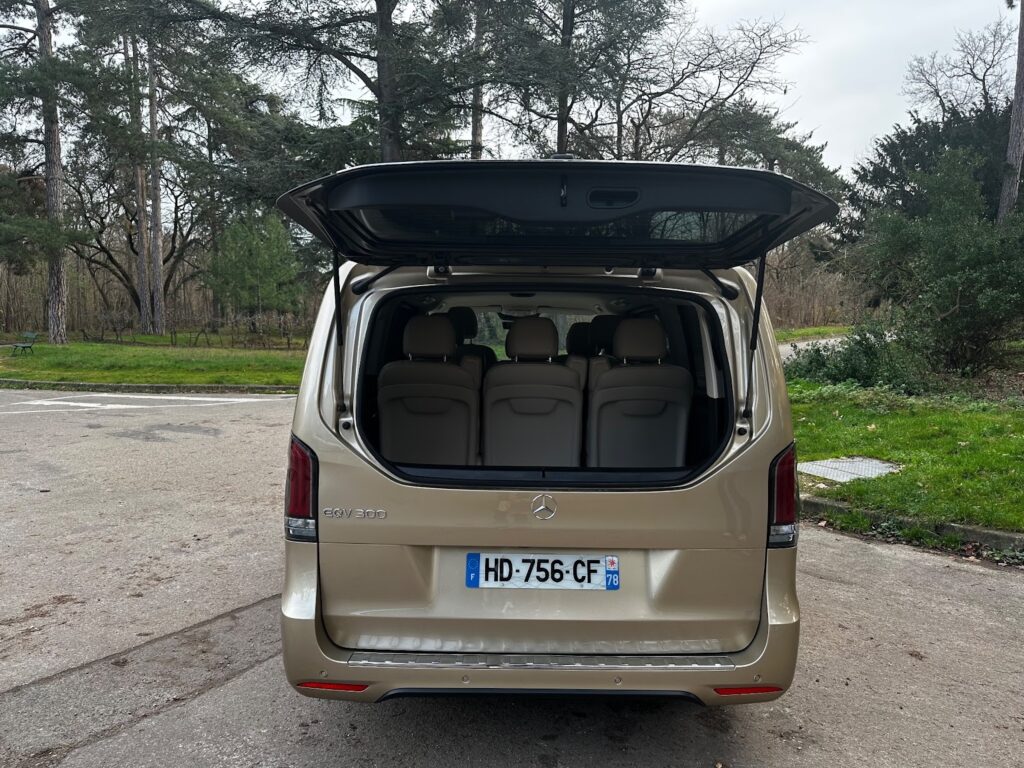
    As for the boot, with 610 litres in 8-seater configuration, it’s obviously not insane at first glance. But as soon as the seats are removed (with ease, no less), the capacity explodes. In fact, the manufacturer claims a total capacity of up to 5,000 litres, enough to carry volumes worthy of conventional vans. Another detail that really appealed to me, and that you don’t often see, is the double opening of the boot: either wide open like a traditional tailgate, or just the glass section, which can also be opened to grab a bag or pull out the charging cables quickly and effortlessly.

    In town, on the road, on the motorway: smooth, adapted driving

    We suspected it, but it’s confirmed: the EQV isn’t designed to flex its muscles. Under the bonnet, the electric motor develops 204 bhp and 362 Nm of torque, a power that allows this beautiful baby to adopt a fluid driving style. And unlike most EVs, acceleration is linear rather than explosive. For the intended use of this type of electric vehicle, it’s a perfect match.

    City driving is pleasant and fluid, even if the dimensions require a little delicacy in narrow streets or on Parisian quays. On the other hand, on the road and motorway, the power is appropriate and, by changing modes (4 different modes in all), overtaking is still largely accessible. What’s more, its weight can become an asset: there’s no jiggle, just a quiet suppleness and an appreciable silence, especially when compared with internal combustion versions.

    Let’s talk about the weight! Empty, it weighs in at just under 2.8 tonnes. The EQV 300 imposes a serious size on the road, but remains within the limits of a conventional B licence, while offering the capacity needed for long, well-laden journeys. You feel the weight when you change direction abruptly, but the handling is more reassuring than you might imagine, thanks in particular to the centre of gravity lowered by the battery. The turning radius isn’t exactly ideal, but given the dimensions, it’s understandable and not disturbing depending on use. Once again, we’re talking about a real van, not a small city car.

    On-board technology: sufficient and well thought-out

    Inside, Mercedes has opted for consistency rather than overkill. Facing the driver, there is a large digital panel made up of two 10.25-inch screens, united under a single panel. One is dedicated to the instrumentation, the other to the multimedia system. It’s an easy-to-read unit, well integrated into the dashboard, which adds a real high-tech touch without visually weighing down the cabin.

    The MBUX system is of course part of the package. The central screen is touch-sensitive, but above all it can be controlled via a pad located on the centre console, a solution that I find particularly relevant in a vehicle of this size. This pad allows you to navigate through the menus without taking your eyes off the road for too long, where some giant screens can be more distracting than ergonomic.

    It’s a far cry from the XXL screens found on some recent electric SUVs, but the interface is fluid, logical and intuitive. Essential information is quickly accessible, navigation is clear and the controls fall naturally to hand. The whole system is designed to accompany the driver, rather than dominate him or her, which is a real strength when driving in dense urban environments or on long motorway journeys.

    Range and recharging: figures in line with actual use

    For the EQV, Mercedes has announced a WLTP range of around 350 to 360 km for this 300 model, depending on conditions and load, which is a solid base for a vehicle of this size.

    In the real world of mixed roads from Paris to the countryside, via the ring road and the main roads, I found that range varied logically according to speed and whether or not the technological equipment was activated.

    What’s more, in terms of aerodynamics, the van has a drag coefficient of around 0.32, a figure that is consistent for this type of vehicle, but logically penalises it at high speeds. This translates into higher fuel consumption on the motorway, a factor to be taken into account when planning long journeys.

    When it comes to recharging, the EQV can handle 11 kW AC for a full charge in less than 10 hours, and up to 110 kW DC, enabling it to go from 10% to 80% in around 40 minutes. These figures are not spectacular compared with some large electric SUVs, but they are still effective and sufficient for an electric van whose vocation is not excessive performance, but pragmatic use.

    Verdict: the EQV is not a revolution, but a real answer

    The EQV 300 Avantgarde does not seek to revolutionise the codes of electromobility. On the contrary, it consistently embodies what we expect from a large premium electric van: comfort, modularity, space, quality and a range adapted to real needs.

    It’s perfect for large families, regular travellers looking for uncompromising comfort, or professionals who want to combine space and image without giving up the smoothness of electric power. This is not a vehicle for pleasure, but a reliable, well thought-out tool for comfort.

    Whether you’re going on a road-trip with the family or a weekend loaded down with luggage and passengers, the EQV has what it takes to make it enjoyable. And on the road, its silence, comfort and flexibility are a reminder that electric power is a real choice.

  • XPeng G6 Performance: high-level performance and XXL range

    XPeng G6 Performance: high-level performance and XXL range

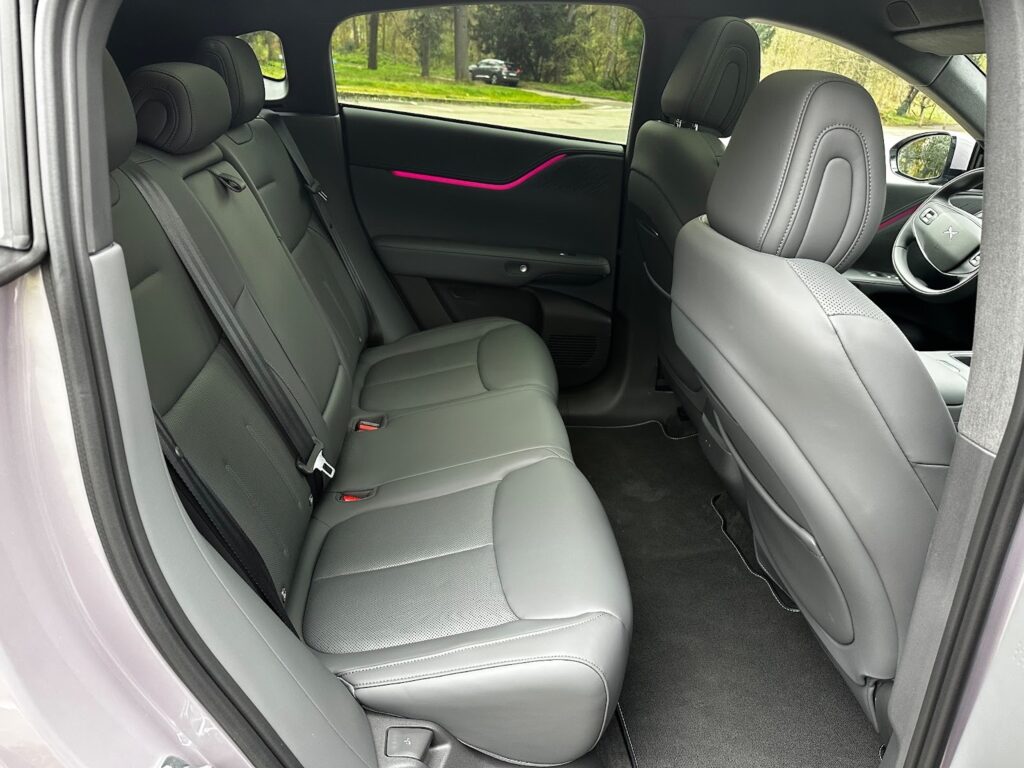
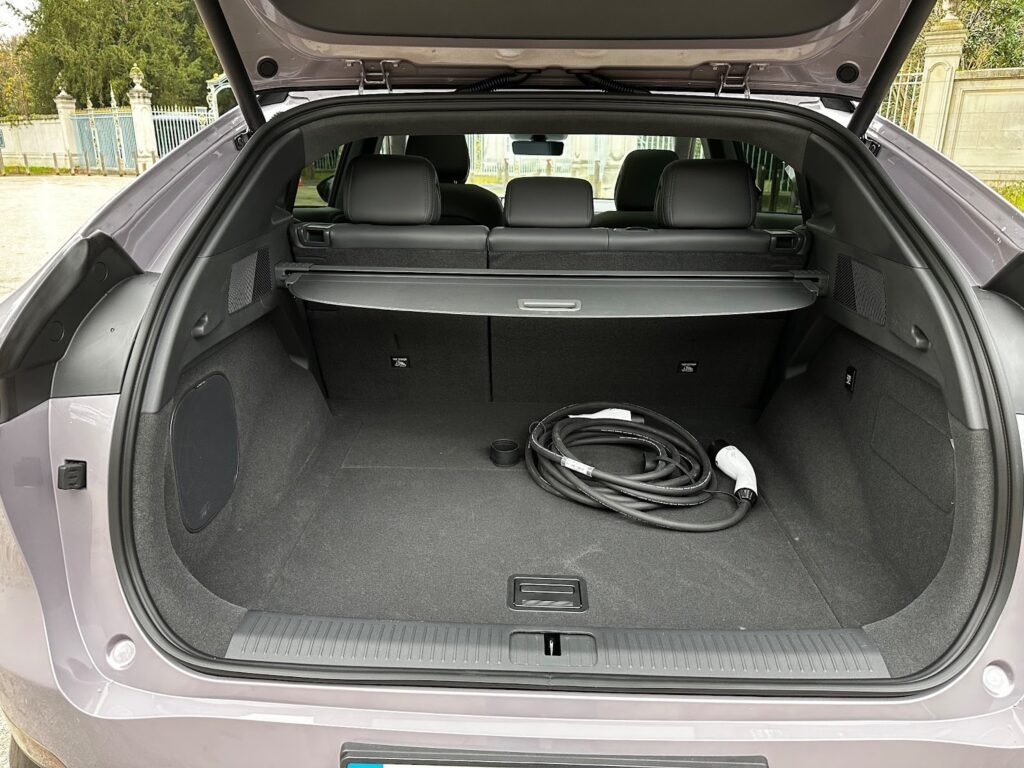
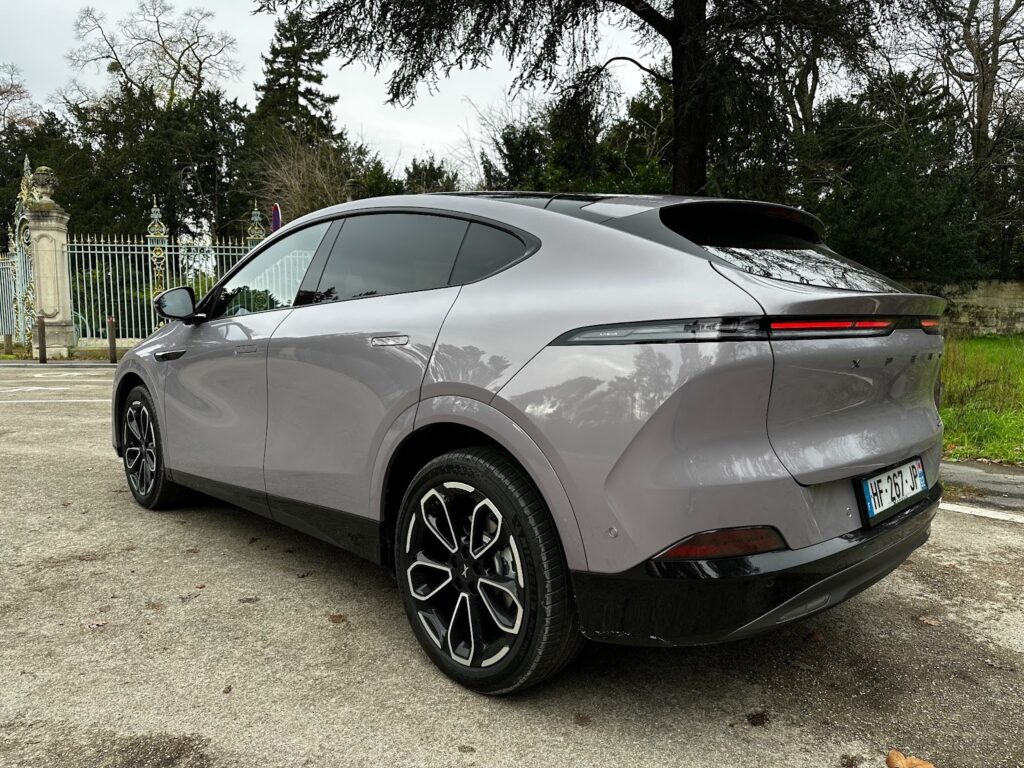
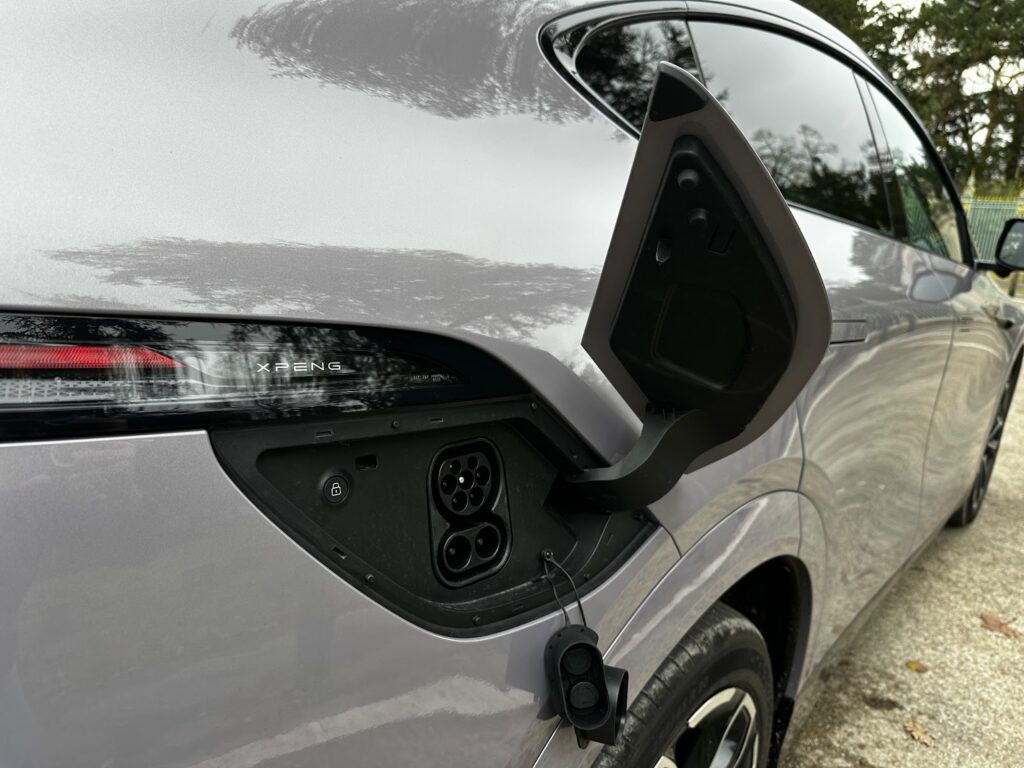
    ECO MOTORS NEWS got behind the wheel of the XPeng G6 Performance, the Chinese manufacturer’s 100% electric SUV coupé, which is clearly targeting European benchmarks… and above all the Tesla Model Y. For two days, we put it through its paces in the Paris region: city, ring road, dual carriageway, motorway and country roads. It was an opportunity to see if this futuristic SUV lived up to its promises in terms of performance, range and on-board comfort.

    First impressions: an assertively futuristic SUV

    At first glance, the XPeng G6 Performance displays a strong styling bias, and it’s no coincidence that it catches the eye. The front end features a wide horizontal LED strip that stretches across the entire width of the vehicle, giving the whole vehicle a highly futuristic lighting signature.

    With its generous dimensions (4,753 mm in length, 1,920 mm in width, 1,650 mm in height and a wheelbase of 2,890 mm), it has a dynamic presence, firmly planted on its wheels despite a kerb weight of around 2,120 kg. All in all, it’s a winner in terms of exterior design: XPeng offers something different from the classic European codes, while retaining a real coherence of style.

    A sleek, high-tech interior… with almost no buttons

    When you step inside, the futuristic look continues. The G6’s interior is refined and minimalist, with very few physical controls. Almost everything is displayed on two large screens: the 10.2-inch instrument panel behind the steering wheel and the 14.96-inch central screen, both of which are well integrated and easy to read, providing rapid access to all the vehicle’s functions.

    When first used, the absence of buttons can be surprising and even frustrating, but once you’ve got to grips with the overall ergonomics of the interface, it more than makes up for this radical choice.

    One of the strong points of the cabin is XPeng’s choice of a well thought-out interior lighting signature: the different lighting strips, which can be chosen and adapted to suit the music, contribute greatly to this high-tech, immersive ambience.

    In terms of perceived quality, XPeng has clearly opted for the top end of the range, with meticulous materials, reliable assembly, heated, ventilated and massaging seats, and very good quality front and rear seats. You really get the feeling that you’re in a premium electric SUV, with a level of presentation that has nothing to be ashamed of when compared with the benchmarks in the segment.

    Life on board: space for all the family

    Let’s stay on board the G6, where there’s no shortage of space. Up front, driver and passenger enjoy a comfortable, well-supported seat, with a driving position that’s easy to find despite the cabin’s very digital philosophy.

    At the rear, the G6 offers three real seats that can be used on a daily basis: there’s plenty of legroom, the headroom remains decent despite the SUV coupé silhouette, and the bench seat makes it easy to envisage journeys with family or friends.

    The boot, meanwhile, is fully in line with this electric family SUV positioning: 571 litres of volume (extendable to 1,374 litres with the seats folded down), more than enough for everyday use as well as for weekend getaways or holidays. Clearly, the XPeng G6 ticks all the essential boxes when it comes to versatility.

    Behind the wheel: a truly powerful electric SUV coupé

    It’s when you’re on the move that the G6 Performance fully justifies its name. In everyday driving, with Eco or Normal modes selected, acceleration is linear but already very much in evidence. Reacceleration is crisp and progressive, perfectly suited to relaxed driving in town or on the fast lane. You’ll enjoy the silence typical of an electric vehicle, with only the presence of a low-velocity external sound to warn pedestrians. A good idea on paper, but in use this ‘music’ becomes a little intrusive over time, even though several tones are available.

    Switching to Sport mode, the G6 Performance clearly changes face: with its maximum power of 350 kW (476 bhp) in AWD mode, torque of 660 Nm and 0-100 km/h time of 4.1 s (top speed 200 km/h), you can feel the instant responsiveness that is typical of EVs. Acceleration becomes downright aggressive, in the good sense of the word: perfect for hard acceleration, high-speed overtaking and fast lane acceleration.

    The steering, meanwhile, remains artificial in its feel, and is very fluid in use. In practice, it’s a pleasure to use on a daily basis, even if purists would no doubt have liked a little more feedback.

    However, the suspension is not the G6’s strong point: on rough or ‘uneven’ roads, our driving experience revealed a certain firmness. On good road surfaces, however, the ride is taken up a notch, and the G6 offers real driving comfort, especially on long journeys. Finally, in town, the car’s size means you have to remain vigilant, but all the manoeuvring aids and numerous parking ‘gadgets’ mean you can park without any particular stress.

    Battery, range and recharging: one of the best in its category

    Let’s talk about one of the strong points of this Chinese SUV. It boasts a battery that clearly places it among the best in its segment in terms of efficiency and range. It is fitted with an 87.5 kWh NCM battery (800 V architecture), offering a range of up to 550 km WLTP for an average consumption in mixed use of 18 kWh/100 km, and over the two days of the test, the on-board estimates proved to be consistent with the official figures. On motorways and expressways, average fuel consumption was around 23 kWh/100 km.

    Recharging is equally impressive on paper and in practice: up to 280 kW DC (10-80% in ~20 min), very competitive times for the category.

    Conclusion: a highly accomplished electric SUV coupé, built for range

    After two days behind the wheel of the XPeng G6 Performance, it’s hard not to recognise the seriousness of the proposition. As far as we’re concerned, it ticks almost all the boxes: a bold, futuristic exterior design, a refined, top-of-the-range interior, a generous, family-friendly interior, first-class performance and a range that’s among the best in its category.

    It’s not perfect, however: the suspension is a little firm on poor surfaces, the steering has an artificial feel and the low-speed warning music gets tiresome, reminding you that this is a vehicle with a strong character. However, as long as you embrace its very digital world and its radical ergonomic choices, you’re in for a real treat.

  • BYD SEAL 6 DM-i Super-Hybrid: the Chinese hybrid that shakes things up

    BYD SEAL 6 DM-i Super-Hybrid: the Chinese hybrid that shakes things up

    ECO MOTORS NEWS had the opportunity to get hands-on with the BYD SEAL 6 DM-i Super-Hybrid, the Chinese manufacturer’s plug-in hybrid saloon that aims to shake up European standards. A vehicle that embodies the new generation of electrification: accessible and with a long range. For two days, we put it to the test in a variety of conditions: local roads, city centres, motorways and expressways.

    BYD SEAL 6 DM-i front view in slight profile
    Front view of the BYD SEAL 6 DM-i, revealing its elegant, dynamic design (Credit: Marceau NIO)

    First impressions: dynamic elegance, Chinese style

    At first glance, the SEAL 6 shows its ambitions. At 4.84 metres long and almost 1.88 metres wide, it is positioned in the large saloon segment. What sets it apart from its competitors is its fastback silhouette, which gives it a resolutely dynamic look. Even though it ends in a conventional boot rather than a hatchback, this rearward-sloping line gives the car a sporty character.

    True to what BYD calls ‘Ocean Aesthetics’, the design remains modern and uncluttered. At the front, the SEAL 6 is adorned with sharp, double-L-shaped LED headlights that catch the eye and give it the air of a large European sports saloon, which is quite successful. The flowing, taut lines of the bonnet reinforce this impression of dynamism, while the active grille optimises aerodynamics with a drag coefficient of just 0.25 Cx.

    At the rear, it’s modern, recognisable and as faithful as ever to the brand’s maritime inspirations, even if personally, we’re still a little divided on the fastback/classic hatchback combination, as a matter of taste.

    A detail that could make all the difference to city-dwellers: the 18-inch wheels with their ‘Flying Axe’ design are set slightly lower than the tyres, which have particularly thick sidewalls. It’s a detail we found pleasing, since this configuration favours comfort and protection for the rims when manoeuvring in town.

    BYD SEAL 6 DM-i full profile view
    Side view of the BYD SEAL 6 DM-i, highlighting its fluid lines and modern style. (Credit: Marceau NIO)

    The boot has a volume of over 490 litres, which is certainly appreciable and generous, but – and there is a but – access is a little narrow. When it comes to stowing bulky items, such as a large suitcase, this quickly becomes a problem. This is due to the fastback design: you gain in aesthetics, but lose a little in practicality. But that’s far from being a problem: everyday needs are largely covered, and weekends away or holidays are still perfectly feasible for a family.

    The interior: sleek, digital and efficient

    Let’s climb aboard, where the BYD philosophy is immediately apparent: sobriety, minimalism and everything done digitally. The first thing that strikes you when you get behind the wheel is how accessible the controls are. The controls fall quite naturally to hand. Whether it’s starting the car, operating the electric windows (a classic, but one that can sometimes get lost) or opening the panoramic sunroof fitted to our test model, everything is intuitive and logical.

    As with most modern vehicles, everything is centralised on a large touchscreen. Here, BYD has fitted a large 15.6-inch screen, compatible with Android Auto and Apple CarPlay, positioned right in the centre of the dashboard. Compared to what’s available on the market, what I found particularly appreciable was being able to navigate the interface at the click of a button, without plunging into complex menus. Our Comfort version is equipped with heated seats that can be adjusted directly from this same panel. It’s ergonomically designed for real-life use, so there’s no need to fiddle around. On the other hand, as part of the ongoing development process, you have to accept the almost total absence of physical buttons: only a few controls remain, notably on the steering wheel.

    BYD SEAL 6 DM-i dashboard, rear view
    Rear-seat view of the digital dashboard and 15.6-inch touchscreen (Credit: Marceau NIO)

    As far as the quality of materials is concerned, BYD is pretty well off the mark. There are very few hard plastics in the cabin. The seats are made of perforated textile, are ventilated and heated, and also have a memory function. The materials are sober and of a frankly very satisfactory quality, even if you can imagine that you won’t find the level of finish of a German premium saloon or a British SUV; in any case, that’s not the brand’s ambition. A package perfectly suited to the vehicle’s price positioning.

    At the rear, for a vehicle almost 5 metres long, there’s plenty of room to spare. And the SEAL 6 delivers. Thanks to a generous wheelbase of 2.79 metres, three real seats are available, with a bench seat of the same quality as up front. Long journeys are no torture. There’s plenty of legroom and decent headroom, so when it comes to transporting children, friends or even belongings, it clearly gets the job done.

    Behind the wheel of the BYD SEAL 6 DM-i Super-Hybrid

    This 2ᵉ hybrid model from BYD that we tested benefits from Dual Mode Super Hybrid technology, which intelligently combines pure electric propulsion and a combustion engine in series or parallel. The system features a combustion engine developing around 98 bhp, combined with an electric motor delivering up to 212 bhp in Comfort trim, for a combined output of 217 bhp.

    In pure electric mode, it’s silent and smooth when you ramp up the power – exactly what you’d expect from city driving in a hybrid. It also handles well for its size. The range in 100% electric mode can reach up to 140 km WLTP thanks to the 19 kWh battery, which more than covers the daily needs of most motorists.

    BYD SEAL 6 DM-i logo on bonnet
    Close-up of the BYD logo and elegant bonnet design (Credit: Marceau NIO)

    But as soon as you apply a little more pressure to the accelerator, the vehicle reveals its true character. The SEAL 6 DM-i has the punch of an electric car, with very strong instantaneous power. Personally, I really enjoyed driving the SEAL 6. BYD has clearly aimed for the best of both worlds: the range and versatility of the combustion engine combined with the power, smoothness, silence and environmental credentials of electric motors. The system intelligently manages the transition between modes, and most of the time you don’t even feel when the combustion engine takes over.

    Driving the SEAL 6 on fast roads is just as enjoyable. It’s well anchored to the ground, thanks in particular to its high weight (over 1.7 tonnes), and its 2.79-metre wheelbase gives it reassuring stability, even at high speeds. Handling is firm and confident. Dynamic handling is well-balanced, and the steering is sufficiently precise, even if it can sometimes lack a little sparkle in tight sequences.

    In terms of fuel consumption, the hybrid system is extremely efficient. The combined range can reach around 1,350 kilometres WLTP, with a claimed fuel consumption of around 1.5 to 1.7 L/100 km in the combined cycle. In reality, in a variety of driving conditions (city, road, motorway), fuel consumption remains very low, well below what an equivalent internal combustion vehicle would achieve: another point for the hybrid.

    BYD SEAL 6 DM-i rear view in slight profile
    Back view of the BYD SEAL 6 DM-i, showing its fastback styling and classic boot (Credit: Marceau NIO).

    Conclusion: the affordable hybrid that keeps its promises

    It’s hard to remain unmoved after this test drive. The BYD SEAL 6 DM-i Super-Hybrid brilliantly combines efficiency, range, versatility and a formidable price tag. With an entry-level price of under €40,000, it is clearly aimed at customers looking for efficiency and rationality, without sacrificing driving pleasure or comfort. It’s not perfect, but its qualities far outweigh its faults. It was a very pleasant test drive: we enjoyed ourselves, and driving pleasure is ‘almost’ the most important thing.

    Admittedly, the interior materials don’t rival those of a Mercedes E-Class, BMW 5 Series or Audi A6. But for the price on offer, the value for money is undeniable. BYD is true to its ambitions: to be the market leader by focusing on technology, range and price.

    ECO MOTORS NEWS notes

  • Range Rover Velar P400e 2025: British hybrid luxury

    Range Rover Velar P400e 2025: British hybrid luxury

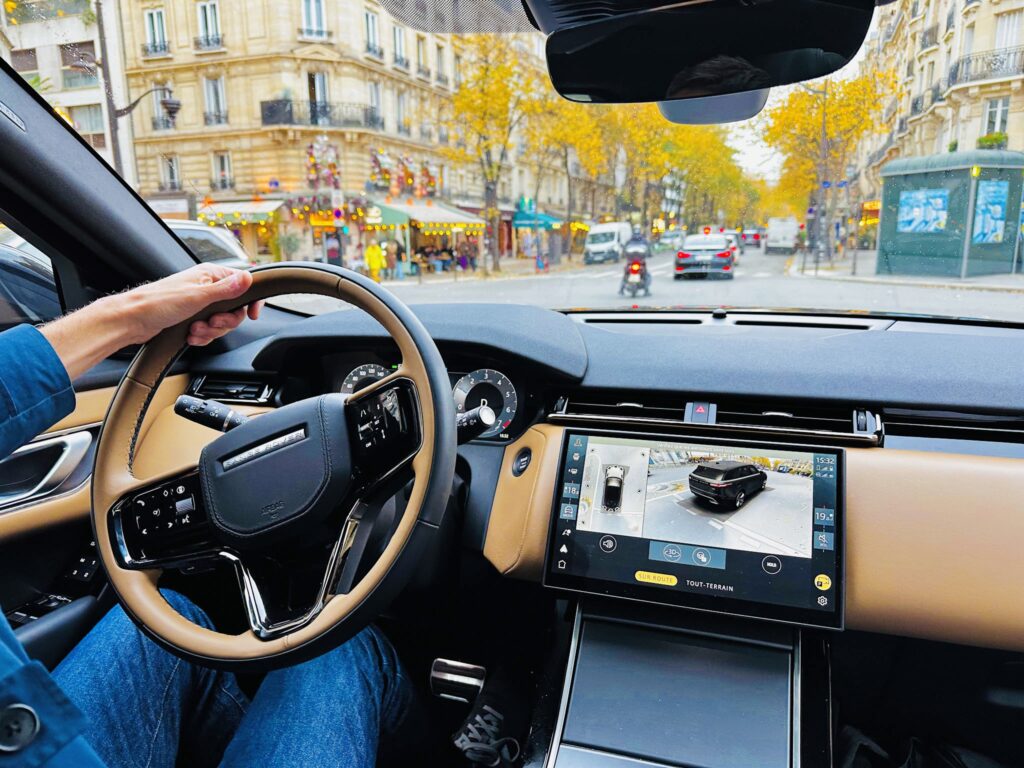
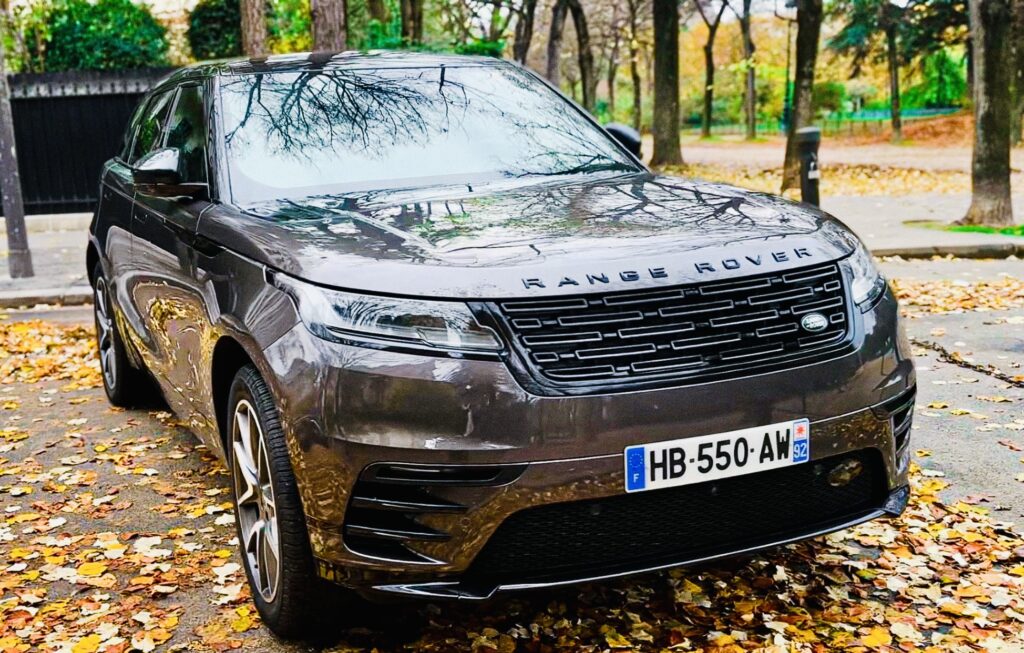
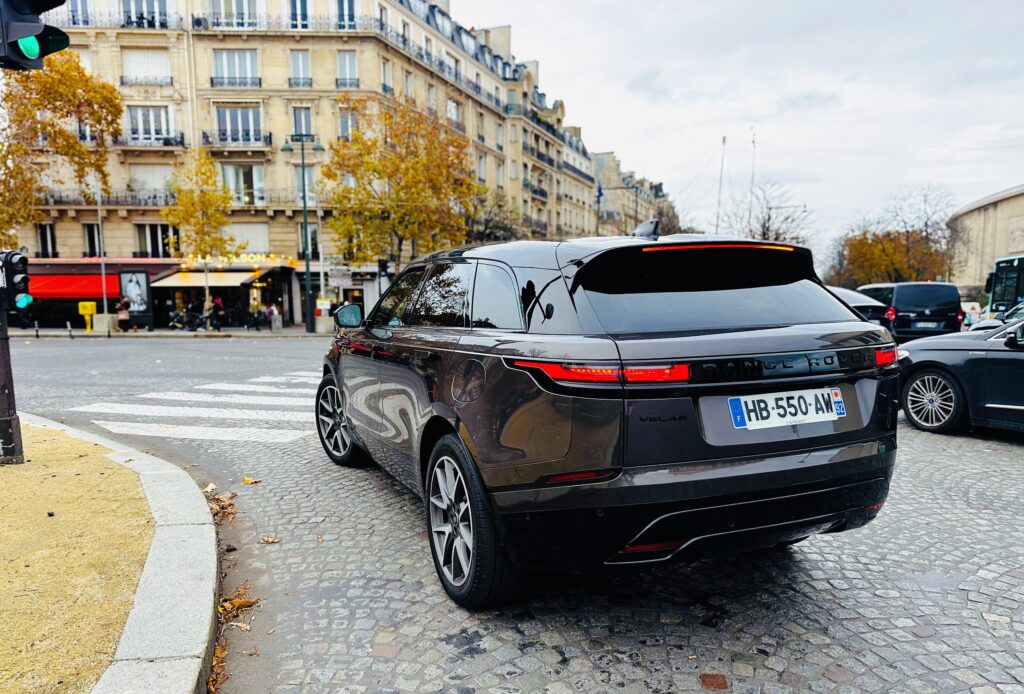
    ECO MOTORS NEWS had the opportunity to get hands-on with the Range Rover Velar P400e, the British manufacturer’s plug-in hybrid SUV. It’s a vehicle that embodies the brand’s DNA, while embracing the energy transition. For four days, from Thursday to Monday, we had plenty of time to put it through its paces in a wide variety of conditions.

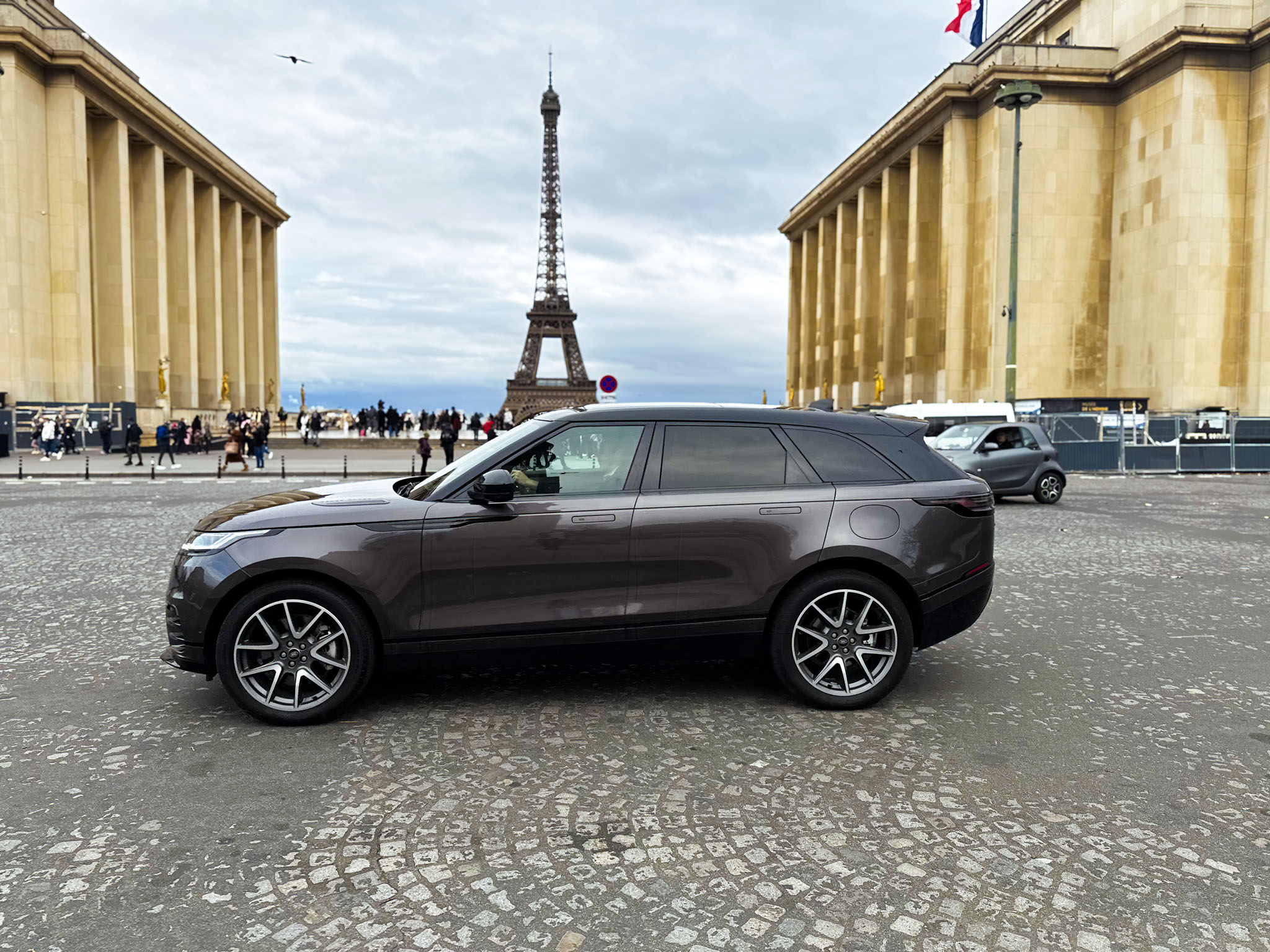
    The Range Rover Velar P400e 2025, a luxury hybrid SUV, elegantly positioned in front of the Trocadero, offering a breathtaking view of the Eiffel Tower (Credit: Marceau NIO)

    The appointment is made at the Argenteuil agency, where our steed awaits us. Dressed in its Chawton Grey livery, this Range Rover Velar P400e in Dynamic HSE finish is ready to devour the kilometres we’ve set aside for it: local roads, city centre, Paris inner city, the legendary Paris ring road, departmental roads, motorways and expressways. A complete tour to put this British behemoth through its paces in every situation.

    First impressions: modern British elegance

    At first glance, the Velar stands out from its Range Rover cousins with a slightly more fluid silhouette. At 4.80 metres long and almost 2 metres wide (including 2.15 m rear-view mirrors), it remains imposing, as Range Rover is obliged to do. What makes it unique, however, is the more dynamic appearance it achieves thanks to its sloping rear profile, a departure from the flat roofline and the iconic, almost rectangular profile of the Range Rover Sport and Evoque. From the outside, the design remains true to the brand’s DNA: charisma, visual power and that immediately obvious impression of luxury. This is a vehicle that makes a statement without being ostentatious, that asserts its status while retaining a certain elegance.

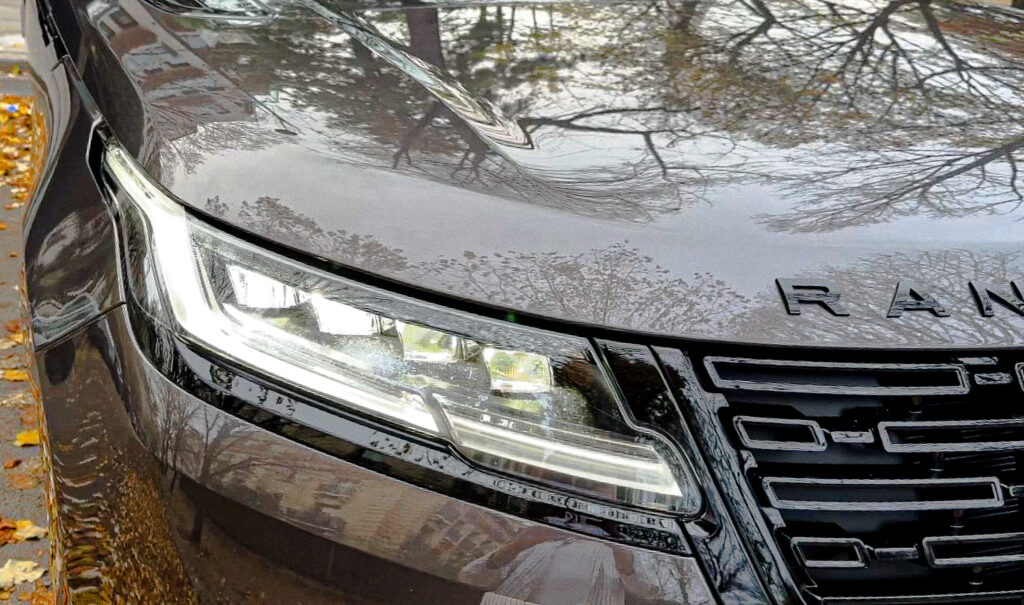
    The front lights have been updated compared with previous versions. Tapered LEDs and a more modern daytime running light signature have been added, maintaining the original image of the Velar: elegant and refined. The rear lights have also been updated, forming a continuous band of light that emphasises the vehicle’s width and reinforces its premium character. These are welcome changes that modernise the vehicle, but do not detract from it.

    Range Rover Velar P400e tapered LED headlight
    Detail of the Velar P400e’s updated LED headlights, highlighting the modern daytime signature and refined design. (Credit: Marceau NIO)

    At the rear, what you’d expect from a vehicle of this size is a large boot. It has a volume of 673 litres and conceals a 17.1 kWh battery, which is still very generous for a plug-in hybrid of this size. There’s plenty of space for everyday luggage and family weekends.

    As for the interior, it perfectly reflects the philosophy of the JLR Group: luxury, yes, but not flashy. There’s leather on the dashboard, perfectly assembled materials and impeccable finishes. The ergonomics are classic, even refined, with a well-positioned 11.4-inch central screen that incorporates all the main functions. The build quality is consistent with the group’s objective of positioning all its vehicles in the luxury segment. With the Velar, there’s no mistaking the fact that we’re offered a really beautifully crafted cabin.

    At the rear, three spacious and comfortable real seats, with the same level of finish, comfortably accommodate passengers. We’re talking about ‘real seats’ here, because legroom is generous, thanks in particular to a wheelbase of 2.87 metres.

    At the wheel of the Range Rover Velar P400e

    One thing is clear from the very first few kilometres: you quickly feel at ease. The visual sensation of accessibility to the controls is immediately confirmed, it’s well thought out, well laid out, and from the very first pedal strokes, the car exudes an immediate smoothness. The Velar P400e combines the advantages of combustion and electric power, and you can feel it. In pure electric mode, the car is silent, smooth as it revs up, almost subdued. Perfect for urban journeys or for enjoying a zen drive on a country lane. But as soon as you apply a little more pressure to the accelerator, the 300bhp 2.0-litre combustion engine takes over, backing up the 143bhp electric motor to deliver a combined output of 404bhp and a colossal 640Nm of torque.

    The sleek, luxurious interior of the Range Rover Velar P400e, with its 11.4-inch central touchscreen and impeccable finishes. (Credit: Marceau NIO)

    The acceleration is firm and present, and even if there is a slight lag time – which is when the vehicle’s 2.3 tonnes become noticeable – the response is immediate and powerful. The 0 to 100 km/h time of 5.4 seconds is impressive for an SUV of this size. On the motorway, you can feel at ease: the combination of smoothness and power makes it a very pleasant road companion. Despite its weight, roadholding remains at a decent level, even on small, winding roads. You feel confident and protected from road imperfections. You feel like you’re in a big car, and that’s particularly pleasant.

    But not everything is ideal. In town, the Velar has some inherent limitations. With a turning circle of almost 12 metres and a substantial width, manoeuvring in town centres or cramped car parks requires a great deal of anticipation. This is clearly not its ideal playground, even if the equipment does help.

    In terms of fuel consumption, the hybrid system is efficient: in town and at low speeds, it’s the electrics that take over, allowing you to drive without using a drop of petrol for the 62-63 km of electric range (WLTP). As soon as the engine revs up or the battery is drained, the internal combustion engine takes over.

    In mixed use (motorway + dual carriageway), actual consumption was around 6 to 7 L/100 km, which is still reasonable for a 404 bhp SUV of this size. This is much higher than the 2.2-2.6 L/100 km announced by JLR in WLTP, but consistent with varied daily use where the battery does not always need to be fully recharged. In terms of total range (electric + internal combustion), the Velar P400e claims up to 684 km, according to Land Rover’s press release.

    Screenshot

    No-frills connected luxury

    When it comes to equipment, the striking thing is the sobriety of the technology. No unnecessary gadgets, but ultra-efficient connectivity. As mentioned earlier, the touch-screen manages the essentials, and the 3D camera system with its all-round view of the surrounding environment is particularly useful for manoeuvring a vehicle of this size in an urban environment. According to JLR, 80% of the most frequently used actions can be performed with just two taps from the home screen. The absence of physical buttons (except for those on the steering wheel) reinforces the ‘all digital’ design, but some people may miss the pure tactile feel (particularly for functions such as quick climate control adjustment).

    The heated and massaging seats, combined with the natural comfort of the cushions, offer optimum comfort on long journeys, a formality for a ‘luxury’ vehicle. The audio system, while not the most striking feature, does the job properly.

    Conclusion: British-style hybrid luxury

    It’s hard to hand back the keys after four days of testing. The Range Rover Velar P400e brilliantly combines comfort, power, versatility and prestige. It is a vehicle that is clearly aimed at CSP+ customers in search of refinement, performance and an impeccable level of finish. The JLR group has succeeded in its challenge: to create a vehicle positioned in the luxury segment, with quality materials, a design unique to the brand and an interior that is refined but of superior quality.

    The rear of the Velar P400e, recognisable by its continuous light strip that accentuates the vehicle’s width and premium character. (Credit: Marceau NIO)

    Admittedly, the Range Rover Velar’s price tag of between €80,000 and €100,000, depending on equipment, may give pause for thought. But when you look at the prices of the competition (BMW X5 hybrid, Mercedes GLE hybrid, Audi Q7 e-tron, Porsche Cayenne E-Hybrid), this price does not seem excessive. The performance is there, the plug-in hybrid technology adds real value to everyday life, and the driving pleasure is undeniable.

    The Velar P400e is a real success for anyone looking for a premium SUV, or even a ‘luxury’ SUV as the manufacturer wishes, capable of combining British luxury and performance. It’s not perfect, but its qualities far outweigh its faults. It’s a very pleasant vehicle, and a real pleasure to drive. It’s clear that British luxury still has a bright future ahead of it…

    ECO MOTORS NEWS scores for the Range Rover Velar P400e